Ancient Sources, Modern Lens·Primary source
Pneuma, Prana and the Breath Traditions
Every major ancient tradition made breath the central lever on the body. A comparative overview of pneuma, prana, qi, ruah — and why slow breathing works.
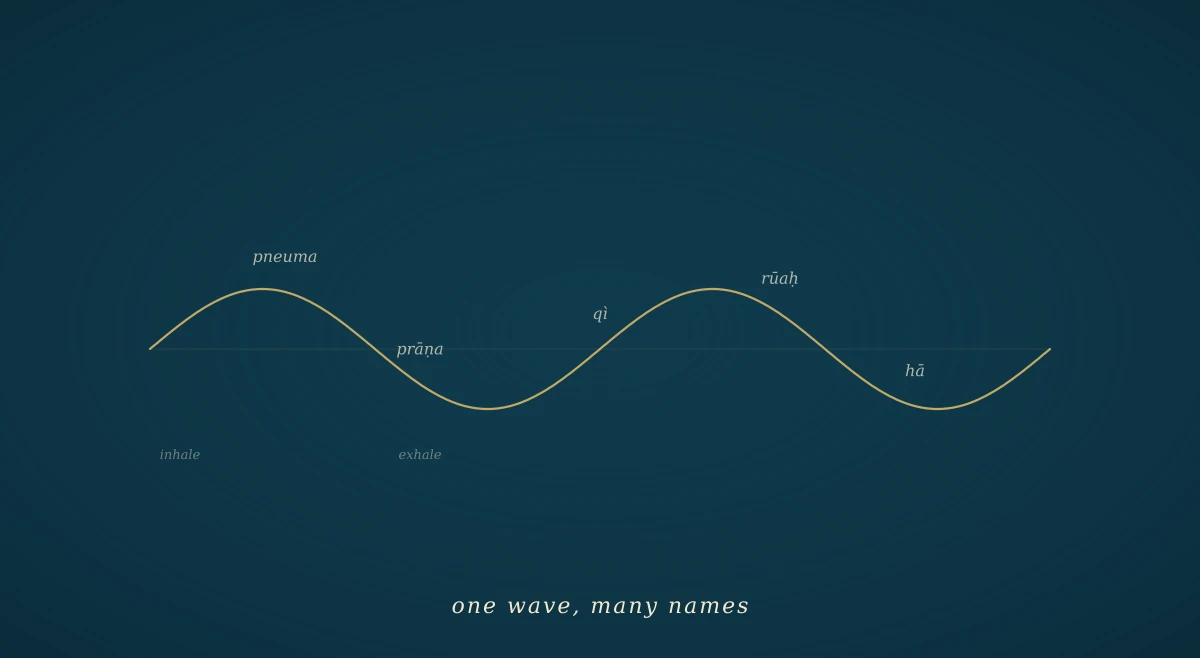
A striking fact, visible once you look for it: in nearly every ancient language that developed a technical vocabulary for the inner life, the word for breath and the word for soul, spirit, or vital force are the same word, or are derived from the same root.
- Greek: πνεῦμα (pneuma) — breath, wind, spirit
- Latin: spiritus (from spirare, “to breathe”) — breath, spirit; and anima, soul, cognate with Greek ánemos, “wind”
- Sanskrit: प्राण (prāṇa) — breath, life force
- Chinese: 氣 (qì) — vapour, breath, vital principle
- Hebrew: רוּחַ (rūaḥ) — wind, breath, spirit; נֶפֶשׁ (nefesh) — throat/breath, soul
- Arabic: روح (rūḥ) — spirit, cognate with the Hebrew
- Classical Māori: hā — breath; the greeting hongi is a sharing of breath
This is not coincidence, and it is not evidence that the ancients were poetic. It is evidence that they were observant. Breath is the one physiological function that is simultaneously automatic and voluntary — the hinge between the deliberate and the involuntary — and anyone who paid sustained attention to the body noticed this, in every tradition that had the means to pay sustained attention.
This article is a comparative overview of what the major traditions did with that observation, what the modern research has established about why it works, and where the honest line falls between the two.
The companion pages on this site treat the primary texts individually: the Greek material in Pneuma, Tonos and the Greek Body, the Indian in Prana, Nadis and the Indian Body, the Chinese in Yin, Yang and the Chinese Body, and the chi/qi vocabulary in What Is Chi? and Chi vs. Qi. This page sits across them.
1. Why breath, and not some other function
To see why breath became central across unrelated traditions, it helps to look at the body as an engineer looks at a system: what can you actually control from inside?
| Autonomic function | Voluntary access? |
|—|—|
| Heart rate | Essentially none directly |
| Blood pressure | None directly |
| Pupil dilation | None |
| Sweating | None |
| Peristalsis | None |
| Insulin, cortisol, adrenaline release | None directly |
| Breath — rate, depth, pattern, pause | Full voluntary control |
The list is close to one-sided. Breath is the single autonomic function with full voluntary override. You can hold it, slow it, speed it, deepen it, pattern it, and the body obeys instantly.
But — and this is the crucial point — because breath is coupled to the rest of the autonomic nervous system through the vagus nerve, changing the breath changes the rest. Slow, deep breathing raises vagal tone, which lowers heart rate and blood pressure, shifts the balance away from sympathetic (“fight or flight”) toward parasympathetic (“rest and digest”), and modulates attention, affect, and cortisol release. The breath is the only hand on a system of levers most of which have no hand.
Any tradition that spent generations watching the body from the inside eventually discovered this. The convergence across traditions is a convergence on the same anatomical fact.
```
BREATH AS THE HINGE OF THE AUTONOMIC SYSTEM
       +-------------------------------------------+
       |                                           |
       |   Voluntary control:                      |
       |   RATE, DEPTH, PATTERN, PAUSE             |
       |              │                            |
       |              v                            |
       |   +----------------------+                |
       |   |  Breathing muscles   |                |
       |   |  (diaphragm, inter-  |                |
       |   |  costals)            |                |
       |   +----------+-----------+                |
       |              │                            |
       |              v   (via vagus nerve)        |
       |   +----------------------+                |
       |   |  Autonomic state     |                |
       |   |   - heart rate       |                |
       |   |   - blood pressure   |                |
       |   |   - HRV              |                |
       |   |   - cortisol         |                |
       |   |   - attention        |                |
       |   +----------------------+                |
       |                                           |
       +-------------------------------------------+
```
2. The vocabularies
Each tradition built the same observation into a different theoretical frame. The frames do not translate cleanly, but they rhyme.
Greek: pneuma
πνεῦμα (pneuma), from the verb πνέω (pneō, “to blow”). Literally: that which blows; breath, wind. In the Stoic physical system, pneuma is air mixed with fire under tension (tonos) — a material-but-subtle medium pervading matter at every point and giving it coherence. The famous Stoic formula is κρᾶσις δι’ ὅλων (krasis di’ holōn), “total mixture through everything.”
Galen’s medical anatomy divides pneuma into three levels — natural (liver), vital (heart), and psychic (brain) — carried by three networks of channels. The scheme is a tidy post-hoc organisation; Galen himself was more cautious than his later systematisers.
The practical centre of the Greek tradition is breath as the point where will touches the involuntary: the only lever by which a human has leverage over physiology.
Full treatment: Pneuma, Tonos and the Greek Body.
Sanskrit: prāṇa
प्राण (prāṇa), from pra + an (“to breathe forth”). In the Upaniṣads (c. 800–500 BCE) prāṇa already appears both as physical breath and as the principle of life itself. The Chāndogya Upaniṣad has a parable in which the sense-faculties leave the body one at a time; the body manages until prāṇa is about to leave, at which point the others concede that prāṇa is the chief.
By the time of Patañjali’s Yoga Sūtras (c. 2nd century BCE – 4th century CE), prāṇāyāma (literally “the stretching / regulation of prāṇa”) is the fourth of the Eight Limbs (aṣṭāṅga). Sūtras 2.49–53 describe it: a cycle of inhalation (pūraka), retention (kumbhaka), and exhalation (recaka), measured in time, place and number.
Later Haṭhayoga texts (Haṭhayogapradīpikā, 15th c.) elaborate specific techniques — nāḍī śodhana (alternate-nostril), bhastrikā (bellows), ujjayī (victorious breath), bhramarī (bee-breath), and others.
The Indian system also inherits a sophisticated channel anatomy — the nāḍīs, with suṣumnā, iḍā, and piṅgalā as the principal three — through which prāṇa is said to flow. Historical caveats on the chakra system are discussed in the companion guide.
Full treatment: Prana, Nadis and the Indian Body.
Chinese: qi
氣 (qì). The character is 气 (vapour, breath) over 米 (rice): the active process of transformation in which fuel and heat produce ordered state. The classical texts — the Neiye (4th c. BCE), the Mencius (4th c. BCE), the Huangdi Neijing (2nd c. BCE) — do not treat qi as an isolated substance. They treat it as the state of a system running without internal friction.
The breath-work tradition in China is qìgōng (氣功, “qi work”) in its modern umbrella name, with historical roots in the Daoyin exercises attested on silk from Mawangdui (c. 168 BCE) and in the breath-regulation (tuna, 吐納) practices described in the Zhuangzi. By the late Tang / Song (c. 10th–13th c. CE), neidan (“inner alchemy”) had codified a mature system centred on slow breathing, posture, and attention to the lower abdomen (dantian).
A particular formula recurs across the literature: “regulate the breath, regulate the body, regulate the mind” (tiao xi, tiao shen, tiao xin). The three regulations are mutually dependent, but the breath is the handle.
Full treatment: Yin, Yang and the Chinese Body.
Hebrew: ruah / nefesh
רוּחַ (rūaḥ) — wind, breath, spirit. The opening lines of Genesis: rūaḥ ʾĕlōhīm məraḥefet ʿal-pənê ha-mayim, “the rūaḥ of God hovered over the face of the waters.” The same word is used, without lexical shift, for a storm wind blowing across a landscape.
נֶפֶשׁ (nefesh) — originally the throat, where breath passes; and so the breath itself; and so the living being, the self, the soul. Genesis 2:7: God breathes neshama (another breath-word) into the man’s nostrils, and the man becomes a nefesh ḥayyā, a “living breath / soul.”
The semantic layering is unusually transparent: throat → breath → living being. The breath is not a sign of life. It is life.
The Hebrew practical tradition did not develop systematic breath exercises in the way the Indian, Chinese and Greek did. But the vocabulary is there, and it was carried forward almost verbatim into Christian and Islamic theology.
Arabic: ruh / nafs
روح (rūḥ), cognate with the Hebrew. نَفْس (nafs), cognate with nefesh. The Qur’an uses both: rūḥ for the divine breath / spirit, nafs for the self or soul.
In Sufi practice, dhikr (ذِكْر, “remembrance”) is often coupled to the breath, particularly in the silent dhikr traditions of the Naqshbandi order. The method is close in form, though not in theology, to the hesychast prayer of Byzantine Christianity (below).
Christian ascetic: pneuma / spiritus
The Greek-speaking Christian ascetic tradition inherited the Stoic vocabulary unchanged — pneuma, prosochē, apatheia. From the 4th century (Evagrius of Pontus) through the full codification of the hesychast method in the 13th–14th centuries (Nikephoros, Gregory of Sinai, Gregory Palamas), the method centres on coupling a short prayer phrase to the respiratory cycle, with the attention descending from the head into the heart.
John Climacus (7th c.) gives the famous one-line instruction: “Let the memory [of the Name] be united with your breath.”
The full technique — posture, gaze, breath, descent of the mind — is late Byzantine, not early Christian. The honest dating matters, and is given in the Greek guide.
Full treatment of the hesychast method: Pneuma, Tonos and the Greek Body, chapter 20.
Theravāda Buddhist: ānāpānasati
आनापानस्मृति / Pāli ānāpānasati — “mindfulness of in-breathing and out-breathing.” The Ānāpānasati Sutta (Majjhima Nikāya 118) is one of the earliest systematic texts on breath meditation we have, with sixteen contemplations arranged in four groups of four.
The method does not regulate the breath. It observes it, without alteration. This is a different approach from the Indian prāṇāyāma, from which it is historically derived but doctrinally distinct: in the Buddhist frame, breath is a stable object of attention, not a lever to be manipulated.
The modern mindfulness movement (MBSR, 1979; Vipassana as taught in the Goenka tradition since the 1960s) is a direct secular descendant of this method.
Māori: hā and mauri
Hā — breath. The traditional Māori greeting, the hongi, is a pressing of noses that is explicitly a sharing of breath. Mauri is the life essence; it is distinct from breath but intimately connected to it. The vocabulary and the practice do not systematise in the way the literate traditions above do, but the structural intuition — breath as the carrier of life — is the same.
3. What is happening physiologically
The twentieth century slowly closed in on what the ancients had been doing. The modern frame is the autonomic nervous system and its division into sympathetic (“fight or flight”) and parasympathetic (“rest and digest”) branches.
Three key findings, in order of their establishment.
Vagal tone and heart-rate variability
The vagus nerve (cranial nerve X) is the main parasympathetic pathway to the heart, lungs, and viscera. Its activity can be measured non-invasively through heart-rate variability (HRV) — the beat-to-beat variation in heart rate, which is higher when vagal tone is high.
Breathing modulates HRV directly. The phenomenon is called respiratory sinus arrhythmia: heart rate rises slightly on the inhale and falls slightly on the exhale. The amplitude of this fluctuation is a reliable index of vagal activity.
The resonance frequency
In the 1990s and 2000s, work by Paul Lehrer and Evgeny Vaschillo established that for most adults, breathing at approximately 6 breaths per minute (one full cycle every 10 seconds, roughly 4 seconds in / 6 seconds out) maximises HRV. This is the “resonance frequency” of the cardiovascular baroreflex, and it is remarkably consistent across individuals.
Six breaths per minute is roughly the pace at which traditional slow-breathing practices — prāṇāyāma counts, the Jesus Prayer, mantra-timed breathing, Zen zazen — tend to settle. The traditions converged on a rate that modern cardiovascular physiology would later identify as optimal. This is a remarkable finding, and it is well-documented (Lehrer & Gevirtz, Frontiers in Psychology, 2014).
The central-nervous-system effects
Breath pacing has been shown to affect:
- Cortisol (acute reductions after 10–20 minutes of slow breathing)
- Blood pressure (meta-analytic effect in mild-to-moderate hypertension; Russo et al., Breathe, 2017)
- Attention and interoception (nasal breathing in particular modulates olfactory bulb and limbic activity in a respiratory-synchronous way; Zelano et al., Journal of Neuroscience, 2016)
- Vagally-mediated affect regulation (slow breathing shifts self-reported anxiety downward in multiple RCTs)
The effects are modest to moderate, consistent across studies, and physiologically explicable. The ancient claims about breath are not vindicated as metaphysics. The practical claims are vindicated as physiology.
4. The common structure — three invariants
Across all the regulated-breath traditions (setting aside Buddhist ānāpānasati, which observes rather than regulates), three features recur:
(i) Slow
Six breaths per minute is a convergent figure, as above. Hesychast prayer, Daoist tuna, Patañjali’s counts, and Sufi silent dhikr all end up in roughly the same range.
(ii) Nasal, deep, abdominal
Mouth-breathing is almost universally discouraged. Diaphragmatic engagement — “sinking the breath to the belly” (dantian in Chinese, lower-abdominal breathing in prāṇāyāma, “settling into the ground” in Alexander work) — is universally recommended. The engineering account is coherent: nasal breathing filters, humidifies, warms, and recruits nitric-oxide pathways; diaphragmatic breathing engages the full lung volume and lowers the centre of mass, which in turn stabilises the whole somatic frame.
(iii) Attention yoked to the breath
Breath without attention is just breathing. Attention yoked to breath — counting it, naming it, following it, coupling a word or phrase to it — is where the practice begins. The breath is the object; attention is the method.
This third invariant is the one the traditions insist on most heavily, and it is also the one that modern research has the least to say about directly — because the research measures outcomes (HRV, cortisol, affect), not practice. The qualitative convergence of the traditions on this point is itself the evidence.
5. What the traditions did NOT share — and a modern deviation
What they did not share
The frame varies dramatically. Greek pneuma is a Stoic material-subtle mixture; Indian prāṇa flows through nāḍīs; Chinese qi is a state of systemic coherence; Hebrew rūaḥ is the breath of God; Māori hā is the carrier of mauri.
These frames do not translate into one another, and the attempt to force them into one “universal vital force” is one of the central errors of 19th- and 20th-century comparative religion. Each system is its own, and the map it draws of the body (channels, centres, levels) is specific to it. See The Convergence Asymmetry for the formal treatment of this: the operational prescriptions converge; the metaphysical maps diverge.
A modern deviation: fast breathing
A set of modern practices — Holotropic Breathwork (Stanislav Grof, 1970s), Rebirthing Breathwork (Leonard Orr, 1970s), and more recently the Wim Hof Method (2000s) — have made hyperventilation central. The physiological mechanism is clear: fast, deep breathing drives down arterial CO₂ (hypocapnia), producing respiratory alkalosis, cerebral vasoconstriction, paraesthesias, and in some practitioners altered states of consciousness.
This is not what the ancient traditions did, and it should not be confused with them. The ancient regulated-breath traditions were overwhelmingly slow. Hyperventilation-based methods have documented risks: in individuals with cardiac arrhythmias, uncontrolled hypertension, or seizure disorders they can be dangerous; a number of deaths have been reported in cold-water cold-exposure contexts after breath-holding induced by hyperventilation.
Honest comparison: slow regulated breathing has substantial physiological evidence behind it. Modern hyperventilation methods do produce altered states, but by a different mechanism and with a different risk profile. They are not vindicated by what the ancient traditions found, and they should not borrow their credibility.
6. Where the boundary sits
What is established
- The autonomic nervous system can be modulated voluntarily through breath, and this is one of the few routes of voluntary access to otherwise involuntary physiology.
- Breathing at approximately 6 breaths per minute maximises heart-rate variability and is a reliable marker of elevated vagal tone (Lehrer, Vaschillo and colleagues, replicated widely).
- Slow regulated breathing produces measurable short-term effects on cortisol, blood pressure, attention and affect, with effect sizes consistent across studies.
- Multiple historically unconnected traditions converged on broadly similar prescriptions: slow, nasal, diaphragmatic, with attention yoked to the breath.
What is the reading on this site
- That the convergence across traditions is explained by the breath’s unique position as the only voluntarily-accessible lever on the autonomic nervous system, and does not require the hypothesis of a shared “vital force”.
- That the metaphysical frames the traditions placed on breath (pneuma as subtle matter, prāṇa as cosmic principle, qi as organising process, rūaḥ as divine breath) do not need to be adopted to explain the convergence of the practices; the convergence is explained physiologically.
- That the practical observations the traditions encoded — above all, the primacy of slow breathing and the yoking of attention — are real, functional, and valuable, independently of the frame in which they were originally stated.
- That the modern hyperventilation-based methods are a separate phenomenon and should be assessed on their own evidence, which is thinner and whose risks are higher.
The traditions did not discover a vital force. They discovered the handle on the autonomic nervous system, in an era with no instruments and no words for it, and they recorded what they found in the vocabulary they had. That the vocabulary differs across traditions is a fact about language. That the practice converges is a fact about the body.
Primary references and further reading
The primary texts
- Patañjali, Yoga Sūtras (c. 2nd c. BCE – 4th c. CE), 2.49–53 on prāṇāyāma. Translations: Edwin F. Bryant (North Point, 2009); Georg Feuerstein (Inner Traditions, 1989).
- Chāndogya Upaniṣad 5.1 (the parable of the chief prāṇa). Translation: Patrick Olivelle, Upaniṣads (Oxford World’s Classics, 1996).
- Majjhima Nikāya 118, Ānāpānasati Sutta. Translation: Bhikkhu Ñāṇamoli and Bhikkhu Bodhi, The Middle Length Discourses of the Buddha (Wisdom, 1995).
- The Philokalia, especially Nikephoros the Hesychast and Gregory of Sinai. English edition: Palmer, Sherrard and Ware (Faber, 1979–1995).
- Zhuangzi 6, on zhenren breathing “from the heels”. Translation: Burton Watson (Columbia).
On the physiology
- Lehrer, P. M., & Gevirtz, R. (2014). “Heart rate variability biofeedback: how and why does it work?” Frontiers in Psychology, 5:756.
- Russo, M. A., Santarelli, D. M., & O’Rourke, D. (2017). “The physiological effects of slow breathing in the healthy human.” Breathe, 13(4), 298–309.
- Zelano, C., et al. (2016). “Nasal respiration entrains human limbic oscillations and modulates cognitive function.” Journal of Neuroscience, 36(49), 12448–12467.
- Noble, D. J., & Hochman, S. (2019). “Hypothesis: Pulmonary afferent activity patterns during slow, deep breathing contribute to the neural induction of physiological relaxation.” Frontiers in Physiology, 10:1176.
Related reading on this site
- What Is Chi? A Systems Engineer’s Reframing — the cornerstone on the chi/qi vocabulary.
- Chi vs. Qi: Same Word, Different Spelling — on the semantic drift of the breath-vocabulary into Western esotericism.
- Pneuma, Tonos and the Greek Body — the full Greek guide, with the hesychast breath method treated honestly in chapter 20.
- Prana, Nadis and the Indian Body — the full Indian guide, with Patañjali’s eight limbs and the nāḍī anatomy.
- Yin, Yang and the Chinese Body — the full Chinese guide, with qigong and the three dantian.
- The Convergence Asymmetry — the meta-essay on why operations converge while maps diverge.
- The Tradition That Diagnosed Its Own Damage — on the warnings against unsupervised breath practice.
← Back to the Ancient Sources, Modern Lens guide
More in this pillar
- The Neiye (內業): Inward Training
- Mencius and Haoran Zhi Qi: The "Flood-Like Qi"
- The Huangdi Neijing: Inner Canon of the Yellow Emperor
- Huangdi Neijing — Suwen 1–5: An Expanded Reading
- Enūma Eliš and the Emergence of Order
- The Architecture of Awareness: The Māṇḍūkya Upaniṣad and the Mapping of Brain States
- Pañcakośa: Five Layers of Human Identity, Read as a System Architecture
- Category Errors of the Self: Adhyāsa and the Modern Account of the Self-Model
- The Māṇḍūkya Upaniṣad: Full Translation of the Twelve Verses
- The Vivekacūḍāmaṇi: A Guided Reading of Śaṅkara's Crest-Jewel
- The Ashtāvakra Gītā: A Guided Reading of the Uncompromising Dialogue
- Advaita Vedānta Glossary
- Chinese Thought Glossary
The other pillars
Be first to know
The book is in its final editing stage. Leave your email and you will hear when it is ready.