Ancient Sources, Modern Lens·Primary source
The Neiye (內業): Inward Training
A guide to the Neiye, the oldest Chinese text on inner cultivation, with a full English translation of its 26 stanzas and ten notes.
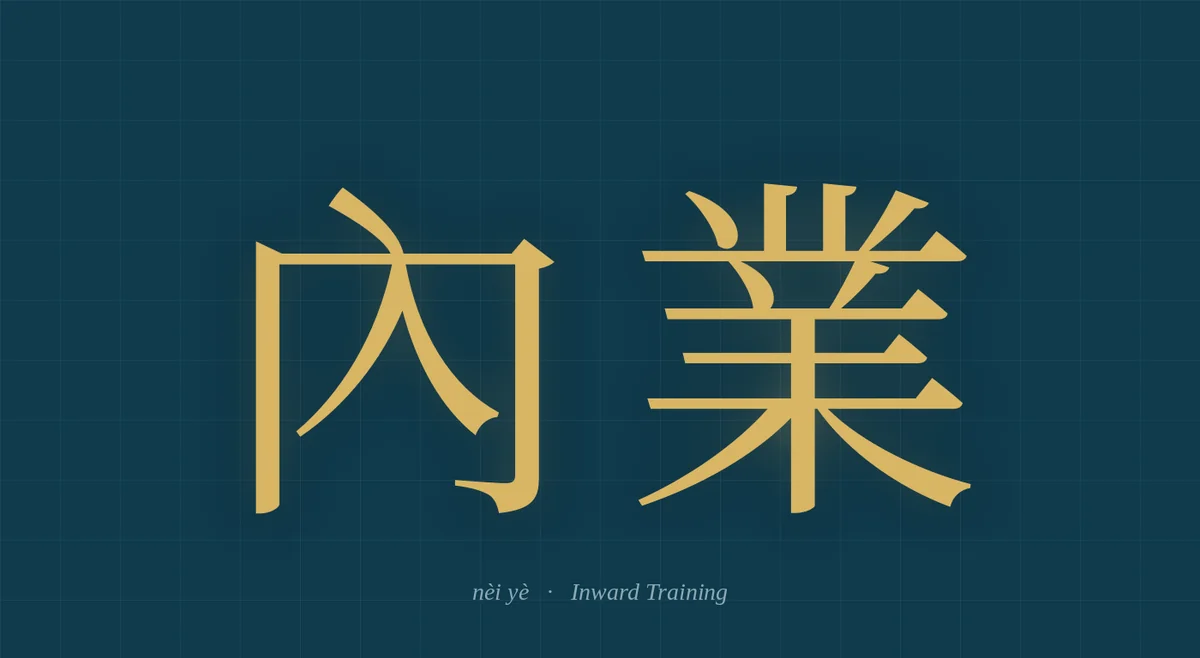
The Neiye (內業, nèi yè, “Inward Training”) is a short text, probably from the fourth century BCE, preserved as a chapter of the Guanzi (管子) — a much later compilation that gathered writings of very different ages and schools. It is almost certainly the oldest surviving Chinese text on inner cultivation.
It predates most of what people assume it depends on. It is not Daoist in any institutional sense; it is earlier than that category. It is not medical.
What it describes is a practice. Stillness. Regulated breathing. Alignment of posture and mind. And the resulting condition in which qi becomes stable and abundant. Qi here is not something you acquire. It is a condition you fall out of, and can return to. The vocabulary is about ordering, aligning, and settling.
Harold Roth’s critical edition and study is the standard scholarly reference. Anyone doing serious work here should start there, not here.
Why this text sits in the Sources Library
Of all the texts in the Sources Library, the Neiye is the one that most clearly breaks the modern “chi is a kind of energy” reading. The Neiye does not describe a substance you take in. It describes a condition of the whole system — a condition of being well-ordered — that produces, as its side effect, the states we recognise as vitality, clarity, and strength.
Read in the terms this book argues for, that is exactly what the flow of organization looks like from the inside. The Neiye has no instruments. It has only the human body and the attention of a practitioner. What it reports, over and over, is that when the whole arrangement is held steady, something comes to rest in it that was not there in the agitation. The language is of ordering, not of filling.
I take the text seriously on those terms. I do not take it as hidden physics. The Neiye was doing something old and valuable: mapping, from the inside, a real phenomenon that modern work on dissipative structures now describes from the outside. That those two descriptions can be set side by side without either collapsing into the other is the argument The Learning Earth is trying to make.
A note on this translation
The English translation below was produced for this site by Claude Opus 4.7 Extra, in October 2026, as a working translation for a philosophical argument. It is not a critical edition.
Panos does not read classical Chinese. The translation was made by asking a large language model trained on classical Chinese and on multiple published English translations to produce a fresh English rendering, keyed semantically to the Greek annotated translation Panos works from and glossed with key terms left in transliteration (jing, qi, dao, xin, de, shen, yi). Where interpretive choices had to be made — above all, treating qi as a process of ordering rather than as a substance — those choices follow the position argued in What Is Chi? and should be read as that position, not as a philological consensus.
For anything hanging on the exact wording of a line, go to Roth’s critical edition. For a sense of what the text says and the shape of its argument, read on. The stanza numbering follows the standard philological division. Transliterations are given in parentheses on first occurrence of each key term; a short glossary sits at the end of the notes.
The text
I.
The jing (vital quintessence) of all things —
this is what gives them life.
Below, it brings forth the five grains → Note 1
above, it sets the ordered stars. → Note 2
Where it flows in the space between heaven (tian) and earth (di),
we call it gui-shen, the daimonic. → Note 3
Where it is gathered inside a human breast,
we call that person a sage.
II.
And so this qi:
bright, as if rising to heaven;
dark, as if sinking into the abyss;
vast, as if dwelling in the ocean;
compact, as if staying within itself.
This qi
cannot be held by force,
yet it will settle through de (inner virtue, inner power).
It cannot be summoned by words,
yet it will come to a mind that is aware.
Guard it with care; do not lose it:
this is what is meant by de completed.
When de is complete and wisdom emerges,
the ten thousand things are all taken in, to the last.
III.
The xin (mind-heart) can hold a mind within it:
inside the mind there is another mind. → Note 9
In that inner mind,
awareness comes before speech.
After awareness, form.
After form, speech.
After speech, use.
After use, order.
Without order, disorder is sure to follow,
and where disorder is, there death is.
IV.
When jing is present, life opens of itself.
Outwardly it shows as a quiet radiance.
Kept within, we draw on it as a wellspring.
Overflowing and well-tuned,
it is the inexhaustible water of vital qi.
As long as the spring does not run dry,
the four limbs stay firm.
As long as the water is not spent,
the nine openings stay clear. → Note 4
Then one may reach the ends of heaven and earth
and cover the four seas. → Note 5
Within, no misleading thought.
Without, no calamity.
V.
The one who keeps the xin whole within
and the form whole without,
who meets neither calamity from heaven
nor harm from other people —
that one we call a sage.
VI.
If a person can truly be zheng (upright, aligned) and still,
the flesh becomes full,
eyes and ears become keen,
muscles grow taut, bones grow firm.
Then one can lift up the great circle of heaven
and tread the great square of earth. → Note 6
One reflects the world as a great mirror does,
and stands before it as sun and moon do.
VII.
Stay alert; do not let it slip away:
this is what is meant by renewing de day by day.
When de is complete, you reach everywhere.
All ten thousand things are won.
VIII.
The dao (way) is what fills the body;
yet people cannot hold it fixed.
It goes and does not return.
It comes and does not stay.
Silent — no one hears its voice.
Gathered — it is in the xin.
Dark — no one sees its form.
Overflowing — it is born along with us.
We do not see its shape,
we do not hear its sound,
and yet there is an order in the way it unfolds:
this we call the dao.
IX.
The dao has no fixed dwelling.
In a good xin it comes to rest and stays.
When the xin is still and the qi ordered,
the dao can then settle in.
This dao is not far away.
People live by it.
This dao does not part from us.
People draw their knowledge from it.
X.
Here is the dao:
the mouth cannot speak it,
the eye cannot see it,
the ear cannot hear it.
It is what we cultivate the xin with and align the form by.
When a person loses it, they die.
When they hold it, they live.
When a work loses it, it fails.
When it holds it, it prospers.
The dao has no root, no trunk,
no leaves, no flowers.
And yet the ten thousand things are born through it
and ripen through it:
this is what we call the dao.
XI.
For heaven (tian), the ruling principle is zheng (uprightness).
For earth (di), the ruling principle is ping (levelness).
For the human, it is quiet and calm (an jing).
Spring and autumn, winter and summer: the seasons of heaven.
Mountains and hills, rivers and valleys: the resources of earth.
Joy and anger, giving and taking: the workings of the human.
And so the sage
changes with the seasons, but is not transformed;
shifts with things, but is not swept along.
XII.
If you can be zheng, if you can be still,
you can be stable.
With a stable xin within you,
eyes and ears keen,
the four limbs firm and strong,
you can become a dwelling for jing.
Jing is the refined form of qi.
When qi is well-directed, life is born.
With life, thought.
With thought, knowledge.
With knowledge, you must know when to stop.
XIII.
The one who can be one (yi) with the dao and change the things,
we call shen (numinous, spiritual).
The one who can be one and shift with circumstance,
we call a sage.
To change without their qi altering;
to shift without their wisdom altering;
only the one who holds the One (shou yi) can do this. → Note 8
The one who holds the One and does not lose it
can command the ten thousand things.
The sage directs things.
They are not directed by them.
XIV.
The one who gathers their qi until it is like shen,
for them the ten thousand things stand all present.
Can you concentrate? Can you be one?
Can you know fortune and misfortune without divination?
Can you stop? Can you come to a halt?
Can you, without asking it of anyone else,
find it within yourself?
Think it, think it, and think it again.
If, in thinking, you still do not come through,
gui-shen will come through for you —
not from the power of ghosts and spirits
but from the extremity of your own refined jing.
XV.
When the four limbs are each in their place
and the blood and qi are quiet,
unify your thought, gather your xin,
and your eyes and ears will not drift.
Then even distant things seem near.
XVI.
Thought is what gives rise to knowledge.
If you stop forcing it, it will rest of itself.
From contemplation, method;
from method, knowledge;
from knowledge, knowing when to stop.
In all that the xin contains,
there is no greater gain than joy,
no greater calamity than fear.
XVII.
The form of the xin
is by nature full, by nature complete,
by nature born, by nature finished.
What robs it of its fullness
is always sorrow, grief, pleasure, anger (you bei xi nu), → Note 7
desire, and gain.
If you can be free of these,
your xin returns to its fullness.
The nature of the xin
thrives in calm and quiet (an jing).
Do not disturb it. Do not confuse it.
Harmony will shape itself.
XVIII.
Clear — as if right beside you.
Clouded — as if you can never reach it.
Remote — as if at the edges of the world.
And yet: it is not far.
Day by day you draw its de.
XIX.
Respect its dwelling and keep it clean,
and jing will come of itself.
Contemplate it; still the thought to catch it;
calm the posture to hold it.
With respect, with care, without slackening,
your de will reach its peak.
XX.
When de is complete and wisdom emerges,
the ten thousand things are won, to the last.
The one who holds within their breast a well-tuned measure
and does not spend their jing on things —
that one, the people of the world call a person of de.
XXI.
When the dao fills a person’s form
but the person cannot hold it fixed,
the cause is that the xin has not been ordered.
When the xin is ordered, the senses are ordered.
When the xin is still, the senses are still.
What orders is the xin.
What is still is the xin.
Within the xin another xin is hidden:
a mind within the mind. → Note 9
XXII.
The jing of qi in the world:
rising, it reaches the stars.
Descending, it becomes the five grains.
Flowing, it becomes gui-shen.
Stored in the breast, it becomes wisdom.
And so this qi
is not held by force
but settles through de.
It is not summoned by voice
but received through intent.
XXIII.
On the way of eating:
great excess harms, and the form does not thrive.
Great deprivation leaves the bones dry and the blood congealed.
Between surfeit and want —
this is what we call the completion of harmony.
There jing dwells.
There knowledge is born.
When hunger and fullness lose their measure,
tend to it:
if overfull, move quickly;
if hungry, loosen your attention;
if old, think ahead.
XXIV.
When overfull, move.
When empty, be still.
This is the general rule.
The one who is overfull and does not move
lets their qi become stagnant, and it never reaches the limbs.
The one who is empty and does not become still
lets their jing leave without return.
XXV.
The one whose anger carries them to excess —
calm them.
Tend to the five viscera (wu zang). → Note 10
Regulate desire.
Remove the two faults — excess and lack.
Do not let joy and anger make you lose yourself.
Sorrow, grief, joy, anger (you bei xi nu) —
while these are present, the dao has no place to stay.
Love and desire — still them.
Foolishness and distress — set them straight.
Do not pull. Do not push.
Happiness will return of itself.
When the dao comes of itself,
you can rely on it and take counsel with it.
Still — and you win it.
Agitated — and you lose it.
XXVI.
This shen qi within the xin:
it comes and goes,
so small that nothing lies within it,
so vast that nothing lies outside it.
The reason we lose it
is that agitation damages it.
When the xin can hold its calm,
the dao settles of itself.
For the one who has gained this dao,
jing runs through the veins and waters the skin.
No calamity will ever defeat them.
Within, it reaches the nine openings.
Without, it extends to the edges of the world.
The one who guards it and does not spend it
is said to hold de.
De, when it is not lost, is renewed day by day,
and the person embraces every part of the world.
End of the Neiye.
Notes
The notes follow the Greek annotated edition Panos worked from. They are commentary, not primary text.
1. 五穀 (wǔ gǔ), “the five grains.” The five staple cereals of ancient Chinese agriculture. The lists vary, but typically: two kinds of millet, rice, wheat (or barley), and legumes/soy. They function as a synecdoche for all cultivated food — for everything that sustains life on the earth.
2. 列星 (liè xīng), “the ordered stars.” The constellations: the stars in rank and arrangement, that is, the heavenly order. The couplet “below … above …” is saying that the same jing composes both the earthly (food) and the celestial (stars): one principle that runs the whole scale of the world.
3. 鬼神 (guǐ shén), literally “ghosts and spirits.” In the Neiye this does not mean personified beings (gods, the dead) but the subtle, invisible manifestations and powers of qi when it moves freely through the world. It is closer to “the daimonic” as a natural force than to “spirits” in a religious sense.
4. 九竅 (jiǔ qiào), “the nine openings.” The nine openings of the human body: two eyes, two ears, two nostrils, the mouth, and the two lower openings (excretory and genital). A symbol of bodily openness — when the jiu qiao “flow,” the body is healthy and permeable to qi.
5. 四海 (sì hǎi), “the four seas.” In ancient Chinese cosmography, the seas that surround the land in the four cardinal directions. As a phrase it means “the whole of the known world” — much as the English phrase “to the ends of the earth.”
6. The great circle and the great square. This reflects the ancient cosmological principle “round heaven, square earth” (天圓地方, tiān yuán dì fāng). To “lift up the circle and tread the square” means to stand fully aligned, as the axis between heaven and earth — the image of the perfectly centred sage.
7. 憂悲喜怒 (yōu bēi xǐ nù), “sorrow, grief, joy, anger.” A standard list of the strong emotions that, in the text’s view, disturb the qi and “evict” the dao from the mind. This is not a moral condemnation of feeling: it is an observation that emotional agitation spends vital quintessence.
8. 守一 (shǒu yī), “holding the One.” The central practice of inner cultivation: a fully unified concentration, a refusal to let the mind scatter into the many. The “One” (一) is both the focus and the unity with the dao. The term has a long career later in Daoism.
9. “A mind within the mind” (心之中又有心). A recurring image (stanzas III and XXI): within the ordinary, thinking mind there is a deeper, prior mind — an awareness that comes before thought and before speech. This is the point at which the text distinguishes everyday cognition from pre-linguistic clear awareness.
10. 五臟 (wǔ zàng), “the five viscera.” The five vital (“solid”) organs of Chinese medical thinking: heart, liver, spleen, lungs, kidneys. These are not understood only anatomically: each is also treated as the seat of psychological and emotional functions, which is why “tending to the five viscera” is at once a bodily and a psychological regulation.
Short glossary
- 精 jīng — vital quintessence; the refined, concentrated form of qi.
- 氣 qì — the vital breath or energy that pervades all beings; in the reading argued here, the flow of organization.
- 道 dào — the Way; the underlying order and course of things.
- 心 xīn — mind-heart; seat of both thought and feeling. Classical Chinese has no separate words for the two.
- 德 dé — virtue, inner power; the accumulated capacity that follows from being aligned with the dao. Not “morality” in the Western sense.
- 神 shén — the numinous, the spiritual; the highest, most clarified state of mind.
- 一 yī — the One; the undivided focus that is also unity with the dao.
← Back to the Ancient Sources, Modern Lens guide
More in this pillar
- Mencius and Haoran Zhi Qi: The “Flood-Like Qi”
- The *Huangdi Neijing*: Inner Canon of the Yellow Emperor
- Huangdi Neijing — Suwen 1–5: An Expanded Reading
- The Convergence Asymmetry: Good Observers, Bad Theorists
- The Tradition That Diagnosed Its Own Damage
- Why the Right Posture Feels Wrong
- Seven Points on the Ground
- The Body Is Not Given, It Is Made
- The Second Arrow
- Tumah Is Not Dirt
- The Past Is in Front
- Enūma Eliš and the Emergence of OrderComing soon
- Pneuma, Prana and the Breath TraditionsComing soon
The other pillars
Be first to know
The book is in its final editing stage. Leave your email and you will hear when it is ready.