Ancient Sources, Modern Lens·Primary source
The Convergence Asymmetry
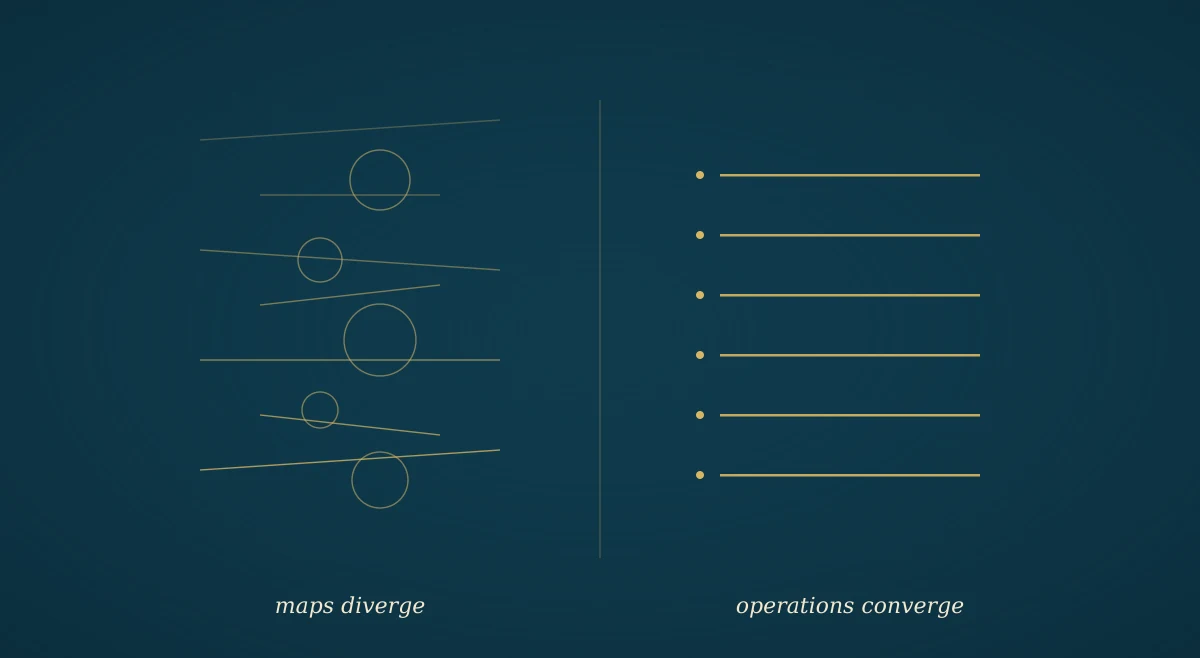
Across fourteen traditions the maps of hidden anatomy disagree. The operations and failure modes converge. What that proves and what it does not.
Good observers, bad theorists — and why that is less than I first claimed
There is an argument that runs through The Learning Earth, and it has a weak joint. I want to put pressure on that joint here. An earlier draft of this piece claimed to have fixed it. That draft was wrong, in a way worth setting out, because the corrected version is more useful than the one I thought I had.
The argument is this. Across thousands of years, in cultures with no contact, people reported something that animates the living: chi, prana, pneuma, ruach, mana, ka. That convergence is data. Not proof — data. When independent observers using different methods in different centuries arrive at similar conclusions, the agreement is worth explaining.
And there is a deflationary answer that cannot be waved away.
The objection, at full strength
The cognitive science of religion — Pascal Boyer, Scott Atran, and the field around them — argues that human minds everywhere generate similar concepts because they run on similar equipment. That equipment includes a hair-trigger agency detector that finds intention in rustling grass; a hard intuitive line between the living and the dead; a memory that preferentially retains ideas that are mostly ordinary but bent in one arresting way.
Feed that machinery the raw material every human life supplies — breath that stops at death, warmth that leaves a body, the uncanny difference between a sleeping person and a corpse — and it will produce vital-force concepts in culture after culture, with no contact required and nothing external to detect.
On that account, chi and prana and pneuma converge because minds converge. The agreement is a fact about us, not about the world.
This objection has history. When Gregory Palamas defended the hesychast monks of Mount Athos in the fourteenth century, his opponent Barlaam of Calabria argued that their luminous experiences were states of the mind rather than perceptions of anything beyond it. Barlaam’s attack was theological and in places simply mocking — he called them omphalopsychoi, navel-souls — so it is a modern reading to call it the cognitive objection. But it is close, in substance, to the modern objection, and it has never been answered cleanly.
My original reply was that shared cognitive biases predict similar concepts but not similar techniques that produce similar bodily states. That is true as far as it goes, and it does not go far enough, because there is an obvious rejoinder: techniques converge because bodies converge. Human physiology is the same everywhere. What slows a heart in Varanasi slows a heart on Athos. No shared external referent is needed for that either.
So I was left with two explanations that both fit, and no way to choose. That is not an argument. That is a tie.
The pattern I found
Over the past year I wrote detailed accounts of how fourteen traditions map the human body — China, India, Greece, the Nahua, Tibet, the Andes, Amazonia, West Africa and its diaspora, the Māori, Islam, Judaism, Theravāda Buddhism, and the modern Western somatic field. Each on its own terms, each held to the same standard: what is textually attested, what is a later development, what has a date, what does not hold.
A pattern came out of it that I had not been looking for.
Where the traditions asserted hidden anatomy, they disagreed with each other, drifted internally, and failed when tested. Where they described what to do to a body and what happens when you overdo it, they agreed, sometimes closely.
The divergence side is not close.
The six- or seven-chakra system most Westerners know comes substantially from the Ṣaṭcakranirūpaṇa of 1577, which reached English through Woodroffe’s The Serpent Power in 1918–19 and became “the” tradition largely because it was translated early. The rainbow colours are not in it; Leadbeater added them in 1927, and Kurt Leland has argued that the familiar rainbow-plus-qualities package only came together as late as 1977. Buddhist tantric sources — the Hevajra Tantra among them, from around the eighth century — work with four centres, some Mother Tantras with five. The Sufi laṭāʾif are six subtle centres with bodily positions, developed mainly in Naqshbandi lineages from the fourteenth century, routinely equated with chakras in popular writing and not remotely like them: different number, different positions, and decisively no central channel and no ascending axis at all. Chinese practice has three dantian, which are not centres to be pierced in sequence but reservoirs and workshops. The Chinese meridian system has named, numbered points mapped to organs; the Indian nadis have neither points nor organ correspondences, and the figure given for them runs from 72,000 in the Haṭha material to 350,000 in the Śiva Saṃhitā — a spread of a factor of five inside one tradition, between texts whose authors read each other.
Greek medicine’s four humors were a falsifiable claim about the material of the body. They were false, and they produced bloodletting, which killed people for two millennia.
The convergence side, reduced to what I can actually defend, comes to two items. Reduce effort to increase sensitivity: the Yoga Sūtra’s prayatna-śaithilya (2.47), the Chinese 鬆, the Buddha’s abandonment of asceticism as the founding event of his tradition, the rabbinic ruling at Taanit 11a that one who fasts needlessly is called a sinner, and Feldenkrais, who derived the principle explicitly from the Weber–Fechner law — the smallest perceptible difference in a stimulus scales with its intensity, so to perceive fine distinctions you must lower the overall force. And the documented adverse effects of intensive practice, which I come back to at the end.
Why this does not break the tie
Here is where the earlier draft went wrong, and I want to be explicit about it because the error is instructive.
That draft argued the asymmetry discriminates: a real referent would constrain traditions into detailed agreement, while pure cognitive generation would produce schema-level agreement with divergent specifics — so selective convergence favours a real referent.
It does not, and the reason is simple. Take the two premises nobody disputes:
- Same minds. Boyer predicts convergence on schemas and divergence in the details. That is exactly what the maps do.
- Same bodies. Shared physiology predicts that operations which work converge, and that failure modes converge.
Those two premises together predict the asymmetry precisely. Nothing further is required — no shared referent beyond the body, and certainly no vital force. My earlier draft tried to absorb the physiology account by calling it “the mechanism rather than a competing hypothesis,” but that move is circular: if the real referent just is ordinary physiology, then the referent claim has collapsed into the deflationary one and the tie stands.
So the asymmetry is not a decision in favour of anything. Anyone who says otherwise, including me three weeks ago, is reaching.
What it does establish
Something narrower, and still worth having.
The traditions were competent observers of what bodies do and poor theorists of what is inside them. Where they acted on a body and watched what happened, something external held them to account, and their reports converge. Where they described hidden structure, nothing held them to account, and their reports fly apart and drift.
That is a claim about the epistemics of traditions, not about metaphysics, and it does two jobs.
It sets a scope limit on the deflationary account. Boyer’s machinery explains the map column very well. It does not explain the operational column at all, because that column is not made of concepts — it is made of interventions and their consequences, and those were tested against a real physical system by people with nothing else to go on. The strong deflationary thesis, that nothing external constrained any of this, is false. The weak one, that minds plus bodies suffice without a vital force, stands.
And it sharpens the book’s third explanation rather than deciding for it. Chapter 3 already proposes that what the traditions were pointing at is not something behind physiology but the flow of organisation that physiology realises. The asymmetry is consistent with that reading and makes the paragraph stronger. It is not evidence for it. I want no credit extended on that confusion.
The items I am withdrawing
Six of them, and the list is longer than what survives.
The breath inference. I claimed that several traditions independently reasoned that breathing is the only vital function both automatic and voluntary, and therefore the only door from the will into the autonomic — and I called this the strongest item on the list, because a shared inference is harder to attribute to cognitive bias than a shared image. I cannot document the claim in that form in any classical source. It is a modern physiological formulation, and the ancient discussion appears to have run differently: Galen treated respiration as a voluntary motion and had to account for why it continues in sleep, which is close to the opposite framing. I have not checked that passage at source and flag it as unverified. Either way the item is withdrawn. Every tradition uses breath as the primary lever, which proves nothing much, because breath is conspicuous.
The Tibetan inversion. I wrote that Tibet inherited its material from the same Indian tradition and inverted the central architecture — four or five wheels centred on the heart against six or seven ascending to the crown. The comparison is wrong. Tibetan systems descend from Indian Buddhist tantra, which worked with four centres from the eighth century; the six-plus-one system belongs to a different Indian lineage, developed in Śākta and Kaula material and codified in 1577. These are two Indian lines that already differed before Tibet received either. My “same lineage, inverted” framing is void — and the divergence point comes out stronger, because the disagreement is internal to India.
The independence of the overexertion syndrome. I listed six traditions “with limited or no contact” recording the same adverse-effect cluster. The independence is overstated to the point of being the claim’s main weakness. China, India, Tibet and Theravāda are connected through Buddhist transmission, and Tibetan medicine absorbed both Indian and Chinese material. “Kundalini crisis” is a twentieth-century term, not a traditional category. And πλάνη does not belong on the list at all: hesychast plani is spiritual self-deception — mistaking illusion for grace — not a symptom cluster of anxiety, palpitations and insomnia. What survives is narrower and still substantial: the Vinaya episode at Pārājika 3, in which corpse-contemplation taught without supervision led to deaths and the teaching was changed; the Visuddhimagga’s dysphoric insight stages; Tibetan srog rlung; and the modern literature. That is one connected tradition documenting the same hazard repeatedly over two millennia, which is evidence about institutions rather than evidence of independent convergence.
Purity as state. I used the Māori tapu/noa, Islamic ṭahāra/ḥadath, Jewish tumah/taharah and Nahua tlazolli systems as a convergence, with tayammum — restoring ritual purity by striking clean earth when no water is available — as near-experimental proof that the category is state and not hygiene. The evidence is right and it is in the wrong column. Nothing bodily constrains ritual purity. It is the textbook case of a cognitive-and-social schema in the sense Mary Douglas and Boyer describe, which means that by my own criterion it belongs on the divergence side, alongside the tripartite division of the person that I had already discounted. Counting it was self-undermining.
While I am correcting: my Jewish example was also simply wrong. I wrote that the high priest becomes tamei by burying a relative. Leviticus 21:11 forbids the high priest to defile himself even for his father or mother. It is the ordinary priest who is permitted — and obligated — to become impure for his seven close relatives (21:1–3). The sharper illustration, and a textually solid one, is the red heifer: the rite that purifies the impure renders the officiating priest and the one who sprinkles the water impure until evening (Numbers 19:7–8, 21). That is a category which cannot be dirt and cannot be sin.
Soul loss from fright. The Nahua tonalli departing on terror, the Andean animu seized by a place, the Tibetan bla leaving and being recalled by name. The Mesoamerican and Andean cases share four centuries of the same Spanish influence, and susto scholarship has long debated how much of the complex is colonial. Calling a person by name so that something returns is precisely the cheap, memorable schema Boyer’s account predicts. Only bla is genuinely independent, being demonstrably pre-Buddhist, and one case is not a convergence. Demoted.
And the stability row of my own table. I claimed techniques are “stable across centuries within a tradition.” That is false as a generalisation, and I knew the counter-evidence because it is in my own notes. Modern postural yoga is substantially a twentieth-century creation (Singleton, Yoga Body, 2010). Qigong as a unified category was assembled in 1950s China (Palmer, Qigong Fever, 2007). The row is deleted.
What the table looks like now
| | Maps and anatomy | Operations and effects |
|—|—|—|
| Between traditions | Incompatible | Convergent on a short list |
| When tested | Fail | Hold, with identified mechanisms |
Two rows, one short list, and no claim that this decides anything about what animates a body.
The one place it has teeth
The surviving convergence I find most useful is reduce effort to increase sensitivity, because it is the one case where a traditional instruction meets a measured mechanism without either being dressed up as the other.
Bernstein’s problem — a body has vastly more degrees of freedom than any controller could specify independently — has a known developmental signature: learners first freeze degrees of freedom, then release them, then begin exploiting the dynamics of the system instead of fighting them. Vereijken and colleagues demonstrated the sequence on a ski simulator in 1992. Learning also reduces metabolic cost, measurably (Sparrow & Newell 1998; Huang, Kram & Ahmed 2012). And the reinvestment literature on choking shows that adding conscious control to a well-learned skill degrades it.
So: the traditions say use less force and you will feel more and work better. The motor-control literature says effort falls as coordination improves, and deliberate control interferes with skills that have been consolidated.
These are not the same claim, and the gap matters. The traditions offer the instruction as a route to perception; the science measures economy and interference. They are compatible, they point the same way, and nothing in the second vindicates the cosmology of the first.
A cost to the book I should name
The asymmetry creates a consistency problem I cannot publish around.
If the general finding is that anatomical maps were untested models, then Chapter 3’s claim that the meridians “are the topology of the body’s self-regulation” cannot stand as written, and Chapter 5’s reading of the meridian map as a network diagram will look like special pleading. Why would the meridians be real topology when the nadis and the laṭāʾif are not? There is no answer that is not selective advocacy. At minimum the “are” has to become “can be read as,” and the honest version probably goes further and keeps only the general point that bodily regulation is not uniformly coupled, dropping the specific lung-and-arm reasoning.
I would rather state that in public than have it pointed out.
The selection problem
I chose these fourteen traditions. I wrote all fourteen accounts myself, to a consistent template, which imposes a shape. I noticed the asymmetry while holding a framework that predicts something like it. Anyone weighing this should weigh that too, because I cannot correct for it from the inside.
What would help: someone else doing the comparison, blind to the hypothesis, on a different sample, with pre-registered criteria for what counts as convergence. I would like to see that done, including if it comes out the other way.
The residue
The question I am left with is smaller than the one I started with, and better posed.
Not why do all these cultures believe in a life force? — the cognitive scientists have answered that well enough. Instead: where a tradition had to act on a body and live with the result, how good did it get?
On the evidence here, in at least one case, very good.
Tibetan medicine has a diagnostic category called srog rlung, “life-wind,” whose stated causes include excessive or badly performed meditation, prolonged solitary practice, intensive breath work, and insufficient food and sleep — and whose treatment is rich fatty food, warmth, oil, sleep, company, explicitly not leaving the person alone, and less practice. The category is medieval; the protocol is elaborated across the commentarial literature and still taught.
The most detailed modern study of meditation-related difficulties (Lindahl, Fisher, Cooper, Rosen & Britton 2017) identifies four domains of influencing factors, one of which is health behaviours — whether the person was eating and sleeping. A systematic review across 83 studies and 6,703 meditators (Farias et al. 2020) found adverse events reported in 55 of them.
Nobody needed to wait for that. It was in a medical curriculum, under a name, with a diet sheet attached.
That is not a vital force. It is careful observation by people who had been paying attention for a long time, and who — unlike most traditions, including the ones that produced the better cosmologies — wrote down the failure instead of explaining it away.
Sources and corrections
Factual corrections in this version concern the Tibetan–Indian chakra lineages, the priestly impurity example, the independence claim for the overexertion syndrome, the breath “inference,” the placement of ritual purity, and the stability of techniques over time. The earlier version of this piece was wrong on all six.
- Singleton M. Yoga Body: The Origins of Modern Posture Practice. Oxford University Press, 2010.
- Palmer DA. Qigong Fever: Body, Science, and Utopia in China. Columbia University Press, 2007.
- Douglas M. Purity and Danger. Routledge, 1966.
- Leland K. Rainbow Body: A History of the Western Chakra System. Ibis Press, 2016.
- Vereijken B, van Emmerik REA, Whiting HTA, Newell KM. Free(z)ing degrees of freedom in skill acquisition. Journal of Motor Behavior 24(1): 133–142, 1992.
- Huang HJ, Kram R, Ahmed AA. Reduction of metabolic cost during motor learning of arm reaching dynamics. Journal of Neuroscience 32(6): 2182–2190, 2012.
- Sparrow WA, Newell KM. Metabolic energy expenditure and the regulation of movement economy. Psychonomic Bulletin & Review 5(2): 173–196, 1998.
- Lindahl JR, Fisher NE, Cooper DJ, Rosen RK, Britton WB. The varieties of contemplative experience. PLOS ONE 12(5): e0176239, 2017.
- Farias M, Maraldi E, Wallenkampf KC, Lucchetti G. Adverse events in meditation practices and meditation-based therapies: a systematic review. Acta Psychiatrica Scandinavica 142(5): 374–393, 2020.
- Deane S. rLung, Mind, and Mental Health. Journal of Religion and Health 58(3): 708–724, 2019.
- Primary references: Yoga Sūtra 2.47; Śiva Saṃhitā 2; Ṣaṭcakranirūpaṇa (1577); Hevajra Tantra; Leviticus 21:1–3, 21:11; Numbers 19:7–8, 21; Taanit 11a; Vinaya, Pārājika 3; Visuddhimagga XXI.
This piece draws on a series of fourteen detailed studies of how world traditions map the human body, written as background work for The Learning Earth. It is an addition to Chapter 3 of that book and, in the section on the meridian map, a correction to it.
← Back to the Ancient Sources, Modern Lens guide
More in this pillar
- The Neiye (內業): Inward Training
- Mencius and Haoran Zhi Qi: The "Flood-Like Qi"
- The Huangdi Neijing: Inner Canon of the Yellow Emperor
- Huangdi Neijing — Suwen 1–5: An Expanded Reading
- The Tradition That Diagnosed Its Own Damage
- Why the Right Posture Feels Wrong
- Seven Points on the Ground
- The Body Is Not Given, It Is Made
- The Second Arrow
- Tumah Is Not Dirt
- The Past Is in Front
- Enūma Eliš and the Emergence of OrderComing soon
- Pneuma, Prana and the Breath TraditionsComing soon
The other pillars
Be first to know
The book is in its final editing stage. Leave your email and you will hear when it is ready.