Ancient Sources, Modern Lens·Primary source
Seven Points on the Ground
Every other tradition with a vertical axis climbs it. Islamic prayer has no axis and the movement is down. On the geometry of sujud.
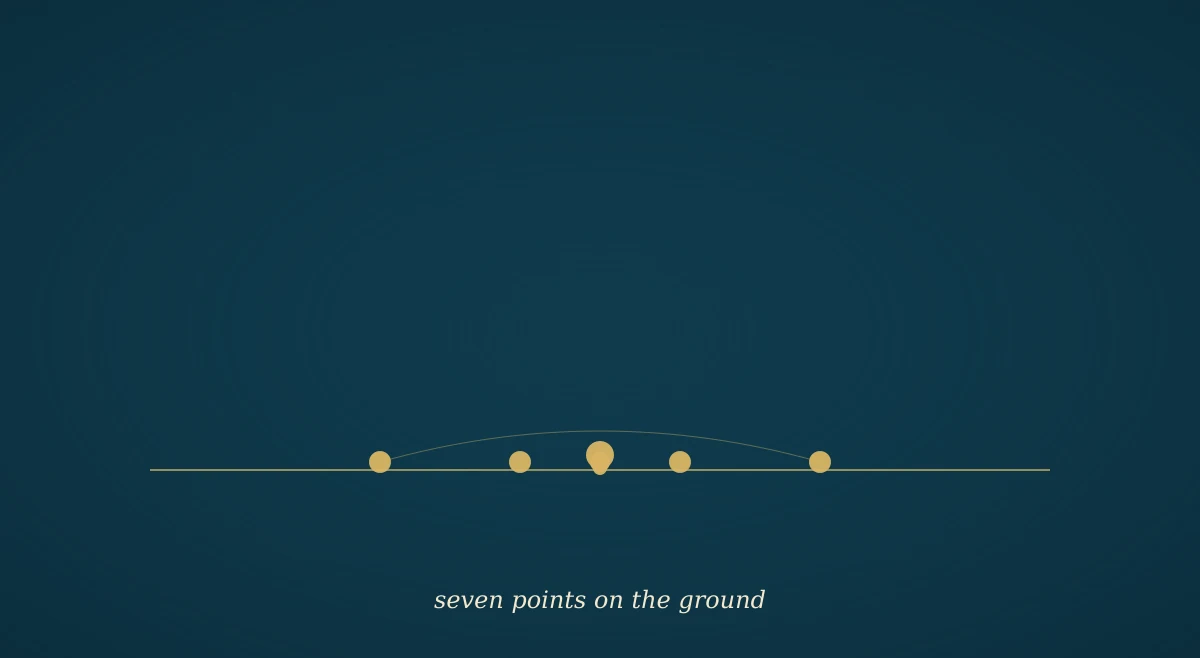
Every other system with a vertical axis climbs it. This one has no axis, and the movement is down.
In sujūd, the prostration of Islamic prayer, seven points of the body touch the ground:
The forehead. The nose. The right palm. The left palm. The right knee. The left knee. The toes.
The elbows stay off the floor and away from the ribs. The belly does not rest on the thighs. The form is specified closely enough that it is taught by correction rather than description.
And the anatomical consequence is the whole point: the head is below the heart.
In the five obligatory prayers there are seventeen rakʿāt, each containing two prostrations — thirty-four times a day, before any voluntary prayer is added. Performed by whoever is praying, in the same form, with no variation by rank.
What the tradition says about it
Not that prostration is humbling, which would be obvious. Something much stronger, stated repeatedly and centrally:
A person is nearest to God when in sujūd.
The moment of maximal nearness is the moment the forehead is on the floor. The supplication made in that position is held to be the likeliest to be answered.
The inversion
I spent a year writing accounts of how fourteen traditions map the body, and most of the ones that posit a vertical axis treat it the same way: as something to be climbed.
A central channel that opens upward. Wheels pierced in ascending order. Ascent to the crown. Even where the centre of gravity is the heart rather than the head, the movement is described as inward and up. The spine is the ladder, and the practice is the climbing of it.
Here there is no ladder.
There is no channel, no sequence of centres, no state to be attained by ascent. The prescribed movement of the body in prayer goes down, and the theological maximum is located at the bottom of it.
For a tradition that is otherwise intensely concerned with transcendence, that is a striking piece of architecture. Height is where God is not located relative to you; the ground is.
The social half, which is the sharper half
In its original cultural meaning, prostration was the maximal gesture of submission — the one performed before kings.
The system takes it away from every human being. Sujūd to any person is prohibited outright.
So the highest available gesture of submission is monopolised by a single recipient, and therefore owed to no one else. Whatever hierarchy exists outside the prayer, inside it there is one posture, one form, and one direction, and the ruler performs it in the same shape as the beggar, thirty-four times a day.
That is a specific social technology, and it is worth naming as such rather than as piety: bodily equality produced by making absolute submission unavailable to any human claimant.
The failure mode the tradition names itself
There is an obvious contradiction in the practice: having your face on the ground and feeling proud of it.
The tradition identifies this as the central spiritual danger of the whole act. Riyāʾ — performing worship to be seen — is held, explicitly and repeatedly, to void the value of the act it adorns.
I find this more interesting than the posture. A system that prescribes a public act of humility thirty-four times a day has a predictable corruption, and rather than ignoring it, the tradition made the corruption a named category and built a vocabulary for diagnosing it. That is unusual. Most institutions deny their characteristic failure; this one teaches it to beginners.
What I am not claiming
That the position does something physiologically special. There is a small literature proposing effects of prostration on cerebral blood flow, autonomic measures, or EEG. It is mostly underpowered and poorly controlled, and I would not rest anything on it. The head is below the heart; blood pressure regulation handles that unremarkably, as it does when you bend to tie a shoe.
That the inversion is unique in some absolute sense. It is unusual in the fourteen traditions I examined, and I chose those fourteen. Christian prostration exists; so do full-body prostrations in Tibetan practice, though there they function within a system that still has an ascending axis elsewhere. The claim is about architecture, not about who bows.
That ritual equality transfers outward. It does not automatically. A tradition can equalise bodies in the prayer line and stratify them thoroughly everywhere else, and the historical record of every tradition in this series shows exactly that pattern. What the prayer does is make a particular claim unavailable — nobody may demand this of you — which is a real constraint and a limited one.
The thing worth taking
Most of the body systems I studied are, at bottom, programmes of acquisition: something to be raised, opened, accumulated, awakened. Their geometry is vertical and their verb is ascend.
This one is a programme of placement. The geometry is the floor. The verb is put your forehead on it, and the claim is that the distance you were trying to close was never vertical in the first place.
You do not have to accept the theology to notice that this is a different idea about where a body should go.
Sources
- The ṣalāh literature in the classical fiqh schools on the form and obligatory elements of sujūd; the canonical ḥadīth collections on the seven points and on nearness in prostration.
- Qurʾān 96:19, 53:62.
- On riyāʾ: al-Ghazālī, Iḥyāʾ ʿUlūm al-Dīn, the book on ostentation.
This piece draws on a detailed study of the Islamic body-map tradition, one of a series of fourteen written as background work for The Learning Earth.
← Back to the Ancient Sources, Modern Lens guide
More in this pillar
- The Neiye (內業): Inward Training
- Mencius and Haoran Zhi Qi: The "Flood-Like Qi"
- The Huangdi Neijing: Inner Canon of the Yellow Emperor
- Huangdi Neijing — Suwen 1–5: An Expanded Reading
- The Convergence Asymmetry
- The Tradition That Diagnosed Its Own Damage
- Why the Right Posture Feels Wrong
- The Body Is Not Given, It Is Made
- The Second Arrow
- Tumah Is Not Dirt
- The Past Is in Front
- Enūma Eliš and the Emergence of OrderComing soon
- Pneuma, Prana and the Breath TraditionsComing soon
The other pillars
Be first to know
The book is in its final editing stage. Leave your email and you will hear when it is ready.