Chi, Reframed·Cornerstone
What Is Chi? A Systems Engineer’s Reframing
Chi is usually called a mysterious life energy. A systems engineer argues it is the flow of organization: a process, not a substance.
Twenty years ago, standing in a quiet room moving my hands in slow curves, I felt heat gather in the center of my palm.
Not the heat of exertion. The room was cool and I was barely moving. Something else. A density, a pressure, as if the space in my hand had acquired weight. I held still and it held with me. I moved my attention away and it faded. I brought my attention back and it returned.
I am an engineer. I do not accept feelings as data. The first instinct was the correct one: this is suggestion. Warm blood, focused attention, a mind primed to feel something. I filed the observation the way you file a fault you cannot yet reproduce on demand, and I kept living.
The file kept getting thicker.
The practice had a name. Chi Gong. The tradition it comes from has a name for the thing it says I was moving. Chi. And the tradition’s account of what chi is, in English, is almost always a mistranslation. Chi is not an energy. It is not a force. It is the flow of organization itself. The rest of this piece is a long explanation of that one line.
The problem with calling it “energy,” or “force”
In physics, energy is not a vague word. It has a specific meaning, a unit, and a conservation law. It is the capacity to do work, measured in joules, and in an isolated system it is conserved.
If chi were a form of energy in that sense, it would be detectable. Energy always is. Every form we have identified (kinetic, thermal, chemical, electromagnetic, nuclear) announces itself through measurable interaction. A century of instrumentation sensitive enough to detect gravitational waves and single photons has not turned up a distinct vital energy. The absence is meaningful.
Force fares no better. In physics it is just as specific: a push or a pull measured in newtons, which registers as an acceleration on anything it acts on. We know of four fundamental forces, and we have built devices sensitive enough to feel single atoms being nudged by any of them. If chi were a fifth force, we would have found it. We have not. The word carries the same imported authority as energy and the same empty bill.
So one of two things is true. Either chi is a physical quantity that has evaded every detector ever built, or the English words energy and force are mistranslations.
I think they are mistranslations, and I think it happened in a specific and forgivable way. The classical Chinese texts describe something that behaves like a flow. It can be strong or depleted. It moves through the body along paths. It correlates with health and vitality. When those texts reached European readers, the closest available concepts in nineteenth-century physics were energy and vital force. The translations stuck. They have been distorting the conversation ever since.
What the sources actually describe
Go back to the primary texts and the energy reading is not the most natural one.
The Neiye, an inner-cultivation text from roughly the fourth century BCE and probably the oldest Chinese writing on the subject, describes qi in the language of ordering and alignment. What produces vitality is not the accumulation of a fluid. It is the achievement of a condition: stillness, regularity, a body and mind arranged so that processes run without conflict. Qi in the Neiye is closer to coherence than to fuel.
Mencius goes somewhere stranger. His haoran zhi qi, usually rendered “flood-like qi,” is explicitly tied to moral conduct. It accumulates through right action and dissipates through wrongdoing. Nothing that behaves like a physical quantity is produced by moral conduct. Whatever Mencius is describing, it is a state of integration between what a person does, intends, and is. That it is described in the same vocabulary as bodily vitality is the interesting fact, not a confusion to be corrected.
The Huangdi Neijing, the foundational medical text, maps channels through the body and describes qi moving along them. This is the passage read as anatomical by enthusiasts and dismissed as pre-scientific by critics. Read as a functional map (which regions are coupled to which, how influence propagates, what a disturbance in one place predicts elsewhere) it is doing something recognizable. Engineers draw diagrams like this constantly. They are not pictures of pipes. They are pictures of dependency.
I go through these texts in detail in the Sources Library, including translated passages, because the argument depends on what they actually say.
Organization is a real thing, and it flows
Here is the move that makes the reframing work.
Living systems are not isolated. They are open systems held far from thermodynamic equilibrium by a continuous throughput of energy and matter. Ilya Prigogine showed that systems in this condition can spontaneously generate and maintain structure. He called them dissipative structures. A candle flame, a convection cell, a hurricane, a cell, an organism, an ecosystem: each is a pattern that persists not despite the flow through it but because of it.
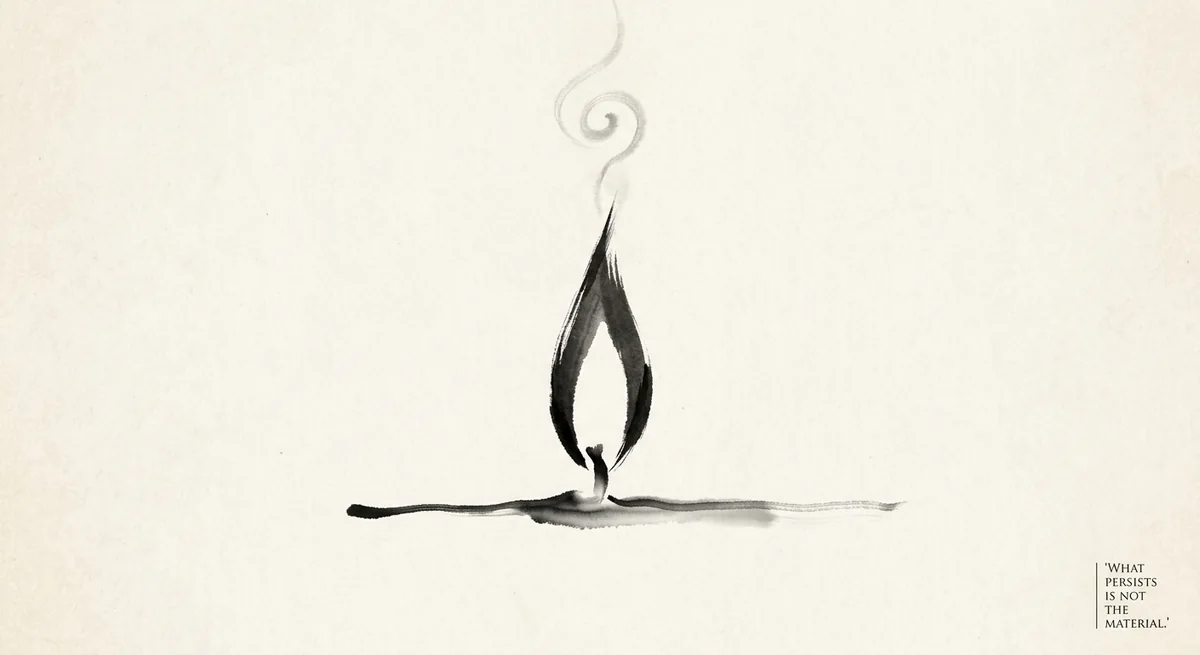
The pattern is not the material. The atoms in a flame are replaced continuously. The molecules in your body are almost entirely different from the ones you had a decade ago. What persists is the organization: the specific arrangement of relations and constraints that keeps the process running.
That organization is not a substance. It is also not nothing. It has structure. It can be more or less coherent. It can degrade. It can be maintained through effort. And it propagates through a system in ways that can be traced. It behaves, in short, very much like the thing the classical texts were pointing at.
This is what I mean by the flow of organization. Not a mystical field. Not an undetected particle. The dynamic architecture of a living system that is holding itself together against entropy, and the ways that architecture strengthens, weakens, and moves.
Where modern biology becomes relevant
If organization propagates through living tissue, we should be able to find mechanisms that do the propagating. We can.
Michael Levin’s work on bioelectricity has shown that cells communicate through voltage gradients across tissue, and that these gradients carry morphological information: instructions about what structure to build, not merely metabolic signals. Manipulate the bioelectric pattern and you can change what an organism grows, independent of its genome. Tissue stores and routes structural information electrically.
This is exactly the point where books like mine usually overreach, so let me be exact about what the work does and does not show.
Levin’s research does not validate meridian theory. It does not show that acupuncture channels exist as anatomical structures. What it shows is that a category the classical texts were reaching for, namely information about form and function propagating through tissue along routes, is not a fantasy. It is an active research area with a growing body of results. That is a weaker claim than “science has confirmed chi.” It is also a more defensible one.
I unpack the research and its limits in Michael Levin’s Bioelectricity, Explained for Non-Biologists, and the specific question of acupuncture and neurophysiology in a separate piece.
What this reframing costs
Every reframing gives something up. This one gives up the most commercially valuable feature of the traditional account: the claim that chi can be transmitted from one person to another, projected, or manipulated at a distance.
If chi is the organizational state of a dissipative system, it cannot be handed over. Organization is not portable. You can influence a system’s organization through movement, breath, attention, sleep, diet, physical intervention, but you influence it by acting on the system, not by donating a quantity to it. There is no reservoir to draw from.
That rules out a large amount of what is currently sold under the heading of energy work. I consider that a feature. A concept that explains everything and forbids nothing is not doing intellectual work.
It also rules out something I would personally have liked to keep. The idea that individual consciousness persists after death is sometimes defended by appeal to the First Law of Thermodynamics: energy is conserved, consciousness is energy, therefore consciousness is conserved. The argument does not survive contact with the definitions. Energy is conserved; the arrangement of energy is not. When a system dissipates, its organization is genuinely lost even though every joule is accounted for. Under the reframing I am proposing, this is exactly what death is.
I make that argument in full in the book, and I make it against my own preference.
This is the conceptual spine of The Learning Earth. The book extends the same reframing upward, from organisms to ecosystems to the planet itself, and asks what follows if organization, rather than energy or matter, is the thing that accumulates.
More in this pillar
- Chi vs. Qi: Same Word, Different Spelling, Different Meanings?Coming soon
- Why Chi Is Not a SubstanceComing soon
The other pillars
Be first to know
The book is in its final editing stage. Leave your email and you will hear when it is ready.