The Science of Organization·Cornerstone
The Science Behind The Learning Earth
The five scientific anchors of The Learning Earth: what each establishes, what it does not support, and where the philosophy begins.
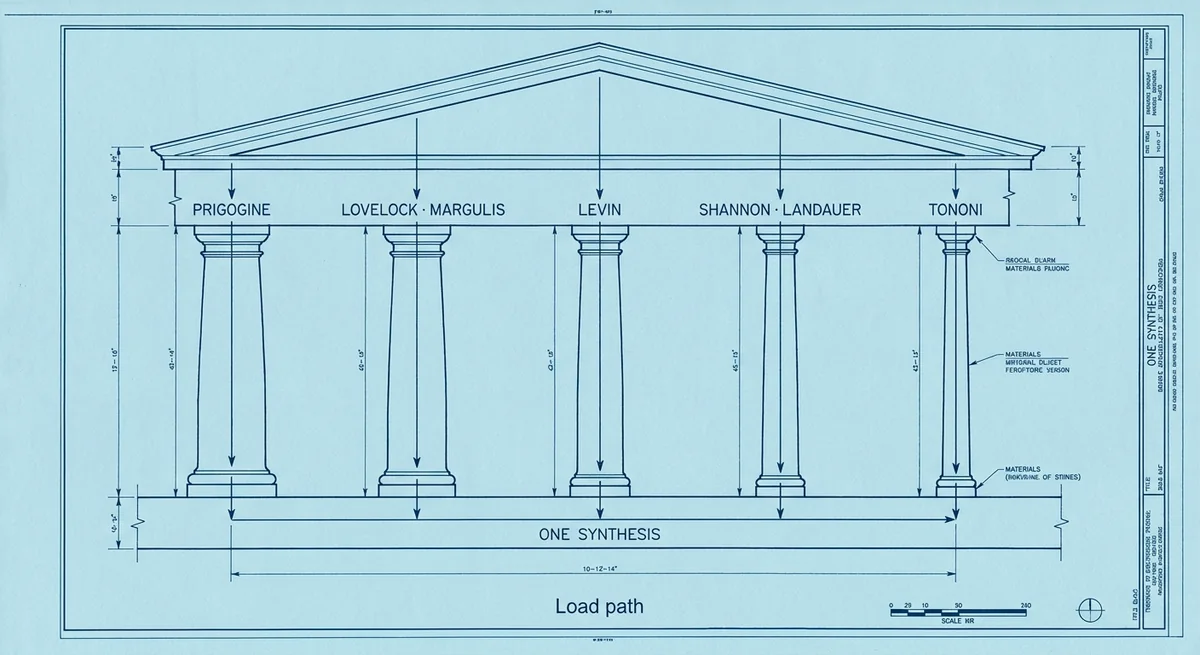
A book that draws on science owes its readers a clear account of what it is drawing on and how heavily.
The failure mode is familiar. An author cites a Nobel laureate, a research programme, and a mathematical formalism, and the citations function as decoration: borrowed authority for a claim the research does not actually support. Readers who know the field spot it immediately. Readers who do not are misled.
So this page is an audit of my own foundations. For each of the five scientific anchors of The Learning Earth, three things: what the research establishes, what I use it for, and what it does not support. The third item is the one that matters. A framework that cannot say what would count against it is not a framework.
At the end I say which anchors are load-bearing and which are illustrative. If one of them collapses, you should know in advance whether the argument goes with it.
1. Prigogine: dissipative structures
What is established. Ilya Prigogine received the 1977 Nobel Prize in Chemistry for work on thermodynamics far from equilibrium. His central result is that open systems with a continuous throughput of energy can spontaneously generate and maintain ordered structure: convection cells, chemical oscillations, flames, organisms. The order is not a violation of the second law. The system exports entropy to its surroundings and the total still increases. This is textbook physics.
What I use it for. This is the foundation of the entire book. It establishes that structure can arise and persist without being designed or selected, purely as a consequence of energy flowing through a system held away from equilibrium. Everything I say about organization accumulating rests on it.
What it does not support. Prigogine’s results say nothing about purpose, direction, or destination. Dissipative structures form and dissolve. They are not building toward anything. Any reading of my book that takes planetary organization as goal-directed is going beyond what this foundation permits, and beyond what I claim.
→ Dissipative Structures Explained
2. Lovelock and Margulis: planetary coupling
What is established. The biosphere and the physical Earth system are tightly coupled and have modified each other continuously for billions of years. Atmospheric oxygen is biological in origin. Soil, the nitrogen cycle, and much of ocean and sediment chemistry are biologically mediated. This coupling is not controversial.
What I use it for. It makes the planet the right unit of analysis. If the biosphere and the planet were separable, “Earth as a system” would be a figure of speech. They are not, so it isn’t.
What it does not support. The strong Gaia hypothesis (that Earth actively regulates itself toward habitability) has a serious unsolved problem. Homeostasis in organisms exists because selection built it, and there is no population of planets for selection to act on. I take the weak version: coupling plus feedback, which produces apparent regulation in some periods and catastrophic runaway in others. Snowball Earth and the mass extinctions are part of the record too.
→ The Earth as a Learning System
3. Levin: bioelectricity and morphological information
What is established. Michael Levin’s laboratory has shown that cells communicate through bioelectric voltage gradients across tissue, and that these gradients carry information about anatomical structure: what to build, where. Manipulating the bioelectric pattern can alter morphological outcomes without altering the genome. This is active, published, replicated experimental biology.
What I use it for. It demonstrates that living tissue stores and routes structural information through a channel that is neither genetic nor neural. That is the mechanism I need for the claim that organization propagates through a body in ways the standard account under-describes.
What it does not support. It does not validate acupuncture meridians as anatomical structures. It does not confirm any traditional medical system. The relationship between Levin’s channels and classical channel maps is a conceptual isomorphism I am proposing (two descriptions with a similar logical shape), not an identification. Anyone citing Levin as scientific proof of qi is misusing his work, and he has been clear about this himself.
→ Michael Levin’s Bioelectricity, Explained for Non-Biologists
4. Shannon and Landauer: information as a physical quantity
What is established. Claude Shannon’s 1948 theory gave information a precise mathematical definition and a unit. Rolf Landauer’s principle, later confirmed experimentally, established that erasing a bit of information has an unavoidable minimum thermodynamic cost. Information is not an abstraction floating free of physics. Manipulating it costs energy.
What I use it for. It licenses treating organization as a real quantity rather than a metaphor. If information has thermodynamic weight, then a system’s informational structure is a physical fact about it, and asking how that structure accumulates is a physical question.
What it does not support. This is the most abused result in popular science writing, and the misuse is worth naming.
Shannon information measures statistical structure: how surprising a signal is given a distribution. It says nothing whatever about meaning. A page of random characters has higher Shannon information than a page of Shakespeare. Landauer’s principle applies to bits in that sense, not to memories, experiences, or the semantic content of a mind.
That distinction rules out an argument I have seen made often and would have found convenient: that because information is physical and energy is conserved, individual consciousness must persist after death. It does not follow. The argument equivocates between two different meanings of “information.” I unpack it in detail in What Is Chi?.
→ Landauer’s Principle: Why Erasing Information Costs Energy
5. Tononi: integrated information
What is established, and what is contested. Integrated Information Theory proposes that consciousness corresponds to the degree to which a system’s information is integrated rather than decomposable, quantified as φ. It has been among the most discussed theories in consciousness science for two decades.
It is also the most contested item on this list. In September 2023, a preprint letter signed by more than a hundred researchers argued that IIT should be labelled pseudoscience, on grounds that included its commitments to a form of panpsychism and the claim that the theory as a whole is not empirically testable. The label itself has been contested on both sides. More recently, the 2025 COGITATE adversarial collaboration tested IIT and a competing theory in a pre-registered multi-site study. Results were mixed: some IIT predictions were supported (content could be decoded from posterior cortex), while others, including sustained synchronization within posterior cortex, were not.
The honest summary: contested, unresolved, taken seriously by serious people on both sides.
What I use it for. One idea only, namely that integration is a plausible candidate for what distinguishes a conscious system from a merely complicated one, and that this candidate is at least the right kind of thing to look for. It is a framing, not a result.
What it does not support. I do not use φ as a measurement, I do not claim consciousness can currently be quantified, and I do not adopt IIT’s panpsychist implications.
Self-organized criticality: a note on the mathematics
The book uses a complexity-science scaffold (self-organized criticality, power-law distributions, phase transitions) to describe how a system accumulating structure behaves near a threshold.
Status: self-organized criticality is a real and well-studied phenomenon in specific systems. Its application to the planetary case in the book is a heuristic analogy, not a derivation. I am borrowing the shape of the mathematics because it captures something about how thresholds behave, not because I have shown that the planetary system satisfies the formal conditions. Where I use the vocabulary, read it as description rather than proof.
Which anchors are load-bearing
An engineer’s habit: before trusting a structure, work out which members carry load and what happens if one fails.
Load-bearing. Prigogine and planetary coupling. If dissipative structures were not real physics, or if the biosphere and the planet were separable systems, the book has no foundation and the argument fails outright.
Substantially supporting. Shannon–Landauer and Levin. If information had no thermodynamic status, my treatment of organization would become metaphorical. If bioelectric morphological signalling were overturned, the chapters on how organization propagates through tissue would need rebuilding. The planetary argument would survive.
Illustrative. Tononi. If IIT were abandoned entirely tomorrow, the book’s argument would not change. Integration would still be the obvious candidate for the relevant threshold. I would simply have no formalism to gesture at. I have deliberately arranged the argument so that the most contested anchor carries the least weight.
More in this pillar
- Michael Levin’s Bioelectricity, Explained for Non-BiologistsComing soon
- Landauer’s Principle: Why Erasing Information Costs EnergyComing soon
The other pillars
Be first to know
The book is in its final editing stage. Leave your email and you will hear when it is ready.