Earth as a Learning System·Cornerstone
The Earth as a Learning System: An Introduction
Life did not just adapt to Earth; it rebuilt it. What can “learning” rigorously mean for a planet? A systems engineer’s introduction.
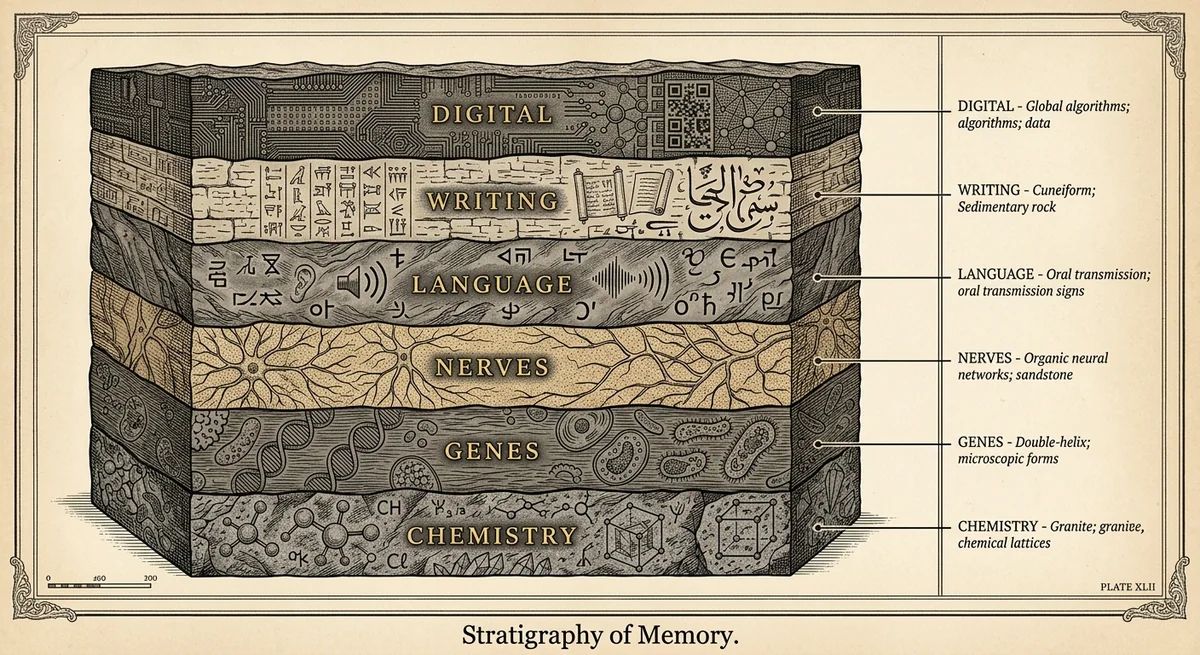
The standard account is simple. The Earth is a habitat. It has certain physical properties (distance from a star, mass, atmosphere, liquid water) and life arose within those properties and adapted to them. The planet is the stage. Life is what happens on it.
That account is not wrong. It is incomplete, and the incompleteness is not subtle once you look for it.
The atmosphere you are breathing is roughly twenty-one percent oxygen. That is not a geological given. It is waste. Photosynthetic organisms produced it over hundreds of millions of years, and in producing it they poisoned most of what was alive at the time and permanently altered the planet’s chemistry, its mineralogy, and its capacity to support everything that came afterward. The stage was rebuilt by the actors.
Once you notice this you notice it everywhere. Soil is a biological product. The nitrogen cycle is biologically driven. Ocean chemistry, the carbon cycle, the composition of sedimentary rock, the very existence of a magnetically shielded oxygenated surface environment: each is coupled to what life has been doing. The relationship between planet and biosphere has never been one-directional.
The honest description is not “life on a planet.” It is a single coupled system in which the distinction between organism and environment is a convenience of scale rather than a fact about the world.
The Gaia problem, stated fairly
James Lovelock and Lynn Margulis reached this conclusion in the 1970s and gave it a name. The Gaia hypothesis proposed that Earth’s surface conditions are actively regulated by the biosphere in ways that keep the system habitable: a planetary homeostasis.
The evidence for coupling is strong and has only strengthened. The evidence for regulation runs into trouble, and the objection is worth stating at full strength.
Homeostasis in an organism exists because organisms that failed to maintain it did not reproduce. Natural selection built the thermostat: an organism’s internal controls are fine-tuned because bad designs get eliminated over generations. There is only one Earth. There is no population of planets, no differential reproduction, no mechanism by which a well-regulating planet could outcompete a badly regulating one.
What survives the objection is weaker and more interesting. You do not need selection to explain feedback. Coupled systems generate feedback loops as a matter of course, some stabilizing, some amplifying, and a system full of them will exhibit periods of apparent regulation without anyone having designed a thermostat. It will also exhibit catastrophic runaway, which the Earth has done repeatedly. Snowball glaciations and mass extinctions are not the behaviour of a well-regulated organism. They are the behaviour of a complex system with feedback, which is a different and less flattering thing.
I take the weaker claim. Not a self-regulating superorganism. A complex adaptive system, with everything unruly that implies.
What “learning” can rigorously mean
The word in my title is doing the most work and carries the most risk, so let me pin it down.
I am not claiming the planet has a mind, intends outcomes, or is working toward a goal. If that is what “learning Earth” suggests, the phrase is a liability rather than an asset.
Define the term at its minimum: a system learns if it retains structure from past states in a way that changes how it responds to future ones.
That definition requires no consciousness, no intention, and no purpose. It requires three things only: a mechanism of retention, a persistence of that retention through time, and a causal effect of the retained structure on subsequent behaviour. An immune system meets it. A river delta meets it in a limited sense; its channels record its history and constrain its future flow. A thermostat does not, because it retains nothing.
By this definition, the question of whether the Earth learns is not mystical. It is empirical, or at least it is the kind of question that admits evidence. Does the planetary system retain structure from its past in ways that change its subsequent behaviour?
The answer is obviously yes. The interesting part is not the answer but the inventory.
What has actually accumulated
Run the record forward and something specific happens. Each major transition creates a new layer of retention, and each new layer handles information the previous ones could not.
Chemistry retains structure in molecular configuration, slowly, and only in aggregate. Genetic inheritance retains it far more precisely and transmits it across generations, but it can only update at the speed of reproduction. Nervous systems retain structure within a single lifetime, at speeds no genome can approach, and can therefore respond to conditions that change faster than generations turn over. Language externalizes the retention so that it survives the organism holding it. Writing removes the requirement that anyone remember. Digital storage removes the requirement that anyone read it before it is needed.
The pattern in that sequence is what I call nested delegation. Each layer does not replace the one below it; it sits on top and delegates the slower work downward. Your genome still does what genomes do. Your nervous system handles what the genome cannot handle fast enough. Culture handles what a single nervous system cannot hold. Nothing was discarded, and each addition increased the total rate at which the system as a whole can incorporate its own history.
That acceleration is measurable in a rough way. Billions of years to move from chemistry to cells. Hundreds of millions to nervous systems. On the order of a hundred thousand years to behavioral modernity (the earliest unambiguously symbolic artefacts, the pierced shell beads of Bizmoune Cave in Morocco, are dated to roughly 142,000 years ago). Thousands to writing. Decades to global digital infrastructure. Whatever else is going on, the interval between transitions is collapsing, and it is collapsing across a single continuous physical system.
I go through the physics that permits this in The Science Behind The Learning Earth, and the thermodynamics of why structure accumulates at all in Dissipative Structures Explained.
Two clocks
There is a constraint on all of this that gets very little attention, and it is the point where the argument becomes properly speculative.
The Sun has a lifecycle. Its luminosity has increased roughly thirty percent since the Earth formed and continues to increase. In something on the order of a billion years it will have made the surface uninhabitable for complex life, regardless of what happens to us. That is one clock, and it runs on stellar physics.
The Earth has its own lifecycle. Its internal heat is finite, plate tectonics will eventually cease, the magnetic field that shields the atmosphere depends on a molten core, and the accumulation of biological complexity took four billion years to reach its current state. That is a second clock, and it runs on planetary physics.
These two clocks are independent. There is no reason they should align. And the window in which a planet can host high-complexity organization is the overlap between them: the interval where the star is stable enough and the planet is still geologically active enough, simultaneously.
Astrobiology has spent most of its effort on a spatial question: where are the habitable planets? The two-clock framing suggests the harder question is temporal. Not where, but when, and how narrow the overlap tends to be. In the book I call this the Dual-Trajectory model. It is a framing, not a result. It reorganizes the question. It does not answer it.
Where this goes next. If organization is the thing that accumulates, then the concept the traditions have been circling for millennia, chi, understood as the flow of organization, stops being mystical and becomes a description. The book follows that thread from thermodynamics through the ancient sources and into what it might mean for how a person actually lives.
More in this pillar
- Dissipative Structures Explained: How Order Arises from Energy FlowComing soon
- Complex Adaptive Systems 101: Ants, Immune Systems and EcosystemsComing soon
The other pillars
Be first to know
The book is in its final editing stage. Leave your email and you will hear when it is ready.