Ancient Sources, Modern Lens·Primary source
Why the Right Posture Feels Wrong
Proprioception is a prediction, not a measurement. Why the familiar posture feels right and the better one feels wrong — and what motor-control research shows.
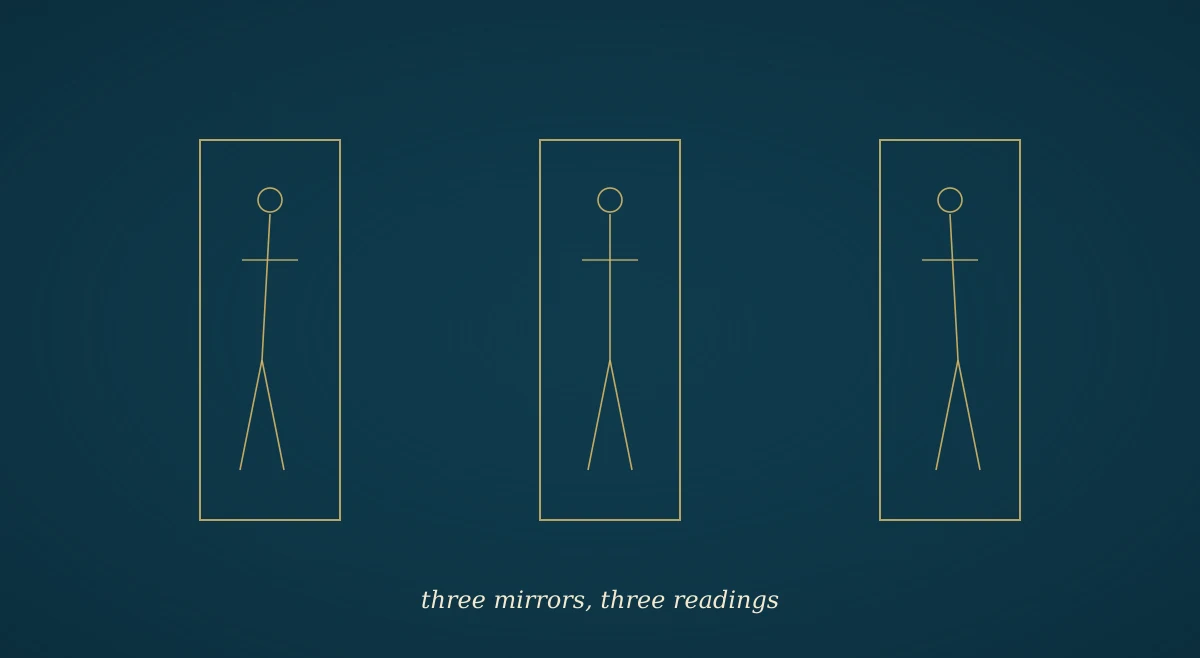
Your sense of your own body is a prediction, not a measurement — and it is calibrated to your habits
In the 1890s an Australian actor named F. M. Alexander kept losing his voice on stage. Doctors found nothing. He suspected he was doing something to himself, so he set up three mirrors and watched himself recite, for years.
What he found is the founding observation of a whole field, and it is worth stating precisely. It was not that he had bad posture. It was that what he felt himself doing and what he was actually doing were two different things — and that when he corrected on the basis of what he felt, he made it worse.
He called it faulty sensory appreciation. He was right, and he had no idea why.
The mechanism took another fifty years to arrive, from a completely different direction, and it explains the thing that makes postural work so frustrating: the better position almost always feels wrong at first, and the familiar one feels correct right up to the moment you see it in a photograph.
The sense that is not a sense
Proprioception — the sense of where your limbs are and what they are doing — is usually described as a kind of internal camera. It is not. It is closer to a running estimate maintained by a system that is mostly guessing ahead of the data.
Two groups found the key piece independently in 1950: Erich von Holst and Horst Mittelstaedt in Germany, who called it the reafference principle, and Roger Sperry in the United States, who called it corollary discharge. The idea in both cases: when the nervous system issues a motor command, it keeps a copy — an efference copy — and uses it to predict what sensations that command should produce. Incoming sensation is then compared against the prediction, and what the system notices is mainly the difference.
In 1995, Wolpert, Ghahramani and Jordan showed in Science how the estimate is actually assembled: the nervous system combines a prediction generated from the motor command with the delayed sensory signal, weighting each by how reliable it is in the circumstances — in the manner of a Kalman filter. Your sense of your own arm is a blend of a forecast and a late report.
This is not an inefficiency. It is forced. Norbert Wiener made the general point in Cybernetics in 1948: a feedback control loop with a time delay and high gain does not settle — it hunts and oscillates. Neural feedback loops have delays on the order of tens to hundreds of milliseconds depending on the pathway, which is far too slow to control standing, let alone speaking or catching. A body that waited for sensory confirmation before acting would shake itself apart. So it predicts, and corrects the prediction.
The consequence is that your sense of your own body is a model’s output, and models have calibration.
The measured version
The cleanest laboratory demonstration I know comes from Shergill, Bays, Frith and Wolpert, in Science in 2003, and it is worth describing because the number is startling.
Pairs of volunteers took turns pressing on each other’s finger, each instructed to match the force they had just received. Neither knew the other’s instructions. Force rose in every single pair — by about 38% per turn, an average increase of 3.2 N over eight exchanges. A tit-for-tat exchange, with both sides sincerely trying to reciprocate exactly, escalated by more than a third each round.
The second experiment explains it. When people matched an externally applied force by pressing with their own finger, they consistently pressed too hard. When they reproduced the same force through a joystick that drove the motor, they were accurate. The conclusion: force you generate yourself feels about half as strong as the same force applied to you.
Your own action is systematically under-felt. The prediction cancels most of the sensation it expects, which is also why you cannot tickle yourself.
One honest limit: that experiment is about finger pressure, not about standing. Reading it across to posture is an extension — the standard one, and the one the whole predictive-control account supports, but an extension.
And why the right one feels wrong
Attenuation explains why effort is misjudged. The title’s problem needs one more step, and it is the one Alexander stumbled into in front of his mirrors.
A prediction has to be trained on something. Yours is trained on your own history — the configurations you actually adopt, thousands of times a day, for years. That history is the reference against which everything is compared.
So when you move into a position you do not habitually use, the system does not report new. It reports discrepancy, and discrepancy is what error feels like. The unfamiliar is registered as the wrong, because the familiar is what “correct” was calibrated to mean.
This is why a straighter spine feels like leaning backwards, why releasing a chronically held shoulder feels like letting the arm fall off, and why a dancer or a cellist who changes something genuinely useful often reports feeling clumsy and exposed for weeks. The feeling is accurate as a report of difference from habit. It is worthless as a report of difference from good.
“I’m standing straight” is a claim about a model. Not a lie, and not a measurement.
Which makes the mirror the point, not the crutch
If the instrument is calibrated to your habits, then no amount of attending more carefully to the feeling will tell you where you are. Attention improves the resolution of a reading from a mis-set gauge.
What helps is an external reference: a mirror, a video, a photograph, the floor against your back, a flat wall, someone else’s hands, a recording of your own voice. This is why hands-on traditions work the way they do, and it is the honest answer to why a teacher is useful — not privileged perception, just an outside reading.
It also makes sense of the oddest-sounding instruction in Alexander’s method. He taught inhibition: on receiving the stimulus to act, do not act. Not as self-discipline or restraint, but — in the terms above — as a way of not issuing the habitual command, so the system does not generate the habitual prediction and the habitual sensation of rightness along with it. His distinction between end-gaining (going straight for the result) and means-whereby (attending to how) is the same point. Go for the result and you will use the available pattern, which is the one being corrected.
The part that keeps this from becoming a sales pitch
Here the somatic field usually overreaches, and the research cuts against it.
A large literature on attentional focus finds that for performing a well-learned movement, an external focus — on the target, the implement, the effect — generally beats an internal focus on the body. And the reinvestment and choking work, from Richard Masters and Sian Beilock among others, finds that directing conscious attention at a consolidated skill actively degrades it. The yips are not a failure of concentration; they are the result of too much of it, aimed inward.
So “feel your way into it, stay with the sensation” is poor advice for doing something you can already do.
The resolution, which I think is the useful content of the whole field: internal attention is a tool of reconstruction, not of execution. You use it to take a pattern apart and rebuild it, deliberately and slowly, with an external reference to tell you where you actually are. Then you put it down and go back to attending to the task, and the new pattern consolidates the way the old one did.
Nikolai Bernstein’s work gives the shape of that process. Learners first freeze degrees of freedom — they stiffen, holding joints in fixed relation to simplify the control problem — then progressively release them, and finally begin exploiting the dynamics of the system rather than fighting it. Vereijken and colleagues documented exactly that sequence on a ski simulator in 1992. Bernstein also observed that no skilled movement is ever a repetition: it is “repetition without repetition,” the same problem re-solved under slightly different conditions each time.
Which disposes of “the right posture” as a thing. There is no position to hold. There is a way of re-solving the problem of being upright, and holding any single configuration — including a prescribed good one — is the error with a different sign.
I should also flag that the account above is one of two live positions. The ecological school — Gibson, Kelso, Turvey and successors — disputes the whole internal-model framing, arguing that coordination emerges from the dynamics of an organism coupled to its environment with no represented model required. That dispute is not settled. Fortunately both sides agree on the practical consequence here: your felt sense is not a direct readout, and external reference is what calibrates it.
What the evidence actually supports
Two findings that point in different directions, and both matter.
The lessons have outcome evidence. The ATEAM trial (Little et al., BMJ, 2008) randomised 579 patients with chronic or recurrent back pain to 24 one-to-one Alexander Technique lessons, 6 lessons, 6 massage sessions, or normal GP care, with half in each arm also prescribed exercise. At one year, the 24-lesson group averaged about 3 days in pain per month against 21 in the control group, with a 42% reduction in activities limited by pain. Massage helped at three months and faded by twelve. That is a real result in a major journal, and few things in this field have one.
The explanation does not. If the mechanism were correct static alignment, posture would predict pain. It largely does not. Swain and colleagues (Journal of Biomechanics, 2020) reviewed 41 systematic reviews of spinal posture and physical exposure in relation to low back pain and concluded there is no consensus regarding causality: positive and null associations throughout, mixed evidence that these exposures precede a first episode or show a dose-response. Where differences between people with and without back pain do show up fairly consistently, they are in movement — slower, smaller range — rather than in static shape (Laird et al., 2014).
So a method that works has a rationale that does not. That is not unusual and it is not a scandal; it is the normal condition of effective practical knowledge, and the reason to keep the two claims separate rather than let the outcome launder the theory.
The trap in the title
One last thing, because this article’s title is exactly the kind of sentence a bad teacher quotes.
If “it feels wrong, so it might be right” is available, then so is “it feels strange, therefore it’s working” — and that inference is precisely as invalid as the one it replaces. Both reason from the felt sense, which is the unreliable instrument under discussion. Novelty feels strange. So does strain. So does a position that is genuinely worse for you, and so does one that is about to injure you.
A field that teaches people to distrust comfort, and offers nothing external in its place, has not fixed the calibration problem. It has given itself a way to dismiss every objection.
The usable version is narrow and holds up:
- Feeling right is not evidence of being right. Your reference is your habit.
- Feeling wrong is not evidence of being right either. Same instrument.
- Use an outside reading. Mirror, video, a wall, a floor, a hand, a recording — something that does not share your calibration.
- Judge by outcome over weeks, not by sensation in the moment. Does the voice hold, does the pain interfere less, does the passage come out. Sensation is the thing being recalibrated, so it cannot also be the test.
- Use deliberate internal attention to rebuild, then put it down. Keeping it on is how a rebuilt skill stays clumsy.
Alexander got to most of this with three mirrors and no theory, which is genuinely impressive. The theory, when it arrived, came from people studying fish reflexes and control engineering and had nothing to do with him.
It says he was right about the instrument and wrong, like nearly everyone in this field, about what the instrument is for.
Sources
- von Holst E, Mittelstaedt H. Das Reafferenzprinzip. Naturwissenschaften, 1950. · Sperry RW. Neural basis of the spontaneous optokinetic response. Journal of Comparative and Physiological Psychology, 1950. (Independent discoveries of efference copy / corollary discharge.)
- Wolpert DM, Ghahramani Z, Jordan MI. An internal model for sensorimotor integration. Science 269: 1880–1882, 1995.
- Wiener N. Cybernetics: Or Control and Communication in the Animal and the Machine. MIT Press, 1948.
- Shergill SS, Bays PM, Frith CD, Wolpert DM. Two eyes for an eye: the neuroscience of force escalation. Science 301: 187, 2003.
- Bernstein NA. The Co-ordination and Regulation of Movements. Pergamon, 1967.
- Vereijken B, van Emmerik REA, Whiting HTA, Newell KM. Free(z)ing degrees of freedom in skill acquisition. Journal of Motor Behavior 24(1): 133–142, 1992.
- Wulf G. Attentional focus and motor learning: a review of 15 years. International Review of Sport and Exercise Psychology 6(1): 77–104, 2013.
- Masters RSW, Maxwell J. The theory of reinvestment. International Review of Sport and Exercise Psychology 1(2): 160–183, 2008.
- Little P, Lewith G, Webley F, et al. Randomised controlled trial of Alexander technique lessons, exercise, and massage (ATEAM) for chronic and recurrent back pain. BMJ 337: a884, 2008.
- Swain CTV, Pan F, Owen PJ, Schmidt H, Belavy DL. No consensus on causality of spine postures or physical exposure and low back pain: a systematic review of systematic reviews. Journal of Biomechanics 102: 109312, 2020.
- Laird RA, Gilbert J, Kent P, Keating JL. Comparing lumbo-pelvic kinematics in people with and without back pain: a systematic review and meta-analysis. BMC Musculoskeletal Disorders 15: 229, 2014.
- Alexander FM. The Use of the Self, 1932.
This piece draws on a study of the modern Western somatic field — Alexander, Feldenkrais, Rolf, Gindler, fascia, interoception, and the motor-control literature — one of a series of fourteen such studies written as background work for The Learning Earth.
← Back to the Ancient Sources, Modern Lens guide
More in this pillar
- The Neiye (內業): Inward Training
- Mencius and Haoran Zhi Qi: The "Flood-Like Qi"
- The Huangdi Neijing: Inner Canon of the Yellow Emperor
- Huangdi Neijing — Suwen 1–5: An Expanded Reading
- The Convergence Asymmetry
- The Tradition That Diagnosed Its Own Damage
- Seven Points on the Ground
- The Body Is Not Given, It Is Made
- The Second Arrow
- Tumah Is Not Dirt
- The Past Is in Front
- Enūma Eliš and the Emergence of OrderComing soon
- Pneuma, Prana and the Breath TraditionsComing soon
The other pillars
Be first to know
The book is in its final editing stage. Leave your email and you will hear when it is ready.