Ancient Sources, Modern Lens·Primary source
The Past Is in Front
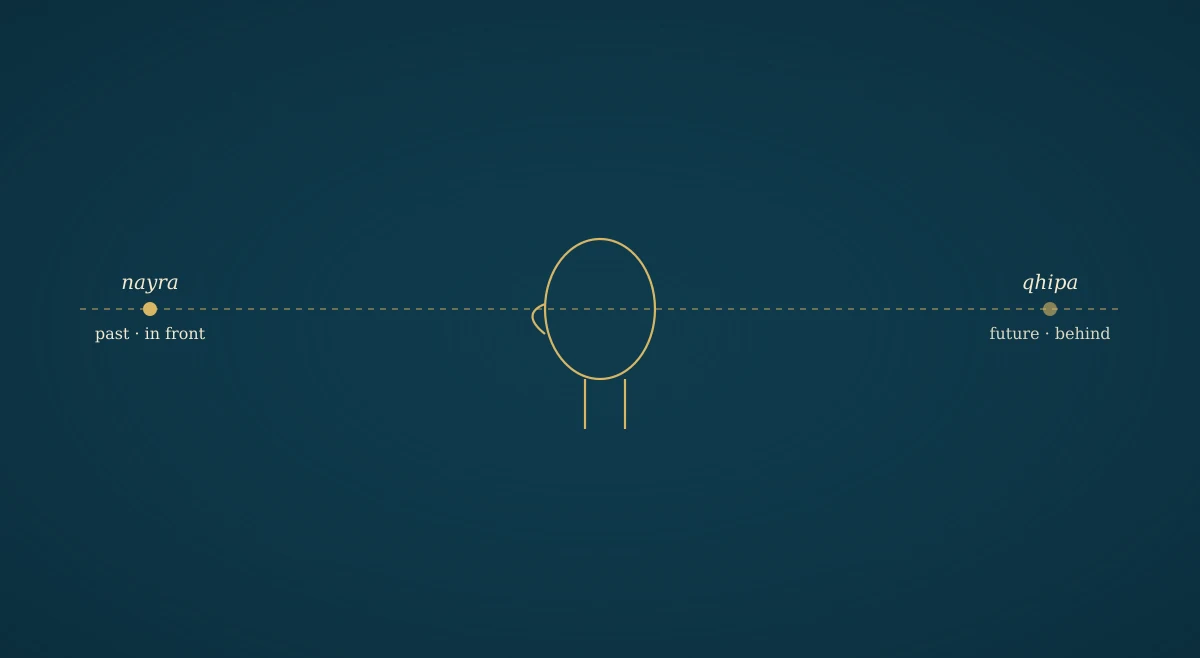
In Aymara, the past is in front and the future behind — and the hands follow the words. The strongest empirical finding in the series.
The strongest empirical finding in the whole series, and the one with the most honest caveats
In Aymara, spoken by two to three million people around Lake Titicaca, the word for the past is built on the word for eye.
Nayra means eye, front, sight. It is also the word used for the past: nayra mara, “last year”; ancha nayra pachana, “a long time ago.”
Qhipa means back, behind. It is the word used for the future: qhipüru, “a future day”; qhipa marana, “in the coming year.”
So the arrangement is the reverse of the English one. The past is in front of you. The future is behind.
And there is an argument for it being the more literal arrangement of the two: you can see what has happened. You cannot see what has not. If the spatial metaphor is built on vision, which the etymology of nayra suggests, then putting the known in front of the eyes and the unknown at your back is the consistent choice. English, which puts the unseen future in front, is the one making the odd move.
Why the words alone prove nothing
This is where most popular accounts stop, and where they should not.
Language is full of dead metaphors that no living speaker computes. English says “before” for earlier events — the week before last — which on the same reasoning would make English a past-in-front language too. It does not, because nobody is doing any spatial thinking when they say it. The word is a fossil.
So the lexical facts are suggestive and cannot settle anything. The question is whether Aymara speakers are actually construing time this way, or just using inherited vocabulary.
The test
Rafael Núñez and Eve Sweetser found a way to check, and it is the methodological move that makes this finding worth more than everything else in this series.
They looked at the hands.
Co-speech gesture is largely unmonitored. People do not plan it, do not usually notice it, and cannot easily fake it. If the spatial mapping is live rather than fossilised, it should show up in what the hands do while the mouth is busy with something else.
They videotaped thirty adult Aymara speakers in the highlands of northern Chile, aged 38 to 84, median 64.5 — around twenty hours of informal ethnographic interview collected over eighteen months. Gestures co-timed with past and future expressions were coded for direction. Twenty-one of the thirty produced codable gestures of this kind.
The result:
- Speakers fluent in Aymara gestured forward for the past and backward for the future.
- Speakers fluent in Spanish gestured in the Western pattern — future forward, past behind.
- Of participants aged 65 or older, eight of nine gestured only forward when referring to the past. Five of six younger participants gestured backward at least once.
- Fisher’s exact test: p = .024 on the language split and on the age split; p = .011 and p = .035 on the past-directed gesture comparisons.
The hands follow the language. The mapping is live.
The caveats, which are not small
I want to be more careful here than the finding usually gets treated, because this is the piece of evidence I would least like to lose to an overstatement.
Age and language are confounded. This is the serious one. The Aymara-dominant speakers in this sample are the older speakers; the Spanish-fluent ones are the younger and more educated. Both splits return the same p-value because they are substantially the same split. So the data cannot cleanly separate “construes time this way because of the language” from “construes time this way because of the generation.” Both readings fit, and distinguishing them would take a sample the study did not have.
The sample is modest and the setting was not experimental. Thirty participants, informal interviews, naturalistic coding — appropriate for the question, and not the same thing as a controlled design.
The future-directed gestures are weaker than the past-directed ones. The authors say so, and offer a physical reason: you cannot gesture as far behind yourself as in front of yourself. Part of the asymmetry in the data is a shoulder joint.
The authors warn against exactly the use this finding usually gets put to. They explicitly caution against assembling a unified “Aymara model of time” out of scattered evidence. The paper is narrower and more careful than its reception.
The gesture data themselves have not been seriously challenged. What is debated is how much weight the interpretation will carry — and the right answer is: less than people want, more than nothing.
Why it is still the strongest thing here
Because of what it does methodologically, which almost nothing else in this series does.
Most claims about how a tradition understands the body are claims about texts — what a source says, when it was written, how it was later read. That is historical work, and it can be done well, but it cannot be tested against a measurement.
This one was converted into a prediction: if the mapping is live, unmonitored behaviour should show it. Then the prediction was checked against a behaviour the participants were not controlling, and it came out as predicted, with a statistic attached.
That is the move the rest of this material mostly cannot make, and it is worth saying plainly rather than letting the series imply otherwise. Fourteen traditions, and one finding in the whole set is a tested prediction with a p-value.
It also happens to be a case where the answer is interesting independent of any larger argument. Nothing in it requires a vital force, a subtle anatomy, or a claim about ancient wisdom. It is a fact about how a particular language organises a particular abstraction, and about the fact that such organisations can be real enough to move someone’s hand while they are thinking about something else.
The thing to take from it
Not that Aymara speakers have a deeper relationship with time. There is no evidence of that and the study does not suggest it.
Something narrower and stranger: the arrangement of time in space is not given. It feels inevitable — of course the future is ahead, you walk into it — and the feeling is a product of the language you learned, visible in your hands, and a different arrangement is equally liveable by people who are in every other respect doing the same thing you are.
Which raises the obvious question about everything else that feels inevitable about being in a body.
Sources
- Núñez RE, Sweetser E. With the future behind them: convergent evidence from Aymara language and gesture in the crosslinguistic comparison of spatial construals of time. Cognitive Science 30(3): 401–450, 2006.
- Núñez R, Cooperrider K. The tangle of space and time in human cognition. Trends in Cognitive Sciences 17(5): 220–229, 2013.
This piece draws on a detailed study of the Andean body-map tradition, one of a series of fourteen written as background work for The Learning Earth.
← Back to the Ancient Sources, Modern Lens guide
More in this pillar
- The Neiye (內業): Inward Training
- Mencius and Haoran Zhi Qi: The "Flood-Like Qi"
- The Huangdi Neijing: Inner Canon of the Yellow Emperor
- Huangdi Neijing — Suwen 1–5: An Expanded Reading
- The Convergence Asymmetry
- The Tradition That Diagnosed Its Own Damage
- Why the Right Posture Feels Wrong
- Seven Points on the Ground
- The Body Is Not Given, It Is Made
- The Second Arrow
- Tumah Is Not Dirt
- Enūma Eliš and the Emergence of OrderComing soon
- Pneuma, Prana and the Breath TraditionsComing soon
The other pillars
Be first to know
The book is in its final editing stage. Leave your email and you will hear when it is ready.