Ancient Sources, Modern Lens·Primary source
Mencius and Haoran Zhi Qi: The "Flood-Like Qi"
The Mencius 2A.2 passage on flood-like qi, with full Chinese text, a fresh English rendering, and philological notes.
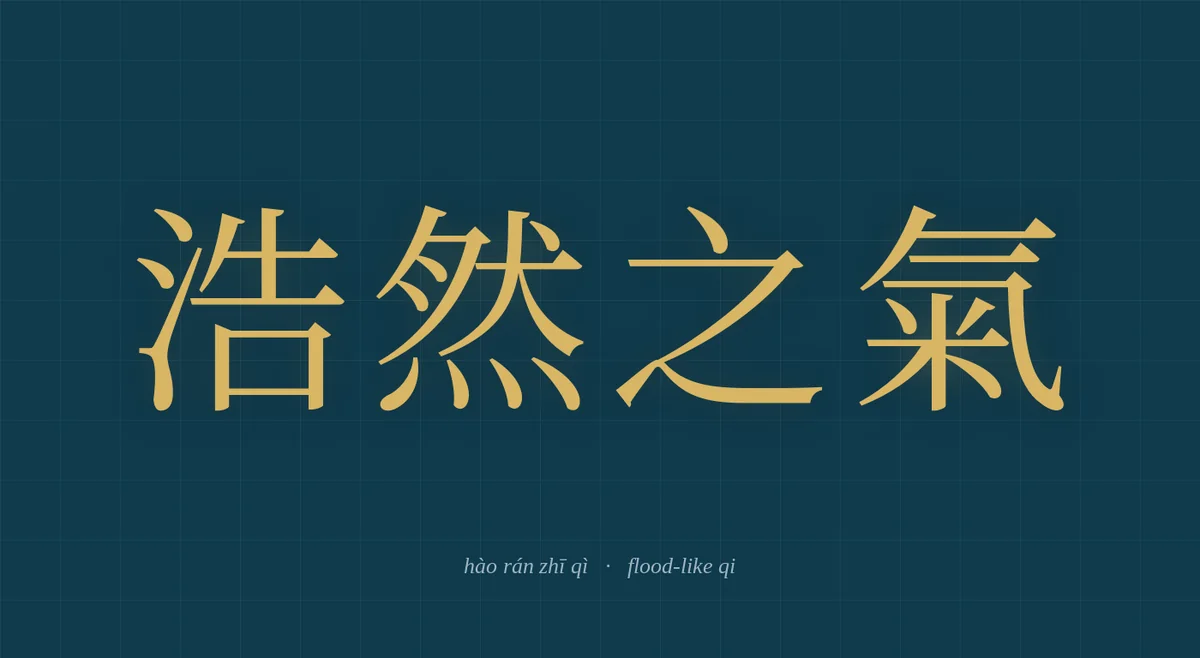
The Mencius (孟子, Mèngzǐ) is a central Confucian text of the fourth century BCE. It is well attested — the manuscript tradition is unusually solid — and the passage this page is about, Book 2A (“Gōngsūn Chǒu, Part One”, 公孫丑上), chapter 2, is the locus classicus for one of the strangest and most important technical terms in classical Chinese thought: 浩然之氣 (hàorán zhī qì), usually rendered “flood-like qi” or “vast, flowing qi.”
It is the single place where Mencius himself defines what he means by this phrase. Everything else in the tradition that invokes it is downstream.
The point for the Sources Library is simple. In this passage, Mencius says the thing he calls qi
- is difficult to describe,
- fills the whole space between heaven and earth,
- is nourished by uprightness and the Way,
- and — critically — is produced by the accumulation of right action and starves when a person acts against conscience.
Nothing that behaves like a physical quantity is produced by moral conduct. Whatever Mencius is pointing at, it is not a substance that fills the body like steam fills a kettle. It is a state of integration between what a person does, what they intend, and who they are. That it is described in the same vocabulary as bodily vitality is the interesting fact, not a confusion to be corrected.
If you came here from What Is Chi?, this is the passage that is doing the most work there. If you have not read that one yet, this page is a good second stop.
A note on this translation
The English rendering below was produced for this site by Claude Opus 4.7 Extra, in October 2026, keyed to the Greek line-by-line translation Panos works from (which itself was made against the standard received Chinese text, with the help of the same model). It is a working translation for a philosophical argument, not a critical edition.
For anything turning on an exact word choice, go to the standard scholarly translations — D. C. Lau (Penguin), Bryan W. Van Norden (Hackett), Irene Bloom (Columbia). Where their renderings and this one diverge on a load-bearing word, those are noted below the passage.
Transliterations follow Pinyin; a few key terms are kept in the original (qi, yi, dao, xin) and glossed on first appearance.
The passage: Mencius 2A.2
The Chinese and English are set side by side. Line breaks follow the received text.
公孫丑問曰:「敢問夫子惡乎長?」
Gōngsūn Chǒu asked, “May I ask: in what does the Master excel?”孟子曰:「我知言,我善養吾浩然之氣。」
Mencius replied, “I understand words — I can tell what lies behind what people say — and I am good at nourishing my flood-like qi.”「敢問何謂浩然之氣?」
“May I ask: what do you mean by ‘flood-like qi’?”曰:「難言也。
He said, “It is difficult to put into words.其為氣也,至大至剛,以直養而無害,則塞于天地之間。
As a qi, it is utterly vast and utterly firm. Nourished by uprightness and left to suffer no harm, it fills the space between heaven and earth.其為氣也,配義與道;無是,餒也。
As a qi, it is paired with righteousness (yi 義) and the Way (dao 道). Without these, it starves. → Note 1是集義所生者,非義襲而取之也。
It is born of the accumulation of right action. It is not something righteousness seizes by sudden raid from outside.行有不慊於心,則餒矣。
If an action does not satisfy the heart (xin 心), [the qi] starves.我故曰,告子未嘗知義,以其外之也。
That is why I said: Gàozǐ never understood righteousness — because he placed it outside the person. → Note 2必有事焉而勿正,心勿忘,勿助長也。
One must constantly be at work on it, without aiming at a fixed result. Let the heart not forget it; let the heart not try to help it grow. → Note 3無若宋人然:
Do not be like the man of Sòng.宋人有閔其苗之不長而揠之者,
There was a man of Sòng who, distressed that his sprouts were not growing, pulled at them to lift them up.芒芒然歸,謂其人曰:『今日病矣!予助苗長矣!』
He went home exhausted and said to his household, ‘Today I’m worn out! I helped the sprouts to grow!’其子趨而往視之,苗則槁矣。
His son ran out to look — and the sprouts had withered.天下之不助苗長者寡矣。
Few in the world are those who do not ‘help the sprouts to grow’. → Note 4以為無益而舍之者,不耘苗者也;
Those who think it pointless and give it up are the ones who never weed their sprouts.助之長者,揠苗者也,非徒無益,而又害之。」
Those who ‘help it grow’ are the ones who pull up their sprouts: not only do they do no good, they do harm.”
Notes on key terms
1. 餒 (něi), “starves.” Literally “hungers” or “famishes,” metaphorically “loses strength, grows faint.” The double sense is deliberate: the qi is nourished by right action the way the body is nourished by food. The verb is the same one you would use for a horse that has not been fed. Mencius is being precise about the kind of thing qi is here — a condition that depletes without input, exactly as the body does.
2. Gàozǐ (告子). The interlocutor Mencius has been arguing against earlier in the chapter. Gàozǐ’s position, in short, was that righteousness is an external standard that one conforms to; Mencius’s position is that righteousness grows from inside, as an outgrowth of the heart. The qi passage is partly an argument against the first view: a qi that is produced by the accumulation of one’s own right action cannot be a response to an external measuring stick.
3. 勿正 (wù zhèng), “without aiming at a fixed result.” This is contested. In Zhū Xī’s reading (12th c.), 正 is glossed as 預期 (“to expect, to anticipate”), giving the sense followed above. A rival school reads 正 as “to force into shape, to correct by violence,” which would give “without trying to force it.” Both readings fit the parable that follows — the man of Sòng was both anticipating a result and forcing it. The ambiguity may be deliberate.
4. 揠苗助長 (yà miáo zhù zhǎng), “pulling the sprouts to help them grow.” Mencius’s parable here became proverbial. In modern Chinese, the four-character compound 揠苗助長 is still an everyday idiom for a well-meaning intervention that destroys what it tries to help. The parable’s point, in Mencius’s own argument, is that the cultivation of flood-like qi works like growing crops: you tend to it steadily, you weed around it, you do not pull.
Why this passage breaks the “energy” reading
Three features of the passage, taken together, rule out qi as a physical quantity:
It is produced by moral action. The qi is “born of the accumulation of right action” (jí yì suǒ shēng, 集義所生). No physical quantity we have ever measured — no energy, no field, no fluid, no gas, no particle — is produced by anyone acting rightly. Energies obey conservation laws tied to physical interactions, not to the integrity of the actor’s conduct.
It can be starved by inner disquiet. “If an action does not satisfy the heart, [the qi] starves.” The thing being starved is not metabolic. A liar can have a full belly and a disordered heart in the same hour; it is the second condition that depletes the qi. What depletes with disorder of character, and is replenished with coherence of conduct, is not a substance. It is a state of integration.
It fills the space between heaven and earth. The flood-like qi “fills the space between heaven and earth.” If one took this physically, we would be reading a theory of pneuma as a cosmic medium — a sort of nineteenth-century ether. The reading argued across this site is that this is better read as a coupling claim: that a well-integrated person’s qi is of a piece with the ordering process of the cosmos as a whole. Vast, in the sense that it is not local to the body; firm, in the sense that it holds its coherence under disturbance.
Read against this background, Mencius is not making a mystical claim about a world-filling fluid. He is making a precise claim about a relationship: the condition we call integrity of conduct is not a feeling that lives in a person; it is a continuous organizing activity that passes between the person and the world they are embedded in, and that activity has characteristic effects — vitality, moral clarity, immovability under pressure — that the tradition noticed and named.
That is what the book means by “the flow of organization”, applied to a person and to that person’s actions. The Neiye describes the same reframing from the bodily side; Mencius describes it from the moral side. Both texts are using the same word — qi — because they are describing the same phenomenon from two different distances.
Where this passage fits in the book
In the manuscript’s chapter on chi as the flow of organization (Chapter 5), the haoran zhi qi passage is cited to make a specific move: to show that even in the earliest Chinese sources, long before “qi” became an all-purpose cosmological vocabulary, the term carried the twin senses of bodily condition and ordering activity at the same time. Treating these as different concepts that happen to share a word is the modern reader’s confusion. For Mencius, as for the author of the Neiye, there is one phenomenon: the organization of a system that is in the right relation to itself.
That is not a defence of ancient physics. It is an argument about what the ancients were actually looking at.
Further reading
- D. C. Lau, trans. Mencius (Penguin Classics, revised edition, 2004). The standard English version for general readers, with facing-page notes.
- Bryan W. Van Norden, trans. Mengzi: With Selections from Traditional Commentaries (Hackett, 2008). Includes the Zhū Xī commentary that fixes several of the readings taken here.
- Franklin Perkins, “Mencius” entry in the Stanford Encyclopedia of Philosophy — a good first stop for the philosophical context.
- For the broader argument about chi as a process rather than a substance, What Is Chi? A Systems Engineer’s Reframing.
- For the companion inner-cultivation text where the practice is laid out, The Neiye.
← Back to the Ancient Sources, Modern Lens guide
More in this pillar
- The Neiye (內業): Inward Training
- The *Huangdi Neijing*: Inner Canon of the Yellow Emperor
- Huangdi Neijing — Suwen 1–5: An Expanded Reading
- The Convergence Asymmetry: Good Observers, Bad Theorists
- The Tradition That Diagnosed Its Own Damage
- Why the Right Posture Feels Wrong
- Seven Points on the Ground
- The Body Is Not Given, It Is Made
- The Second Arrow
- Tumah Is Not Dirt
- The Past Is in Front
- Enūma Eliš and the Emergence of OrderComing soon
- Pneuma, Prana and the Breath TraditionsComing soon
The other pillars
Be first to know
The book is in its final editing stage. Leave your email and you will hear when it is ready.