Ancient Sources, Modern Lens·Primary source
The Second Arrow
A 2,500-year-old Buddhist distinction between the pain of an event and the reaction to it, read next to the modern pain-science dissociation.
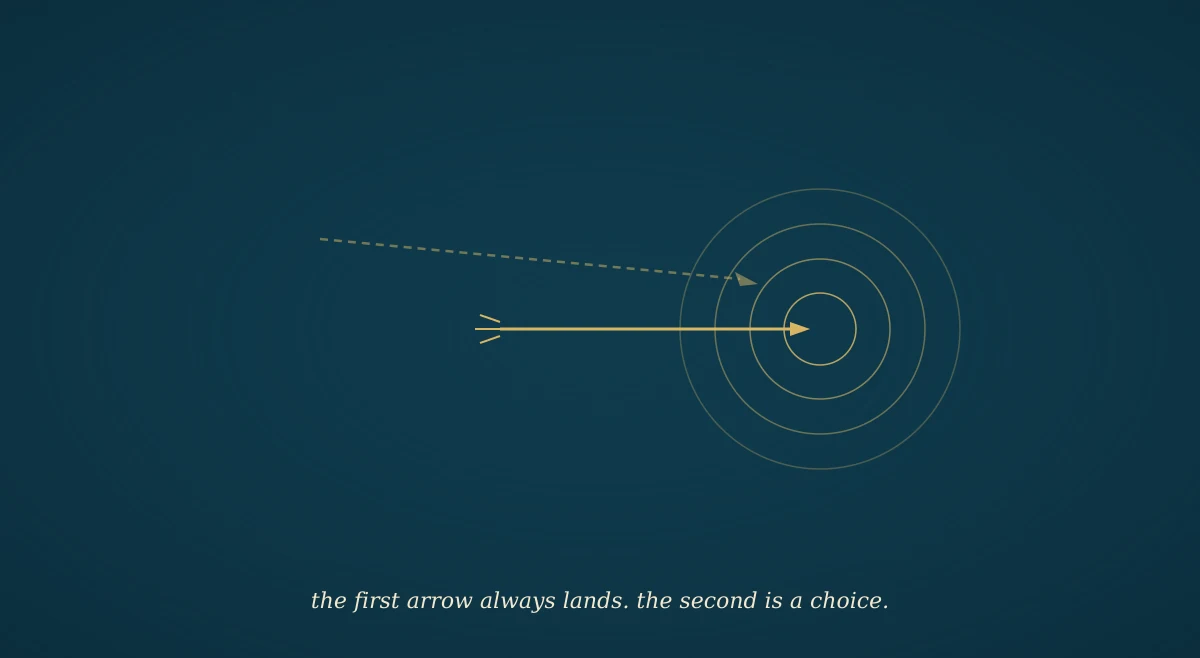
A 2,500-year-old distinction, a measurable dissociation, and the way the idea gets weaponised
A man is struck by an arrow.
Then he is struck by a second arrow, in the same place.
The Pāli text asks how much it hurts — and then draws the distinction that the whole of the tradition’s approach to pain rests on.
The first arrow is the bodily sensation: the pain, the illness, the fatigue, the loss. It is unavoidable. The trained person and the untrained person receive it identically.
The second arrow is the reaction: the resentment, the fear, the anxiety, the resistance, the narrative about what this pain means, the projection into the future, the search for someone to blame.
The untaught person, touched by a painful feeling, sorrows, grieves and laments. He feels two feelings — bodily and mental.
The trained person feels one: the bodily, not the mental.
The misreading the text itself blocks
The common misreading is that the trained person does not feel pain.
The text rules it out explicitly, and this matters more than anything else in the parable. The first arrow always lands. What differs is the second.
That is a modest claim, and its modesty is the reason it has survived. It does not promise transcendence of the body, and it does not make equanimity a test you can fail.
Where the two arrows show up in a laboratory
Modern pain science splits the experience along almost exactly the same line, using instruments.
Pain intensity — how strong the sensation is — and pain unpleasantness or bothersomeness — how much it bothers you — are measured separately, and they come apart. That dissociation is the two-arrow claim rendered as two scales.
Zeidan and colleagues (Journal of Neuroscience, 2011) trained fifteen healthy volunteers in focused-attention mindfulness for four days, twenty minutes a day, and measured their response to experimental heat pain with arterial spin labelling fMRI. Meditation reduced reported pain intensity by 40% and unpleasantness by 57%.
The asymmetry is the finding. The second number is larger than the first — which is what the parable predicts, and not what you would expect if the practice were simply dulling sensation. Different brain regions tracked each: greater orbitofrontal activation and thalamic deactivation correlated with the drop in unpleasantness; anterior cingulate and insula with the drop in intensity.
In a clinical population, Cherkin and colleagues (JAMA, 2016) randomised 342 adults with chronic low back pain to mindfulness-based stress reduction, cognitive behavioural therapy, or usual care — eight weekly two-hour group sessions. At 26 weeks, clinically meaningful improvement in function was reached by 60.5% (MBSR), 57.7% (CBT), and 44.1% (usual care). On pain bothersomeness: 43.6%, 44.9%, and 26.6%. The MBSR results held at a year.
Four things that are wrong with reading this as vindication
It is transmission, not convergence. Mindfulness-based stress reduction was built by Jon Kabat-Zinn directly and openly out of Buddhist practice. When MBSR trials show effects on the sensation/suffering split, that is not independent confirmation of an ancient insight — it is a tradition’s own technique being tested with a modern instrument. The lineage is declared. That makes it good evidence that the technique does something, and no evidence at all that anyone converged on anything.
The mechanism study is tiny. Fifteen healthy young volunteers, four days of training, experimental heat pain. That design is appropriate for asking how, and it cannot tell you what happens to a person who has had back pain for nine years.
And the clinical trial’s most interesting result is the tie. MBSR and CBT did not differ significantly. If the active ingredient were something specific to the contemplative tradition, you would expect it to beat a structured psychological therapy that shares its general architecture — attention to the relationship between thought and symptom — and it did not. The honest reading is that both work, by overlapping routes, and that nothing in the data isolates a distinctively Buddhist component.
The effects are real and modest. Around 44% improved on bothersomeness against 27% on usual care. That is a genuine difference and worth having. It also means most participants did not meaningfully improve, including most of those who did the training. Anyone presenting this as a solution to chronic pain is reading the abstract and not the numbers.
The part that needs saying
There is a way of deploying this idea that does real harm, and it is common enough that the useful version has to be defended from it.
If suffering is the second arrow, and the second arrow is fired by you, then a person who is still suffering can be told that they are doing it to themselves. From there it is a very short step to: your pain is a failure of practice, your distress is a choice, and the fact that this is not working for you is a fact about your effort.
The suttas do not make that move — the first arrow is explicitly not negotiable, and the trained person is never described as unaffected. But wellness culture makes it constantly, and it lands hardest on people with chronic illness, who have usually already been told some version of it by several professionals.
The distinction is a tool for the person holding it, about their own experience, used voluntarily. It is not a diagnosis to apply to someone else’s pain, and it is not an explanation for why someone else is not better yet.
The usable version
When something hurts, ask: how much of this is the event, and how much is my reaction to it?
The question does not reduce pain. That is not what it does.
It separates two things that had been stuck together — and of the two, only one was ever negotiable. Knowing which one you are dealing with at any given moment is worth something, and it is approximately all this particular idea delivers.
Which, for an idea this old, with this much freight attached to it, is still more than most.
Sources
- Sallatha Sutta, Saṃyutta Nikāya 36.6 (the two arrows); Visuddhimagga on vedanā.
- Zeidan F, Martucci KT, Kraft RA, Gordon NS, McHaffie JG, Coghill RC. Brain mechanisms supporting the modulation of pain by mindfulness meditation. Journal of Neuroscience 31(14): 5540–5548, 2011.
- Cherkin DC, Sherman KJ, Balderson BH, et al. Effect of mindfulness-based stress reduction vs cognitive behavioral therapy or usual care on back pain and functional limitations in adults with chronic low back pain: a randomized clinical trial. JAMA 315(12): 1240–1249, 2016.
- Kabat-Zinn J. Full Catastrophe Living. Delacorte, 1990. (On the derivation of MBSR from Buddhist practice.)
This piece draws on a detailed study of the Theravāda body-map tradition, one of a series of fourteen written as background work for The Learning Earth.
← Back to the Ancient Sources, Modern Lens guide
More in this pillar
- The Neiye (內業): Inward Training
- Mencius and Haoran Zhi Qi: The "Flood-Like Qi"
- The Huangdi Neijing: Inner Canon of the Yellow Emperor
- Huangdi Neijing — Suwen 1–5: An Expanded Reading
- The Convergence Asymmetry
- The Tradition That Diagnosed Its Own Damage
- Why the Right Posture Feels Wrong
- Seven Points on the Ground
- The Body Is Not Given, It Is Made
- Tumah Is Not Dirt
- The Past Is in Front
- Enūma Eliš and the Emergence of OrderComing soon
- Pneuma, Prana and the Breath TraditionsComing soon
The other pillars
Be first to know
The book is in its final editing stage. Leave your email and you will hear when it is ready.