Ancient Sources, Modern Lens·Primary source
Chinese Thought Glossary
An alphabetical Pinyin glossary of the Chinese vocabulary of the Neiye, Mencius, Huangdi Neijing and the chi/qi pages — each term in Pinyin, hanzi and English.
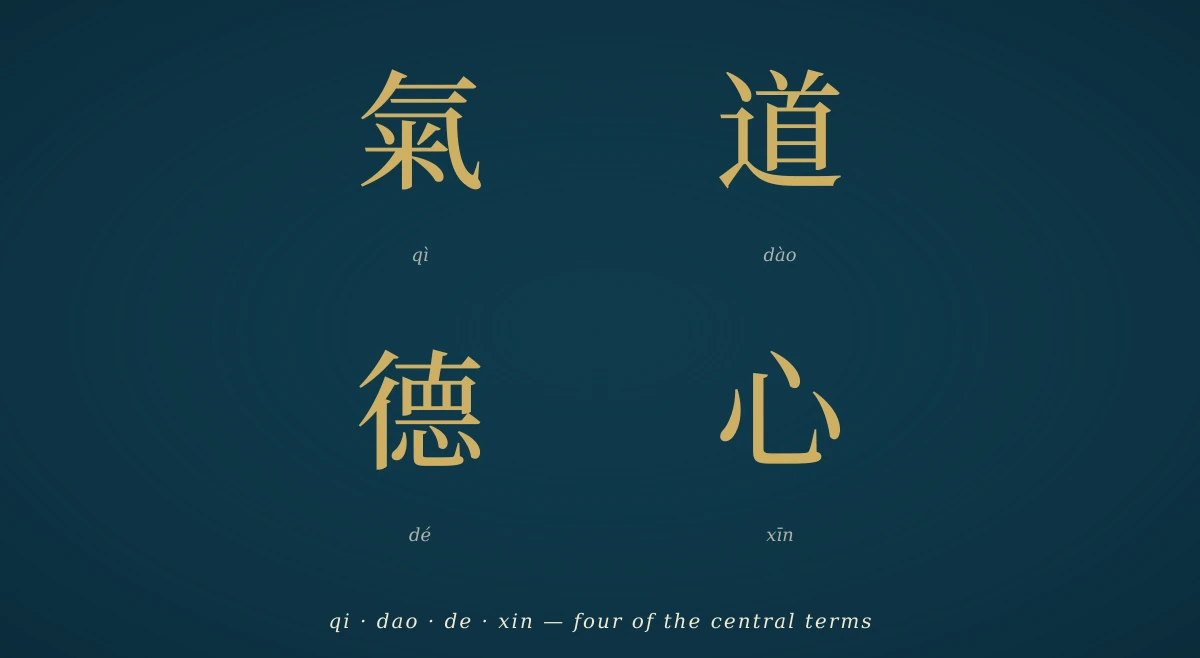
This is a working reference for the Chinese vocabulary used across the primary-source and modern-reading pages on this site: the Neiye, the Mencius on Haoran Zhi Qi, the Huangdi Neijing and its extended Suwen reading, together with the chi-pillar pages What Is Chi?, Chi vs. Qi, Why Chi Is Not a Substance, and the body-pillar guide Yin, Yang and the Chinese Body.
Entries are alphabetical by Hanyu Pinyin (the modern standard romanisation of Mandarin, used throughout this site). Each term is given in Pinyin, hanzi (Chinese characters; both traditional and simplified where they differ), and English meaning, with a short note on how it functions in the system.
A note on the spelling. The older Wade-Giles system (1859) and the modern Hanyu Pinyin (1958) render the same characters differently: ch’i vs. qì, tao vs. dào, jen vs. rén. This site uses Pinyin throughout, and the entry chi vs. qi argues that the two spellings have had different intellectual careers in English — one of the central reasons for keeping the vocabulary clear. Older spellings are cross-referenced where likely to be met in English-language sources.
B
Baijia (百家, bǎi jiā). “The Hundred Schools” — the great period of competing philosophical schools in the Warring States (c. 475–221 BCE). The Confucians, Daoists, Mohists, Legalists and others. Chinese thought reaches a density here it never quite recovers afterward.
D
Dān tián (丹田, dān tián). “Field of cinnabar” — a region of the body, usually the lower abdomen about three finger-widths below the navel, that is the site of attention in internal-alchemy practice (nèi dān, 內丹), tàijíquán (太極拳) and qìgōng (氣功). The term literally refers to the elixir-field of inner alchemy; in practice it is the point to which one “sinks the breath”. See Why Chi Is Not a Substance for the honest reading: there is no biological container there; sinking the breath is a particular bio-mechanical and autonomic shift.
Three dāntián are traditionally distinguished: lower (lower abdomen), middle (chest, near the heart), upper (between the eyebrows). See Yin, Yang and the Chinese Body.
Dào (道, dào). “The Way.” The central term of Daoism (Dàojiā, 道家 as philosophical school; Dàojiào, 道教 as religious tradition). Not a path one walks on, but something closer to “how things go when nothing is interfering” — the pattern of all pattern-making. Opening of the Daodejing: 道可道,非常道 — “the Way that can be spoken is not the enduring Way.”
In the Mencius, dào has a more Confucian sense of “the right conduct of a human life.” The two senses are related, not identical.
Dàodéjīng (道德經). “The Classic of the Way and its Virtue” — the foundational text of philosophical Daoism, traditionally attributed to Lǎozǐ (老子), probably compiled between the 4th and 2nd centuries BCE. 81 short chapters.
Dàoyǐn (導引, dǎo yǐn). “Guiding and pulling” — the oldest documented Chinese physical cultivation practice. The Mawangdui Daoyin Tu (馬王堆導引圖), a silk illustration from a tomb sealed in 168 BCE, depicts 44 postures and movements. The direct ancestor of what is now called qìgōng.
Dé (德, dé). “Virtue, power, inner character” — translated “virtue” but closer to “the characteristic power something has by virtue of what it is.” In Daoism: the particular way the dào expresses itself in a given being. In Confucianism: moral quality developed by practice. In both: not a social reputation, but what you actually are.
F
Fā jìn (發勁, fā jìn). “Issuing force / explosive force release” — the martial-arts technique in which force stored in the whole body is released suddenly through a specific contact point. Associated with tàijíquán and other internal arts. It is not an “energy projection”; it is a particular biomechanical sequence described in detail at Why Chi Is Not a Substance, section 3.
H
Hàorán zhī qì (浩然之氣, hào rán zhī qì). “Vast-flowing qi, flood-like qi” — the technical term Mencius introduces at Mencius 2A.2 for the particular quality of qi that is nourished by right action and starves when actions contradict intentions. Not a physical fluid; a state of integration between what you do, what you intend, and who you are. Treated in full at Mencius and Haoran Zhi Qi.
Hún (魂, hún). “Ethereal soul” — in traditional Chinese thought, one of two souls (with pò, below). The hún is yang, associated with breath, mind, and ascent after death. Three hún are usually distinguished.
Huángdì Nèijīng (黃帝內經). “The Inner Canon of the Yellow Emperor” — the foundational text of Chinese medicine, probably compiled in the Han dynasty (c. 2nd century BCE), presented as a dialogue between the mythical Huángdì (Yellow Emperor) and his physician Qíbó (岐伯). Two parts: the Sùwèn (素問, “Basic Questions”) on theory, and the Língshū (靈樞, “Spiritual Pivot”) on acupuncture. Treated in full at The Huangdi Neijing and Suwen 1-5.
J
Jīng (精, jīng). “Essence” — the first of the Three Treasures (sān bǎo) of Chinese internal cultivation: jīng (essence), qì (vital energy), shén (spirit). Jīng is the dense, foundational substrate — associated with reproductive essence and the structural integrity of the body. The classical injunction is to transform jīng into qì and qì into shén.
Jìng (靜, jìng). “Stillness, quiet” — the central practice of the Neiye. Not inactivity, but the condition in which internal turbulence has settled and clear perception becomes possible. Together with zhèng (alignment), the two pillars of early Daoist cultivation.
Jīngluò (經絡, jīng luò). “Channels and collaterals” — the network along which qì is said to flow in Chinese medicine. Not anatomical structures like blood vessels; functional couplings between organ systems. There are twelve “regular” meridians and eight “extraordinary” ones. See The Huangdi Neijing.
Jūnzǐ (君子, jūn zǐ). “The gentleman, the exemplary person” — the Confucian ideal of moral character. Not an aristocrat by birth, but one who has become genuinely cultivated through practice.
L
Lǎozǐ (老子). “The Old Master” — the semi-legendary author to whom the Dàodéjīng is attributed. Historicity is debated; the text is almost certainly a composite.
Lǐ (禮, lǐ). “Ritual propriety” — Confucian term for the forms of right conduct: not etiquette, but the recognisable patterns of a well-ordered social life. Related but distinct from lǐ (理), the next entry.
Lǐ (理, lǐ). “Pattern, principle, inherent order” — Neo-Confucian term, especially from the Song dynasty (960–1279 CE) onward. The intelligible pattern that makes a thing the thing it is. See What Is Chi? for the reading of qì as the carrier of lǐ.
Língshū (靈樞). “Spiritual Pivot” — the second part of the Huangdi Neijing, dealing mainly with acupuncture technique.
M
Mèngzǐ (孟子). “Master Mèng” — Mencius, c. 372–289 BCE, the second great Confucian after Confucius himself. The text named after him defends the thesis that human nature (xìng) is fundamentally good. See Mencius on Haoran Zhi Qi.
N
Nèi (內, nèi). “Inner, inside.” Contrasts with wài (外, outer). The Neiye is “inward training”; the Huangdi Neijing is the “inner canon.”
Nèidān (內丹, nèi dān). “Internal alchemy” — the Daoist practice of transforming the Three Treasures (jīng, qì, shén) within the body. Codified in the late Tang / Song period (c. 10th–13th c. CE). The physical descendant of the much older Dàoyǐn tradition. See Yin, Yang and the Chinese Body.
Nèiyè (內業). “Inward Training” — the oldest extant Chinese text on inner cultivation, 4th century BCE, preserved as four chapters of the Guǎnzǐ (管子) compilation. Not primarily about qì as a fluid; about zhèng (alignment) and jìng (stillness) as the conditions under which vitality arises. Full translation at The Neiye.
P
Pò (魄, pò). “Corporeal soul” — the yin counterpart to the hún. Associated with bodily life, instincts, and dissolution into earth after death. Seven pò are usually distinguished.
Q
Qì (氣 traditional; 气 simplified; qì). The central term. Not “energy” in the physical sense — see Chi vs. Qi and Why Chi Is Not a Substance for the extended argument. In the classical texts, qì is better read as the operational state of a system that is running without internal friction — a state variable, not a substance. The character shows vapour (气) rising over rice (米), the active process in which fuel and heat produce transformation.
The older Wade-Giles spelling is ch’i; the Pinyin is qì. The Chinese character is unchanged. See What Is Chi? for the main site treatment.
Qìgōng (氣功, qì gōng). “Qi-work” — the modern umbrella term for Chinese breathing, posture, and movement cultivation practices. The specific techniques are often ancient (Dàoyǐn, tuìnà, tǔnà), but the term qìgōng is itself a 20th-century coinage.
R
Rén (仁, rén). “Humaneness, benevolence” — the central Confucian virtue. Not a feeling but a developed way of relating to others. The character pairs 人 (person) with 二 (two) — “person as two”, i.e., the self as always in relation.
Rú (儒, rú). “Confucian” — strictly, the scholarly tradition that reads the Confucian classics. Rújiā (儒家) is Confucianism as philosophical school; Rújiào (儒教) as institutional practice.
S
Shén (神, shén). “Spirit, divinity, mind” — the third of the Three Treasures. The subtlest, most refined level of vitality. In medicine: cognitive clarity, awareness. In broader usage: a divine or spiritual being. The classical move is to refine qì into shén.
Shī (士, shī). “Scholar-official, educated person” — the social class that formed the backbone of the imperial administration, trained in the Confucian classics.
Sūwèn (素問). “Basic Questions” — the first part of the Huangdi Neijing, dealing with theory of medicine, including the yin-yang and five-phase frameworks. The first five chapters are the philosophical core; see Suwen 1-5.
Shēn (身, shēn). “Body, person, self” — the whole embodied being, not just the physical body (which is more specifically tǐ, 體).
T
Tàijí (太極, tài jí). “The supreme pole, the great ultimate” — in later Confucian metaphysics, the undifferentiated source from which yin and yang arise. The tàijí tú (太極圖), the familiar black-and-white “yin-yang symbol,” is a visual rendering. In Daoist cosmology, often identified with the dào in its most primal state.
Tàijíquán (太極拳, tài jí quán). “Supreme-ultimate fist” — the martial-cultivational art associated with the Chen family (Henan province), later systematised by the Yang family. Yang Chengfu’s “Ten Essentials” are discussed at length in Yin, Yang and the Chinese Body.
Táolù (套路, tào lù). “Form, routine” — a prescribed sequence of movements in a martial-cultivational practice. The 108-movement, 24-movement, and other named sequences of tàijíquán are táolù.
Tǔnà (吐納, tǔ nà). “Expelling and taking in” — breath-regulation practices attested in the Zhuangzi (chapter 15) and in later Daoist texts. The ancestor of what is now called qìgōng breath practice. See Pneuma, Prana and the Breath Traditions.
W
Wài (外, wài). “Outer, outside.” Contrasts with nèi. External martial arts (wàijiā, 外家) emphasise speed and strength; internal (nèijiā, 內家) emphasise structural alignment and qì.
Wǔxíng (五行, wǔ xíng). “The five phases” — the five dynamic transformations (wood 木, fire 火, earth 土, metal 金, water 水) that organise much of Chinese natural philosophy and medicine. Often misleadingly translated “five elements”; the Chinese term emphasises movement (xíng = “to go”), not static substances. Each phase generates one, overcomes another, and corresponds to specific organs, seasons, colours and tastes in medicine. See The Huangdi Neijing.
Wújiā (無為, wú wéi). “Non-contrived action, non-interference” — the Daoist practical principle. Not inactivity; action that does not force. Related: zìrán (自然), spontaneity.
X
Xīn (心, xīn). “Heart-mind” — the organ of both thought and feeling in Chinese thought, which does not distinguish them as sharply as the modern West. The character shows a stylised anatomical heart. In Mencius, the “four sprouts” (sìduān, 四端) grow from the xīn: compassion, shame, deference, right/wrong.
Xíng (形, xíng). “Form, shape, body” — the physical form; what can be seen.
Xìng (性, xìng). “Nature, inborn character” — the central term of Chinese ethics. In Mencius: xìng is originally good, and ethical cultivation is the development of what is already there. In Xunzi: xìng needs the shaping of ritual and learning before it is good.
Y
Yáng (陽 traditional; 阳 simplified; yáng). The bright/warm/active/outer/upward pole of the yin-yang pair. Not “male” in a fixed sense — a relational quality that any specific thing has in some respect and lacks in another.
Yāng-qì (陽氣, yáng qì). “Yang qi” — the active, warming aspect of qì that drives physiology. Fully covered in Suwen 1-5.
Yì (義, yì). “Righteousness, appropriateness” — the Confucian virtue of doing what is right in the circumstances, not from calculation but from character. Central to Mencius: the hàorán zhī qì is nourished by yì.
Yì (意, yì). “Intention, mind-directed-toward” — different character, different concept from the above. In tàijíquán practice, yì leads qì: the intention goes first, the movement follows.
Yīn (陰 traditional; 阴 simplified; yīn). The dark/cool/receptive/inner/downward pole of the yin-yang pair. Like yáng, relational — not a fixed substance.
Yīn-yáng (陰陽). “The yin and the yang” — the fundamental polarity. Not a dualism: the two are mutually constitutive, each contains the seed of the other, each can only be defined by its relation to the other. The tàijí diagram shows this: the dot of one in the field of the other. Full treatment at Yin, Yang and the Chinese Body.
Yuán-qì (元氣, yuán qì). “Original qi, primordial qi” — the qì one is born with, inherited from the parents. Distinct from acquired qì (from food, breath, environment). Loss of yuán qì through unregulated life is a central concern of traditional Chinese medicine.
Z
Zhàn zhuāng (站樁, zhàn zhuāng). “Standing like a post” — the standing-meditation practice central to tàijíquán and yìquán training. The practitioner holds specific postures (usually with arms raised as if embracing a tree) for extended periods, cultivating structural alignment and the drop of unnecessary muscular tension.
Zhèng (正, zhèng). “Correct, upright, aligned” — the central term of the Neiye: qì arises when the body is aligned (zhèng) and the mind is still (jìng). Not “upright” in a moralistic sense; rather, the structural correctness that allows the system to run without internal friction.
Zhuāngzǐ (莊子). “Master Zhuang” — the second great Daoist text after the Dàodéjīng, probably compiled between the 4th and 2nd centuries BCE. More playful, more paradoxical, more literary. The famous butterfly-dream passage; the cook cutting up the ox; the useless tree.
Zìrán (自然, zì rán). “Self-so, spontaneity, ‘of itself’” — the Daoist category for what happens without being forced or planned. Not randomness; the way things go when they are allowed to be what they are. Related: wú wéi.
Zàngfǔ (臟腑, zàng fǔ). “The storage and workshop organs” — the eleven organs of Chinese medicine, five zàng (yin, storing) and six fǔ (yang, transforming). Not identical with the Western anatomical organs: the Chinese “spleen” (pí, 脾) covers much of what the West locates in the pancreas and digestive system, and so on. The zàngfǔ system is covered at The Huangdi Neijing.
A short reader’s note on the vocabulary
A reader coming to this vocabulary from English should keep three cautions in mind.
First, almost every term resists direct translation. Qì is not energy; dào is not way; xīn is not heart; yì is not intention. The English words are approximations that carry their own baggage. The glossary gives the Chinese term, the hanzi, and an operational gloss. Use the English only as a handle.
Second, the same Chinese character can be read in two completely different intellectual traditions. Dào in a Confucian text means something different from dào in a Daoist text. Qì in the Neiye is a cultivation state; qì in Mencius is a quality of integrated action; qì in the Huangdi Neijing is a functional index of health. The character is one; the uses are many.
Third, “Chinese thought” is not one thing. The Hundred Schools disagreed with each other. Later Confucianism disagreed with Han medicine disagreed with Tang Daoism disagreed with Song neo-Confucianism. The glossary necessarily flattens this; the specific pages linked from each entry restore the context.
Related reading on this site
Primary sources:
- The Neiye (Inward Training) — the oldest text, with full translation.
- Mencius on Haoran Zhi Qi — the key Confucian passage.
- The Huangdi Neijing: Inner Canon of the Yellow Emperor
- Huangdi Neijing — Suwen 1–5: An Expanded Reading
Modern readings:
- What Is Chi? A Systems Engineer’s Reframing — the main reading.
- Chi vs. Qi: Same Word, Different Spelling, Different Meanings? — on the semantic drift.
- Why Chi Is Not a Substance — the engineering critique of the substance model.
- Yin, Yang and the Chinese Body: A Complete Guide — the full pedagogical guide.
Comparative:
- Pneuma, Prana and the Breath Traditions — on how the qì / prāṇa / pneuma vocabularies rhyme across traditions.
- Advaita Vedānta glossary — the companion glossary for the Sanskrit sources.
- Sources Library — the full set of primary-source guides.
← Back to the Ancient Sources, Modern Lens guide
More in this pillar
- The Neiye (內業): Inward Training
- Mencius and Haoran Zhi Qi: The "Flood-Like Qi"
- The Huangdi Neijing: Inner Canon of the Yellow Emperor
- Huangdi Neijing — Suwen 1–5: An Expanded Reading
- Enūma Eliš and the Emergence of Order
- Pneuma, Prana and the Breath Traditions
- The Architecture of Awareness: The Māṇḍūkya Upaniṣad and the Mapping of Brain States
- Pañcakośa: Five Layers of Human Identity, Read as a System Architecture
- Category Errors of the Self: Adhyāsa and the Modern Account of the Self-Model
- The Māṇḍūkya Upaniṣad: Full Translation of the Twelve Verses
- The Vivekacūḍāmaṇi: A Guided Reading of Śaṅkara’s Crest-Jewel
- The Ashtāvakra Gītā: A Guided Reading of the Uncompromising Dialogue
- Advaita Vedānta Glossary
The other pillars
Be first to know
The book is in its final editing stage. Leave your email and you will hear when it is ready.