Ancient Sources, Modern Lens·Primary source
The Māṇḍūkya Upaniṣad: Full Translation of the Twelve Verses
The complete Māṇḍūkya Upaniṣad in English, with Sanskrit terms kept inline. The shortest of the principal Upaniṣads, in its entirety.
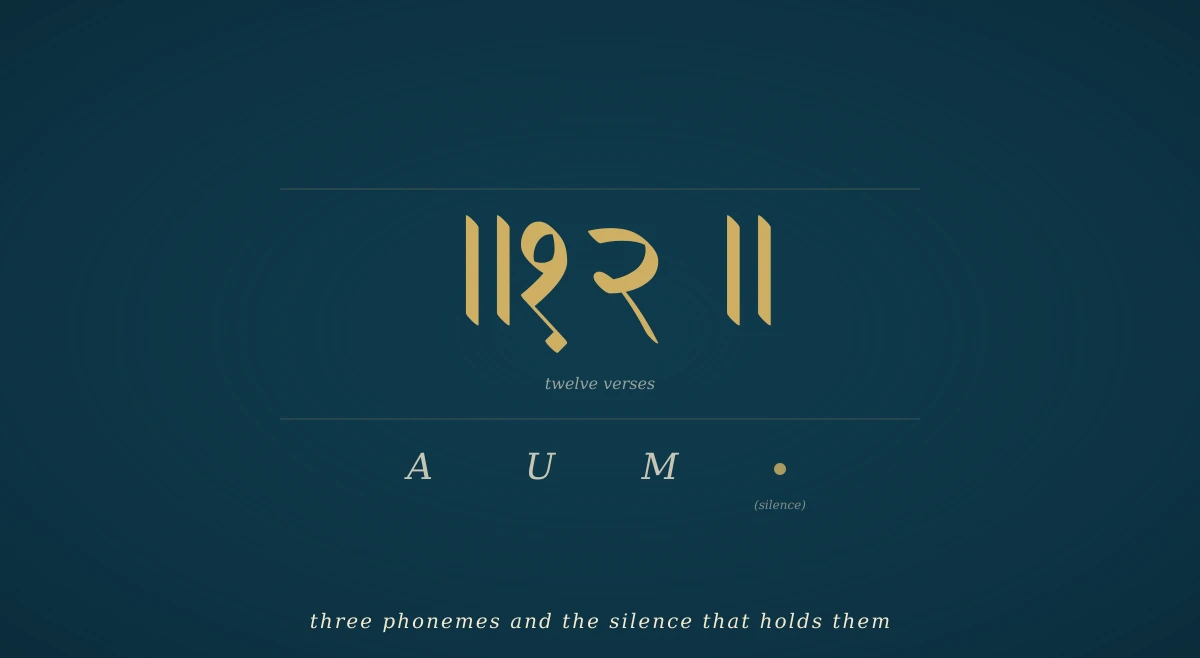
The Māṇḍūkya (माण्डूक्य) is the shortest of the “principal” Upaniṣads — twelve prose verses, no narrative, no dialogue, no mythology. It belongs to the Atharva Veda and was almost certainly composed in several stages between the late Vedic and early classical periods; its final form may be as late as the 1st century BCE.
What it does, in those twelve verses, is lay out a four-fold scheme of consciousness — waking, dreaming, deep sleep, and a fourth element behind them — each mapped to one phoneme of the primordial syllable AUM (ॐ). This page gives the twelve verses in English, with the Sanskrit terms kept inline on first use.
For the companion piece that reads this material against modern brain-state research, see The Architecture of Awareness.
A note on this translation
The English rendering below was produced for this site by Claude Opus, in October 2026, from the received Sanskrit text and keyed to Panos’s own Greek rendering of the twelve verses. It is a working translation for philosophical reading, not a critical edition. Where the Sanskrit is terse or ambiguous — and the Māṇḍūkya is unusually terse — the sense has been preferred over a word-for-word rendering, with the Sanskrit term given in brackets so the reader can check.
For a critical scholarly translation, the standard references are Patrick Olivelle, Upaniṣads (Oxford World’s Classics, 1996), and Swami Nikhilananda, The Māṇḍūkyopaniṣad with Gauḍapāda’s Kārikā and Śaṅkara’s Commentary (Advaita Ashrama, 1932).
A short glossary of recurring terms (Brahman, Ātman, Vaiśvānara, Taijasa, Prājña, Turīya and the rest) is at the Advaita Vedānta glossary.
Prelude: AUM
The traditional opening of the Upaniṣad frames everything that follows.
AUM (ॐ) is the whole. What was, what is, what will be — all of this is AUM. And whatever is beyond the three times, that too is AUM.
The syllable AUM is understood as having three audible components — A, U, M — plus a fourth, the silence that follows. The twelve verses below map these four components onto four states of consciousness.
The twelve verses
Verse 1
The whole of this is this Brahman (ब्रह्मन्, “the Absolute, the totality”). This Ātman (आत्मन्, “the Self”) is Brahman. This Ātman has four quarters (pādas, पाद — literally “feet”; here, aspects).
Verse 2 — the first quarter: waking
The first quarter is Vaiśvānara (वैश्वानर, “the one common to all people”) — the state of waking (jāgrat, जाग्रत्). Here consciousness (caitanya) is turned outward (bahiḥprajña). It has seven limbs (sapta-aṅga) and nineteen mouths (ekonaviṃśati-mukha). It enjoys gross objects (sthūla-bhuj).
Verse 3 — the second quarter: dreaming
The second quarter is Taijasa (तैजस, “the luminous one”, from tejas, “light / fire”) — the state of dreaming (svapna, स्वप्न). Here consciousness is turned inward (antaḥprajña). It has seven limbs and nineteen mouths. It enjoys subtle objects (pravivikta-bhuj).
Verse 4 — deep sleep
When the sleeper desires no desire (kāma, काम) and sees no dream, that is deep sleep (suṣupti, सुषुप्ति). The third quarter is Prājña (प्रज्ञा, “the knowing one”). Here consciousness has become one (ekī-bhūta); it is a dense mass of pure cognition (prajñāna-ghana). It consists of bliss (ānanda, आनन्द), it enjoys bliss (ānanda-bhuj), and its gateway is bliss (ānanda-mukha).
Verse 5
This is the Lord of All (sarvajña, सर्वज्ञ — “the All-Knower”). This is the Inner Ruler (antaryāmin, अन्तर्यामिन्). This is the womb of all (yoni, योनि — “source”) — that from which all beings arise (prabhava) and into which they dissolve (apyaya).
Verse 6 — the fourth
The fourth quarter — Turīya (तुरीय, “the fourth”) — is not the knowing of outer objects (bahiḥprajña), nor the knowing of inner (antaḥprajña), nor the knowing of both together, nor a mass of knowing (prajñāna-ghana), nor knowing (prajña), nor non-knowing (aprajña).
It is unseen (adṛṣṭa), cannot be dealt with (avyavahārya), cannot be grasped (agrāhya), has no distinguishing marks (alakṣaṇa), cannot be thought of (acintyā), cannot be designated (avyapadeśya).
Its essence is the sure sense of the one Self (ekātmapratyayasāra). The world of phenomena (prapañca, प्रपञ्च) is extinguished within it (prapañcopaśama). It is at peace (śāntā). It is good (śiva, शिव). It is non-dual (advaita, अद्वैत).
This is the Turīya. This is what one must come to know.
Verse 7
This one, who “sleeps” without alertness — the Prājña — is the Lord (Īśvara, ईश्वर) of all, the All-Knower (sarvajña), the Inner Ruler (antaryāmin), the source of all (yoni), the beginning (prabhava) and the end (apyaya) of all beings (bhūta).
Verse 8
Vaiśvānara, whose sphere is the waking world (jāgrat), has as its point of concentration the right eye (dakṣiṇākṣi).
Taijasa, whose sphere is the dream world (svapna), has as its point of concentration the mind (manas, मनस्) within the body.
Prājña, whose sphere is deep sleep (suṣupti), has as its point of concentration the heart (hṛdaya, हृदय).
Verse 9
The one who knows these — the sphere (sthāna) and the state (avasthā) — is not shaken (na kampate) by anything.
Verse 10
AUM is the Ātman in terms of its syllable-components (mātrā, मात्रा). The four states (avasthās) are the four components of the syllable: A, U, M, and the fourth — the unwritten silence (amātra, “without component”) that follows.
Verse 11
Vaiśvānara (waking / jāgrat) corresponds to A — the first component — through attainment (āpti) or being the first (āditvatva). One who knows this attains all desires (kāma) and becomes the first (ādi).
Taijasa (dream / svapna) corresponds to U — the second component — through elevation (utkarṣa) or being between (ubhayatva). One who knows this elevates the stream of knowledge; no one in his family is born who does not know Brahman.
Verse 12
Prājña (deep sleep / suṣupti) corresponds to M — the third component — through merging (miti) or measuring (apīti). One who knows this measures the whole and becomes the measure itself.
Turīya corresponds to no component (amātra). The fourth — without component (amātra), non-dual (advaita), at peace (śāntā), good (śiva) — is AUM itself. The Ātman, without doubt, is this. The one who knows (jñānin) enters the Ātman through the Ātman.
Why the text is so compact
A reader coming to the Māṇḍūkya for the first time is often surprised at how little is here. Twelve verses, no story, no character — not even a dialogue. The entire text can be read aloud in under three minutes.
The compactness is deliberate. The Māṇḍūkya was composed to be memorised and recited, and its structural claim is that the four states (plus the one behind them) are all there is to say about consciousness as a topology. The commentarial tradition (Gauḍapāda’s Kārikā, c. 6th century CE, and Śaṅkara’s commentary on both, c. 8th century CE) expands this handful of verses into a full-blown metaphysical system. The expansion is theirs. The verses themselves are the compact kernel.
For the modern reader interested in what the kernel does and does not commit to — and in how it maps against contemporary neuroscience — see the companion piece The Architecture of Awareness: The Māṇḍūkya Upaniṣad and the Mapping of Brain States.
Related reading on this site
- The Architecture of Awareness — the modern reading of the twelve verses, against Global Workspace Theory, predictive-processing accounts of REM, Integrated Information Theory, and the Default Mode Network research.
- Pañcakośa: Five Layers of Human Identity — the layered-self model from the same Advaita tradition.
- Category Errors of the Self — on adhyāsa (“superimposition”) and the modern self-model theory.
- Vivekacūḍāmaṇi — Śaṅkara’s extended systematic treatment of the material.
- Ashtāvakra Gītā — the most uncompromising statement of the same non-dual position.
- Advaita Vedānta glossary — every Sanskrit term on this page defined.
- Sources Library — the full set of primary-source guides.
← Back to the Ancient Sources, Modern Lens guide
More in this pillar
- The Neiye (內業): Inward Training
- Mencius and Haoran Zhi Qi: The "Flood-Like Qi"
- The Huangdi Neijing: Inner Canon of the Yellow Emperor
- Huangdi Neijing — Suwen 1–5: An Expanded Reading
- Enūma Eliš and the Emergence of Order
- Pneuma, Prana and the Breath Traditions
- The Architecture of Awareness: The Māṇḍūkya Upaniṣad and the Mapping of Brain States
- Pañcakośa: Five Layers of Human Identity, Read as a System Architecture
- Category Errors of the Self: Adhyāsa and the Modern Account of the Self-Model
- The Vivekacūḍāmaṇi: A Guided Reading of Śaṅkara's Crest-Jewel
- The Ashtāvakra Gītā: A Guided Reading of the Uncompromising Dialogue
- Advaita Vedānta Glossary
- Chinese Thought Glossary
The other pillars
Be first to know
The book is in its final editing stage. Leave your email and you will hear when it is ready.