Ancient Sources, Modern Lens·Primary source
Advaita Vedānta Glossary
An alphabetical glossary of the Sanskrit vocabulary of the Māṇḍūkya, Vivekacūḍāmaṇi and Ashtāvakra Gītā — each term in IAST, Devanāgarī and English.
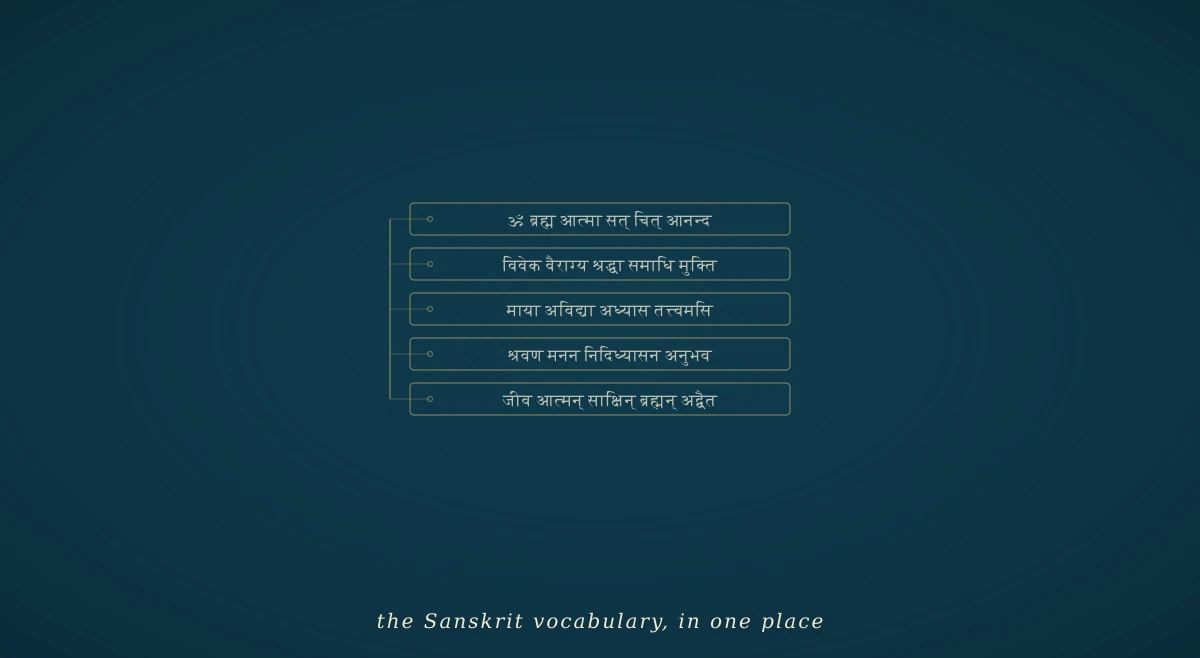
This is a working reference for the Sanskrit vocabulary used across the three Advaita Vedānta primary-source guides on this site: the Māṇḍūkya Upaniṣad, the Vivekacūḍāmaṇi, and the Ashtāvakra Gītā, together with the modern-reading pieces The Architecture of Awareness, Pañcakośa, and Category Errors of the Self: Adhyāsa.
Entries are alphabetical by their IAST transliteration (the standard scholarly romanisation of Sanskrit, with diacritics). Each term is given in IAST, Devanāgarī script, and English meaning, with a short note on how it functions in the system. Where a term is treated in depth in one of the pages above, the link follows the definition.
A short note on the alphabet: this glossary follows IAST ordering, which puts vowels first (A, Ā, I, Ī, U, Ū…) and treats ś and ṣ as separate letters. The usual English order would be scrambled, so a “find in page” is the fastest way to look something up.
A
Adhikāra (अधिकार). “Qualification, suitability” — the maturity of the student. Śaṅkara distinguishes three levels: Uttamādhikārin (exceptionally mature), Madhyamādhikārin (middling), Mandādhikārin (slow). The level determines how much practice is needed.
Adharma (अधर्म). The opposite of dharma — injustice, violation of order. Belongs to the mind (manas), not to the Ātman.
Adhyāsa (अध्यास). “Superimposition, mistaken identification” — the fundamental delusion according to Śaṅkara. We superimpose the Ātman onto the body (“I am sick”) and the body onto the Ātman (“the Ātman was born”). This mutual superimposition (itaretarādhyāsa) is saṃsāra itself. Resolved by jñāna. Treated in depth at Category Errors of the Self: Adhyāsa.
Advaita (अद्वैत). Literally “not-two”. Non-dualism — the teaching that reality is one and indivisible. There is no separation between Ātman and Brahman. The sense of separateness is māyā.
Advitīya (अद्वितीय). “Without a second” — an epithet of Brahman. There is nothing outside Brahman with which it could be compared or contrasted.
Āgāmikarma (आगामिकर्म). “Future karma” — actions that are to bear fruit in future births. For the Jīvanmukta, no new āgāmikarma accumulates.
Ahaṃkāra (अहङ्कार). “The I-maker” — the ego, the sense “I am this one” — the doer, the owner. Considered one of the deepest delusions covering the Ātman. In the Ashtāvakra: “it has bitten your mind like a venomous snake.”
Aham Brahmāsmi (अहं ब्रह्मास्मि). “I am Brahman” — the second of the four Mahāvākyas, from the Bṛhadāraṇyaka Upaniṣad. The most direct expression of Advaita.
Ajaḥ (अजः). “Unborn” — an epithet of Ātman. What was never born cannot die.
Ajñāna (अज्ञान). “Ignorance” — the cause of saṃsāra. Not mere lack of information, but the fundamental confusion that identifies the Ātman with body, mind and world. Opposite: jñāna.
Ākāśa (आकाश). “Ether / space” — the fifth of the pañcabhūta (five elements). Used as a classical metaphor for the Ātman: vast, unstained, pervading all without being affected. See Ghaṭākāśa / Mahākāśa.
Amṛta (अमृत). “Nectar of immortality” — literally “that which does not die” (a + mṛta). In the Ashtāvakra used metaphorically: the knowledge “I am not the doer” is amṛta.
Ānanda (आनन्द). “Bliss” — not pleasure dependent on external objects, but the intrinsic nature of the Ātman / Brahman. The third element of the triad Sat-Cit-Ānanda.
Ānandamaya Kośa (आनन्दमय कोश). “The sheath of bliss” — the fifth and subtlest of the five sheaths. Corresponds to the causal body (Kāraṇa Śarīra) and to deep sleep (suṣupti). In deep sleep, bliss is experienced, but veiled by ajñāna. The Ātman lies beyond this too. See Pañcakośa.
Ananta (अनन्त). “Infinite, without end” — an epithet of Ātman / Brahman. There is no boundary at which the Ātman ends and something else begins.
Anādyanta (अनाद्यन्त). “Without beginning or end” — an epithet of Brahman. From an + ādi (beginning) + anta (end).
Anātman (अनात्मन्). “The non-Ātman” — whatever is not the Self: body, mind, senses, experiences. Adhyāsa is the identification of Ātman with anātman.
Anirvacanīya (अनिर्वचनीय). “Indescribable, impossible to define” — the character of māyā: it is neither real (sat) nor unreal (asat). It escapes every logical category.
Annamaya Kośa (अन्नमय कोश). “The sheath of food” — the first and coarsest of the five sheaths. The physical body, which is born from food, lives on food and returns to earth. Corresponds to the Sthūla Śarīra. See Pañcakośa.
Anubhava (अनुभव). “Direct experience” — not second-hand knowledge. The final goal: not to understand that “Aham Brahmāsmi” but to directly live it. “The word ‘fire’ does not burn.”
Antaryāmin (अन्तर्यामिन्). “The inner ruler” — the one who dwells within every being and directs everything. An epithet of Prājña and of Brahman.
Artha (अर्थ). “Wealth, material pursuit” — one of the four puruṣārthas. In the Ashtāvakra, the Jīvanmukta is not bound by it.
Asaṅga (असङ्ग). “Without attachment” — the quality of the Muktātman. The liberated one does not stick to anything — not to objects, not to ideas, not to liberation itself.
Āśrama (आश्रम). The four stages of life: Brahmacarya (studentship), Gṛhastha (householder), Vānaprastha (withdrawal), Sannyāsa (renunciation). The Ātman exists in all four, unchanged.
Ātman (आत्मन्). “The Self” — not the ego or personality, but the pure consciousness that lies behind everything. In Advaita Vedānta, the Ātman is identical with Brahman.
AUM / OM (ॐ). The primordial syllable, the sound of creation. In the Māṇḍūkya, it symbolises four states of consciousness and the Ātman itself. It is composed of A (waking), U (dream), M (deep sleep), and the silent fourth (Turīya). See Māṇḍūkya Upaniṣad: Full Translation.
Avasthā (अवस्था). “State” — the four states of consciousness (jāgrat, svapna, suṣupti, turīya). The Ātman exists unchanged in all.
Āvaraṇa (आवरण). “Covering, veil” — the function of māyā that hides the Ātman. One of the three obstacles to jñāna (together with mala and vikṣepa). Resolved only by jñāna — not by karma or upāsanā.
Āvaraṇa-śakti (आवरणशक्ति). “The power of covering” of māyā — the one that hides the Ātman like a cloud hiding the sun. It does not change the Ātman; it just makes it invisible.
Avidyā (अविद्या). “Ignorance” — essentially a synonym for ajñāna, though avidyā often has the technical sense of the primordial ignorance that gives rise to the manifest world.
Avināśin (अविनाशिन्). “Indestructible” — an epithet of Brahman / Ātman. What has no beginning can have no end.
Ayam Ātmā Brahma (अयमात्मा ब्रह्म). “This Ātman is Brahman” — the fourth of the four Mahāvākyas, from the Māṇḍūkya Upaniṣad.
B
Bandha (बन्ध). “Bondage” — the state of being bound. Arises when the mind desires, grieves, avoids, accepts, rejoices or becomes angry. Alternatively: adhyāsa itself. Opposite: mukti.
Bhakti (भक्ति). “Devotion” — love and worship directed to the Divine. In the Vivekacūḍāmaṇi: helps to clear mala (moral impurity) but is not enough on its own for mukti.
Bheda (भेद). “Difference, separation” — the illusion that there are many separate beings. A product of māyā. The Jīvanmukta sees no bheda anywhere.
Bhrama (भ्रम). “Delusion, false perception” — as when one sees a snake in a rope or silver in a shell. The classical analogy for the way the jagat appears real because of ajñāna.
Bodha (बोध). “Awakening, consciousness” — pure knowing without an object. In the Ashtāvakra: “I am the sole pure Bodha.”
Brahman (ब्रह्मन्). “The Absolute” — the one, undivided, eternal reality. Not a personal god, but existence itself, consciousness itself, bliss itself (Sat-Cit-Ānanda). Whatever exists, is Brahman.
Brahmanubhava (ब्रह्मानुभव). “Direct experience of Brahman” — the final goal. Not an idea or belief, but living recognition. What the Vivekacūḍāmaṇi names as the only true outcome of practice.
Brahmavid (ब्रह्मविद्). “One who knows Brahman” — the truly enlightened. Not inflated by praise, not crushed by dishonour, does not fear death, sees the Ātman everywhere.
Brahman-vicāra (ब्रह्मविचार). “Inquiry into Brahman” — the direct examination “what am I?”. According to Śaṅkara, this — and not ritual or austerity — leads to jñāna.
Buddhi (बुद्धि). “Intellect, discrimination” — the higher mental function that decides and discriminates. Higher than manas. Corresponds to the Vijñānamaya Kośa. The instrument of manana — but not the Ātman.
C
Caitanya (चैतन्य). “Pure consciousness” — a synonym of Ātman as living, self-illuminating awareness. In the Ashtāvakra: “I am Caitanya — this is my mukti.”
Cit (चित्). “Consciousness, knowing” — the second element of the triad Sat-Cit-Ānanda. Pure, self-illuminating recognition of being. Illuminates the jagat without being affected by it.
Citta (चित्त). “Field of mind” — the totality of mental processes, memories, impressions. Distinct from Cit (pure consciousness): citta is an object, Cit is the observer.
D
Dama (दम). “Control of the senses” — the second of the six virtues (Ṣaṭsampat). While Śama concerns the mind, Dama concerns the indriyas (sense organs and organs of action).
Dayā (दया). “Compassion” — one of the virtues the Ashtāvakra names as amṛta for one who desires mukti.
Deha (देह). “Body” — the physical covering. In Advaita, the body is an object of observation, not the observer. The Ātman is not the body, but the one that illuminates it.
Dharma (धर्म). “Order, duty, righteousness” — one of the four puruṣārthas. Belongs to the mind (manas), not to the Ātman. The Jīvanmukta is not bound even by dharma.
Dhyāna (ध्यान). “Meditation” — the sixth of the eight limbs of Yoga. In the Ashtāvakra, Janaka says he has at last abandoned even this. See also Nididhyāsana.
Draṣṭā (द्रष्टा). “The seer” — a synonym for sākṣin. The Ātman as pure observation without identification with what is observed.
Duḥkha (दुःख). “Suffering, pain” — the opposite of sukha. The result of identification with the body (deha) and the sense-objects (viṣaya). Resolved by jñāna.
G
Ghaṭākāśa (घटाकाश). “The space inside the pot” — a metaphor for the Jīvātman (individual soul). It appears separate, but it is the same space as the Mahākāśa. The pot-space difference is māyā.
Guru (गुरु). “Teacher” — literally “heavy”, one who bears the weight of knowledge. In the Vivekacūḍāmaṇi: necessary for the transmission of knowledge, especially for śravaṇa. But in the Ashtāvakra: “you do not need a Guru” — for the mature.
H
Hṛdaya (हृदय). “Heart” — in the Māṇḍūkya, the point of concentration for Prājña (deep sleep). More broadly in the Upaniṣads, the seat of the inner self.
I
Indriya (इन्द्रिय). “Senses, sense organs” — five cognitive (hearing, touch, sight, taste, smell) and five of action. The Ātman is not the indriyas — it is the one that illuminates them.
Īśvara (ईश्वर). “Lord” — Brahman in relation to the world; the personal face of the Absolute. In Advaita, Īśvara is Brahman under the latent influence of māyā.
Itaretarādhyāsa (इतरेतराध्यास). “Mutual superimposition” — the technical term for the two-way adhyāsa: body onto Ātman and Ātman onto body. The complete form of the error.
J
Jāgrat (जाग्रत्). “Waking” — the first state of consciousness. Corresponds to the A of AUM and to the Sthūla Śarīra.
Jagat (जगत्). “Universe, world” — the whole of appearance. Arises in the Ātman, from the Ātman, dissolves into it. Like waves in the ocean.
Jīva (जीव). “Individual soul” — the Ātman identified with body and mind through adhyāsa. The difference between jīva and Ātman is māyā.
Jīvanmukta (जीवन्मुक्त). “Liberated while alive” — one who has attained mokṣa while still living. Sees the Ātman everywhere, is sama toward praise and blame, accumulates no new karma.
Jīvanmukti (जीवन्मुक्ति). “Liberation while alive” — the state of the Jīvanmukta. Leads at last to Videhamukti when the Prārabdhakarma is exhausted.
Jīvātman (जीवात्मन्). “The individual soul as Ātman” — the Ātman seemingly limited to the body. Like the Ghaṭākāśa — it appears separate, but is the same as the Paramātman.
Jñāna (ज्ञान). “Knowledge, illumination” — direct recognition of the identity Ātman–Brahman. Not acquired gradually: “the moment it arises, saṃsāra ends.” The only remedy for ajñāna.
Jñānendriya (ज्ञानेन्द्रिय). The five cognitive senses — part of the Sūkṣma Śarīra: hearing (śrotra), touch (tvak), sight (cakṣus), taste (rasanā), smell (ghrāṇa).
Jñānin (ज्ञानिन्). “One who possesses jñāna.” In the paradox of the Ashtāvakra: “neither Jñānin nor Ajñānin exists” — from the vantage of Turīya.
K
Kāma (काम). “Desire” — one of the four puruṣārthas. In the Ashtāvakra, even the desire for mokṣa (Mumukṣutā) is bandha.
Kāraṇa Śarīra (कारण शरीर). “Causal body” — the third and subtlest of the three bodies. Corresponds to deep sleep (suṣupti) and the Ānandamaya Kośa. The “cause” of the other two bodies; composed of pure ajñāna.
Karma (कर्म). “Action and its result” — the law of cause and effect. Feeds saṃsāra. Does not touch the Ātman. See Prārabdhakarma, Sañcitakarma, Āgāmikarma.
Karmendriya (कर्मेन्द्रिय). The five action senses — part of the Sūkṣma Śarīra: speech (vāk), hands (pāṇi), feet (pāda), reproduction (upastha), elimination (pāyu).
Kartā (कर्ता). “The doer” — the illusion that “I act”. Source of bandha. Opposite: Akartā.
Kośa (कोश). “Sheath, covering” — each of the five Pañcakośa that cover the Ātman. Literally: “sword-sheath” or “pollen-case”.
Kṣamā (क्षमा). “Tolerance” — one of the amṛta virtues of the Ashtāvakra.
M
Mahākāśa (महाकाश). “The vast space” — a metaphor for the Paramātman (Supreme Self). Ghaṭākāśa and Mahākāśa are one — as Jīvātman and Paramātman are.
Mahāvākyas (महावाक्य). The four “Great Sayings” of the Upaniṣads — the concentrated teaching of Advaita:
- Prajñānam Brahma — “Consciousness is Brahman” (Aitareya Upaniṣad)
- Aham Brahmāsmi — “I am Brahman” (Bṛhadāraṇyaka Upaniṣad)
- Tat tvam asi — “That you are” (Chāndogya Upaniṣad)
- Ayam Ātmā Brahma — “This Ātman is Brahman” (Māṇḍūkya Upaniṣad)
Mala (मल). “Impurity” — moral impurity of the mind (egoism, passions, desires). One of the three obstacles to jñāna. Resolved by karma (action / service) and bhakti (devotion).
Manas (मनस्). “Mind” — the intellectual function that thinks, hesitates, feels. Higher function: Buddhi. Field: Citta. Root: Ahaṃkāra.
Manana (मनन). “Reflection” — the second stage of practice after Śravaṇa. Systematic examination of the teaching with the Buddhi until every doubt (saṃśaya) is eliminated.
Manomaya Kośa (मनोमय कोश). “The sheath of the mind” — the third of the five sheaths. Composed of Manas and the Jñānendriyas. Thinks, desires, fears, dreams. Operates primarily in the Sūkṣma Śarīra.
Māyā (माया). “That which is not” — cosmic illusion. The śakti of Brahman that makes the One appear as many. Neither real (sat) nor unreal (asat) — anirvacanīya. Has two functions: Āvaraṇa-śakti and Vikṣepa-śakti.
Mokṣa (मोक्ष). “Liberation” — recognition that Ātman and Brahman are identical. Not a state that is attained — it is the recognition of what is always already true.
Mṛtyu (मृत्यु). “Death” — the Brahmavid does not fear it, because he knows that the Ātman is Avināśin.
Mukta (मुक्त). “The liberated one.” In the paradox of the Ashtāvakra: “neither Mukta exists” — because no one was ever bound.
Mukti (मुक्ति). “Liberation” — synonymous with Mokṣa. More common in the Ashtāvakra.
Mumukṣu (मुमुक्षु). “One who seeks Mukti” — the spiritual seeker.
Mumukṣutva (मुमुक्षुत्व). “The burning desire for Mukti” — the fourth of the Sādhanacatuṣṭaya. Without it, the other three qualifications lead nowhere.
N
Neti, Neti (नेति नेति). “Not this, not this” — Śaṅkara’s method of exclusion. You exclude everything that is not the Ātman, until what remains is what cannot be excluded — the Ātman itself. First appears in the Bṛhadāraṇyaka Upaniṣad (c. 7th c. BCE).
Nididhyāsana (निदिध्यासन). “Deep, continuous meditation” — the third stage of practice after Śravaṇa and Manana. Displaces old vāsanās with continuous vicāra until the knowledge becomes anubhava.
Nirañjana (निरञ्जन). “Unstained” — an epithet of the Ātman. As ether is not stained by clouds.
Nirākāra (निराकार). “Without form” — an epithet of Brahman / Ātman.
Nirguṇa (निर्गुण). “Without qualities” — an epithet of Brahman in its absolute aspect. Opposite: Saguṇa (“with qualities”), which corresponds to Īśvara.
Nirlipta (निर्लिप्त). “Unstained, with nothing adhering” — the Ātman does not “stick” to karma, vāsanā or citta.
Nirvāṇa (निर्वाण). “Extinguishing” — the extinction of false identification. Used in the Ashtāvakra interchangeably with Mukti.
Nirvikāra (निर्विकार). “Unchanging” — an epithet of the Ātman. Changes (vikāra) belong to Prakṛti.
Nirvikalpa (निर्विकल्प). “Without distinctions, without thoughts” — the state of pure consciousness without content. In the Ashtāvakra: “rest in Śūnya, in Nirvikalpa consciousness.”
Nitya (नित्य). “Eternal” — an epithet of Ātman / Brahman. Opposite: Anitya (क्षणिक, transient).
P
Pādas (पाद). “The four quarters” of the Ātman — four states of consciousness. Literally “feet”, used in the Upaniṣads for aspects.
Pañcabhūta (पञ्चभूत). “The five elements”: earth (pṛthvī), water (jala), fire (agni), air (vāyu), ether (ākāśa). Compose the material world — but not the Ātman.
Pañcakośa (पञ्चकोश). “The five sheaths” that cover the Ātman like layers of an onion: Annamaya, Prāṇamaya, Manomaya, Vijñānamaya, Ānandamaya Kośa. None is the Ātman — the Ātman is the Sākṣin of all. See Pañcakośa: Five Layers of Human Identity.
Paramārtha (परमार्थ). “The ultimate truth” — what is true from the absolute vantage. Opposite: Vyavahāra (the conventional truth of everyday experience).
Paramātman (परमात्मन्). “The Supreme Self” — Brahman as Ātman. The Ghaṭākāśa (Jīvātman) and the Mahākāśa (Paramātman) are one.
Pariṇāma (परिणाम). “Real transformation” — the theory that Brahman actually changes in order to produce the world. Śaṅkara rejects it: he uses Vivartavāda instead.
Prakāśa (प्रकाश). “Light” — the Ātman as self-illuminating consciousness.
Prakṛti (प्रकृति). “Nature, matter” — the dynamic, changing element. Changes (vikāra) belong to Prakṛti, not to the Ātman.
Prājña (प्रज्ञा). “The knowing one” — the third state of consciousness (deep sleep / suṣupti). A dense mass of pure cognition, but veiled by ajñāna.
Prajñānam Brahma (प्रज्ञानं ब्रह्म). “Consciousness is Brahman” — the first of the four Mahāvākyas, from the Aitareya Upaniṣad.
Prāṇa (प्राण). “Vital energy / breath” — five forms: Prāṇa (inhalation / head), Apāna (exhalation / lower body), Vyāna (diffusion), Udāna (upward), Samāna (digestion). Compose the Prāṇamaya Kośa. See also Pneuma, Prana and the Breath Traditions.
Prāṇamaya Kośa (प्राणमय कोश). “The sheath of vital energy” — the second of the five sheaths. Composed of the five prāṇas. What breathes, moves, warms.
Prārabdhakarma (प्रारब्धकर्म). “Karma that has already begun to bear fruit” — what has determined the current birth and cannot be avoided. Even the Jīvanmukta carries Prārabdhakarma — which is why he continues to live after awakening. When it is exhausted, Videhamukti comes. See also Sañcitakarma, Āgāmikarma.
Prapañca (प्रपञ्च). “The world of phenomena” — the multiplicity, the extension. In Turīya, it “extinguishes” — is recognised as Brahman.
Prasāda (प्रसाद). “Grace, blessing” — the grace that allows the acquisition of rare qualifications (human birth, mumukṣutva, Guru).
Pratibimba (प्रतिबिम्ब). “Reflection” — a metaphor for the jagat: it appears in the Ātman without the Ātman changing.
Puruṣārthas (पुरुषार्थ). The four aims of life: Dharma, Artha, Kāma, Mokṣa. The Jīvanmukta transcends all four.
S
Sādhanacatuṣṭaya (साधनचतुष्टय). “The four qualifications” of the seeker: Viveka, Vairāgya, Ṣaṭsampat, Mumukṣutva. Defined in the Vivekacūḍāmaṇi as prerequisites for jñāna.
Sākṣin (साक्षिन्). “Witness, observer” — the Ātman as pure observation. “This is your only chain: you see yourself as other than the Sākṣin.”
Sama (सम). “Equal, indifferent” — the state of the Jīvanmukta toward opposites.
Samādhāna (समाधान). “Concentration, focus” — the sixth of the Ṣaṭsampat. The ability to keep the mind steadily on the practice.
Samādhi (समाधि). “Deep absorption” — a state in which observer, observation and observed become one. The Jīvanmukta remains in samādhi even in the midst of activity.
Saṃsāra (संसार). “The cycle of birth and death” — fed by karma and ajñāna. Ends with jñāna.
Sañcitakarma (सञ्चितकर्म). “The accumulated karma of many lives” — destroyed by jñāna. Different from Prārabdhakarma, which cannot be avoided.
Santoṣa (सन्तोष). “Contentment” — one of the amṛta virtues of the Ashtāvakra.
Sat (सत्). “Existence, Being” — the first element of the triad Sat-Cit-Ānanda. What always is, without beginning or end.
Sat-Cit-Ānanda (सच्चिदानन्द). “Existence–Consciousness–Bliss” — the triple nature of Brahman: an indivisible reality described from three angles.
Satya (सत्य). “Truth” — an amṛta virtue, but also the absolute reality of Brahman.
Śama (शम). “Calming of the mind” — the first of the Ṣaṭsampat. The ability to keep the mind calm and focused, away from the sense-objects (viṣaya).
Śāstra (शास्त्र). “Sacred scripture” — Vedas, Upaniṣads, Brahma Sūtras etc. In the Ashtāvakra: “you do not need Śāstra.” In the Vivekacūḍāmaṇi: necessary but not sufficient.
Śānta (शान्त). “At peace” — an epithet of the Ātman and of the Jīvanmukta.
Śānti (शान्ति). “Peace” — the natural state of the Ātman.
Śarīratraya (शरीरत्रय). “The three bodies” — the teaching of the Vivekacūḍāmaṇi: Sthūla Śarīra, Sūkṣma Śarīra, Kāraṇa Śarīra. None is the Ātman.
Ṣaṭsampat (षट्सम्पत्). “The six virtues” — the third qualification of the Sādhanacatuṣṭaya: Śama, Dama, Uparati, Titikṣā, Śraddhā, Samādhāna.
Śiva (शिव). “The good, the perfect” — an epithet of the Ātman / Brahman. In the Māṇḍūkya: Turīya is śiva.
Śoka (शोक). “Sorrow” — a product of ajñāna. “Know this and be free from śoka.”
Śraddhā (श्रद्धा). “Faith, trust” — the fifth of the Ṣaṭsampat. Not blind faith, but trust in the teaching and the Guru sufficient to practise it before verifying it.
Śravaṇa (श्रवण). “Hearing” — the first stage of practice. Hear the teaching “Tat tvam asi” from a reliable Guru. Living transmission is necessary.
Śuddha (शुद्ध). “Pure” — an epithet of the Ātman. Not stained by karma or experiences.
Śūnya (शून्य). “Empty” — the Nirvikalpa consciousness without content. Not nihilism — it is fullness without an object.
Sukha (सुख). “Bliss, happiness” — opposite of duḥkha. The intrinsic nature of the Ātman.
Suṣupti (सुषुप्ति). “Deep sleep” — the third state of consciousness. Corresponds to the M of AUM and to the Kāraṇa Śarīra.
Sūkṣma Śarīra (सूक्ष्म शरीर). “Subtle body” — composed of 19 elements: 5 Prāṇas, 5 Jñānendriyas, 5 Karmendriyas, Manas, Buddhi, Citta, Ahaṃkāra. Wanders in dreams, carries vāsanās.
Svabhāva (स्वभाव). “Intrinsic nature.” “I am Svabhāva — neither Kartā nor Bhoktā.”
Svapna (स्वप्न). “Dream” — the second state of consciousness. Corresponds to the U of AUM and to the Sūkṣma Śarīra.
Svarūpa (स्वरूप). “True nature” — what one is (sva = own, rūpa = nature). The Jīvanmukta dwells in his Svarūpa.
T
Taijasa (तैजस). “The luminous one” — consciousness in dream (svapna). Creates internal objects from its own light (tejas).
Tapas (तपस्). “Austerity” — literally “heat”. In the Ashtāvakra: “you do not need Tapas.”
Tat tvam asi (तत्त्वमसि). “That you are” — the third of the four Mahāvākyas, from the Chāndogya Upaniṣad. Identifies the Ātman (you) with Brahman (That).
Tattva (तत्त्व). “Truth, ‘that-ness’” — the essence, the true nature.
Titikṣā (तितिक्षा). “Endurance” — the fourth of the Ṣaṭsampat. The ability to endure opposites (cold / heat, pain / pleasure, honour / dishonour) without being disturbed.
Turīya (तुरीय). “The fourth” — the base of all states. Pure consciousness that observes without moving. Identical with Ātman and Brahman.
U
Upaniṣads (उपनिषद्). “Sit near” — the esoteric teachings from teacher to student. The culmination of the Vedas (Vedānta).
Uparati (उपरति). “Withdrawal” — the third of the Ṣaṭsampat. Withdrawal from external actions and rituals that no longer serve jñāna. The mind stops seeking external satisfaction.
Upāsanā (उपासना). “Meditation / worship” — helps to clear Vikṣepa (dispersion). One of the three obstacles resolved by it.
V
Vaiśvānara (वैश्वानर). “The one common to all” — consciousness in waking (jāgrat). Corresponds to the A of AUM.
Vairāgya (वैराग्य). “Detachment” — natural recognition that the viṣayas are not worth the investment. Together with jñāna, the two wings of Mukti.
Vāsanā (वासना). “Latent impressions” — the “traces” of experiences that feed saṃsāra. Do not touch the Ātman.
Vedānta (वेदान्त). “The end of the Vedas” — the Upaniṣads and the philosophy founded on them.
Vicāra (विचार). “Inquiry” — the continuous examination “what am I?”. Instrument of Nididhyāsana.
Videhamukti (विदेहमुक्ति). “Liberation after the dissolution of the body” — when the Prārabdhakarma is exhausted. The Jīvātman does not return; it dissolves into the Paramātman as a river into the ocean.
Vijñānamaya Kośa (विज्ञानमय कोश). “The sheath of discrimination” — the fourth of the five sheaths. Composed of Buddhi and the Jñānendriyas. Judges, decides — what thinks “I am the doer.” See Pañcakośa.
Vikāra (विकार). “Changes” — belong to Prakṛti. The Ātman is Nirvikāra.
Vikṣepa (विक्षेप). “Dispersion of the mind” — inability to concentrate. One of the three obstacles. Resolved by upāsanā.
Vikṣepa-śakti (विक्षेपशक्ति). “The projective power” of māyā — projects the jagat as if it were independent. The shadow of the sun thinking it is autonomous.
Viṣaya (विषय). “Objects of the senses.” “Avoid them like poison if you desire Mukti.”
Viśrānti (विश्रान्ति). “Rest in the Ātman.” “Strong is one who is in Viśrānti in the Ātman.”
Viveka (विवेक). “Discrimination” — the ability to distinguish the eternal (nitya) from the transient (anitya), the Ātman from the anātman. First of the four qualifications (Sādhanacatuṣṭaya) and the title-word of the Vivekacūḍāmaṇi.
Vivartavāda (विवर्तवाद). “The theory of apparent appearance” — Śaṅkara’s cornerstone move: the jagat is not really produced from Brahman (pariṇāma) — it merely appears (vivarta). As the rope does not really become a snake.
Related reading on this site
Primary-source translations:
- Māṇḍūkya Upaniṣad: Full Translation of the Twelve Verses
- Vivekacūḍāmaṇi: A Guided Reading
- Ashtāvakra Gītā: A Guided Reading
Modern readings of the same material:
- The Architecture of Awareness: The Māṇḍūkya and the Mapping of Brain States
- Pañcakośa: Five Layers of Human Identity
- Category Errors of the Self: Adhyāsa and the Modern Self-Model
Comparative:
- Pneuma, Prana and the Breath Traditions — on the breath vocabulary (prāṇa) that recurs across traditions.
- Chinese Thought: Glossary — the companion glossary for the Chinese sources on this site.
- Sources Library — the full set of primary-source guides.
← Back to the Ancient Sources, Modern Lens guide
More in this pillar
- The Neiye (內業): Inward Training
- Mencius and Haoran Zhi Qi: The "Flood-Like Qi"
- The Huangdi Neijing: Inner Canon of the Yellow Emperor
- Huangdi Neijing — Suwen 1–5: An Expanded Reading
- Enūma Eliš and the Emergence of Order
- Pneuma, Prana and the Breath Traditions
- The Architecture of Awareness: The Māṇḍūkya Upaniṣad and the Mapping of Brain States
- Pañcakośa: Five Layers of Human Identity, Read as a System Architecture
- Category Errors of the Self: Adhyāsa and the Modern Account of the Self-Model
- The Māṇḍūkya Upaniṣad: Full Translation of the Twelve Verses
- The Vivekacūḍāmaṇi: A Guided Reading of Śaṅkara’s Crest-Jewel
- The Ashtāvakra Gītā: A Guided Reading of the Uncompromising Dialogue
- Chinese Thought Glossary
The other pillars
Be first to know
The book is in its final editing stage. Leave your email and you will hear when it is ready.