Ancient Sources, Modern Lens·Primary source
The Architecture of Awareness: The Māṇḍūkya Upaniṣad and the Mapping of Brain States
Twelve Sanskrit verses, probably composed before 100 BCE, mapped waking, dreaming, deep sleep and a fourth "invariant" state. The modern neuroscience lines up.
Human awareness is not continuous. It changes state several times a day — through waking, dreaming and dreamless sleep — and whatever consciousness is, it is at least this: something that moves between distinct functional modes.
The modern vocabulary for these modes is clinical: wakefulness, REM sleep, NREM slow-wave sleep, each with an EEG signature and a polysomnography score. The earliest known attempt to map the same modes systematically, as a complete functional topology rather than as a list, is a short Sanskrit text of twelve verses, probably composed between the 6th and 1st centuries BCE: the Māṇḍūkya Upaniṣad.
This article is about what the Māṇḍūkya saw, what modern neuroscience has since filled in, and where the honest line falls between structural convergence and metaphysical overreach.
1. What the text is, and what it does
The Māṇḍūkya is the shortest of the “principal” Upaniṣads — twelve prose verses, no narrative, no dialogue, no mythology. It belongs to the Atharva Veda and was almost certainly composed in several stages between the late Vedic and early classical periods; its final form may be as late as the 1st century BCE.
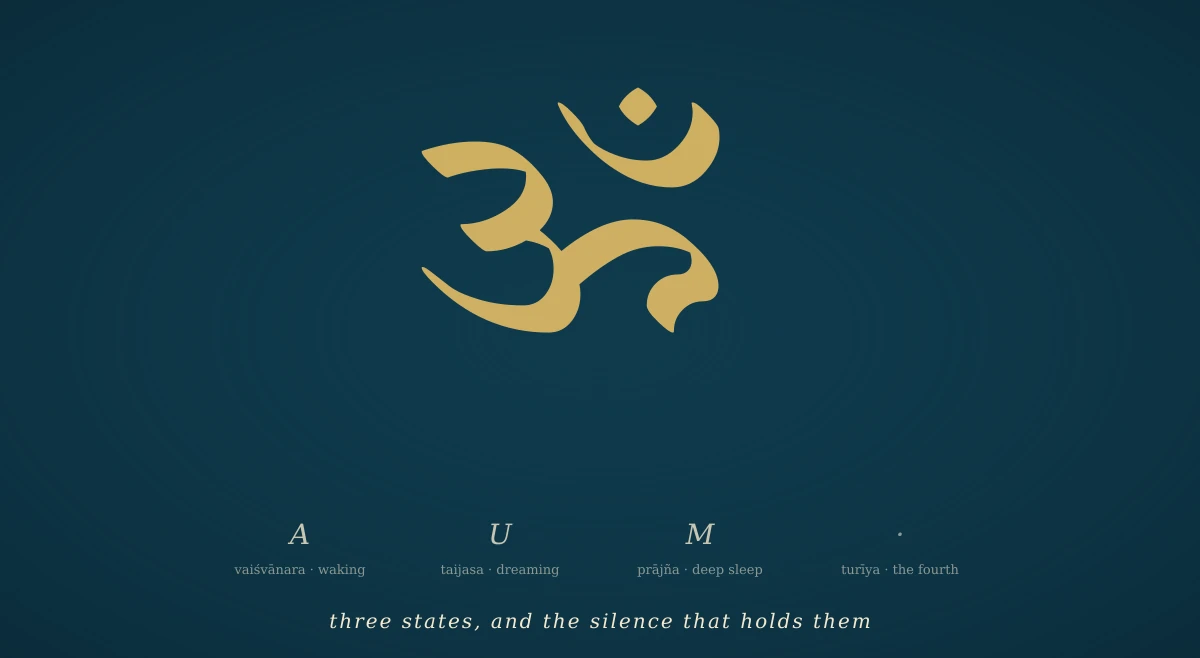
What it does, in those twelve verses, is lay out a four-fold scheme of consciousness, each mode mapped to one phoneme of the primordial syllable AUM (ॐ). The scheme is tight enough to be read as a block diagram and old enough to predate every modern language it is usually translated into.
The four modes (avasthās, “states”):
| State | Sanskrit name | Everyday mode | AUM phoneme |
|—|—|—|—|
| 1 | Vaiśvānara (vaiśvānara) | Waking (jāgrat) | A |
| 2 | Taijasa (taijasa) | Dreaming (svapna) | U |
| 3 | Prājña (prājña) | Deep dreamless sleep (suṣupti) | M |
| 4 | Turīya (turīya, “the fourth”) | — | the silence after M |
The fourth is the surprise, and this article will come back to it. The first three correspond, in rough and not-exact terms, to three distinct neurophysiological regimes that modern sleep science has independently identified over the last seventy years. The surprise is less that the categories match (they roughly do), and more that the Māṇḍūkya treats them as one map, with a fourth element behind them.
2. The four states, as the text describes them
Vaiśvānara — waking
Consciousness is directed outward (bahiḥ-prajña). It interacts with the “coarse” physical world through what the text calls nineteen mouths (ekonaviṃśati-mukha): the five sense-organs (eye, ear, nose, tongue, skin), the five organs of action (hand, foot, speech, excretion, generation), the five vital breaths (prāṇas), and the four internal mental functions (manas, buddhi, citta, ahaṃkāra).
In modern terms: the full multi-modal sensorium, coupled to the environment through sensory and motor channels, with an internal self-monitoring system layered on top.
The point of the “nineteen mouths” is not the exact count. It is that the waking mind is a networked system with many open channels.
Taijasa — dreaming
Consciousness turns inward (antaḥ-prajña). The external sensory channels are gated off, but the system keeps running: it operates on subtle internal representations, built from memory traces (vāsanās), lit by its own light (tejas, hence the name taijasa, “the luminous one”).
In modern terms: an internally generated simulation, decoupled from live sensory input but running on the same cortical hardware. The brain in REM sleep is doing most of what it does when awake, but with the external channels closed.
Prājña — deep dreamless sleep
The internal projections also stop. Desires, images, sensory distinctions all collapse. What remains is a dense, undifferentiated mass of potential awareness (prajñāna-ghana), undisturbed by content.
The text’s word for the experience is ānanda — usually translated “bliss”, but better rendered as the absence of friction. The system is not experiencing anything; it is also not in distress. It is at rest, with the capacity intact.
In modern terms: NREM Stage 3 slow-wave sleep. Highly synchronised, low-complexity, low-information — but still clearly alive.
Turīya — “the fourth”
This is the part that does not have a clean neurophysiological equivalent, and the Māṇḍūkya is careful about what it says.
Turīya is not a fourth state alongside the other three. The text is explicit: it is neither outward-directed nor inward-directed, neither knowledge nor ignorance (acintyā, avyapadeśya). It is the invariant background against which the other three alternate — the capacity for awareness that is present in each of them without being any of them.
The best modern analogy is a display screen. The screen can show a storm, an equation, or complete darkness. The images come and go; the pixels do not. Turīya is the pixel.
Whether that pixel is anything more than the biological substrate of a working brain is the question the Māṇḍūkya’s later commentators spent fourteen hundred years arguing about. We will come back to that.
3. Where modern neuroscience converges with the map
Three well-established frameworks in contemporary consciousness research line up, with striking neatness, against the Māṇḍūkya’s first three states.
Waking: Global Workspace Theory (Baars, Dehaene)
The dominant working model of waking consciousness is the Global Workspace Theory of Bernard Baars (1988) and Stanislas Dehaene (2014). It describes the waking brain as a competition of localised specialist modules — visual, auditory, somatosensory, motor, memory — most of them processing in parallel, mostly unconscious.
An item becomes conscious when it wins access to a “global workspace” and is broadcast across the cortex, making it available to language, memory, and planning simultaneously. The capacity bottleneck of consciousness (we can only hold a few items at a time) is explained by this competition.
Mapped onto the Māṇḍūkya: the specialist modules are the nineteen mouths. The global workspace is the integrated reportable state of Vaiśvānara.
Dreaming: predictive processing and REM (Hobson, Friston)
Under the predictive-processing frame (Karl Friston, Andy Clark, Jakob Hohwy), the brain is an active inference engine. It does not passively receive sensory data; it generates predictions about what it expects to see, hear and feel, and compares those predictions against sensory input.
In REM sleep, the external sensory input is gated off at the thalamus. The generative model, free of correction, runs on its own — producing the vivid, narrative, often bizarre internal simulations we call dreams. The content is drawn from stored priors; the simulator is the same cortical machinery that handles perception when awake.
Mapped onto the Māṇḍūkya: the generative model is Taijasa, running on memory traces (vāsanās), lit “by its own light”.
Deep sleep: Integrated Information Theory and slow-wave N3 (Tononi)
Giulio Tononi’s Integrated Information Theory (IIT) quantifies consciousness by a measure Φ (phi) — roughly, the amount of information generated by the system as a whole that exceeds the sum of its parts.
During deep NREM slow-wave sleep (Stage 3), the cortical EEG shifts to massive, synchronised slow delta oscillations (<1 Hz). Local modules fire together in rigid unison. Because local differentiation collapses, Φ drops sharply, even though neural connectivity remains fully intact. The system is still alive and processing basics; it is just not generating integrated information at the level that corresponds to subjective experience.
Mapped onto the Māṇḍūkya: a high-coherence, low-complexity, low-content state — exactly the “unified mass” (prajñāna-ghana) of Prājña.
A visual
+----------------------------------------------------------------+
|                 MĀṆḌŪKYA        <->       MODERN FRAME         |
+----------------------------------------------------------------+
|   Vaiśvānara (waking)       Global Workspace Theory            |
|                             - specialist modules compete       |
|                             - winner is broadcast cortex-wide  |
|                                                                |
|   Taijasa (dreaming)        Predictive processing in REM       |
|                             - sensory channels gated           |
|                             - generative model runs on priors  |
|                                                                |
|   Prājña (deep sleep)       NREM slow-wave / low Φ             |
|                             - synchronised delta oscillations  |
|                             - low differentiation, no content  |
|                                                                |
|   Turīya ("the fourth")     [no clean equivalent — section 5]  |
+----------------------------------------------------------------+
The convergence on the first three is not a vindication of the ancient text as physics. The Māṇḍūkya was not doing physics. It was doing phenomenology — careful first-person observation of the actual, repeatable transitions a mind goes through every twenty-four hours. The convergence is evidence that if you look carefully enough at the inside of a brain, the categories you end up with are not infinitely many; the brain has a limited number of modes, and both traditions found them.
4. Turīya: what the text actually claims, and what it does not
The fourth element is where the text takes a step that neuroscience cannot presently take with it, and where honest reading matters most.
What the Māṇḍūkya does claim
Three things.
(i) That the three states alternate against a continuous substrate. You do not experience waking, dreaming and deep sleep as three isolated universes; there is a thread of sameness that lets you remember, on waking, that you slept, and that you dreamt. The text calls this thread Turīya.
(ii) That this substrate is not another state. Turīya is not something you can enter alongside waking, dreaming and deep sleep. If it were, there would be a fifth. It is specifically the invariant in the three.
(iii) That awareness, as a capacity, is more fundamental than any particular content of awareness. The screen is older than any image on it.
What later commentators claimed, and what the text does not say
Gauḍapāda (c. 6th c. CE) and Śaṅkara (c. 8th c. CE) built on the Māṇḍūkya a full-blown non-dualist metaphysics: that Turīya is identical with Brahman, the ground of all being; that it is uncreated and immortal; that the apparent individual self (jīva) that persists across births is in reality this invariant awareness, misidentified with transient bodies and minds.
This is a theological claim, not a reading of the text. The twelve verses themselves do not say the fourth is immortal, do not say it survives physical death, and do not identify it with any cosmic principle. They say it is the invariant background of the three ordinary states, and they stop there.
The site’s position:
- Turīya as the invariant integrative capacity of a working brain, present in all three functional modes — this is a careful phenomenological observation, and it does not require any metaphysics beyond “the brain is still a brain across state transitions”.
- Turīya as a free-standing immaterial entity that persists after the brain stops — this is a theological extension that neither the twelve verses nor any modern evidence supports.
The distinction matters because the two readings have been fused in most English-language presentations of Advaita Vedānta for a century. The text is more conservative than its commentators. The modern reader does not have to accept the metaphysics to accept the map.
5. The dynamic question — why the Default Mode Network matters
A piece of modern evidence makes the Māṇḍūkya’s fourth element more interesting, not less.
The Default Mode Network (DMN) — identified in the early 2000s by Marcus Raichle and colleagues — is a set of brain regions (medial prefrontal cortex, posterior cingulate, angular gyrus, precuneus and others) that are active when you are not doing a task. It generates autobiographical thought, future projection, self-referential narrative, mental time travel. It is, in rough terms, the brain’s self-model generator.
Two findings matter here.
(i) DMN activity drops in deep meditation. Judson Brewer and colleagues (PNAS, 2011; and subsequent work) have shown that experienced meditators show reduced DMN activation, particularly in the posterior cingulate cortex, during focused-attention and open-monitoring practice. The narrative-self machinery quiets down.
(ii) The subjective experience during such states is not blankness. Practitioners report the absence of the narrating self, with awareness still present. Not nothing; something, with the usual content stripped out.
This is the clearest modern operational handle on what the Māṇḍūkya pointed to with Turīya: a functional state in which the narrative content of awareness is dropped but the capacity for awareness is not. The three ordinary states (waking, dreaming, deep sleep) each have characteristic content; this is awareness with the content machinery turned down.
It is not evidence of an immaterial soul. It is evidence that the capacity for conscious integration can be partially decoupled from the narrative-self machinery that usually overlays it — which is interesting, and consistent with the text, and a long way from vindicating the metaphysics the text’s commentators later built on top.
6. Where the boundary sits
What is established
- Sleep science has independently identified three broadly distinct neurophysiological regimes (waking, REM, NREM slow-wave), characterised by different EEG signatures and different functional capacities.
- The Global Workspace framework (Baars, Dehaene), predictive-processing accounts of REM dreaming (Hobson, Friston), and Integrated Information Theory (Tononi) are the current major theoretical frames for these three regimes.
- Default Mode Network activity drops in experienced meditators during attention-based practices, and this is replicable (Brewer et al., 2011 onward).
What is the reading on this site
- That the Māṇḍūkya Upaniṣad’s four-fold scheme (Vaiśvānara, Taijasa, Prājña, Turīya) is best understood as an early, phenomenologically careful functional map of human brain-state topology.
- That the convergence between its first three states and the three modern frameworks is a convergence of structural description, not an anticipation of modern physics.
- That the fourth element (Turīya) is a reasonable observation about the invariant integrative capacity of a working brain, and does not require — and the text itself does not claim — the metaphysical commitments that later commentators (Gauḍapāda, Śaṅkara) built on top of it.
- That the practical interest of the fourth, once stripped of metaphysics, is empirical: there are measurable states in which the narrative-self machinery quiets while basic awareness remains, and the modern DMN research has begun to characterise them.
The ancient phenomenologists did not need instruments to map the architecture of mind. They had an instrument the modern lab is still catching up with: trained, non-reactive first-person attention, applied repeatedly, over generations, with the discipline not to over-interpret what it found.
Primary references and further reading
The primary text
- The Māṇḍūkya Upaniṣad, with Gauḍapāda’s Kārikā and Śaṅkara’s commentary. English translation: Swami Nikhilananda, The Mandukyopanishad with Gaudapada’s Karika and Shankara’s Commentary (Advaita Ashrama, 1932). More recent: Patrick Olivelle, Upaniṣads (Oxford World’s Classics, 1996) — a careful, non-sectarian translation.
On the brain-state frameworks
- Dehaene, S. (2014). Consciousness and the Brain: Deciphering How the Brain Codes Our Thoughts. Viking.
- Tononi, G. (2004). “An information integration theory of consciousness.” BMC Neuroscience 5:42.
- Friston, K. (2010). “The free-energy principle: a unified brain theory?” Nature Reviews Neuroscience 11(2), 127–138.
- Hobson, J. A., & Friston, K. J. (2012). “Waking and dreaming consciousness: Neurobiological and functional considerations.” Progress in Neurobiology 98(1), 82–98.
On the DMN and meditation
- Raichle, M. E., et al. (2001). “A default mode of brain function.” PNAS 98(2), 676–682.
- Brewer, J. A., et al. (2011). “Meditation experience is associated with differences in default mode network activity and connectivity.” PNAS 108(50), 20254–20259.
Related reading on this site
- Pañcakośa: Five Layers of Human Identity, as a System Architecture — the companion piece on the layered-self model from the same Vedāntic tradition.
- Category Errors of the Self — the companion piece on Adhyāsa and predictive processing.
- Dissipative Structures Explained — on why the “capacity for awareness” has a physical cost, and depends on continuous metabolic flow.
- Pneuma, Prana and the Breath Traditions — on how the ancient traditions found a lever on this architecture via the breath.
- Sources Library — the full set of primary-source guides.
← Back to the Ancient Sources, Modern Lens guide
More in this pillar
- The Neiye (內業): Inward Training
- Mencius and Haoran Zhi Qi: The "Flood-Like Qi"
- The Huangdi Neijing: Inner Canon of the Yellow Emperor
- Huangdi Neijing — Suwen 1–5: An Expanded Reading
- Enūma Eliš and the Emergence of Order
- Pneuma, Prana and the Breath Traditions
- Pañcakośa: Five Layers of Human Identity, Read as a System Architecture
- Category Errors of the Self: Adhyāsa and the Modern Account of the Self-Model
- The Māṇḍūkya Upaniṣad: Full Translation of the Twelve Verses
- The Vivekacūḍāmaṇi: A Guided Reading of Śaṅkara's Crest-Jewel
- The Ashtāvakra Gītā: A Guided Reading of the Uncompromising Dialogue
- Advaita Vedānta Glossary
- Chinese Thought Glossary
The other pillars
Be first to know
The book is in its final editing stage. Leave your email and you will hear when it is ready.