Ancient Sources, Modern Lens·Primary source
Pañcakośa: Five Layers of Human Identity, Read as a System Architecture
Ādi Śaṅkara's 8th-century Vivekacūḍāmaṇi lays out a stack-of-layers model of the human being, with a diagnosis of the central error that follows from it.
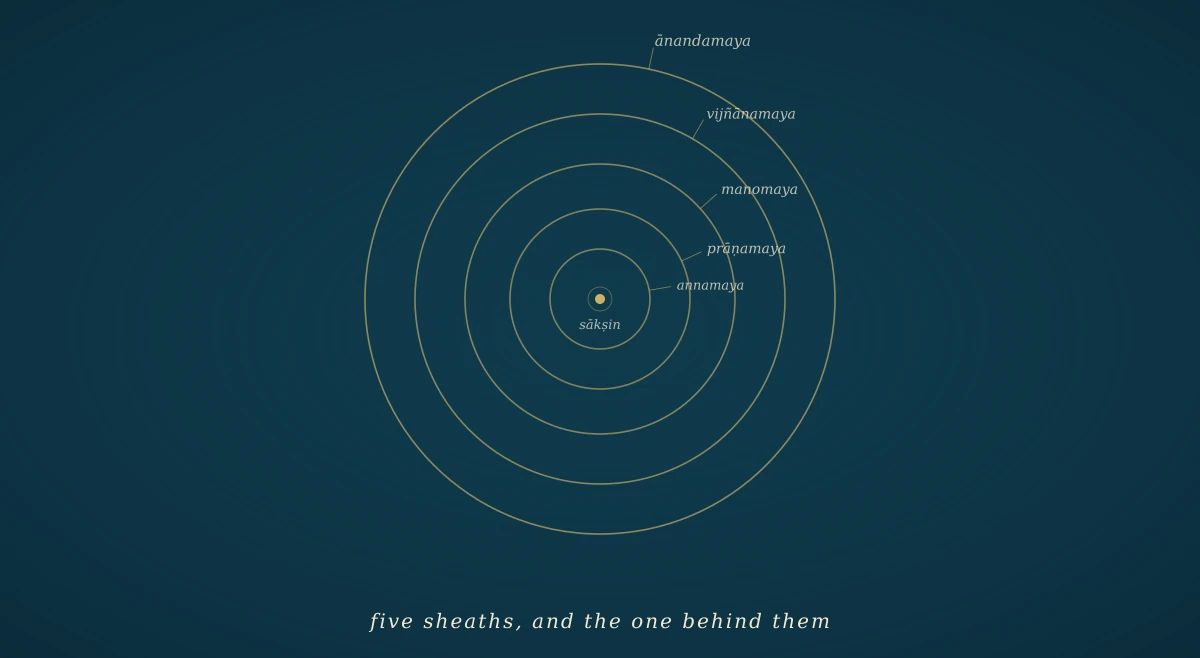
A long tradition in software and systems engineering reads complex objects as stacks of layers: physical hardware at the bottom, electrical signals above it, data protocols above that, applications on top. The point of such a model is not to describe reality faithfully; it is to make debugging possible. When something fails, you can ask at which layer it failed, instead of calling the whole system broken.
An 8th-century Sanskrit treatise, Ādi Śaṅkara’s Vivekacūḍāmaṇi (“The Crest-Jewel of Discrimination”), proposes exactly such a stack for the human being: five nested layers (kośas, “sheaths”) that together produce what we call a person, with a sixth element — the observer — behind them all. The scheme is called the Pañcakośa, “five sheaths”.
The Vivekacūḍāmaṇi is traditionally attributed to Śaṅkara, the great systematiser of Advaita Vedānta (the non-dualist school of Hindu philosophy, c. 8th century CE). Modern scholarship is cautious about the attribution — the text may be as late as the 14th century, from Śaṅkara’s school rather than from his own hand — but the layered scheme itself is older, drawn from the much earlier Taittirīya Upaniṣad (c. 6th century BCE).
This article reads the Pañcakośa as a system architecture, says what it maps and where the mapping breaks down, and traces the central Vedāntic diagnosis that follows from it: that most human suffering is a category error between layers.
1. The five layers, named
The word kośa literally means “sheath”, “cover”, or “container” — the kind of thing you wrap something more valuable in. In the Pañcakośa, each layer is thought of as a sheath around the next-finer layer, and all five together wrap the observer.
| # | Kośa | Literally | What it covers |
|—|—|—|—|
| 1 | Annamaya (anna-maya) | “made of food” | The physical body — tissues, bones, organs |
| 2 | Prāṇamaya (prāṇa-maya) | “made of breath / vital force” | Breath, metabolism, autonomic function |
| 3 | Manomaya (mano-maya) | “made of mind” | Sense-processing, emotion, habit |
| 4 | Vijñānamaya (vijñāna-maya) | “made of understanding” | Discrimination, decision, self-reference |
| 5 | Ānandamaya (ānanda-maya) | “made of bliss” | The quiescent baseline state in deep sleep |
Behind the five sits the observer — the sākṣin (sākṣin, “witness”) or ātman (ātman, “self”) — which is not a sheath at all. It is what the sheaths are sheathing.
The layers run from coarse to subtle. The physical body is the most tangible; the baseline state in deep sleep is the most elusive. The move from one to the next is not a move from one object to another, but a move inward from one level of description to the next.
2. The five layers as a stack
The analogy with a software stack is tight enough to be worth drawing out in full. Each layer rests on the one below it, encapsulates its own kind of process, and serves the layer above.
+-----------------------------------------------------------------+
|                 THE PAÑCAKOŚA, AS A STACK                       |
+---------------------+-------------------------------------------+
|  5. Ānandamaya      |  Baseline / quiescent state               |
|     (bliss)         |  — the configuration held in deep sleep   |
+---------------------+-------------------------------------------+
|  4. Vijñānamaya     |  Executive logic / self-model             |
|     (understanding) |  — discrimination, decision, "I"          |
+---------------------+-------------------------------------------+
|  3. Manomaya        |  I/O layer / routing                      |
|     (mind)          |  — sense-processing, emotion, habit       |
+---------------------+-------------------------------------------+
|  2. Prāṇamaya       |  Power / signal layer                     |
|     (vital force)   |  — breath, autonomic function, metabolism |
+---------------------+-------------------------------------------+
|  1. Annamaya        |  Physical hardware                        |
|     (food)          |  — tissues, bones, organs                 |
+---------------------+-------------------------------------------+
|  SĀKṢIN             |  The observer behind the stack            |
|  (witness)          |  — not a layer; the thing watching        |
+---------------------+-------------------------------------------+
A short walk through each layer, with a modern gloss.
Layer 1 — Annamaya kośa: the physical body
annamaya = “made of food”. The body that is built from what you eat and will, when you stop eating, decompose. Bones, muscles, skin, organs. The structural chassis.
The modern gloss is anatomy and physiology at the gross tissue level. This is the layer that is born, grows, ages and dies.
Layer 2 — Prāṇamaya kośa: the vital-energy layer
prāṇamaya = “made of prāṇa” (breath, vital force; see the breath traditions overview). This is the dynamic layer that keeps the hardware running: breath, heartbeat, autonomic regulation, metabolism, the five classical prāṇas (prāṇa, apāna, vyāna, udāna, samāna).
The modern gloss is the autonomic nervous system, cardiovascular rhythm, respiration, and metabolic flux. In the language of the dissipative structures essay, this is the layer of continuous energy flow that keeps the hardware from decaying.
Layer 3 — Manomaya kośa: the mental / sensory layer
manomaya = “made of manas” (the mind in its reactive, routing sense — not reasoning, but reception). This is the layer that receives sensory input, runs it against conditioning, and produces fast attraction / aversion / recognition responses. It also includes the emotional response patterns and habitual thought loops.
The modern gloss covers sensory cortex, limbic system, and most of what cognitive psychology calls System 1 — the fast, automatic, pattern-matching mind.
Layer 4 — Vijñānamaya kośa: the executive / self-model layer
vijñānamaya = “made of vijñāna” (discrimination, understanding, discerning cognition). This is the layer of deliberate decision: evaluating options, projecting consequences, holding plans. It also includes ahaṃkāra — literally “the I-maker” — the function that constructs and maintains a persistent sense of “I”.
The modern gloss covers prefrontal executive networks, the Default Mode Network (self-referential processing), and System 2 — the slow, deliberative, reflective mind. This is the layer where the ordinary sense of being a person is constructed.
Layer 5 — Ānandamaya kośa: the quiescent / baseline layer
ānandamaya = “made of ānanda” (“bliss” is the standard translation, but the absence of friction is more accurate — see the Māṇḍūkya article on the same term). This is the layer that is dominant in deep dreamless sleep: minimal content, high coherence, restorative.
The modern gloss is NREM slow-wave sleep — the state in which the upper layers go quiet and the system runs on its baseline configuration. The felt quality is not experience but the absence of disturbance.
Behind the layers — the sākṣin
sākṣin = “witness”. The capacity for awareness itself, which is present in all five layers but is not any of them.
This is where the modern reading has to be careful (see Section 5), and where this article will stop before the metaphysics starts.
3. Why the model is useful: the diagnosis of adhyāsa
A stack-of-layers model, by itself, is just a classification. What makes the Pañcakośa interesting is the diagnosis it supports: a specific, formal account of what goes wrong in human experience.
The diagnosis is called adhyāsa (adhyāsa, “superimposition” or “overlay”), and Śaṅkara defines it carefully in the preamble to his Brahma Sūtra Bhāṣya and throughout the Vivekacūḍāmaṇi:
Adhyāsa is the apparent presentation to consciousness, by way of memory, of something previously observed in some other locus.
Put more plainly: it is the cognitive act of mistaking something at one layer for something at another. In engineering terms, a category error between abstraction levels.
Everyday examples of layer-confusion
| Statement people routinely say | What is actually happening | Layer confused for the observer |
|—|—|—|
| “I am sick” | A joint is inflamed | Annamaya (physical) |
| “I am exhausted” | Glycogen is low, cortisol is high | Prāṇamaya (metabolic) |
| “I am anxious” | A limbic loop is firing | Manomaya (reactive mind) |
| “I am a failure” | A self-model is producing a negative prediction | Vijñānamaya (self-model) |
The grammatical form is always the same: I am X. The claim is always the same: that the observer is identical with a transient state of one specific layer. The Vedāntic diagnosis is that this identification is almost always false, and almost always costly.
A sentence like “my knee hurts” is unproblematic — it correctly locates pain at Layer 1. The problem starts with “I am broken”, which transfers an Annamaya state to the observer. The pain is real; the “I am broken” is a superposition.
The computational analogy
The analogy that fits best is this: a monitor is not on fire because the movie playing on it depicts a burning building.
The movie is data flowing across the stack. The monitor is the substrate. Confusing the two is a category error. The ancient claim is that human suffering, in its specifically psychological form, is this category error at scale: a self-model confusing itself with the system that is running it.
4. The decoupling procedure: neti, neti
Advaita’s practical method for undoing adhyāsa has a name: neti, neti (neti neti, “not this, not this”). It is a recursive procedure, not a mystical mantra. The structure is simple enough to write out as pseudo-code:
```
for each candidate layer in the stack:
if the observer can observe this layer as an object:
–> the observer is not this layer
–> strip the identification
what remains after the loop:
the capacity doing the observing
(which cannot be stripped, because it is the thing stripping)
```
Walked through the five layers:
- Annamaya — I can observe my body changing, ageing, in pain. Therefore I am the one observing the body; I am not the body.
- Prāṇamaya — I can observe my breath speeding up, my heart racing. Therefore I am not the breath, not the heartbeat.
- Manomaya — I can observe anger arise, peak, and fade. Therefore I am not the anger.
- Vijñānamaya — I can observe my own thoughts, decisions, and the sense of “I” itself. Therefore I am not the self-model.
- Ānandamaya — on waking from dreamless sleep, I can report that there was a dark quiet gap. Something registered the gap; something was present. Therefore I am not the quiet state either.
What remains, on this procedure, is the capacity for awareness that was present throughout — not any object the awareness held. This is what Vedānta calls the sākṣin.
The Vivekacūḍāmaṇi uses an image: the axle of a wheel does not spin, even though every point on the rim does. The sheaths spin; the observer does not.
How to take the procedure, non-mystically
The procedure is useful even if you take no position whatever on the metaphysics of the observer. Three things fall out of it that stand on their own:
(i) It separates diagnosis from identity. “A limbic loop is firing” leads to different interventions than “I am anxious.” The first is addressable. The second is an identity statement, and identity statements do not respond to treatment.
(ii) It locates problems at the right layer. Fatigue of Layer 2 (metabolic) does not respond to Layer 4 (executive) solutions. Hours of self-criticism do not restore glycogen. The reverse is also true: Layer 4 problems do not respond to Layer 1 interventions. Running until you drop does not fix a bad decision.
(iii) It drains unnecessary metabolic cost. Running a self-model that is constantly under threat (“I am failing”, “I am sick”, “I am lonely”) is expensive. The Default Mode Network, which generates most of this, is one of the most energy-hungry structures in the brain. Dropping unnecessary layer-confusion lowers the running cost of the system. The Vedāntic texts describe the aftermath of this as ānanda (the absence of friction, section 1); the modern description is reduced sympathetic tone and reduced default-mode activation.
5. Where the model is honest, and where its commentators are not
The Pañcakośa as a functional classification holds up under modern scrutiny. The five layers correspond to real, distinct levels of description of a human being (anatomy, physiology, reactive cognition, executive cognition, baseline state), and the diagnosis of adhyāsa describes a real pattern of category error that cognitive therapy — in a completely different vocabulary — has independently converged on. (“I had a failure” vs. “I am a failure” is the exact move Aaron Beck’s cognitive therapy teaches.)
The model becomes contestable at exactly one place: the status of the sākṣin.
The site’s position, in two statements:
- Sākṣin as the invariant integrative capacity of a working brain — present across waking, dreaming and deep sleep because the brain is still a brain across the transitions — is a reasonable, careful observation and does not require any metaphysics beyond ordinary neurobiology.
- Sākṣin as a free-standing immaterial witness that survives the physical destruction of the brain and reincarnates — is a theological extension that the base texts do not actually require, and that no modern evidence supports.
Advaita’s traditional commentators, especially Śaṅkara and his school, make the second move. The Vivekacūḍāmaṇi in several passages makes it directly, identifying the sākṣin with the uncreated absolute (Brahman) and asserting its immortality. That is a philosophical commitment, not an inference from the stack model itself. The stack model works, and the diagnosis of adhyāsa works, without it.
A fair modern reading keeps the structure, drops the metaphysics, and names what has been dropped.
6. Where the boundary sits
What is established
- The hierarchical organisation of human biology (anatomical, autonomic, affective-sensory, executive, baseline-restorative) is a well-mapped feature of modern physiology and cognitive neuroscience.
- Category-error diagnoses of psychological distress — the gap between an event and the self-model’s interpretation of that event — are the operative claim of cognitive-behavioural therapy, with substantial outcome evidence.
- The Default Mode Network, identified in the early 2000s, is the current best candidate for the neural substrate of the self-model, and its activity is modulable (down, with practice) by attention-based meditation.
What is the reading on this site
- That the Pañcakośa model from the Vivekacūḍāmaṇi provides an unusually clear ancient architecture for naming the layers of a human being and the kinds of error that confusion between those layers produces.
- That the diagnosis of adhyāsa (“I am X” when X is really a transient state of one layer) is operationally useful independently of its metaphysical frame, and converges on the same move that modern cognitive therapy makes without the vocabulary.
- That the sākṣin (“witness”) is best taken as a name for the invariant integrative capacity of a working brain, and that the stronger claim — that this capacity exists without a brain — is a commitment the base model does not need and current evidence does not support.
The stack is useful. The diagnosis is useful. The practical procedure is useful. What they require, metaphysically, is almost nothing; what the tradition’s commentators added on top is a separate matter, and can be set down.
Primary references and further reading
The primary texts
- Taittirīya Upaniṣad, especially the Brahmānandavallī (chapter 2) — the earliest source of the five-sheath scheme (c. 6th c. BCE). Translation: Patrick Olivelle, Upaniṣads (Oxford World’s Classics, 1996).
- Vivekacūḍāmaṇi (“The Crest-Jewel of Discrimination”), traditionally attributed to Ādi Śaṅkara. Translations: Swami Madhavananda (Advaita Ashrama, 1921) is the standard English rendering; John Grimes, The Vivekacūḍāmaṇi of Śaṅkarācārya Bhagavatpāda (Ashgate, 2004) includes a careful discussion of the authorship question.
- Śaṅkara, Brahma Sūtra Bhāṣya, preamble (adhyāsa-bhāṣya). Translation: Swami Gambhirananda (Advaita Ashrama, 1965).
On the modern parallels
- Beck, A. T. (1976). Cognitive Therapy and the Emotional Disorders. International Universities Press. The classic exposition of the cognitive model.
- Metzinger, T. (2003). Being No One: The Self-Model Theory of Subjectivity. MIT Press.
- Brewer, J. A., et al. (2011). “Meditation experience is associated with differences in default mode network activity and connectivity.” PNAS 108(50), 20254–20259.
Related reading on this site
- The Architecture of Awareness — the companion piece on the Māṇḍūkya’s four states of consciousness.
- Category Errors of the Self — the companion piece that develops the adhyāsa diagnosis against modern predictive-processing accounts of the self.
- Pneuma, Prana and the Breath Traditions — on the second layer (Prāṇamaya) in comparative context.
- Dissipative Structures Explained — why the stack requires continuous metabolic flow to hold together at all.
- Sources Library — the full set of primary-source guides.
← Back to the Ancient Sources, Modern Lens guide
More in this pillar
- The Neiye (內業): Inward Training
- Mencius and Haoran Zhi Qi: The "Flood-Like Qi"
- The Huangdi Neijing: Inner Canon of the Yellow Emperor
- Huangdi Neijing — Suwen 1–5: An Expanded Reading
- Enūma Eliš and the Emergence of Order
- Pneuma, Prana and the Breath Traditions
- The Architecture of Awareness: The Māṇḍūkya Upaniṣad and the Mapping of Brain States
- Category Errors of the Self: Adhyāsa and the Modern Account of the Self-Model
- The Māṇḍūkya Upaniṣad: Full Translation of the Twelve Verses
- The Vivekacūḍāmaṇi: A Guided Reading of Śaṅkara's Crest-Jewel
- The Ashtāvakra Gītā: A Guided Reading of the Uncompromising Dialogue
- Advaita Vedānta Glossary
- Chinese Thought Glossary
The other pillars
Be first to know
The book is in its final editing stage. Leave your email and you will hear when it is ready.