Earth as a Learning System·Article
Dissipative Structures Explained: How Order Arises from Energy Flow
Prigogine's dissipative structures from zero: how open systems build order while obeying the Second Law, and why life is the sharpest case.
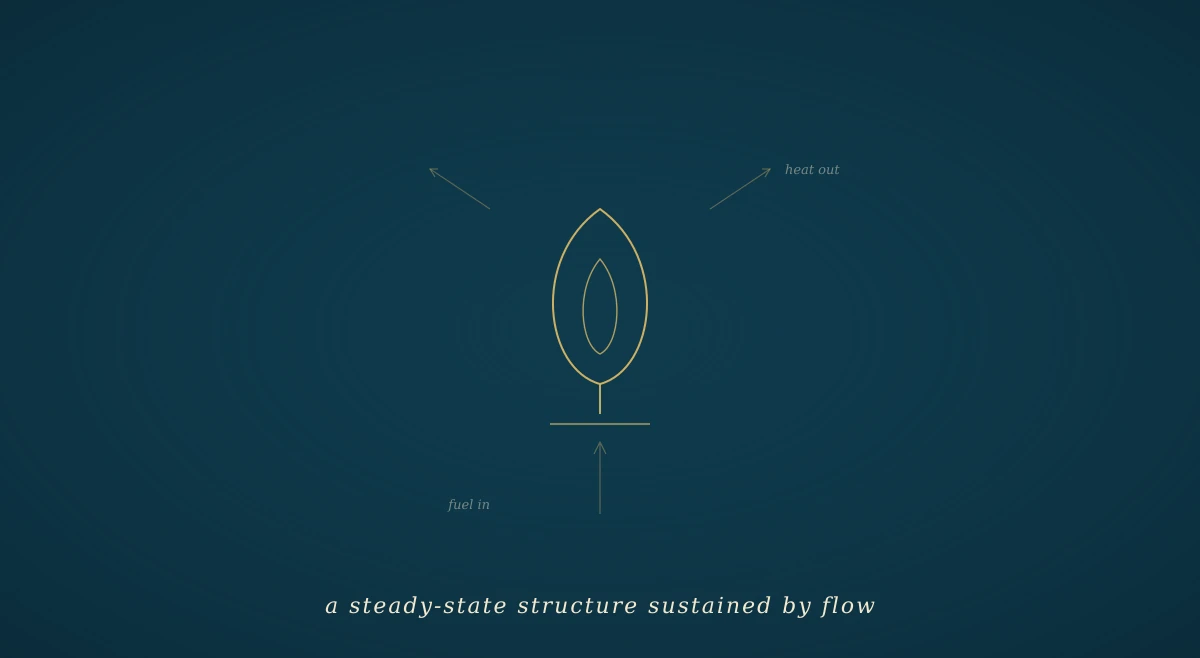
The flame persists because the candle burns
Look closely at a quiet candle flame in a windless room.
It maintains a precise, tear-drop shape. It has a distinct inner boundary, a bright outer mantle, and a predictable thermal gradient. It behaves, for all practical purposes, like an object.
Yet there is no object there. The atoms comprising the flame at this second are entirely different from the atoms that comprised it ten seconds ago. The wax melts, vaporises, reacts with oxygen, radiates light, and vanishes into carbon dioxide and water vapour.
The flame is not a thing. It is a process — a steady-state structure that exists only because fuel and energy are continuously flowing through it. If you cap the jar and stop the flow, the structure does not freeze in place; it vanishes instantly.
As an engineer trained to evaluate systems by their inputs, outputs, and thermodynamic constraints, I spent years looking at biology through a mechanical lens. Mechanics teaches us that structures decay, gears wear out, and energy degrades. But living systems — from a single bacterium to a rainforest, to the human brain reading this page — do the exact opposite. They build complexity out of chaos.
Ilya Prigogine won the Nobel Prize in Chemistry in 1977 for explaining how this happens. He named the mechanism dissipative structures. This article is an attempt to unpack what that concept actually means, stripped of dense jargon, and why it forms the physical foundation for understanding life, organisation, and planetary dynamics.
1. The second law’s apparent paradox
The Second Law of Thermodynamics is the most uncompromising rule in physics. Stated simply: in any isolated system, total entropy — a measure of spatial disorder or energy dispersal — must always increase over time.
ΔSisolated ≥ 0
Hot coffee cools to room temperature. A house drops into disrepair. A drop of ink diffuses evenly throughout a glass of water. Left to themselves, systems slide irreversibly toward homogeneous, maximum-entropy equilibrium — a state where no useful work can be performed.
ISOLATED SYSTEM (Near Equilibrium)
+------------------------------------+
|  [Hot Coffee]  --> Heat Disperses  |
|  High Order    --> Max Entropy     |
|  (Irreversible Decay to Uniformity)|
+------------------------------------+
For over a century, this law created a deep conceptual tension with biology.
If the universe is relentlessly sliding toward decay, how can life — which is characterised by hyper-dense spatial organisation, precise molecular choreography, and self-repair — persist and evolve into ever more complex forms over billions of years?
The nineteenth-century physicist Ludwig Boltzmann wrestled with this. The resolution is not a violation of the Second Law, but a correction of its boundary conditions. The Second Law applies strictly to isolated systems — systems that exchange neither matter nor energy with their surroundings.
Earth is not an isolated system. A cell is not an isolated system. You are not an isolated system. We are all wide open.
2. Equilibrium vs. non-equilibrium
To understand where order comes from, we have to distinguish between two completely different physical regimes: near-equilibrium and far-from-equilibrium.
```
EQUILIBRIUM FAR-FROM-EQUILIBRIUM
(Static / Passive) (Dynamic / Dissipative)
+------------------+ +------------------+
| | | Energy Input |
| Uniform Mix | | | |
| No Gradients | | v |
| Maximum | | [Self-Organised |
| Entropy | | Pattern] |
| | | | |
| Example: Crystal| | v |
+------------------+ | Heat Output |
+------------------+
Example: Hurricane, Cell
```
Static order (equilibrium)
A diamond or a salt crystal is organised, but it is organised at equilibrium. Its atoms settle into a rigid lattice because that state minimises potential energy. It requires no energy input to stay a crystal. Lock a diamond in a vacuum vault at absolute zero, and it remains a diamond forever. It is static, inert, and structurally dead.
Dynamic order (far-from-equilibrium)
A hurricane, a Rayleigh-Bénard convection cell, or an animal’s heart is organised far from equilibrium.
If you heat a shallow pan of oil from below, at first the heat moves upward slowly by simple conduction. But as you turn up the heat, driving the temperature gradient past a critical threshold, the fluid suddenly reorganises itself. Millions of molecules spontaneously align into a hexagonal grid of rolling convection cells.
Order appears out of random molecular motion. Why? Because organised convective loops transport heat to the surface far more efficiently than chaotic collisions can. The system organises itself to dissipate the thermal gradient imposed upon it.
3. Prigogine’s insight: order through dissipation
Ilya Prigogine formalised this mathematically by splitting a system’s internal entropy change (dS) into two distinct components:
dS = diS + deS
Where:
- diS is the entropy produced inside the system by irreversible processes (chemical reactions, friction, metabolic decay). By the Second Law, diS is always positive.
- deS is the entropy exchanged with the external environment (heat radiated out, waste excreted, raw energy imported).
```
DISSIPATIVE STRUCTURE BOUNDARY
          Energy / Matter Import  (Low Entropy)
                     |
                     v
             +---------------+
             |   LOCAL       |  --> Internal Entropy Production
             |   SYSTEM      |      (d_iS > 0)
             |  (Organised)  |
             +---------------+
                     |
                     v
          Heat / Waste Export     (High Entropy)
                    (d_eS < 0)
```
If a system exports more entropy to its environment than it generates internally (deS < −diS), then the total internal entropy change dS becomes negative:
dS < 0
The system does not violate thermodynamics; it pays for its internal local order by increasing the entropy of its surrounding environment. It acts as an entropy pump.
This is the definition of a dissipative structure: an open thermodynamic system that consumes high-grade energy, uses it to construct and maintain internal spatial-temporal organisation, and dissipates high-entropy low-grade heat back into its environment.
4. The dynamic architecture of living systems
Living organisms are the most sophisticated dissipative structures in the known universe.
Your body is currently maintaining an internal temperature around 37 °C, keeping ion concentrations tightly regulated across trillions of cell membranes, and repairing DNA strands broken by cosmic rays. None of this happens by default.
```
THE METABOLIC DISSIPATIVE LOOP
[ Food / Oxygen / Sunlight ]
| (High-grade energy input)
v
+---------------------------+
| Biological Organism | <– Maintains structural integrity &
| Local Entropy Reduction | rebuilds damaged molecular components
+---------------------------+
|
v (Low-grade waste heat radiated away)
[ Thermal Waste / CO2 ]
```
To maintain your internal organisation, you must continuously consume high-grade chemical energy (food and oxygen) and export low-grade heat and degraded chemical waste (CO2, urea).
If you stop eating, or if you stop breathing, your exchange mechanism (deS) drops to zero. Within minutes, diS takes over. Irreversible internal decay proceeds, internal entropy rises, and your physical organisation dissolves back into simple chemical components.
That sudden collapse of self-maintaining structural flow is what we call death.
5. Why structure requires a continuous tax
There is a fundamental engineering trade-off built into the physics of dissipative structures: complexity is expensive, and its maintenance cost scales non-linearly.
A simple dissipative system — like a whirlpool in a drain — requires only a water-level difference to stay alive. A complex dissipative system — like a mammalian brain — requires a continuous supply of glucose, oxygen, neural feedback loops, and vascular infrastructure just to keep its state from decaying.
```
COMPLEXITY ACCUMULATION vs. DISSIPATIVE COST
Energy Required
^
| / High-Complexity Life
| / (Requires massive energy flow)
| /
| / Convection Cells
| /
| / Whirlpool
+--------------------------------------------->
Internal Structural Complexity
```
This explains why living systems are intrinsically fragile. Because their form is sustained by continuous flow rather than static bonds, any interruption in the flow, any corruption in the feedback mechanisms, or any sudden environmental shift can trigger rapid structural collapse.
The planet Earth itself operates as a giant, multi-layered dissipative system. Solar radiation streams in from above as high-grade photon flux. The biosphere, atmosphere, and oceans intercept this flux, using it to power photosynthesising forests, ocean currents, atmospheric heat engines, and complex food webs, before finally radiating the degraded thermal energy back into cold space as infrared radiation.
Life did not just adapt to this planetary flow; life stepped into the circuit and amplified it.
6. Where the boundary sits
As with all conceptual frameworks, we must be careful about where established physics ends and interpretation begins.
What is established
- Open systems operating far from thermodynamic equilibrium can spontaneously form stable, highly ordered spatial-temporal patterns (Prigogine’s Nobel-winning work).
- Living organisms function strictly within these non-equilibrium thermodynamic laws, continuously importing energy and exporting entropy to maintain local internal order.
- The accumulation of local organisation is mathematically balanced by an equal or greater generation of entropy in the surrounding environment.
What is the reading on this site
- That the continuous accumulation of structural memory across evolutionary and geological timescales — what the book calls the Learning Earth — is best understood as the progressive nesting of dissipative structures within larger dissipative structures.
- That ancient concepts like qi, prana, or pneuma were early phenomenological attempts to describe the subjective experience of this dynamic organisational flow from the inside, long before the mathematical tools of non-equilibrium thermodynamics existed to describe it from the outside.
A dissipative structure reminds us of a fundamental truth that is easy to forget in a world dominated by static objects: we are not things that move through time; we are patterns that time flows through.
Primary references and further reading
- Prigogine, I. (1977). Time, Structure, and Fluctuations. Nobel Lecture in Chemistry.
- Nicolis, G., & Prigogine, I. (1977). Self-Organization in Non-Equilibrium Systems. Wiley-Interscience.
- Schrödinger, E. (1944). What is Life? The Physical Aspect of the Living Cell. Cambridge University Press.
- Schneider, E. D., & Kay, J. J. (1994). “Life as a consequence of thermodynamics.” Computers & Mathematics with Applications, 27(9–10), 25–48.
Related reading on this site
- Earth as a Learning System — the cornerstone this piece belongs to.
- Complex Adaptive Systems 101 — the companion piece on bottom-up order and emergence.
- What Is Chi? A Systems Engineer’s Reframing — reading qi / prana / pneuma as the phenomenological side of this same thermodynamic story.
- Science Behind The Learning Earth — the five anchors; Prigogine is the first of them.
← Back to the Earth as a Learning System guide
More in this pillar
The other pillars
Be first to know
The book is in its final editing stage. Leave your email and you will hear when it is ready.