Earth as a Learning System·Article
Complex Adaptive Systems 101: Ants, Immune Systems and Ecosystems
Complex Adaptive Systems from zero: ant colonies, immune networks, trophic cascades — and the shared logic of distributed control, stigmergy and emergence.
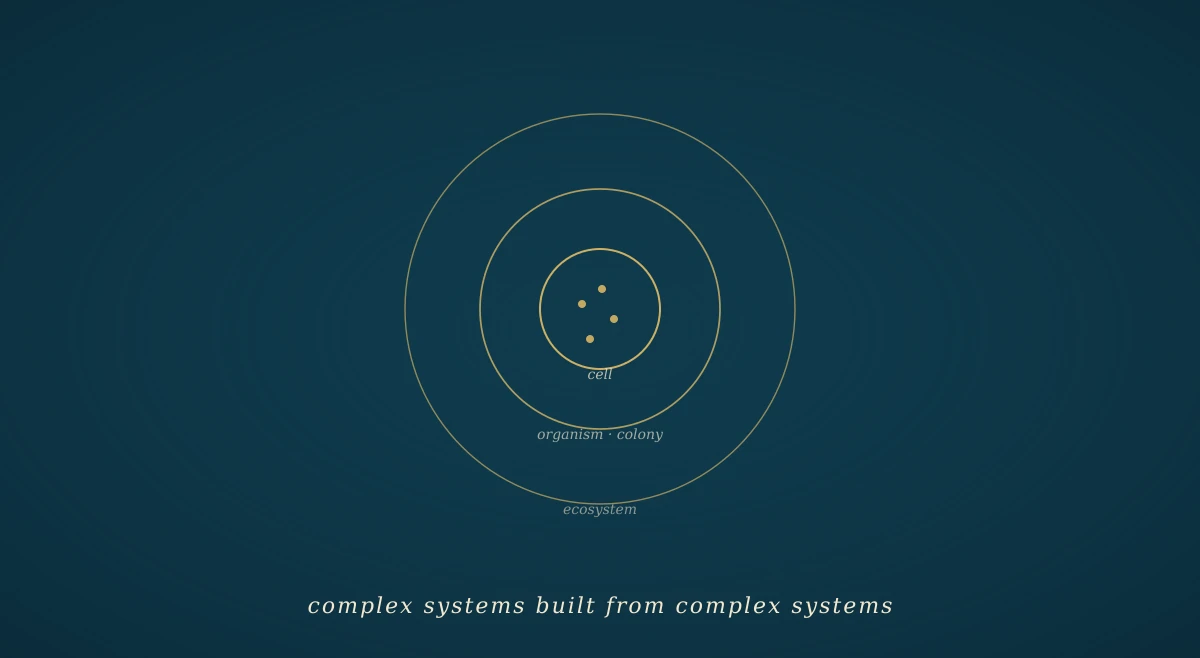
The intelligence is not in the parts. It is in the relationships
Put a single harvester ant on a kitchen table. It will wander in chaotic, erratic loops until it dehydrates and dies. It has a brain composed of roughly a quarter of a million neurons, virtually no long-term memory, and no understanding of architectural design.
Now put ten thousand harvester ants together in a field.
Without a master blueprint, a central supervisor, or a chain of command, the group constructs subterranean cities extending metres into the soil. They build temperature-regulated chambers, ventilate air currents, optimise foraging pathways, and manage collective waste disposal. If a sudden rainstorm destroys a tunnel wall, nearby workers instantly pivot to repair the breach without receiving orders from the queen.
The queen, despite her monarchical title, issues zero directives. She is a specialised reproductive organ, not an executive.
```
INDIVIDUAL LEVEL COLLECTIVE LEVEL
(Simple Rules, Local Info) (Emergent Macro-Behaviour)
           [ Ant ]  [ Ant ]                    +--------------------+
              \    /                           |  Optimised Food    |
          (Local Signals)  =================>  |  Foraging Networks |
              /    \                           |  & Soil Hydro-     |
           [ Ant ]  [ Ant ]                    |  dynamics          |
                                               +--------------------+
                                                Emergent Intelligence
```
How does global intelligence arise from local simplicity? As an engineer, I was taught to design systems top-down: start with a specification, draft a blueprint, and ensure every component performs its assigned function. But nature operates almost entirely in reverse.
This bottom-up dynamic is the domain of Complex Adaptive Systems (CAS). Understanding how CAS operate is not merely an academic exercise; it is the essential framework for understanding how life, immunology, markets, and the planetary system survive and learn.
1. The ant and the aircraft: complicated vs. complex
To understand a complex adaptive system, we must first make a precise distinction that standard language blurs: the difference between complicated and complex.
A modern passenger airliner, such as a Boeing 787, is complicated. It consists of millions of discrete parts operating according to precise physical laws. But if you have the engineering schematics and sufficient computational power, you can predict the exact state of the entire aircraft from its components. There are no surprises. More importantly, an airliner cannot adapt: if a wing flap breaks mid-flight, the metal does not spontaneously reorganise itself to compensate.
An ant colony, a human brain, or a coral reef is complex and adaptive. It is built from a dense network of interacting agents that continuously modify their internal rules based on feedback from their immediate surroundings.
```
COMPLICATED SYSTEMS vs. COMPLEX ADAPTIVE SYSTEMS
================================================================================
- Linear & Deterministic - Non-linear & Dynamic
- Predictable macro-behaviour - Emergent macro-behaviour
- Static structural design - Adaptive & Self-organising
- Centralised control (Blueprint) - Distributed control (Agents)
- Example: Jet engine, mechanical watch - Example: Ant colony, immune system
================================================================================
```
A complex adaptive system exhibits three core properties:
- Distributed control. There is no single controlling node. Macro-level behaviour emerges bottom-up from local interactions.
- Emergence. The macro-system possesses properties that cannot be found in, nor predicted from, any individual part analysed in isolation.
- Adaptive feedback. The agents change their rules of interaction based on past experience. The system learns.
2. Anatomy of a self-organising superorganism
How do simple agents solve complex optimisation problems without a central brain? In ant colonies, the mechanism is called stigmergy — indirect communication mediated through physical modifications of the environment.
```
THE STIGMERGIC FEEDBACK LOOP
                Ant deposits pheromone on path
              +--------------------------------+
              |                                |
              v                                |
     +-----------------+              +-----------------+
     | ENVIRONMENTAL   | ===========> | BEHAVIOURAL     |
     | CHEMICAL TRAIL  |  Attracts    | REINFORCEMENT   |
     +-----------------+              +-----------------+
              ^                                |
              |  Shorter paths get reinforced  |
              |  faster (Positive Feedback)    |
              +--------------------------------+
```
When a foraging ant stumbles upon food, it walks back to the nest while depositing a faint chemical trail of volatile pheromones. Randomly passing ants are statistically drawn to follow the scent. If they also find food, they return along the same path, leaving their own chemical signature.
Because shorter paths allow faster round-trips, pheromones accumulate faster on shorter routes. Longer, inefficient routes evaporate away before they can be reinforced.
Notice what has happened here: no single ant ever measured the distance or calculated the optimal vector. The calculation was performed physically and distributed across space and time by the environment itself. The colony acts as a decentralised biological computer.
3. The immune system’s evolutionary computation
If an ant colony is a CAS operating across physical terrain, your adaptive immune system is a CAS operating inside your bloodstream.
When a novel pathogen enters your body, there is no central neural controller that inspects the virus, decodes its genetic sequence, and drafts an antibody blueprint. Instead, the immune system uses a process that mirrors natural selection inside a single organism: clonal selection.
```
CLONAL SELECTION IN ADAPTIVE IMMUNITY
   Random Receptor Generation (High Diversity)
   [ Cell A ]  [ Cell B ]  [ Cell C ]  [ Cell D ]
                   |
                   | Pathogen Antigen Binds to Cell C
                   v
   Affinity Selection & Differential Amplification
                   |
           +---------------+
           |   CELL C      |  ===> Clonal Expansion (Massive Proliferation)
           +---------------+  ===> High-affinity Antibody Production
```
- Stochastic diversity. The bone marrow continuously releases billions of B and T lymphocytes, each carrying a unique, randomly assembled surface receptor.
- Affinity selection. When a foreign antigen happens to dock with one of these random receptors — even weakly — it triggers that specific cell to divide rapidly.
- Iterative tuning. As these cells proliferate, they undergo high-rate somatic hypermutation, fine-tuning their fit. High-affinity variants receive stronger survival signals, out-competing weaker variants.
The immune system maintains a dynamic memory of its past environment not by writing data to a central brain, but by shifting its internal population distributions. The memory is the population of persistent memory T cells.
4. Trophic cascades and non-linear tipping points
At ecosystem scales, the non-linear dynamics of complex adaptive systems become starkly visible.
In linear systems, small inputs produce small outputs, and large inputs produce large outputs. In complex systems, interactions are non-linear: tiny changes can trigger massive system-wide reorganisations, while large shocks can sometimes be completely absorbed.
```
FOOD WEB NON-LINEAR NETWORK
================================================================================
          [ Apex Predators ] (Wolves / Sharks)
                 /       \
                v         v
     [ Mesopredators ]  [ Herbivores ] (Deer / Sea Urchins)
             \             /
              v           v
      [ Primary Producers ] (Trees / Kelp Forests)
                 |
                 v
       [ Decomposers / Soil Microbiome ]
================================================================================
```
Consider the classic example of a trophic cascade.
When grey wolves were reintroduced to Yellowstone National Park in 1995 after a seventy-year absence, ecologists expected a simple, linear reduction in the elk population. What actually occurred was a systemic reorganisation.
The presence of wolves changed elk behaviour. Elk avoided open valleys and riverbanks where they were vulnerable to attack. This allowed overgrazed aspen, willow, and cottonwood trees to regenerate. Stabilised tree roots reduced riverbank erosion, altering the physical course of the rivers. The regenerating vegetation invited back beavers, songbirds, amphibians, and micro-fauna.
Removing or introducing a single apex agent shifted the entire macroscopic state of the landscape.
(A note of honesty: the Yellowstone story is often told more cleanly than the data allow. The behaviourally-mediated vegetation recovery is real; the magnitude of the geomorphic effect, and how much of it is attributable to wolves rather than to concurrent changes in climate, beaver populations and other predators, is still debated in the ecology literature. The lesson about non-linear sensitivity to a single node is sound even where the specific accounting is contested.)
5. The dynamics: stigmergy, feedback, and scaling
Across ants, immune cells, and ecosystems, the same core principles emerge repeatedly:
```
NESTED COMPLEX ADAPTIVE SYSTEMS
  +---------------------------------------------------+
  | ECOSYSTEM (Species Networks & Nutrient Cycling)   |
  |   +-------------------------------------------+   |
  |   | ORGANISM / COLONY (Stigmergy & Behaviour) |   |
  |   |   +-----------------------------------+   |   |
  |   |   | CELLULAR (Bioelectric & Immunity) |   |   |
  |   |   +-----------------------------------+   |   |
  |   +-------------------------------------------+   |
  +---------------------------------------------------+
```
- Positive feedback loops. Mechanisms that amplify small signals (pheromone trail reinforcement, clonal cell expansion).
- Negative feedback loops. Mechanisms that stabilise the system against disruption (predator-prey oscillations, body temperature regulation).
- Nested architecture. Complex adaptive systems are built from smaller complex adaptive systems, forming a ladder of dynamic scale.
When we look at the biosphere through this lens, we realise that life does not merely inhabit an environment. Life forms an interconnected, multi-tiered computational network that processes environmental information across multiple time scales simultaneously.
6. Where the boundary sits
As always, it is critical to separate the rigorous framework of complex-systems science from over-extended metaphors.
What is established
- Complex adaptive systems (ant colonies, immune networks, food webs) generate macroscopic emergent behaviours that cannot be predicted by analysing individual agents in isolation.
- Distributed control, stigmergic communication, and non-linear feedback loops are mathematically proven mechanisms for decentralised optimisation.
- Ecosystems exhibit dynamic thresholds (tipping points) where small parameter shifts cause rapid state transitions.
What is the reading on this site
- That these diverse biological phenomena are manifestations of a unified planetary process: the accumulation of structural memory across nested scales.
- That the traditional distinction between “organism” and “environment” is primarily a boundary of convenience; functionally, the environment acts as the externalised memory storage of the complex system itself.
Shift your perspective from linear cause-and-effect to systemic feedback, and the natural world stops looking like a collection of objects. It begins to look like what it truly is: an interconnected, self-organising learning process.
Primary references and further reading
- Holland, J. H. (1995). Hidden Order: How Adaptation Builds Complexity. Addison-Wesley.
- Levin, S. A. (1998). “Ecosystems and the Biosphere as Complex Adaptive Systems.” Ecosystems, 1(5), 431–436.
- Camazine, S. et al. (2001). Self-Organization in Biological Systems. Princeton University Press.
- Mitchell, M. (2009). Complexity: A Guided Tour. Oxford University Press.
Related reading on this site
- Earth as a Learning System — the cornerstone this piece belongs to.
- Dissipative Structures Explained — the companion piece on the thermodynamic substrate of all this emergence.
- Science Behind The Learning Earth — the five scientific anchors of the book.
← Back to the Earth as a Learning System guide
More in this pillar
The other pillars
Be first to know
The book is in its final editing stage. Leave your email and you will hear when it is ready.