Ancient Sources, Modern Lens·Primary source
Category Errors of the Self: Adhyāsa and the Modern Account of the Self-Model
Śaṅkara's 8th-century account of superimposition (adhyāsa) read against modern predictive-processing. Convergence of structure, not of theology.
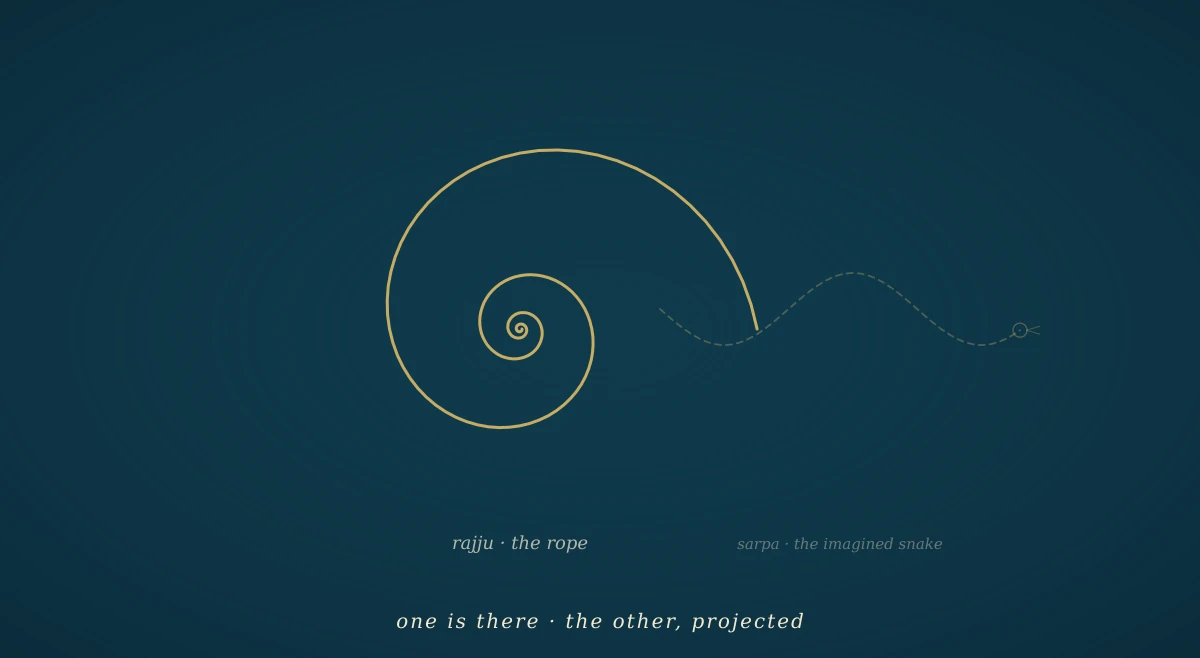
A coiled rope in a dim room reads to the brain as a snake. The heart rate spikes, cortisol releases, the body prepares to flee. Switch on the light and the snake does not slither away: it simply ceases to exist. There was no snake. There was a rope, a low-light environment, and a brain that filled in missing optical data with its worst-case prior.
The example is standard in Indian philosophy. It is called rajju-sarpa-bhrama (rajju-sarpa-bhrama, “the rope-and-snake illusion”), and in Advaita Vedānta — the non-dualist Hindu school codified in the 8th century CE by Ādi Śaṅkara — it is not an optical curiosity but the central metaphor for a specific claim about human cognition.
The claim is that the ordinary sense of being a bounded, continuous self is structurally the same mistake as mistaking the rope for a snake: a predictive projection, confidently taken for the thing itself. Śaṅkara’s name for the mistake is adhyāsa (adhyāsa, “superimposition”). His account of what produces it is unusually formal — and it maps, with striking fidelity, onto the modern predictive-processing account of perception and selfhood developed by Karl Friston, Andy Clark, and Thomas Metzinger from the late 1990s onward.
This article unpacks Śaṅkara’s diagnosis, lays it next to the modern frame, and marks exactly what the convergence does and does not establish.
1. The traditional diagnosis: adhyāsa
Śaṅkara defines adhyāsa in the preamble to his Brahma Sūtra Bhāṣya and throughout the Vivekacūḍāmaṇi (“The Crest-Jewel of Discrimination”). His definition, in paraphrase:
Adhyāsa is the apparent presentation to consciousness, by way of memory, of something previously observed in some other locus.
Put in plain terms: adhyāsa is the cognitive act of pasting the properties of one thing onto another. The classic examples the texts return to are the rope-as-snake, the shell-as-silver (a mother-of-pearl shell on a beach glinting as silver), and the mirage of water in a desert. In each case, a feature stored in memory from somewhere else is projected onto present sensory data where it does not belong.
Śaṅkara’s structural claim about adhyāsa has two directions, which Vedāntic texts call itaretarādhyāsa — “mutual superimposition”:
(i) Non-self projected onto the self. We take features of the physical body, the metabolism, or the mind — decay, hunger, anxiety, mortality — and attach them to the one who is aware of them. We say “I am sick”, “I am tired”, “I am a failure”, when the honest description would be “something at some layer of me is in this state”.
(ii) Self projected onto the non-self. We take the intrinsic awareness that is present when we look at something and treat the thing being looked at as if it had awareness of its own. The clearest example in the texts is the internal self-model — the sense of “I” generated by cognition — which we experience as a living entity sitting inside the head rather than as a construct the brain is maintaining.
+-------------------------------------------------------------+
|              MUTUAL SUPERIMPOSITION (itaretarādhyāsa)       |
+---------------------+---------------------------------------+
|  (i) Non-self onto self                                     |
|      "I am sick / anxious / mortal / broken"                |
|      — attributes of the body or mind                       |
|        attached to the observer                             |
+---------------------+---------------------------------------+
|  (ii) Self onto non-self                                    |
|      "I live inside my head as a thinking entity"           |
|      — the attribute of being-aware                         |
|        attached to a construct that merely runs             |
+-------------------------------------------------------------+
The traditional diagnosis is that the ordinary psychological experience of being a person is this double superimposition running continuously. Not a one-off mistake; a persistent one, maintained from waking to sleep.
This looks mystical only until the modern account arrives.
2. How the illusion operates: āvaraṇa and vikṣepa
Śaṅkara’s account of how adhyāsa is produced names two subroutines of the macro-mechanism Advaita calls māyā (māyā, often weakly rendered “illusion” — a better translation is “the generative projection”). The Vivekacūḍāmaṇi lays them out explicitly:
(i) āvaraṇa-śakti (āvaraṇa, “covering”; śakti, “power”). The concealing power. It obscures the baseline, like a bank of fog obscuring a mountain. The underlying substrate — the plain awareness that is simply present — is not destroyed, just hidden.
(ii) vikṣepa-śakti (vikṣepa, “projection”). The projective power. Once āvaraṇa has obscured the baseline, vikṣepa fills the obscured space with actively constructed content — the snake on the rope, the “I” in the head, the elaborate world of apparent objects.
The two work together. First the baseline is hidden; then something is projected in its place. The ordinary experience of being a self, in this account, is what you get when you cannot see the actual substrate and the projection machinery runs unchecked.
This is a two-stage mechanism, carefully described, in an 8th-century text. The modern reader who recognises it from somewhere is right.
3. The modern account: predictive processing
The current best-supported working model of how the brain generates perception comes from the predictive-processing framework, developed from the mid-1990s onward by Karl Friston (A theory of cortical responses, 2005; the Free Energy Principle), Andy Clark (Surfing Uncertainty, 2016), and Jakob Hohwy (The Predictive Mind, 2013).
Its central claim is counter-intuitive: the brain does not primarily receive data from the senses and construct a picture from it. The brain is a dark, isolated organ inside a bony skull. The only thing that reaches it from the outside is a stream of noisy electrical signals.
What the brain does instead is run a continuous generative model of what the world probably is, and uses incoming sensory signals only to correct the model when it is wrong. The information that flows up the cortical hierarchy — from sensory areas to higher areas — is not the sensory data itself. It is the prediction error: the mismatch between what the top-down model expected and what the bottom-up input delivered.
+-------------------------------------------------------------+
|                 PREDICTIVE-PROCESSING LOOP                  |
+-------------------------------------------------------------+
|                                                             |
|    TOP-DOWN:  predictions, from the generative model        |
|               (what the brain expects to see / feel / hear) |
|                              |                              |
|                              v                              |
|                   +---------------------+                   |
|                   |     comparator      | <-- BOTTOM-UP:    |
|                   +---------------------+     sensory input |
|                              |                              |
|                              v                              |
|                   prediction error                          |
|                   (the only thing that                      |
|                    propagates up the hierarchy)             |
|                                                             |
+-------------------------------------------------------------+
What you perceive, on this account, is the top-down prediction, continuously updated by prediction error from below. When the prediction is good, you “see” the world. When the prediction is wildly wrong, as with the rope in low light, you see what the model predicted — a snake — until better data arrives and the prediction updates.
Mapping onto Śaṅkara
The alignment is almost literal.
- vikṣepa-śakti = the top-down projection of the generative model.
- āvaraṇa-śakti = the degradation of bottom-up sensory evidence (low light, high noise, insufficient data) that lets the top-down projection dominate unchecked.
- adhyāsa = the resulting perception, which is the projected content, confidently experienced as reality.
The rope-and-snake example is, in modern terms, a case of high prior precision and low sensory precision — exactly the regime in which the predictive model is known to dominate perception.
4. The self as a predictive construct
The deeper move is that the same mechanism applies to the self.
Thomas Metzinger’s Being No One (2003) and The Ego Tunnel (2009), and Anil Seth’s Being You (2021), extend the predictive-processing frame from external perception to self-perception. The brain, they argue, does not just predict what tigers and tables look like; it also predicts what a self looks and feels like. It builds a continuous top-down model of a bounded, persistent subject — one who owns a body, has a history, holds intentions, authors decisions.
Metzinger’s term for this construct is the Phenomenological Self-Model (PSM). His central claim about it: the self-model is transparent. We do not experience it as a model; we look through it, the way we look through the lens of our eye without ever seeing the lens. The construction is invisible from the inside, and what remains visible is the thing it constructs — a self.
The system looks through its internal self-model without seeing the model itself, misattributing the constructed simulation for fundamental reality.
— Metzinger, paraphrasing his own position
This is Śaṅkara’s adhyāsa, in a different vocabulary. Mistaking a top-down predictive simulation for the conscious substrate that is lighting it up is exactly what the 8th-century text describes.
The convergence is close enough that it deserves to be stated plainly: two independent traditions, separated by 1,200 years and operating from completely different starting points, converged on the same structural claim about what the ordinary sense of being a self actually is.
5. The method: neti, neti as a decoupling procedure
If adhyāsa is the diagnosis, Vedānta’s method for addressing it is a procedure called neti, neti (neti neti, “not this, not this”). It appears first in the much older Bṛhadāranyaka Upaniṣad (c. 7th century BCE) and is developed in the Vivekacūḍāmaṇi and the Māṇḍūkya Upaniṣad.
The procedure is not a mantra. It is a recursive filtering algorithm with a clear termination condition. Written out:
```
step through each candidate layer of experience:
- the physical body
- the breath / metabolism
- sensory and emotional reactions
- deliberate thought and the sense of “I”
for each layer, ask:
“Can I observe this as an object?”
   if YES:
       the observer is not this layer
       --> strip the identification
       --> apply "neti" ("not this")
when no more layers can be stripped:
what remains is the capacity doing the stripping
(it cannot be stripped, because it is the thing stripping)
–> this is the sākṣin (the witness)
```
The point of the procedure is not metaphysical insight; it is operational decoupling. The Vivekacūḍāmaṇi works through each candidate in turn:
- You can observe your body ageing, bruising, changing. Therefore you are the one observing the body, not the body.
- You can observe your breath speed up and slow down. Therefore you are not the breath.
- You can observe anger arise, peak, and pass. Therefore you are not the anger.
- You can observe your own thoughts — including the thought “I” itself. Therefore you are not the thought.
What is left on this procedure is what cannot be made into an object of observation, because it is the capacity for observation itself. The sākṣin.
What the procedure actually does, operationally
Independently of the metaphysics (which section 7 addresses), the procedure produces three measurable effects:
(i) It separates identity from state. “A limbic loop is firing” is tractable. “I am anxious” is an identity statement, and identity statements do not respond to intervention.
(ii) It drops the metabolic cost of over-identification. The Default Mode Network — the self-model generator — is one of the most energy-expensive structures in the brain. Running it in constant threat mode (“I am failing”, “I am sick”) is expensive. Dropping the identification with any particular transient state lowers that cost.
(iii) It reproduces, by a different route, the central move of cognitive-behavioural therapy. CBT’s distinction between an event and the thought-about-the-event, and between a thought-about-the-event and the identity-claim built from that thought, is exactly the neti-filtered chain. The vocabularies are different; the operation is the same.
6. The thermodynamic consequence
A detail that connects this material to the physics covered elsewhere on the site.
As argued in Dissipative Structures Explained, a living organism maintains its local order by continuously exporting entropy to its environment — paying for its organisation, in Prigogine’s formal language, by increasing the entropy of its surroundings.
Running a highly active, highly-threatened self-model is not free. The Default Mode Network is metabolically expensive, and chronic activation of it under perceived threat engages the sympathetic nervous system, elevates cortisol, and accelerates tissue wear. In the vocabulary of the dissipative-structure essay, this is high internal entropy production that the system must then export.
What Vedāntic texts describe as the subjective aftermath of vicāra (“discriminative inquiry”) completed well — ānanda, “the absence of friction” — maps, in the modern account, onto reduced sympathetic activation, lower default-mode activity, and lower baseline metabolic cost. The system has stopped burning fuel to defend a model that was always, in part, a projection.
This is not a mystical outcome. It is a predictable consequence of running the same organism with less unnecessary signalling.
7. Where the boundary sits
The convergence between Śaṅkara’s 8th-century analysis and the modern predictive-processing account is real, and it is worth stating carefully. But it is a convergence of structural description, not a vindication of ancient theology.
What is established
- The predictive-processing framework (Friston, Clark, Hohwy) is the current major working model of cortical function and perception; it has substantial empirical support across sensory modalities.
- Self-model theory (Metzinger, Seth) extends the frame to the construction of selfhood, and is consistent with findings about Default Mode Network activity, out-of-body experiences, and the dissolution of the sense of self in certain neurological and pharmacological conditions.
- Attention-based practices measurably reduce DMN activity in experienced practitioners (Brewer et al., 2011 onward).
- The central CBT move — separating event from interpretation, and interpretation from identity — has substantial outcome evidence and is structurally the same move the neti, neti procedure makes.
What is the reading on this site
- That Śaṅkara’s concepts of adhyāsa (superimposition) and the twofold machinery of āvaraṇa / vikṣepa can be directly mapped onto the modern predictive-processing account of perception, and specifically onto the Metzinger / Seth account of the self-model.
- That neti, neti is best understood not as a metaphysical doctrine but as a careful recursive filtering procedure for stripping category errors out of the self-report.
- That the procedure, independently of the metaphysics the tradition built on top of it, has operational value: it lowers unnecessary metabolic cost, improves accuracy of self-description, and converges on the same clinical move that cognitive therapy makes by a different route.
- That the stronger metaphysical claim — that the sākṣin is an immaterial witness that persists outside a working brain — is not required by the structural analysis and is not supported by current evidence.
Illusion, on this reading, is not a mystical curse. It is a specific, well-named class of category error: a prior taken for the thing itself. Turn on the light, run the filter, and see what was there all along. The rope was never a snake. The self-model was never the one that was aware.
Primary references and further reading
The primary texts
- Śaṅkara, Brahma Sūtra Bhāṣya, preamble (the adhyāsa-bhāṣya). Translation: Swami Gambhirananda (Advaita Ashrama, 1965).
- Vivekacūḍāmaṇi, ślokas 108–145 (on māyā, āvaraṇa, vikṣepa) and 251–275 (on adhyāsa). Translation: Swami Madhavananda (Advaita Ashrama, 1921); John Grimes (Ashgate, 2004) for the authorship discussion.
- Bṛhadāranyaka Upaniṣad 2.3.6, 3.9.26, 4.2.4, 4.4.22 — the earliest neti, neti passages. Translation: Patrick Olivelle, Upaniṣads (Oxford World’s Classics, 1996).
On the modern frame
- Friston, K. (2005). “A theory of cortical responses.” Philosophical Transactions of the Royal Society B 360(1456), 815–836.
- Clark, A. (2016). Surfing Uncertainty: Prediction, Action, and the Embodied Mind. Oxford University Press.
- Hohwy, J. (2013). The Predictive Mind. Oxford University Press.
- Metzinger, T. (2003). Being No One: The Self-Model Theory of Subjectivity. MIT Press.
- Seth, A. (2021). Being You: A New Science of Consciousness. Faber & Faber.
- Brewer, J. A., et al. (2011). “Meditation experience is associated with differences in default mode network activity and connectivity.” PNAS 108(50), 20254–20259.
Related reading on this site
- The Architecture of Awareness — the Māṇḍūkya’s four states, including the Turīya that neti, neti is designed to isolate.
- Pañcakośa: Five Layers of Human Identity — the layer-model that defines what the neti procedure is iterating over.
- Dissipative Structures Explained — on why running an inflated self-model has a thermodynamic cost.
- Complex Adaptive Systems 101 — on nested systems and the general principle that a model is not the thing modelled.
- Sources Library — the full set of primary-source guides.
← Back to the Ancient Sources, Modern Lens guide
More in this pillar
- The Neiye (內業): Inward Training
- Mencius and Haoran Zhi Qi: The "Flood-Like Qi"
- The Huangdi Neijing: Inner Canon of the Yellow Emperor
- Huangdi Neijing — Suwen 1–5: An Expanded Reading
- Enūma Eliš and the Emergence of Order
- Pneuma, Prana and the Breath Traditions
- The Architecture of Awareness: The Māṇḍūkya Upaniṣad and the Mapping of Brain States
- Pañcakośa: Five Layers of Human Identity, Read as a System Architecture
- The Māṇḍūkya Upaniṣad: Full Translation of the Twelve Verses
- The Vivekacūḍāmaṇi: A Guided Reading of Śaṅkara's Crest-Jewel
- The Ashtāvakra Gītā: A Guided Reading of the Uncompromising Dialogue
- Advaita Vedānta Glossary
- Chinese Thought Glossary
The other pillars
Be first to know
The book is in its final editing stage. Leave your email and you will hear when it is ready.