Chi, Reframed·Article
Why Chi Is Not a Substance
An engineering critique of the substance model of chi: why storage, projection and depletion all fail under physics, and what the process model gives back.
To treat a state of relation as a physical fluid is the primary category error of modern somatic thought
Imagine an engineer trying to measure the “health” of an internal combustion engine.
She attaches sensors to monitor cylinder pressure, crankshaft vibration, exhaust temperature, and fuel consumption efficiency. When all components interact with optimal timing, the engine runs smoothly, generates maximum torque, and minimises heat waste.
Now imagine a second observer looking at the exact same engine running smoothly and declaring: “Ah, look at that engine! It is filled with a high amount of ‘Smoothness Fluid.’ If we can extract that Smoothness Fluid and pour it into a broken engine, the broken engine will run well too.”
We would laugh at the second observer. “Smoothness” is not a fluid inside the engine. It is not an ingredient you add to the oil. It is an emergent state of alignment — a qualitative description of how well the parts interact in space and time.
Yet for over a century, the Western understanding of Chi (or Qi) has committed this exact mistake.
When practitioners talk about “storing Chi in the Dan Tien,” “transmitting Chi to a patient,” or “having depleted Chi,” they are operating under a substance model. They are treating a dynamic condition of system coherence as if it were a physical fluid that can be poured into a vessel, drained, or projected across space.
This article is an engineering critique of the substance model of Chi. It explains why treating Chi as a substance fails computationally, thermodynamically, and somatically — and why replacing it with a process model restores real power to physical cultivation.
1. The persistent myth of the internal fluid
The tendency to turn abstract processes into physical substances is a deeply ingrained human habit. Philosophers call it reification or the fallacy of misplaced concreteness (the latter term is Alfred North Whitehead’s).
When humans observe a complex pattern that persists over time, our brains naturally search for an “object” responsible for the behaviour:
```
THE MECHANISM OF REIFICATION
  OBSERVED PHENOMENON                        REIFIED CONCEPT
+--------------------+                     +--------------------+
| Body moves with    |  Reification Trap   | "There must be an  |
| effortless balance |  =================> | internal fluid     |
| & reduced friction |                     | called Chi flowing |
+--------------------+                     | through pipes."    |
                                           +--------------------+
```
Throughout history, science has repeatedly fallen into this trap and had to climb its way out:
- Caloric theory. Physicists once believed heat was an invisible, weightless fluid called caloric that flowed from hot bodies to cold bodies. We now know heat is simply the kinetic motion of atoms.
- Phlogiston theory. Chemists believed combustible materials contained a substance called phlogiston that was released during burning. We now know fire is a chemical reaction involving oxygen.
- Luminiferous aether. 19th-century physicists assumed light waves required a physical substance (the aether) to ripple through. Einstein showed that electromagnetic waves require no medium at all.
In every case, progress occurred only when science stopped looking for a phantom substance and started analysing the underlying relations, reactions, and field dynamics.
“Chi,” as it is popularly used in English, is the last surviving caloric fluid of the nineteenth century.
2. Category errors and reification
In his 1949 book The Concept of Mind, philosopher Gilbert Ryle introduced the idea of a category error.
He gave the famous example of a visitor being shown Oxford’s colleges, libraries, laboratories, and playing fields. At the end of the tour, the visitor asks: “But where is the University?”
The visitor made a category error. He assumed “the University” was another physical building alongside the library and the lab, rather than the organising architecture that integrates all those buildings into a single institution.
```
SUBSTANCE MODEL vs. PROCESS MODEL
================================================================================
THE SUBSTANCE MODEL (Category Error) THE PROCESS/STATE MODEL (Rigorous)
-------------------------------------- --------------------------------------
- Chi is a substance inside the body - Chi is the operational state
- Analogous to: Water in a pipe - Analogous to: Harmony in an orchestra
- Measured as: Quantity (Litres/Joules) - Measured as: Coherence / Low Friction
- Action: Store, pump, emit - Action: Align, tune, release stress
================================================================================
```
To call Chi a substance is to commit a classic category error.
Chi is not a constituent part of the body lying alongside blood, lymph, nerve tissue, or interstitial fluid. Chi is the degree of systemic order existing across those tissues.
You cannot extract the “harmony” from an orchestra and keep it in a jar. If the musicians stop playing in sync, the harmony does not evaporate into thin air — it simply ceases to exist because the relational condition that produced it has broken down.
3. The breakdown of the container-substance model
If Chi were a substance, it would have to conform to basic physical constraints. Let us evaluate the three main claims of the substance model through an engineering lens:
```
THREE FAILED SUBSTANCE CLAIMS
[ 1. STORAGE ] [ 2. TRANSMISSION ] [ 3. DELETION ]
+------------------+ +----------------------+ +------------------+
| “Storing Chi in | | “Projecting Chi out | | “Losing Chi when |
| the lower belly” | | of the hands” | | exhausted” |
+------------------+ +----------------------+ +------------------+
| | |
v v v
PHYSICAL TRUTH: PHYSICAL TRUTH: PHYSICAL TRUTH:
No biochemical container No non-EM force emitted; System entropy rose;
exists; tissue simply only thermal radiation & structural coherence
drops muscular tension. mechanical press. degraded locally.
```
Claim 1: “Storing Chi in the Dan Tien”
In traditional somatic arts, practitioners are instructed to “accumulate and store Chi in the lower abdomen (Dan Tien).”
If Chi is a substance, where is the container? Anatomically, the lower abdomen contains the intestines, deep abdominal fascia, pelvic floor musculature, major blood vessels, and dense neural plexuses (the enteric nervous system). There is no hollow organ or specialised cellular storage bay for an unidentified liquid or field.
What actually happens when a practitioner “sinks Chi to the Dan Tien”?
From a biomechanical perspective, the practitioner is lowering their centre of mass, relaxing the diaphragm, engaging abdominal breathing, and shifting pelvic alignment. This drops unnecessary muscular bracing in the upper chest and shoulders, increases intra-abdominal pressure, and stimulates parasympathetic tone via the vagus nerve.
You have not filled a bucket with fluid. You have altered the structural equilibrium and neural state of the organism.
Claim 2: “Projecting Chi (Fa Jin / External Qi Emission)”
Popular martial arts films and sensationalised demonstrations claim that advanced masters can project Chi through the air to push or strike an opponent without physical contact.
If Chi were a substance or force projected through empty space, it would be bound by Maxwell’s equations or the inverse-square law of field propagation. Yet under controlled, double-blind laboratory conditions, no non-contact force or unidentified wave has ever moved a physical object or registered on sensitive sensors.
When a skilled martial artist generates devastating close-range force (Fa Jin), they are not shooting an invisible energy beam. They are executing a kinetic wave chain: initiating ground force through the feet, passing it through rotation of the hips, transmitting it across a pre-tensioned fascial web, and transferring momentum through physical impact.
The force is real, but it is pure Newtonian mechanics mediated by exquisite somatic alignment.
Claim 3: “Depleting or losing Chi”
People frequently say, “I worked twelve hours today and drained all my Chi.”
Under the substance model, they imagine a fluid reservoir that was high in the morning and is now low at night. But as explored in What Is Chi? A Systems Engineer’s Reframing, metabolic energy (glycogen, ATP) is consumed, but what degrades under fatigue is organisation, not fluid level.
Extreme fatigue is not the loss of an etheric fuel. It is the accumulation of metabolic waste products, cellular inflammation, neural fatigue, and the temporary loss of structural coherence. The system’s internal entropy (diS) has temporarily outpaced its capacity to export heat and waste (deS).
4. Thermodynamics of state vs. conservation of matter
To formalise why Chi cannot be a substance, we must return to non-equilibrium thermodynamics.
As established in Dissipative Structures Explained, living systems are open systems that maintain internal order by exchanging energy and matter with their environment.
The fundamental thermodynamic equation for the internal entropy change (dS) of an open system is:
dS = diS + deS
Where:
- diS is internal entropy production (always positive due to friction, metabolic decay, and disorder).
- deS is entropy exchanged with the environment.
Notice what is missing from this equation: there is no variable for “vital substance.”
Order (dS < 0) is achieved purely through the rate of flow and the efficiency of internal structure.
```
THERMODYNAMIC COMPARISON: FUEL vs. STATE
SUBSTANCE (Fuel / Matter) STATE (Organisation / Order)
+---------------------------+ +---------------------------+
| - Conserved (Joules) | | - Not Conserved |
| - Material / Quantifiable| | - Purely Relational |
| - Can be stored in tanks | | - Destroyed when flow |
| | | stops |
+---------------------------+ +---------------------------+
```
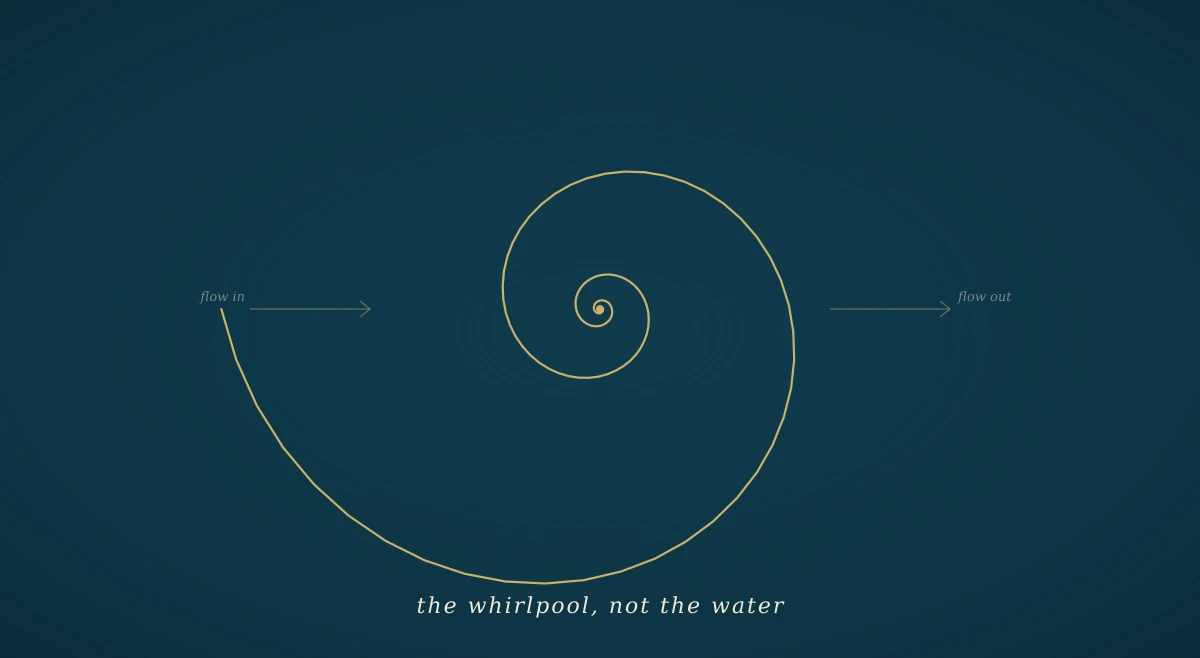
A whirlpool in a river is a structure. It has a shape, a centre, and dynamic behaviour. But if you take a bucket of water out of the whirlpool, you do not have “a bucket of whirlpool fluid.” You just have water.
The whirlpool was never a substance; it was a condition of motion sustained by the river’s gradient.
Your body’s Chi is the whirlpool, not the water.
5. What happens to somatic practice when we abandon substance
When practitioners abandon the magical substance model and embrace the process model, their physical practice does not deteriorate — it becomes dramatically more precise, reproducible, and effective.
Here is how the transition transforms practice:
```
TRANSFORMATION OF SOMATIC PRACTICE
================================================================================
OLD MENTAL MODEL (Substance) NEW MENTAL MODEL (Process / State)
---------------------------------- ----------------------------------------
- “I am trying to feel an - “I am scanning for unnecessary
invisible energy.” muscular tension and noise.”
-
“I am trying to move fluid - “I am aligning my skeletal frame so
along invisible lines.” gravity transfers cleanly.” -
“I need a master to give - “I am modulating my autonomic state
me energy.” via breath and biofeedback.”
================================================================================
```
1. From fantasy to sensory precision
When you stop hunting for imaginary buzzing fluids, you tune into real bodily signals: micro-proprioception, fascial tension, vascular dilation, respiratory rhythm, and joint articulation. You move from wishful thinking to precise somatic feedback.
2. From passive reliance to self-regulation
If Chi is a substance that must be given to you, you are dependent on external sources or gurus. If Chi is the state of organisational alignment of your own dissipative structure, then you hold the controls. Through breath, posture, movement, and mental attention, you directly tune your internal state.
3. Integration with science
Abandoning the substance model eliminates the wall between ancient body arts and modern science. You no longer have to choose between believing in physics or practising qigong. You realise that ancient practitioners were using phenomenological language to describe real biomechanical, bioelectric, and autonomic optimisations.
6. Where the boundary sits
To remain rigorous, we must separate established physical principles from philosophical synthesis.
What is established
- Matter and energy obey strict conservation laws; no unaccounted “vital fluid” or “fifth force” has ever been detected by physical instruments.
- Living organisms maintain structure through non-equilibrium thermodynamics (Prigogine’s dissipative structures), paying for local order by exporting entropy to their surroundings.
- Reification (treating a relation or process as a substance) is a recognised cognitive fallibility in the history of science.
What is the reading on this site
- That the traditional term Chi (or Qi) is best understood as a historical, phenomenological map of systemic organisation and low-friction energy flow, rather than a physical substance.
- That modern somatic practices (such as qigong, taiji and prāṇāyāma) derive their true efficacy not from manipulating invisible fluids, but from modulating bioelectric signalling, autonomic nervous system tone, and fascial structural alignment.
Once you realise Chi is a process rather than a substance, you stop searching for a phantom liquid. You begin the real work: cultivating the alignment, stillness, and flow of your own living system.
Primary references and further reading
- Ryle, G. (1949). The Concept of Mind. Hutchinson. (The source of “category error”.)
- Whitehead, A. N. (1925). Science and the Modern World. Macmillan. (The origin of “the fallacy of misplaced concreteness”.)
- Prigogine, I. (1977). Time, Structure, and Fluctuations. Nobel Lecture in Chemistry.
Related reading on this site
- What Is Chi? A Systems Engineer’s Reframing — the cornerstone this piece belongs to.
- Chi vs. Qi: Same Word, Different Spelling, Different Meanings? — the companion piece on how the semantic drift happened.
- Dissipative Structures Explained — the thermodynamic frame used in Section 4.
- Yin, Yang and the Chinese Body: A Complete Guide — qi in its native pedagogical context.
← Back to the Chi, Reframed guide
More in this pillar
The other pillars
Be first to know
The book is in its final editing stage. Leave your email and you will hear when it is ready.