Traditions of the Body·Essay
Yin, Yang and the Chinese Body: A Complete Guide
A complete guide, from zero, to the Chinese model of the body: yin and yang, the five phases, meridians, dantian, and the Ten Essentials of Yang Chengfu.
How to read this text
You do not need any prior knowledge. Every term is explained the first time it appears. The Chinese characters are there so you can look things up further if you want — you do not have to memorise them.
An honest note before we start
What you will read here is a model, not anatomy. The “meridians” are not vessels you will find at autopsy. “Qi” is not a measurable energy in the physics sense. The “Liver” of Chinese medicine is not the same thing as the anatomist’s liver.
That does not make it nonsense. It makes it a language of experience — a system developed over two millennia to describe and act on what someone feels inside their own body, not on what someone sees cutting it open. It is a functional, phenomenological map. And like any good map, it is judged by whether it gets you where you want to go — not by whether it looks like a photograph.
So hold both at the same time: take it seriously as a practical tool, do not confuse it with physiology. Where the text speaks for the tradition, it says so. Where there is disagreement even inside the tradition, it says that too.
A short introduction to Chinese thought, for the reader who is new
Before any of the technical material lands, it helps to have five things in mind. If you already know them, skip to the Contents.
Where this comes from, in time and place
Chinese civilization has an unbroken textual record going back about three and a half thousand years, to the oracle-bone inscriptions of the Shang dynasty (c. 1200 BCE). What we today call “Chinese thought” was not produced by one culture at one time; it is a two-and-a-half-thousand-year conversation across many dynasties, in a vast region, with a shared writing system that let later readers continue to read earlier texts even when the spoken languages had drifted apart.
The thinking you will meet in this guide was mostly consolidated between roughly 500 BCE and 200 CE — the Warring States and Han periods — and has been continuously used, taught, and argued over since. “Chinese medicine” is not an artefact in a museum. It is a working profession practised today by hundreds of thousands of licensed physicians, with its own hospitals, journals, and licensing boards, in parallel with biomedicine.
There is no “the” Chinese tradition
Chinese thought has at least three main streams, usually called the three teachings (三教, sān jiào):
- Confucianism (儒家) — ritual, social order, moral self-cultivation, the regulation of relationships. The dominant frame of the imperial state.
- Daoism (道家) — nature, spontaneity, non-forcing, the practice of inner stillness; later, an elaborate internal alchemy that is one of the main sources of the material in this guide.
- Buddhism (佛教) — arriving from India around the 1st century CE and gradually sinicized; the source of several meditative techniques and vocabulary.
The three were in constant exchange, and a given later text (such as a Qigong or Taiji treatise) typically draws on all three without noting which thread is which.
What kind of body-knowledge this is
The body material in this guide is a synthesis, worked out mostly inside the medical and the Daoist internal-alchemy traditions, with contributions from the Confucian cultivation literature and, later, from Chan (Zen) Buddhism and from the martial arts.
Its backbone texts are:
- The Yi Jing (易經, Book of Changes, received form c. 9th c. BCE with Han-period commentaries) — the origin of the yin-yang vocabulary as a tool for describing change.
- The Huangdi Neijing (黃帝內經, Inner Canon of the Yellow Emperor, c. 2nd c. BCE — 2nd c. CE) — the foundational medical text; the source of the meridian system, the organ theory, and most of the diagnostic framework. The site has a reader’s guide and an expanded reading of its first five chapters.
- The Daodejing (道德經) and the Zhuangzi (莊子), 4th–3rd c. BCE — the classical Daoist sources on dao, de, and spontaneous action.
- Internal-alchemy treatises from roughly the Tang period (7th–10th c. CE) onward, which develop the three dantian vocabulary and the Microcosmic Orbit practice.
- The Taijiquan classics (太極拳論), 19th–20th c. CE, which codified the martial-internal application of all of the above into the Ten Essentials you will meet in Part E.
What this material is not
It is not a fossil, and it is not metaphysics you have to accept to use the techniques. It is a working vocabulary that has survived selection by many thousands of practitioners over many centuries because the operational parts of it keep producing useful results.
The theoretical parts have not survived that kind of test. Where modern biology has looked for the meridians, it has not found them as anatomical structures; where it has looked for qi as a physical energy, it has not found that either. The companion essay The Convergence Asymmetry treats this split head-on: Chinese body-knowledge, like most of its counterparts around the world, was a very good observer of what happens when you do certain things to a body, and a poor theorist of why.
A word on names
Chinese is written in a logographic script where the same character has been pronounced differently in different periods and places. Modern standard pronunciation is given here in Hanyu Pinyin (the official romanisation), with tone marks on the first appearance of a term. “Qi” and “chi” are the same word, in two different romanisation systems (Pinyin qì, Wade-Giles ch’i); this guide uses the Pinyin spelling throughout.
With that in hand, the material below should be legible without prior training.
Contents
PART A — The foundational idea
PART B — The material of the system
PART C — The geography
- The meridians: the network
- The flow of the Twelve
- The Eight Extraordinary Vessels
- Ren Mai and Du Mai: the two seas
- The Four Seas
- The three Dantian
- The Three Gates
- The Small and the Great Celestial Orbit
PART D — The organs
PART E — The practice
PART A — THE FOUNDATIONAL IDEA
1. The hill
The ideograms say it before any philosophy does.
陽 (yáng) — the sunlit side of a hill. 陰 (yīn) — the shaded side of the same hill.
Hold on to that image, because everything comes out of it. Three things fall out immediately.
First, it is the same hill. Not two things that met. One thing seen from two sides. There is no “conflict of yin with yang” — that is a Western misreading, importing the Christian good-against-evil antithesis into a system that does not have it.
Second, neither one is better. The shaded side is not the bad side. It is the cool, the damp, where mosses grow. You need both.
Third, it changes. The sun turns. The side that was bright in the morning is shaded in the afternoon. Nothing is yang permanently.
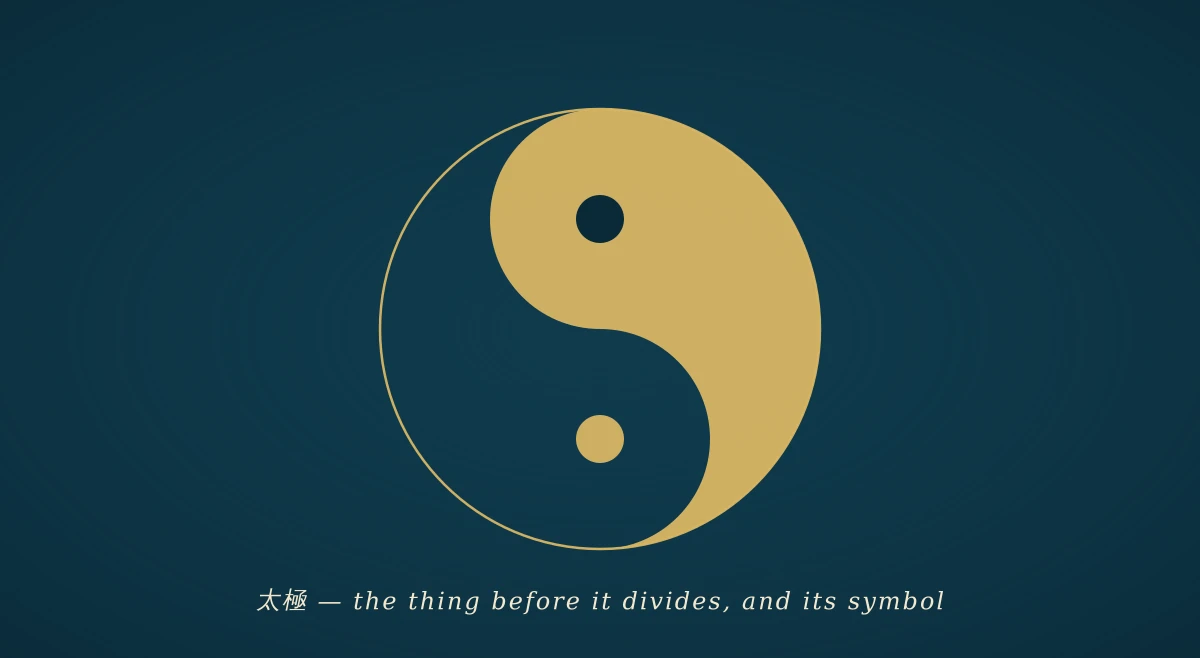
Out of this comes the symbol too. The 太極圖 (tàijí tú) — what everyone knows as “the yin-yang symbol” — is not two halves. It is a circle with a curved dividing line (because the transition is flow, not cut), with a dot of each inside the other (because nothing is ever pure).
2. The four laws of Yin-Yang
The classical formulation has four relations. It is worth knowing them because they explain almost everything that follows.
2.1 Opposition (陰陽對立)
They are defined through each other. “Hot” has meaning only because there is “cold”. If you abolished one, the other would lose its meaning — not prevail.
2.2 Interdependence (陰陽互根)
Literally: “yin and yang share a common root”. Each gives rise to the other. In the body: structure (yin — fluids, tissue, substance) is what produces function (yang — heat, movement). And function is what sustains structure. It is not a chain of causation you can cut at any point.
2.3 Mutual consumption and support (陰陽消長)
Not a static balance — a dynamic one. When one grows, the other shrinks, continuously. Like day and night across the year: they never sit still at 50-50. “Balance” here means oscillation within limits, not stasis.
This matters for practice too. Health is not stillness. It is good oscillation.
2.4 Transformation (陰陽轉化)
At its extreme, each becomes the other. 物極必反 — “when something reaches its extreme, it turns around”. The deepest point of night is the birth of the day. The fever that peaks collapses into shivering.
In Tai Chi this is the whole art: you do not wait for the yin to finish before the yang begins. Yin, at its peak, already generates the yang.
3. The relational: why there is no list
This is where most Westerners trip up, so let us say it clearly:
Yin/yang is not a property. It is a relation.
There is no such thing as a “yang thing”. There is only “yang in relation to”.
The thigh is yin relative to the calf (higher up, more interior, less exposed). The same thigh is yang relative to the belly. Nothing changed in the thigh. The reference point changed.
Infinite subdivision
The classical Su Wen (素問, the oldest medical text, c. 2nd century BCE) shows this exemplarily:
The back is yang. But within the yang:
- The Heart is the yang-within-yang
- The Lung is the yin-within-yang
The belly is yin. But within the yin:
- The Kidneys are the yin-within-yin
- The Liver is the yang-within-yin
- The Spleen is the “extreme yin” within the yin
Every time you zoom in, the division is born again. You never reach a final, undividable yang. It is fractal.
The practical proof
In Tai Chi there is the principle 分虛實 — “separate the empty from the full”. The loaded leg is 實 (shí, full = yang), the unloaded one is 虛 (xū, empty = yin).
In three seconds it reverses.
The same leg. Without a single thing changing in its anatomy. Only the relation changed.
The conclusion: you do not memorise labels. You learn to ask “in relation to what, right now?”
4. The body as landscape
Now that you have the hill, the body is easy.
The four-footed test
Imagine yourself on all fours, with the sun above.
Whatever the sun hits = YANG. Whatever stays in shadow, looking at the earth = YIN.
| YANG (sunlit side) | YIN (shaded side) |
|—|—|
| Back | Chest |
| Neck, top of head | Belly |
| Outside of arms | Inside of arms (where you take the pulse) |
| Outside of legs | Inside of thighs |
| Buttocks, calves | Soles, palms |
| Upper body | Lower body |
| Surface (skin, muscle) | Depth (organs, bones) |
It is not arbitrary. Notice that the belly is soft and vulnerable while the back is hard and protective. Yin nourishes and contains; yang guards and acts. Anatomy and function say the same thing.
The movement: arms held high
This is the posture that makes everything “click”. Stand with your arms stretched up above your head.
- YIN rises from the earth: inside of legs → belly/chest → inside of arms → fingers
- YANG descends from the heavens: outside of arms → shoulders/head → back → outside of legs → soles
A closed loop. Hold on to that image — we will see it again in chapter 9, and you will see it is exactly the flow of the twelve meridians.
PART B — THE MATERIAL OF THE SYSTEM
5. Qi: what they really mean
氣 (qì) is usually translated “energy”. It is a bad translation and it creates half a lifetime of misunderstandings.
The character depicts steam rising from boiling rice. That is: the subtle that comes out of the gross. The active that comes out of the inert.
Better renderings: function, active tendency, what makes something work.
In Chinese thought, qi is not “something that circulates inside a body”. Qi is what both the body and everything else are made of, at different degrees of condensation. Dense qi = matter. Rarefied qi = movement, heat, thought. There is no matter/energy split in this model — there is a spectrum of condensation.
How to take it practically: when the practice says “send the qi there”, functionally it means “direct your attention and let the body respond”. And something does happen — vasodilation, muscle-tone change, breath shift. You do not have to believe metaphysics for the method to work.
6. The Three Treasures: Jing, Qi, Shen
三寶 (sān bǎo) — the three levels of condensation of the same thing.
精 (jīng) — Essence
The densest. The “capital” of the organism. Two kinds:
- Pre-natal (先天): what you inherited from your parents. Finite. Spent as you live. Sets your constitutional endurance.
- Post-natal (後天): what you produce from food and breath. Renewable. Can protect the pre-natal so it is not spent.
Seated in the Kidneys. Related to growth, reproduction, ageing, bones, brain.
氣 (qì) — Function
The intermediate. Movement, heat, metabolism, defence.
神 (shén) — Spirit / Consciousness
The subtlest. Awareness, clarity, presence. Housed in the Heart. Shows in the eyes — which is why the old teacher looks you in the eye before he asks you anything.
The chain
煉精化氣 → 煉氣化神 → 煉神還虛
“Refine Jing into Qi → Qi into Shen → Shen back into the Void.”
This is the whole of internal alchemy in a single line: movement from the dense toward the subtle. And the reverse reading explains illness: when you spend too much shen (anxiety, over-stimulation), you draw on qi; when you exhaust qi, you draw on jing — and jing is not easily replenished.
7. The kinds of Qi
Not all qi is the same. Four names you will meet:
| Name | Source | Function |
|—|—|—|
| 元氣 Yuan Qi (Original) | From the pre-natal Jing, in the Kidneys | The fundamental motive force. Activates all the rest. Circulates via the Triple Burner |
| 宗氣 Zong Qi (Gathering) | Air (Lung) + food (Spleen), gathered in the chest | Moves breath and heart. Gives power to the voice |
| 營氣 Ying Qi (Nutritive) | From food | Circulates within the meridians. Nourishes. Yin relative to Wei |
| 衛氣 Wei Qi (Defensive) | From food, “cruder” | Circulates outside the meridians, at the surface. Regulates pores, temperature, defence. Yang relative to Ying |
Wei Qi is the reason the tradition says “do not stay sweating in a draught” — the surface defence is held to be open when the pores are open.
PART C — THE GEOGRAPHY
8. The meridians: the network
經絡 (jīng luò). Two words:
- 經 (jīng) = the warp of a loom — the vertical, principal routes
- 絡 (luò) = net — the horizontal, secondary connections
That is: a fabric. Vertical main lines, horizontal connections.
The system has:
- 12 regular meridians (正經) — each connected to one organ
- 8 extraordinary vessels (奇經八脈) — reservoirs, not channels
- A plexus of secondaries (luo branches, tendinomuscular channels)
What are they, really? There is no anatomical structure that corresponds to them. The most serious modern hypotheses speak of connective-tissue planes (fasciae), neurovascular bundles, or simply an empirical map of referred sensations. The honest answer: we do not know, and the system works as a map of experience independently of the answer.
9. The flow of the Twelve
Remember the posture with arms held high. Here is the rule, and it is simple:
YIN channels flow upward (from earth to heaven). YANG channels flow downward (from heaven to earth).
In detail:
| Group | Route |
|—|—|
| Yin of the hand (3) | Chest → Hand |
| Yang of the hand (3) | Hand → Head |
| Yang of the foot (3) | Head → Foot |
| Yin of the foot (3) | Foot → Chest |
…and back to the start. An endless loop. The qi makes one complete circuit in 24 hours (see ch. 19).
The six levels (六經)
Each meridian also has a “depth name”:
- Yin (from surface to deep): 太陰 Taiyin → 少陰 Shaoyin → 厥陰 Jueyin
- Yang (from surface to deep): 太陽 Taiyang → 陽明 Yangming → 少陽 Shaoyang
So the full title is e.g. “Taiyin meridian of the hand — Lung”. This system is the skeleton of classical diagnosis: illness “enters” from Taiyang and “deepens” toward Jueyin.
10. The Eight Extraordinary Vessels
奇經八脈 (qí jīng bā mài) — “eight strange channels”.
They are called “extraordinary” because:
- They do not connect directly to an organ
- They are not part of the circulating loop
- They act as reservoirs: they absorb the surplus of the twelve and lend it back to deficiency
The classical image: the twelve are rivers, the eight are lakes and dams.
They are tied to the pre-natal level — which is why they are the main field of Qigong and internal work, whereas the twelve are the main field of acupuncture.
The four most important:
- 任脈 Ren Mai — Conception Vessel (anterior midline)
- 督脈 Du Mai — Governing Vessel (posterior midline)
- 衝脈 Chong Mai — Penetrating Vessel (deep central axis)
- 帶脈 Dai Mai — Belt Vessel (the only horizontal one — a belt around the waist, “tying” all the vertical ones)
The other four (Yin/Yang Qiao, Yin/Yang Wei) handle left-right balance and the connection of levels.
11. Ren Mai and Du Mai: the two seas
These two are the axis of all the practice.
任脈 — Ren Mai, Conception Vessel
- Route: from the perineum (point 會陰 Huiyin) it rises along the anterior midline — pubic region, belly, sternum, throat — up to below the lower lip
- Title: 陰脈之海 — “the Sea of all Yin channels”
- Function: nourishes, holds, feeds. Governs the Yin of the body. Closely linked to fertility and pregnancy (hence “conception”)
- The character 任 means “to take on, bear responsibility, carry in the womb”
督脈 — Du Mai, Governing Vessel
- Route: from the perineum/coccyx it rises up the spine, over the crown, down the forehead and nose, ending at the gums of the upper lip
- Title: 陽脈之海 — “the Sea of all Yang channels”
- Function: governs, warms, activates. Controls the Yang. Directly related to brain and spinal cord
- The character 督 means “to oversee, to command”
The circuit
The two nearly touch at both ends: at the perineum below and at the mouth above. At the mouth there is a gap — and here comes one of the most practical instructions in the whole tradition:
搭鵲橋 — “set up the magpie bridge”: rest the tip of the tongue on the roof of the mouth, behind the upper teeth.
This “closes” the circuit. It is the first instruction in any serious qigong practice and it is not symbolic — try to hold your tongue there for ten minutes while sitting and you will understand why they say so.
12. The Four Seas
Beyond the two “seas of channels”, the classical Ling Shu (靈樞) defines 四海 — four seas, that is, four centres of storage and distribution:
| Sea | Location | What it stores | Sign of deficiency |
|—|—|—|—|
| 髓海 Sea of Marrow | The brain | Jing / marrow | Dizziness, ringing in ears, foggy head, weakness in the legs |
| 氣海 Sea of Qi | The chest (point 膻中 Danzhong) | Zong Qi | Short breath, weak voice |
| 血海 Sea of Blood | The Chong Mai | Blood | Anaemic symptoms, irregular menstruation |
| 水穀之海 Sea of Water and Grains | The Stomach | Food / raw material | Digestive problems, exhaustion |
Note the logic: two seas you take from outside (food, air) and two you inherit or produce inside (blood, marrow). The system demands all four.
13. The three Dantian
丹田 (dān tián) = “cinnabar field” — an alchemical term, the place where the transformation is “cooked”.
| | Location | Treasure | Role |
|—|—|—|—|
| 下丹田 Lower | ~3 fingers below the navel, in depth | Jing | Reservoir, root, centre of gravity. The main one in practice |
| 中丹田 Middle | Centre of the sternum (Danzhong) | Qi | Distribution, feeling, breath |
| 上丹田 Upper | Between the eyebrows (Yintang) | Shen | Awareness, clarity |
Practical warning from the tradition itself: the beginner works in the lower dantian. Premature concentration on the upper dantian is traditionally connected with what is called 走火入魔 (zǒu huǒ rù mó, “fire runs wild, demons enter”) — over-stimulation, insomnia, headaches, mental instability. This is not superstition; it is a serious warning, and the modern literature on meditation-related adverse effects says similar things. See the Tibetan srog rlung essay for the parallel diagnostic category.
The key phrase: 氣沉丹田 (qì chén dān tián) — “the qi sinks into the dantian”. Practically: the centre of gravity and the attention drop low. Top light, bottom heavy. This is the root.
14. The Three Gates
三關 (sān guān) — the three points along the Du Mai (back) where the flow typically sticks. They are, not accidentally, the three points where the spine changes curvature.
1. 尾閭關 Weilü Guan — the Gate of the Coccyx
- Location: sacrum / coccyx
- The problem: pronounced lumbar lordosis, a “stuck-out” buttock, tight pelvis
- The instruction: 尾閭中正 — “the coccyx aligned”. The pelvis in neutral, the sacrum “hangs” downward. Not tightening — release
2. 夾脊關 Jiaji Guan — the Gate between the Shoulder-Blades
- Location: mid-thoracic, between the shoulder blades (~T4–T7)
- The problem: a thrust-out chest, closed back, shoulders pulled back
- The instruction: 拔背 — the back “opens”, the shoulder blades spread lightly outward
- This is the gate you feel opening and closing in practice. The sense that “the body moves between the shoulder blades” is exactly this
3. 玉枕關 Yuzhen Guan — the Gate of the Jade Pillow
- Location: occipital bone, base of the skull
- The problem: the chin juts out, the neck compresses (the classic “screen posture”)
- The instruction: 虛靈頂勁 — the crown of the head hangs lightly upward, the chin tucks a little, the neck lengthens
How to think of them all together: these are the three points where the spine “folds” under gravity. To “open” them does not mean to force them apart with muscle — it means to remove the compression, so the column can lengthen itself from the two ends.
15. The Small and the Great Celestial Orbit
小周天 — Small Celestial Orbit (Microcosmic Orbit)
The fundamental circulation practice.
The route:
┌──── crown of head ────┐
    │                        │
 [Yuzhen]                  forehead
    ↑                        ↓
 [Jiaji]                    mouth
    ↑                 (tongue = bridge)
 [Weilü]                     ↓
    ↑                      chest
    │                        ↓
    └──── perineum ←──── lower belly
       (Huiyin)
Rises up the BACK (Du Mai), descends down the FRONT (Ren Mai).
The mnemonic: yang rises up the back, yin descends down the front — and the two close at the perineum below and at the tongue above.
It is called “celestial orbit” because it is held to be a miniature of the daily rotation of the heavens. The micro–macrocosmic correspondence is not decorative in this system; it is its foundational assumption.
大周天 — Great Celestial Orbit (Macrocosmic Orbit)
An extension: the circuit now includes the four limbs, that is, the twelve regular meridians. The qi reaches the soles (point 湧泉 Yongquan, “Bubbling Well”) and the palms (勞宮 Laogong).
Why it matters for Tai Chi: the principle 上下相隨 (“above and below follow each other”) is exactly the bodily expression of the great orbit. And the phrase 其根在腳,發於腿,主宰於腰,形於手指 — “the root is in the soles, it issues from the legs, is governed by the waist, is expressed in the fingers” — describes the same route in mechanical rather than energetic terms.
PART D — THE ORGANS
16. Zang and Fu: full and hollow
Again the basic warning: the “organs” here are functional systems, not anatomical organs. The “Spleen” of Chinese medicine does digestion; the anatomist’s spleen filters blood. They are not the same thing and should not be confused. I will write the Chinese organs with a capital letter to keep them separate.
臟 Zang — the “full” (YIN)
Solid. They store. Deeper, more yin. → Heart, Lung, Spleen, Liver, Kidneys (+ Pericardium as a sixth)
腑 Fu — the “hollow” (YANG)
Hollow. They transport and transform, they do not store. More surface, more yang. → Small Intestine, Large Intestine, Stomach, Gallbladder, Urinary Bladder, Triple Burner
The pairs
Each yin organ has its yang mate. They are connected through meridians and share an element.
| Element | ZANG (yin) | FU (yang) |
|—|—|—|
| 木 Wood | Liver | Gallbladder |
| 火 Fire | Heart | Small Intestine |
| 土 Earth | Spleen | Stomach |
| 金 Metal | Lung | Large Intestine |
| 水 Water | Kidneys | Urinary Bladder |
| 火 Fire (ministerial) | Pericardium | Triple Burner |
What each one does (functionally)
- Heart (心) — governs blood and vessels; houses the Shen. Expressed in the face, opens into the tongue
- Lung (肺) — governs qi and breath; diffuses and descends; controls the skin and the Wei Qi. Opens into the nose
- Spleen (脾) — transforms and transports food; raises the clear; holds blood in the vessels; governs the muscles. Opens into the mouth
- Liver (肝) — ensures the smooth flow of qi (its most important function); stores blood; governs tendons. Opens into the eyes. The organ of anger and of stagnation
- Kidneys (腎) — store the Jing; root of yin and yang of the whole body; govern bones and marrow; “grasp” the breath. Open into the ears
- Pericardium (心包) — the “protective wrapping” of the Heart. Takes the attacks first
Each organ is also linked to an emotion: Heart–joy, Liver–anger, Spleen–worry/overthinking, Lung–sadness, Kidneys–fear. The link runs both ways: chronic emotion damages the organ, organ dysfunction produces the emotion.
17. The Five Phases and their cycles
五行 (wǔ xíng) — a better translation: “five phases” or “five movements”. Not static materials — stages of a cycle.
The most natural reading is seasonal:
- Wood = spring, emergence, outward expansion
- Fire = summer, peak, ascent
- Earth = transitional / late summer, centre, ripening
- Metal = autumn, contraction, gathering
- Water = winter, storage, submergence
The Generation cycle (相生) — “mother-child”
Wood → Fire → Earth → Metal → Water → Wood →
Mnemonic: wood burns and gives fire; fire leaves ash (earth); earth contains metals; metal condenses water; water waters the plants.
The Control cycle (相剋) — “grandfather-grandchild”
Wood → Earth → Water → Fire → Metal → Wood → (a star inside the circle)
Mnemonic: roots hold the soil; soil dams water; water puts out fire; fire melts metal; metal (the axe) cuts wood.
Why both are needed: the generation cycle on its own would lead to runaway growth. The control cycle brakes it. It is, in modern terms, a system with positive and negative feedback — and that is probably the deepest insight of the model: stability does not come from stillness but from opposing loops.
18. The Triple Burner
三焦 (sān jiāo). The strangest and the most misunderstood piece of the system. It is worth the time.
The problem
The classical Nan Jing (難經) says: 有名而無形 — “it has a name but no form”.
That is: the tradition itself admits that this is not an organ. It is the only Fu without a corresponding anatomical structure. Disagreements about it have existed inside Chinese medicine for two thousand years.
What it is, then
Three things at once:
(a) A spatial division of the torso into three zones:
| Zone | Extent | Contains | Classical image |
|—|—|—|—|
| 上焦 Upper | Above the diaphragm | Heart, Lung | 如霧 “like mist” — diffuses the fine material |
| 中焦 Middle | Diaphragm → navel | Spleen, Stomach | 如漚 “like a cauldron that ferments” — transforms |
| 下焦 Lower | Below the navel | Kidneys, Bladder, Intestines | 如瀆 “like a drainage ditch” — separates and expels |
The progressive image is beautiful: mist → boiling → drainage. Fine, intermediate, coarse. Top-yang, bottom-yin, with the middle as the workshop of transformation.
(b) The channel of the Yuan Qi. Its chief function: it carries the original qi from the Kidneys to all the organs. It is the only system that has access everywhere.
(c) The channel of the fluids. It controls the route of water from intake to excretion.
How to grasp it practically
The Triple Burner is not a thing. It is a relation — the way the three levels of the torso communicate with each other. It is “the between”.
This is entirely consistent with everything that came before: the system does not think in entities, it thinks in relations. The Triple Burner is the cleanest proof — an “organ” that is pure connectivity.
In practice: the “hollow chest” (含胸) releases the diaphragm, which is exactly the boundary between Upper and Middle Burner. Abdominal breathing moves the boundary between Middle and Lower. This is why breath is held to be the main tool: it is the only thing that moves both boundaries at once.
19. The organ clock
子午流注 (zǐwǔ liúzhù) — the theory that qi completes a full circuit of the twelve meridians in 24 hours, with a two-hour peak in each.
| Hour | Meridian |
|—|—|
| 03–05 | Lung |
| 05–07 | Large Intestine |
| 07–09 | Stomach |
| 09–11 | Spleen |
| 11–13 | Heart |
| 13–15 | Small Intestine |
| 15–17 | Urinary Bladder |
| 17–19 | Kidneys |
| 19–21 | Pericardium |
| 21–23 | Triple Burner |
| 23–01 | Gallbladder |
| 01–03 | Liver |
Notice that the organ at its maximum activity has its opposite (12 hours away) at its minimum.
Practical consequences by tradition: a big breakfast (07–09, Stomach); insomnia at 01–03 is linked to the Liver; qigong practice is favoured early morning (05–07).
Scientific note: the idea of cyclical biological rhythms with a stable period is fully confirmed by chronobiology (circadian rhythms, Nobel 2017). The specific organ–hour correspondences have not been confirmed. Keep it as an empirical pattern, not as a mechanism.
PART E — THE PRACTICE
20. The Ten Essentials of Yang Chengfu
太極拳十要 (tàijíquán shí yào) — oral teaching of Yang Chengfu (楊澄甫, 1883–1936), recorded by his student Chen Weiming.
Before the list, the most important thing:
They are not postures. They are not movements. They are 要領 (yàolǐng) — requirements, conditions. Things that must be present continuously, inside every posture and every transition. You do not “take” them and then move; you move inside them.
It is like saying “keep the spine long while you walk” — it is not a pose, it is a parameter running in the background.
The trap: if you take them as shapes, you make them once and freeze. You become 僵 (jiāng, rigid) — the exact opposite of the asked-for.
1. 虛靈頂勁 — Empty, living force at the crown
What: the crown of the head “hangs” lightly upward, as if a thread held it from above. The chin tucks a little, the neck lengthens.
The key is 虛靈 — “empty and living”. If you put force into the neck, it is gone. It must be intention, not contraction.
Why: opens the Yuzhen gate; lets the shen “rise”; gives the upper pole of the spinal stretch.
Mistake: chin lifted, or the opposite — gaze nailed to the floor.
2. 含胸拔背 — The chest contains, the back opens
What it is not: hunching. The most common mistake is to “collapse” the chest and round the shoulders forward. That is collapse, not 含.
What it is: 含 means “to contain, hold inside” — like holding water in the mouth without swallowing. The sternum simply relaxes and sinks a little; it does not jut out. 拔背 is the complement: the spine lengthens, the shoulder blades spread lightly outward.
Front gathers, back opens. Simultaneously.
Why, three reasons:
- 氣沉丹田. If you push the chest out (挺胸), the qi rises into the chest: top heavy, bottom light, you lose the root.
- The torso bow. 拔背 turns the spine into a drawn bow — stored power (see ch. 21).
- 力由脊發 — “power is emitted from the spine”. Without this, you emit from the shoulders.
How to feel it: stand with your back against a wall. Bring sacrum and shoulder blades into contact without squeezing. Feel the sternum “yield” a finger’s width and the back “fill”.
The deeper point: 含胸拔背 is not a property of the chest or of the back. It is their relation. You cannot do it only in front.
And it does not have a fixed value — it breathes:
- In 蓄 (xù, gathering) the 含 deepens, the bow draws tighter
- In 發 (fā, emission) the back opens more, the bow releases
The width changes continuously. The principle never leaves.
3. 鬆腰 — Relax the waist
What: the lower back releases; the sacrum “hangs” downward; the pelvis in neutral (尾閭中正).
Why: 腰為主宰 — “the waist is the ruler”. It is the transfer point between legs and torso. A tight waist = a broken chain; the force of the legs reaches nowhere.
The link to #2: 拔背 is not done with the back. It is impossible locally — if you try to “open” the shoulder blades with the muscles, you tighten. The spine stretches from the two ends: 尾閭中正 from below, 虛靈頂勁 from above.
And: once the sacrum drops correctly, the sternum cannot jut out — if you push it out, the lower back hollows and the sacrum locks. That is, you do not “do” 含胸; it appears.
That is why in the Ten Essentials #2 and #3 sit side by side. It is not a coincidence.
4. 分虛實 — Separate empty and full
What: at every moment, weight must be cleanly distributed. One leg 實 (full), the other 虛 (empty).
The opposite: 雙重 (shuāng zhòng) — “double weight”. 50-50. The classic error, explicitly denounced in the Taijiquan Classic: 偏沉則隨,雙重則滯 — “when you sink to one side, you follow; with double weight, you stick”.
Why: without separation there is no mobility. You cannot turn, you cannot empty, you cannot change. They push you and you fall.
The generalisation: it is not only about the legs. It applies to every pair: arms, sides, top-bottom. Separation must be present everywhere.
And here the basic teaching returns: the loaded leg is yang now, yin in three seconds. The same leg. This is yin/yang in action.
5. 沉肩墜肘 — Sunk shoulders, dropped elbows
What: the shoulders relaxed, dropped, not lifted toward the ears. The elbows always with a sense of weight downward, never flung outward and never higher than the wrist without reason.
Why: lifted shoulder = qi rises into the chest = the connection to the lower body is lost. Also: with lifted shoulders, a push goes straight to your centre. With sunk shoulders, it is transferred into the ground.
The link to #2: a sunk shoulder is a precondition for 拔背. If you tighten the shoulder, the shoulder blade locks and the Jiaji gate will not open.
6. 用意不用力 — Use intention, not force
Perhaps the hardest.
What: the movement is directed by 意 (yì, intention/mind), not by 力 (lì, muscular force).
The chain-phrase: 意到氣到,氣到勁到 — “where intention goes, qi goes; where qi goes, power goes”.
The distinction 力 vs 勁:
- 力 (lì) = raw, local, muscular force. You tighten the shoulder and push
- 勁 (jìn) = organised, through-going force of the whole body. Nothing tightens locally
Tai Chi does not say “do not have force”. It says: stop producing force locally, so it can be organised globally.
The classical mnemonic: look for 綿裡藏針 — “a needle hidden in cotton”. Soft outside, extremely hard at the core.
Why it works (without metaphysics): mental practice of motor patterns is measurably effective; relaxing the antagonist muscles increases net force production; force transfer through fascia requires the absence of local tightening. The old language and the newer biomechanics point to the same place.
7. 上下相隨 — Above and below follow each other
What: the body moves as one. If the hand moves, the waist and the leg move. No isolated movement.
The classical line: 其根在腳,發於腿,主宰於腰,形於手指 — “the root in the soles, issued from the legs, governed by the waist, expressed in the fingers”.
The test: if you can move your hand without a single thing changing at your waist, you are not doing it.
8. 內外相合 — Inside and outside unite
What: the outer shape and the inner intention do not live separately.
The classical scheme of the “six unions” (六合):
- Three outer: shoulder↔hip, elbow↔knee, wrist↔ankle
- Three inner: 心 (mind) ↔ 意 (intention), 意 ↔ 氣 (qi), 氣 ↔ 力/勁 (force)
Practically: if the form is right but your mind is elsewhere, you are doing gymnastics. If the mind is there but the structure is broken, you are fantasising. You need both.
9. 相連不斷 — Uninterrupted, continuous
What: no breaks. 綿綿不斷 — “continuous like a thread unwinding from a cocoon”. 如長江大河,滔滔不絕 — “like the Great River, flowing without end”.
Why: if there is a clean boundary between two movements, there is a dead point — a moment of zero movement where the structure collapses and is rebuilt. That is exactly where they throw you in push hands. This is 斷勁 (broken power), the basic defect.
The positive formulation: one phase begins before the other ends. The descent already contains the rise.
And this is yin/yang itself: 陰陽相濟 — yin and yang mutually feeding each other. There is no clean yin that then becomes yang. Yin at its peak already gives birth to yang. The overlap is not a technical detail — it is principle #2 of chapter 2, expressed by the body.
10. 動中求靜 — Seek stillness within movement
What: the body moves, the mind quiets. And in reverse: in static practice (zhan zhuang), the body is still but everything moves inside.
Why Tai Chi is slow: slow movement lets you maintain all of the preceding nine at the same time. At speed, the system falls back on habits. In slow movement, every tightening is exposed.
The quality criterion: breath 細、勻、深、長 — fine, even, deep, long.
And here belongs the maturity of the system:
由大圈到小圈,由小圈到無圈
“From the large circle to the small; from the small to none.”
The beginner makes large, visible movements. The advanced makes them smaller. The mature does not seem to be doing almost anything — not because he has stopped, but because the circle has moved inside.
有圈之意,無圈之形 — “the intention of the circle is there, the shape of it is not”.
That is why the smaller the movement, the greater its effect: the energy is not dissipated in outer amplitude; it stays concentrated in the transfer route.
The essential about the Essentials
They are not ten. They are one, seen from ten angles.
2 does not stand without #3. #9 does not stand without #4. #6 is impossible without #5.
If you break one, you have already broken the other nine.
21. The Five Bows
五弓 (wǔ gōng) — one of the most useful images for unifying everything above.
The body as five drawn bows:
| Bow | Grip (centre) | Ends |
|—|—|—|
| Torso (the chief one) | Waist (命門 Mingmen, in the lumbar) | Coccyx ↔ Neck |
| Right arm | Elbow | Shoulder ↔ Wrist |
| Left arm | Elbow | Shoulder ↔ Wrist |
| Right leg | Knee | Hip ↔ Ankle |
| Left leg | Knee | Hip ↔ Ankle |
The chief bow is the torso. The other four are subordinate to it. A bow that is not drawn stores nothing — and an over-drawn one breaks.
The link: 含胸拔背 (#2) + 鬆腰 (#3) is exactly how the central bow is drawn. 沉肩墜肘 (#5) draws the arm bows. 分虛實 (#4) determines which of the two leg bows is loaded.
And the 蓄/發: you gather = you draw the bows; you emit = you release. 蓄勁如張弓,發勁如放箭 — “gather power as if drawing a bow; emit it as if releasing an arrow”.
22. How it all ties together
Let us pull the text into one path.
1. One thing, two sides. The hill. Yin and yang are not forces that fight — they are the way of talking about a difference inside a unity.
2. So nothing has a fixed identity. The thigh, the leg, the Heart inside the back. Always “in relation to what”.
3. The body is read with this map. Back yang, belly yin. Outside yang, inside yin. And the meridians are nothing other than the drawn shape of this reading — yin rises, yang descends, closed loop.
4. The two midlines are the axis. Ren Mai in front, sea of the yin. Du Mai behind, sea of the yang. The small celestial orbit joins them: up the back, down the front, with the tongue bridging.
5. On the back there are three points where it sticks. Weilü, Jiaji, Yuzhen — and these are exactly the points at which three of the Ten Essentials aim: 鬆腰/尾閭中正, 拔背, 虛靈頂勁.
6. The organs give the functional dimension. Zang full and yin, Fu hollow and yang, five phases in two cycles — generation and control, positive and negative feedback. And the Triple Burner, which is not an organ but a relation — the final proof that the system thinks in relations, not in things.
7. And the Ten Essentials are all of this, executed.
-
4 (分虛實) is yin/yang in motion
-
9 (相連不斷) is the law of transformation: yin already generates yang
-
2 (含胸拔背) is the opening of the middle gate
-
1 and #3 are the two ends of the axis
-
6 (用意不用力) is the chain Shen → Qi → Jin
-
10 is the end of the road: the circle that has moved inside
The last thought
The system does not ask you to believe anything. It asks you to observe.
The phrase that holds the whole edifice is not metaphysical; it is methodological:
The question is never “what is this?” It is always “in relation to what, right now?”
If you keep only that, you can rebuild the rest on your own.
APPENDIX — Glossary
| Term | Characters | Meaning |
|—|—|—|
| Yin / Yang | 陰 / 陽 | Shaded / sunlit side; the foundational relational polarity |
| Taiji | 太極 | “Supreme Pole” — the state before division, and its symbol |
| Qi | 氣 | Function, active tendency; what makes something work |
| Jing | 精 | Essence; the dense capital of the organism |
| Shen | 神 | Spirit, awareness, clarity |
| Dantian | 丹田 | “Cinnabar field” — the three centres |
| Jingluo | 經絡 | The network of meridians |
| Ren Mai | 任脈 | Conception Vessel; sea of the yin |
| Du Mai | 督脈 | Governing Vessel; sea of the yang |
| Chong Mai | 衝脈 | Penetrating Vessel; sea of blood |
| Dai Mai | 帶脈 | Belt Vessel; the only horizontal one |
| San Guan | 三關 | The three gates of the back |
| Weilü / Jiaji / Yuzhen | 尾閭 / 夾脊 / 玉枕 | Coccyx / mid-back / occiput |
| Xiao Zhoutian | 小周天 | Small Celestial Orbit |
| Zang / Fu | 臟 / 腑 | Full (yin) / hollow (yang) organs |
| Wu Xing | 五行 | The five phases |
| San Jiao | 三焦 | Triple Burner |
| Yaoling | 要領 | Essential requirement — not posture, condition |
| Shuang zhong | 雙重 | “Double weight” — the classic error |
| Yi / Li / Jin | 意 / 力 / 勁 | Intention / raw force / organised force |
| Xu / Shi | 虛 / 實 | Empty / full |
| Xu / Fa | 蓄 / 發 | Gather / emit |
| Song | 鬆 | Relaxation — not slackness, but the absence of unneeded tightening |
| Jiang | 僵 | Rigidity — the basic defect |
Main sources of the tradition
- 黃帝內經 Huangdi Neijing (Inner Canon of the Yellow Emperor) — its two parts 素問 Su Wen and 靈樞 Ling Shu, c. 2nd century BCE. See the companion reader’s guide and the expanded reading of Suwen 1–5 on this site.
- 難經 Nan Jing (Classic of Difficult Issues), c. 1st–2nd century CE.
- 太極拳論 Taijiquan Lun (attributed to Wang Zongyue).
- 太極拳十要 The Ten Essentials, Yang Chengfu / Chen Weiming, early 20th century.
Related reading on this site
- What Is Chi? A Systems Engineer’s Reframing — the main site argument for reading qi as the flow of organization, which maps directly onto several claims in this guide.
- Mencius and Haoran Zhi Qi — the Confucian passage where qi becomes explicitly moral.
- The Neiye — the oldest Chinese inner-cultivation text.
- The Convergence Asymmetry — on where this tradition’s claims hold up and where they do not, in comparison with the others.
- Traditions of the Body — the full set of guides and essays.
← Back to the Traditions of the Body guide
More in this pillar
- The Convergence Asymmetry
- The Tradition That Diagnosed Its Own Damage
- Why the Right Posture Feels Wrong
- Seven Points on the Ground
- The Body Is Not Given, It Is Made
- The Second Arrow
- Tumah Is Not Dirt
- The Past Is in Front
- Indian Body-Knowledge: Prana, Nadis, and the Yogic BodyComing soon
- Greek Body-Knowledge: Pneuma, Tonos, and the Stoic PhysiologyComing soon
- Nahua Body-Knowledge: Tonalli and the Three-Soul SystemComing soon
- Andean Body-Knowledge: Camay, Animu, and the Ensouled PlaceComing soon
- Amazonian Body-Knowledge: Yuxin, the Dieta, and the Constructed BodyComing soon
- Tibetan Body-Knowledge: Rlung, Channels, and the Four TantrasComing soon
- Māori Body-Knowledge: Tapu, Noa, and the Binding of the PersonComing soon
- Yoruba Body-Knowledge: Ori, Ase, and the Head as DestinyComing soon
- Western Somatic Work: The Body as Recalibrated InstrumentComing soon
- Islamic Body-Knowledge: Salah, Taharah, and the Prostrating BodyComing soon
- Theravāda Body-Knowledge: Kaya, Vedanā, and the Four Foundations of MindfulnessComing soon
- Jewish Body-Knowledge: Mitzvot, Tumah, Mikveh, and the Bound TextComing soon
The other pillars
Be first to know
The book is in its final editing stage. Leave your email and you will hear when it is ready.