Chi, Reframed·Article
Chi vs. Qi: Same Word, Different Spelling, Different Meanings?
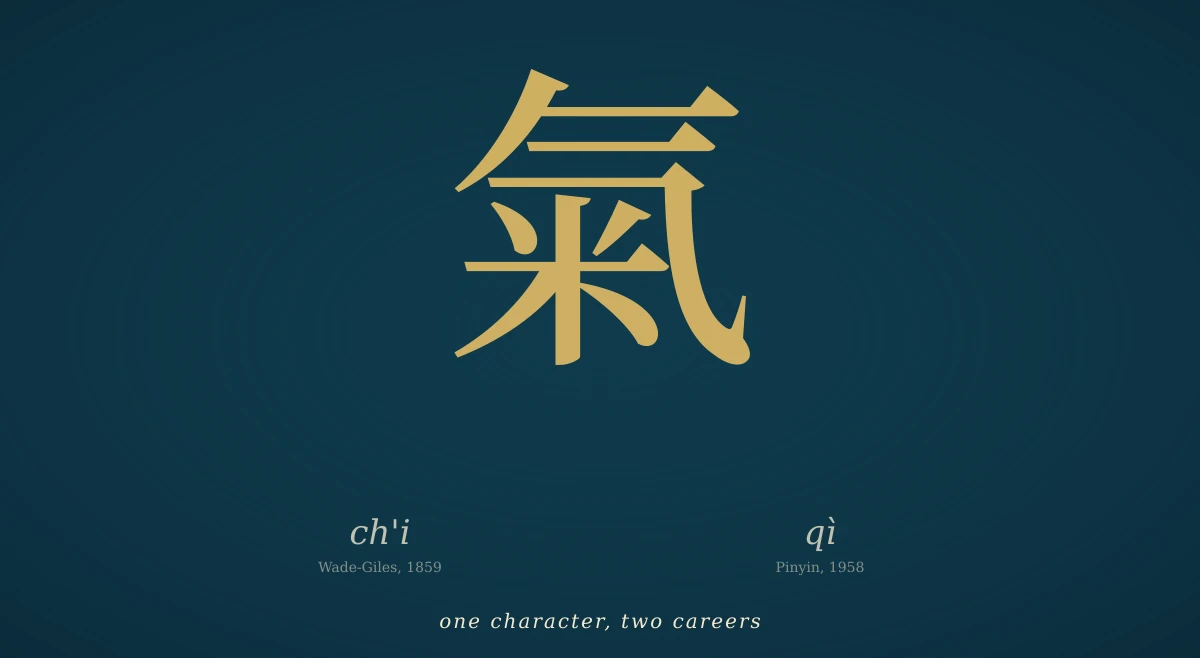
"Chi" and "Qi" are the same character — but the two spellings have had very different careers in English. One became a substance; the other, a process.
A change in spelling is trivial. A drift in definition is catastrophic
Ask any martial artist, acupuncturist, or pop-culture enthusiast if there is a difference between Chi and Qi, and you will almost certainly receive a swift linguistic correction:
“They are the exact same word. ‘Chi’ is the older Wade-Giles romanisation, while ‘Qi’ is the modern Hanyu Pinyin standard. It’s just a matter of spelling.”
From a purely orthographic standpoint, this answer is correct. When Sir Thomas Wade devised his romanisation system for Mandarin in the mid-nineteenth century (later modified by Herbert Giles), he rendered the character 氣 as ch’i. When the Chinese government officially introduced Hanyu Pinyin in 1958 to standardise modern Mandarin phonetics, that same character 氣 became qì. The Chinese character never shifted. The underlying Mandarin pronunciation remained virtually identical.
Yet, from the perspective of an engineer who has watched concepts move across cultural boundaries and system interfaces, this answer is dangerously incomplete.
Orthography may be identical in origin, but the cultural and intellectual trajectories of the two spellings split dramatically during the twentieth century. In the English-speaking world, “Chi” and “Qi” have come to denote two radically different mental models.
“Chi” became the badge of a Westernised, New Age energy mysticism — a mysterious vital substance to be hoarded, projected, or channelled. “Qi,” when read through the primary classical texts and systems science, describes something far more subtle and rigorous: the dynamic state of structural alignment, coherence, and organisational flow within an open system.
This article is an investigation into that semantic drift, why it occurred, and why resolving it is essential if we are to extract real value from classical traditions of the body.
1. The transliteration trap: Wade-Giles vs. Pinyin
To understand how a phonetic standard turned into a conceptual divide, we must first trace the mechanics of translation.
```
THE HISTORICAL SPLIT OF 氣 (QI / CHI)
                       Chinese Character
                             [ 氣 ]
                               |
              +----------------+----------------+
              |                                 |
     Wade-Giles System (1859)          Hanyu Pinyin System (1958)
         Renders as "Ch'i"                  Renders as "Qì"
              |                                 |
     19th/20th Century Import          Late 20th Century Academic
     Western Esotericism &              Re-translation & Classical
     "Vital Force" Metaphor             Systems Re-examination
              |                                 |
              v                                 v
    [ "CHI" = VITAL FLUID ]           [ "QI" = DYNAMIC ALIGNMENT ]
    (Substance / Mysticism)           (Pattern / Process / State)
```
When nineteenth-century British diplomats and scholars encountered classical Chinese medicine and philosophy, they were forced to map foreign operational concepts onto European intellectual categories.
The Western mind of the 1800s was steeped in two dominant frameworks: Newtonian physics (which viewed the world as discrete material particles acted upon by forces) and Vitalism (the belief that living organisms are animated by an unmeasurable “vital force” or élan vital distinct from physical laws).
When Westerners read classical passages describing the movement of ch’i through the human body, they naturally fell back on the vocabulary of their era. They translated ch’i as “vital force,” “etheric energy,” or “life fluid.”
By the time the Wade-Giles spelling “Chi” dominated Western martial arts studios and alternative healing literature in the 1970s, it had absorbed an entire ecosystem of Western esoteric assumptions. “Chi” became an ethereal thing — an invisible juice that ran through spiritual pipes.
2. How “Chi” became a Western metaphor for energy
Language shapes perception. Once the word “Chi” became synonymous with “energy” in English, it triggered a series of category errors.
In physics, energy is not a fuzzy concept. As argued in What Is Chi? A Systems Engineer’s Reframing, energy is a scalar quantity measured in Joules. It obeys strict conservation laws. Electromagnetic radiation, thermal kinetic motion, and chemical bonds are all measurable forms of energy.
If “Chi” were a physical energy in the Western sense, it would register on physical instruments. Yet a century of bio-electromagnetic measurement, quantum sensor development, and high-energy physics has failed to uncover a separate “vital energy” field.
```
THE TWO CONVOLUTED MENTAL MODELS
================================================================================
MODEL A: WESTERN “CHI” MYSTICISM MODEL B: CLASSICAL “QI” SYSTEMS
---------------------------------- ----------------------------------
- A substance (fluid / gas) - A dynamic condition (state)
- Can be stored, projected, donated - Emerges from internal alignment
- Operates outside physical laws - Governed by non-equilibrium physics
- Measured by subjective sensation - Measured by functional coherence
- Category: Entity / Field - Category: Process / Relationship
================================================================================
```
When Western popular culture adopted “Chi,” it retained the substance model. People began speaking about “Chi” as though it were fluid in a battery:
- “I am low on Chi today.”
- “He projected his Chi to strike an opponent from a distance.”
- “This master can transfer his Chi into your body to heal you.”
This substance-based mental model led straight into a dead end. Skeptics rightly dismissed it as pre-scientific nonsense, while believers retreated into unfalsifiable mysticism. Both groups missed the point entirely because both were working from a mistranslation.
3. What “Qi” means in classical systems thought
If we discard the nineteenth-century Western baggage and look at how the classical texts use the character 氣 (qi), a completely different picture emerges.
The etymology of the character 氣 reveals its original context. It consists of two parts: 气 (representing vapour, steam, or breath rising) over 米 (rice). It captures the image of steam rising from cooking rice — a phenomenon that is neither purely material (like raw grain) nor purely immaterial (like empty space). It is a process of transformation.
```
ETYMOLOGY OF 氣
                   [ 气 ]  Vapour / Steam / Breath (Movement & Heat)
                   ------
                   [ 米 ]  Rice / Grain (Material Base & Fuel)

   = The active process of transformation occurring when fuel
     and heat interact to generate work and spatial order.
```
When you examine the earliest texts, qi is never treated as an isolated substance that exists on its own shelf.
The Neiye (4th century BCE)
The Neiye (“Inner Cultivation”) does not talk about hoarding energy. It talks about alignment (zheng) and stillness (jing). Vitality arises when the body and mind are aligned so that internal functions proceed without friction or internal turbulence. Qi in the Neiye is the state of a system that is running without internal conflict.
Mencius (4th century BCE)
Mencius speaks of haoran zhi qi (“flood-like qi”), which he explicitly links to moral integrity (yi). You cannot build flood-like qi by doing breathing exercises alone; it dissipates if your actions contradict your intentions. Moral conduct does not generate a physical fluid. It generates psychological and physiological coherence — the alignment of intention, action, and bodily state.
The Huangdi Neijing (2nd century BCE)
The foundational text of Chinese medicine describes qi moving through jingluo (channels or meridians). But as unpacked in the Sources Library, these channels were never intended as anatomical pipes like blood vessels. They were mapped as functional couplings — diagrams of systemic dependency showing how a disturbance in one organ network propagates to affect another.
In modern engineering terminology, qi in these texts is an emergent state variable. It describes how effectively an open system maintains its operational integrity far from equilibrium.
4. The semantic drift: from coherence to substance
How did an emergent state of coherence become distorted into an etheric substance?
The shift can be mapped as a three-stage semantic drift:
STAGE 1: CLASSICAL CHINA (4th BCE - 2nd CE)
  Qi = Process / Relationship / Dynamic Coherence
  "The system is running with minimal internal friction."
                           |
                           v
STAGE 2: NINETEENTH-CENTURY TRANSLATION (1850 - 1920)
  Ch'i = Vital Force / Etheric Fluid
  "The body is animated by a mysterious non-Newtonian energy."
                           |
                           v
STAGE 3: WESTERN POPULAR CULTURE (1970 - Present)
  Chi = Commodity / Magic Fuel
  "I can store, project, and transfer this energy to others."
This semantic drift was not harmless. It created two distinct dialects that talk past each other:
- The modern esoteric dialect (“Chi”). Uses the language of substance, projection, and magic. It appeals to people looking for quick fixes, supernatural abilities, or anti-scientific romanticism.
- The systems / somatic dialect (“Qi”). Uses the language of pattern, structural alignment, bioelectric coupling, and non-equilibrium thermodynamics.
When we use the spelling “Chi”, we almost always drag along the baggage of Stage 3. When we use “Qi”, particularly within modern scholarship and somatic science, we have an opportunity to reset the conversation back to Stage 1 — and connect it directly with modern systems theory.
As argued in Dissipative Structures Explained, living systems survive by maintaining a continuous flow of energy and matter through their structures to keep entropy at bay:
dS = diS + deS
The ancient concept of qi was a brilliant, pre-scientific attempt to describe the quality of that dissipative flow from the inside — phenomenologically — long before we had the differential equations to describe it from the outside.
5. Why precision matters for the engineer and the practitioner
Why should we care about this distinction? Is it just academic nitpicking?
It matters immensely, because your mental model dictates your practice.
If you believe you are cultivating “Chi” as a substance, your practice will focus on acquisition and retention. You will look for tricks to “store” energy in your abdomen, seek out gurus who promise to “transmit” power to you, or worry about “losing” energy through your eyes or skin. You become a passive consumer of a hypothetical fuel.
If you understand that you are cultivating “Qi” as a state of systemic organisation, your entire approach changes:
```
PRACTICAL CONSEQUENCES OF THE TWO MODELS
================================================================================
PRACTICE BASED ON “CHI” (Substance) PRACTICE BASED ON “QI” (Organisation)
------------------------------------ ------------------------------------
- Seeking external energy transfers - Optimising internal mechanics
- Focus on subjective “buzzing” - Focus on structural alignment
- Passive consumption of force - Active reduction of tissue friction
- Fragile, untestable beliefs - Reproducible somatic feedback
================================================================================
```
When you adjust your posture in standing meditation (Zhan Zhuang) so that weight drops cleanly through the skeletal frame without unnecessary muscular contraction, you are not trapping a fluid. You are reducing mechanical noise and metabolic friction.
When your breath slows down and your vagal tone increases, lowering your heart-rate variability and settling your nervous system, you are not pumping in magic energy. You are increasing the functional coherence of your biological dissipative structure.
The feeling of heat, tingling, or weight in the palms — the very experience that often starts an investigation into these traditions — is not a mystical field. It is the real-time vascular and neuroelectric feedback of a system dropping its internal turbulence and improving its local flow of organisation.
6. Where the boundary sits
As always on this site, we must draw a clear line between what is established physics and what is conceptual synthesis.
What is established
- The distinction between Wade-Giles (ch’i) and Pinyin (qì) is a matter of modern linguistic standardisation; both translate the same historical Chinese character 氣.
- Classical Chinese philosophical and medical texts describe qi primarily through concepts of order, alignment, functional coupling, and transformation, rather than as an isolated physical force.
- No distinct “vital energy” field operating outside the known laws of physics has ever been measured or demonstrated.
What is the reading on this site
- That the Westernised spelling “Chi” has become culturally corrupted by 19th-century Vitalism and 20th-century New Age esotericism, turning a dynamic process into a substance metaphor.
- That restoring the classical reading of “Qi” allows us to bridge ancient somatic wisdom directly with modern concepts in Complex Adaptive Systems, dissipative structures, and bioelectricity.
- That Qi is best understood not as a thing that flows through a system, but as the degree of structural and functional organisation of the system itself.
When you strip away the bad translation and the Western energy mysticism, what remains is not less interesting — it is infinitely more profound. Ancient practitioners did not discover a magic fuel. They discovered how to optimise the living machinery of the human body from the inside out.
Primary references and further reading
- Roth, H. D. (1999). Original Tao: Inward Training (Nei-yeh) and the Foundations of Taoist Mysticism. Columbia University Press.
- Unschuld, P. U. (2011). Huang Di Nei Jing Su Wen: Nature, Knowledge, Imagery in an Ancient Chinese Medical Text. University of California Press.
- Needham, J. (1956). Science and Civilisation in China: Volume 2, History of Scientific Thought. Cambridge University Press.
Related reading on this site
- What Is Chi? A Systems Engineer’s Reframing — the cornerstone this piece belongs to.
- Why Chi Is Not a Substance — the engineering critique of the substance model in detail.
- The Neiye (Inward Training), Mencius on Haoran Zhi Qi, and the Huangdi Neijing — the three classical sources discussed above.
- Dissipative Structures Explained — the thermodynamic frame behind the “process” reading.
← Back to the Chi, Reframed guide
More in this pillar
The other pillars
Be first to know
The book is in its final editing stage. Leave your email and you will hear when it is ready.