Traditions of the Body·Essay
Prana, Nadis and the Indian Body: A Complete Guide
A complete guide, from zero, to the Indian model of the body: prana, nadis, chakras, koshas and the Eight Limbs of Patanjali.
How to read this text
You do not need any prior knowledge. Every term is explained the first time it appears. The Sanskrit is there so you can look things up further — you do not have to memorise it.
An honest note before we start
What you will read here is a model, not anatomy. The nadis are not vessels you will find at autopsy. Prana is not a measurable energy in the physics sense. The chakras do not show up on an X-ray — and the tradition itself has never seriously claimed they do; it names them explicitly as objects of meditative construction and visualisation.
That does not make it nonsense. It makes it a language of experience — a system developed over two and a half millennia to describe and act on what someone feels inside their own body and mind.
But there is a second warning here, specific to this tradition and larger than its Chinese counterpart:
Most of what circulates today as “yoga” is a 20th-century construction.
Patañjali devotes three verses to āsana, in a work of 195 verses — and describes no posture. The modern sequences of standing postures took their current shape in Mysore in the 1930s, in the school of T. Krishnamacharya, with documented influences from British gymnastics and Scandinavian physical culture. The seven-chakra system everybody knows comes from a single sixteenth-century text, translated in 1919, which became “the” tradition because it happened to be translated first.
This text will tell you each time whether something is ancient, medieval, or modern. Not to discredit the modern — some of the best things in practice are modern — but because confusion here is the rule, not the exception.
So hold both at once: take it seriously as a practical tool, do not confuse it with physiology, and do not confuse it with history.
A short introduction to Indian thought, for the reader who is new
Before any of the technical material lands, it helps to have five things in mind. If you already know them, skip to the Contents.
Where this comes from, in time and place
The Indian subcontinent has a textual record going back to the Ṛg Veda (ऋग्वेद), the oldest layer of which is dated to roughly 1500–1200 BCE — a corpus of ritual hymns composed in Vedic Sanskrit, transmitted orally with extraordinary fidelity for about a thousand years before being written down. Underneath the Vedic layer, the Indus Valley Civilization (c. 2600–1900 BCE) left seals that may show a figure in a seated posture, but its script remains undeciphered; the connection to later yoga is suggestive and unprovable.
The thinking you will meet in this guide was shaped mostly between the Upaniṣadic period (c. 800–200 BCE) and the Tantric / Haṭha period (c. 800–1700 CE), with Patañjali’s Yoga Sūtra (around 2nd–4th century CE) as the canonical articulation of the classical system. It has been continuously taught, practised, and argued over since, and now exists as a modern global practice — in forms that are not continuous with any single historical lineage, which this text will mark carefully.
There is no “the” Indian tradition
Indian thought has roughly nine classical schools of philosophy — the ṣaḍ-darśana or six “orthodox” (āstika) systems (Nyāya, Vaiśeṣika, Sāṃkhya, Yoga, Mīmāṃsā, Vedānta) and three “heterodox” (nāstika) systems (Buddhism, Jainism, Cārvāka). What is usually called “Hindu” is itself a modern umbrella covering several distinct theologies and worldviews, including:
- Vedānta — the mainstream philosophical tradition rooted in the Upaniṣads. Advaita (non-dual, Śaṅkara, c. 8th c. CE), Viśiṣṭādvaita (qualified non-dual, Rāmānuja, 11th c.) and Dvaita (dualist, Madhva, 13th c.) are three of its major schools, and they contradict each other on fundamentals.
- Sāṃkhya — the dualist system that provides the theoretical backbone of classical Yoga, treated in chapter 2 of this guide.
- Tantra — a diverse body of practices (both Hindu and Buddhist) that developed the chakra and kundalini material, mostly from the 8th century CE onward.
- Bhakti — the great devotional traditions, which have the largest Indian following today and whose body-practices are closer to prayer and song than to posture work.
Buddhism and Jainism emerged alongside the Upaniṣadic ferment in the 6th–5th centuries BCE and share much of the vocabulary and background, while differing sharply on key questions (notably whether there is an ātman at all — Buddhism denies it).
What kind of body-knowledge this is
The body material in this guide is a synthesis of several streams, drawn mostly from:
- The Upaniṣads (उपनिषद्, 800–200 BCE), especially the Kaṭha, Taittirīya, Chāndogya and Praśna Upaniṣads — the source of the chariot image, the five koshas, and the first systematic reflection on prāṇa.
- The Sāṃkhya Kārikā of Īśvarakṛṣṇa (c. 4th c. CE) — the theoretical backbone.
- The Yoga Sūtra of Patañjali (c. 2nd–4th c. CE) — the 195-verse canonical codification; the source of the Eight Limbs and the definition in chapter 15.
- The Haṭha manuals of the 15th–17th centuries — Haṭhayogapradīpikā of Svātmārāma, Gheraṇḍa Saṃhitā, Śiva Saṃhitā — the source of most of the “geography” (nadis, bandhas, mudras, kumbhaka).
- The Ṣaṭ-cakra-nirūpaṇa (1577), which is where the familiar seven-chakra system comes from — one text, late, translated in 1919 and thus made globally dominant by accident of translation history.
- The Āyurveda compendia (Caraka and Suśruta Saṃhitās, roughly 1st c. BCE – 4th c. CE) — the source of agni, ojas, āma, and the doṣa framework.
- Modern postural yoga (early 20th c. onward), which is a hybrid of Haṭha vocabulary, European physical culture, and the specific pedagogy of Krishnamacharya’s Mysore school (teacher of Iyengar, Pattabhi Jois, Desikachar). It is now the main delivery system for the practice globally and is often — and incorrectly — described as “ancient”.
What this material is not
It is not a monolith. Different texts give different numbers of chakras (4, 5, 6, 7, 9, 12, 21), different lists of nadis (72,000 to 350,000), and incompatible metaphysical frameworks. The familiar rainbow-coloured seven-chakra diagram with endocrine-gland correspondences is a modern construction, assembled in the 20th century mostly through the Theosophical Society. The chakra material in this guide treats this honestly — chapter 11 details what the actual pre-modern sources say.
It is also not entirely safe. The practices described here can produce real adverse effects — this is not metaphysics but documented clinical observation. The guide marks these explicitly where they occur (chapters 11, 13, 14, 21).
A word on names
Sanskrit is written in several scripts, principally Devanāgarī (देवनागरी). This guide uses IAST (International Alphabet of Sanskrit Transliteration — the standard scholarly romanisation with diacritics: prāṇa, nāḍī, cakra) throughout; where the popular romanisation is dominant (prana, nadi, chakra) the two are given together. Devanāgarī appears on first use so you can look things up.
A pronunciation note: c in IAST is always a soft “ch” (like English “church”), so cakra is pronounced “chakra”. Long vowels (ā, ī, ū) are twice the length of short ones. Retroflex consonants (ṭ, ḍ, ṇ, ṣ) are made with the tongue tip curled back; approximate them with the English t, d, n, sh and nobody will mind.
With that in hand, the material below should be legible without prior training.
Contents
PART A — The foundational idea
- The chariot
- Purusha and Prakriti: a real dualism
- The three gunas: why they are not yin-yang
- The five elements and the body
PART B — The material of the system
- Prana: what they really mean
- The five Vayus
- Agni, Ojas, Ama: the economy of the organism
- The five Koshas: the layers
PART C — The geography
- The Nadis: the network
- Ida, Pingala, Sushumna: the three main ones
- The Chakras — with all the caveats
- The three Granthis: the knots
- The three Bandhas: the locks
- Kundalini: what the tradition does and does not say
PART D — The mind
PART E — The practice
- The Eight Limbs (Ashtanga)
- Āsana: what Patañjali actually says
- Ten practical principles for the body
- Pranayama: the mechanics of breath
- Drishti and Pratyahara: the economy of attention
PART F — Synthesis
APPENDIX — Glossary and sources
PART A — THE FOUNDATIONAL IDEA
1. The chariot
Where the Chinese system starts from a hill, the Indian starts from a chariot. The image is from the Kaṭha Upaniṣad (कठोपनिषद्, c. 5th–3rd c. BCE), and it is the most compressed description of the whole system:
| Chariot element | Correspondence |
|—|—|
| The vehicle | The body (शरीर śarīra) |
| The horses | The senses (इन्द्रिय indriya) |
| The reins | The mind (मनस् manas) |
| The charioteer | Discernment, intellect (बुद्धि buddhi) |
| The passenger | The self (आत्मन् ātman) |
Three things come out of the image immediately, and they are the whole of Indian thought about the body:
First, there is a hierarchy. This is the critical difference from Chinese thought. These are not two equal sides of a hill. They are layers, with a clear order: the coarse serves the subtle. The whole Indian system is tiered, not polar.
Second, the passenger is not driving. The ātman does nothing. It is not an engine, not a will, not “the soul struggling”. It is a witness. This is the hardest point for a Western mind and it will return in every chapter.
Third, the problem is not the horses. The horses (the senses) are not bad — they are necessary, without them the chariot goes nowhere. The problem is slack reins and a sleeping charioteer. Yoga is not a war on the body. It is training the wiring.
Hold on to this image. Every technique you will meet below — āsana, prāṇāyāma, bandha, dṛṣṭi — answers the question “where did the connection fail?”
2. Purusha and Prakriti: a real dualism
The theoretical background of classical Yoga is called Sāṃkhya (सांख्य, “enumeration”) and it is one of the oldest philosophical systems of India. Patañjali does not invent it — he presupposes it.
Sāṃkhya divides everything that exists into two:
पुरुष Puruṣa — pure consciousness
It has no properties. It does not move. It does not change. It does not act. It only observes. It is the light that illuminates, not the illuminated. In Sāṃkhya it is plural (each being has its own) — Advaita will later overturn this.
प्रकृति Prakṛti — nature, matter
Everything else. And watch out here, because this is where almost everyone stumbles: Prakriti includes not only the flesh and the world, but also the mind, emotion, intelligence, ego and memory. Thought is matter. Subtle matter, but matter.
Prakṛti acts, evolves, produces forms, is extraordinarily intelligent — but it has no consciousness. It is the perfect automaton.
Why this matters in practice
The whole problem, according to the system, is a confusion of identity: Puruṣa thinks it is Prakṛti. The witness identifies with the spectacle.
Patañjali says it in the second verse of his work, and again in the third:
तदा द्रष्टुः स्वरूपेऽवस्थानम् tadā draṣṭuḥ svarūpe ‘vasthānam (Yoga Sūtra 1.3)
“Then the observer rests in its own nature.”
So: yoga does not produce anything. It does not give you a new state. It stops a misunderstanding. What remains when the noise stops is what you already were.
The practical consequence: when in your practice you try to “achieve a state”, by the system’s own logic you are facing the wrong direction. It is subtractive work, not additive. The sculptor, not the builder.
The honest note
This dualism is a real dualism — two essentially different realities. It is not yin-yang. Yin and yang are the same hill. Puruṣa and Prakṛti are not the same thing as anything, and the one is never transformed into the other.
This created huge philosophical problems (how do they interact if they have nothing in common?) and led, centuries later, to the radical solution of Advaita Vedānta: there are not two — there is one, and the second is appearance. See chapter 25.
3. The three gunas: why they are not yin-yang
Prakṛti is not homogeneous. It is composed of three qualities, the गुण guṇa (literally: “threads” of a rope).
And here is the deepest structural difference from Chinese thought: three, not two. A binary system describes oscillation. A triadic system describes a state with a direction.
| Guna | Quality | In the body | In the mind | Excess |
|—|—|—|—|—|
| सत्त्व sattva | Clarity, balance, light | Lightness, clean sensation, easy breathing | Quiet, lucidity, presence | No “bad” sattva, but there is attachment to it |
| रजस् rajas | Motion, passion, restlessness | Nervousness, tension, irregular breathing | Desire, scatter, haste | Anxiety, exhaustion, insomnia |
| तमस् tamas | Weight, inertia, darkness | Heaviness, stiffness, sluggishness | Fogginess, confusion, denial | Depression, stagnation |
The three are not a moral scale
The temptation is to read sattva=good, tamas=bad. Wrong, or at least half-wrong.
- Without tamas there is no sleep, no stability, no bone, no structure, no rest.
- Without rajas there is no movement, no digestion, no will, no action at all.
- Sattva without the other two has no body.
All three are always present, in everything, in different proportion. The question is which one dominates now.
The practical use — and it is the biggest in the chapter
This is the single most immediately useful self-observation tool of the whole system. Before any practice, ask: which guna dominates right now?
- If you are rajasic (nervous, scattered, “I can’t sit still”) → the correct practice is long exhale, low in the body, slow. Doing an intense flow will feed the rajas and you will call it “release” when it is in fact fuel on the fire.
- If you are tamasic (heavy, sluggish, foggy) → you do not start with meditation. You will fall asleep and call it quiet. You need movement, inhalation, heat first.
- If you are sattvic → sit. Do not spoil it by scheduling.
The classical sequence is explicit and not optional: from tamas → through rajas → toward sattva. You do not go from inertia to clarity directly. You have to pass through motion. This is why āsana precedes meditation and not the other way around.
4. The five elements and the body
The पञ्चमहाभूत pañca-mahābhūta, “five great elements”. Not chemistry — states of organisation of matter, from the subtlest to the densest.
| Element | Quality | Sense | In the body |
|—|—|—|—|
| आकाश ākāśa (ether/space) | Space, receptivity | Hearing | Cavities: joints, mouth, thorax, intervertebrals |
| वायु vāyu (air) | Motion | Touch | Breath, nervous impulse, peristalsis |
| अग्नि agni (fire) | Transformation | Sight | Digestion, metabolism, temperature, vision |
| जल jala / ap (water) | Cohesion | Taste | Plasma, lymph, synovial fluid, mucus |
| पृथ्वी pṛthvī (earth) | Stability | Smell | Bones, muscles, skin, structure |
The logic of the order: each element contains the previous. Space allows motion; motion produces friction, which is heat; heat melts, so liquid; liquid solidifies. Causality runs from the subtle toward the dense — exactly the opposite of modern materialist intuition, and that is deliberate.
The direct practical application
This is the most useful diagnostic tool for a posture or a body:
- Stiffness, dryness, pain in the joints → deficiency of ākāśa/jala; you need space and flow, not force
- Trembling, instability, cold extremities, dry sounds in the joints → excess vāyu; you need grounding, weight, slow breathing
- Overheating, irritation, competitiveness in practice → excess agni; you need cool, long exhale
- Heaviness, oedema, sluggishness → excess jala/pṛthvī; you need movement and heat
This is also the basis of Āyurveda, which groups the five elements into three functional types — the दोष doṣa:
| Dosha | Elements | Function | When disturbed |
|—|—|—|—|
| वात Vāta | Air + Ether | Every movement, nerves, breath, elimination | Anxiety, insomnia, dryness, bloating, pain |
| पित्त Pitta | Fire + Water | Every transformation: digestion, metabolism, sight, judgement | Inflammation, acidity, anger, rashes |
| कफ Kapha | Water + Earth | Structure, lubrication, immunity, stability | Stagnation, mucus, weight, attachment |
A note on interpretation: the doshas are not “personality types” as sold by the Western wellness industry. In classical Āyurveda they are functional principles that everyone has — your prakṛti (constitution) is the baseline ratio, and your vikṛti (current state) is the deviation. The interesting thing is the deviation, not the label.
PART B — THE MATERIAL OF THE SYSTEM
5. Prana: what they really mean
प्राण prāṇa. The word is a compound: pra- (“forward, out-“) + an (“to breathe”). Literally: what moves forward; the propulsive breath.
It is usually translated “life energy”. Not wrong, but vague. Better renderings: the motive principle, the tendency toward motion, what makes a body alive instead of dead.
Three levels of meaning — do not confuse them
The word is used at three scales, and the texts shift level without warning:
- Cosmic: prāṇa as the vital principle of the universe. The Upaniṣads say everything is born from it.
- Organismic: prāṇa as the sum of vital functions of a particular body.
- Specific: prāṇa-vāyu, one of five currents — the one that moves inward and upward (ch. 6).
When you read “the prāṇa rises”, the third is meant. When you read “prāṇa is everything”, the first.
The relation to breath
Prāṇa is not the breath. But the breath is its only handle.
This is the central practical argument of the whole tradition, and it is genuinely clever:
The breath is the only vital function that is simultaneously automatic and voluntary.
You cannot decide to change digestion or blood pressure. You can change breath — and the breath is coupled to everything else. So the breath is the door from voluntary to involuntary. It is the point where the will can touch the autonomic.
The classical axiom, from the Haṭhayogapradīpikā (2.2):
चले वाते चलं चित्तं cale vāte calaṃ cittaṃ — “when the breath moves, the mind moves; when it is still, it is still.”
Why it works, without metaphysics: long exhalation activates the parasympathetic via the vagus; respiratory rhythm couples with cardiac rhythm (respiratory arrhythmia); slow breathing around 6 cycles per minute coincides with baroreflex resonance. The old language and modern neurophysiology point to the same place.
How to take it practically: when they say “send prāṇa there”, functionally it means “direct the attention to the area and couple it to the breath cycle”. And something does happen — change in muscle tone, local vasodilation, breath-pattern shift. You do not have to believe anything for the method to work.
6. The five Vayus
वायु vāyu = “wind”. The prāṇa differentiates into five currents, each with a direction and a region. This is one of the most useful pieces of the system, because it translates almost directly into sensation.
| Vayu | Direction | Seat | Function | Sign of disturbance |
|—|—|—|—|—|
| प्राण Prāṇa | Inward and upward | Chest, heart | Inhalation, uptake (food, impressions) | Shallow breath, “I can’t get enough air” |
| अपान Apāna | Downward and outward | Pelvis, lower belly | Exhalation, elimination, childbirth, menses, grounding | Constipation, feeling uprooted, anxiety |
| समान Samāna | Toward the centre | Navel | Digestion, assimilation — material and mental | Indigestion, “I can’t process it” |
| उदान Udāna | Upward, into the throat | Throat, head | Speech, upright posture, expression, ascent | Hoarseness, inability to speak, slumping |
| व्यान Vyāna | From the centre outward | Whole body | Circulation, coordination of limbs, periphery | Uncoordinated movement, numbness, disconnection |
The central pair: Prana and Apana
The whole practice boils down to one relation: prāṇa descends, apāna rises, they meet.
This is the explicit position of the Haṭhayogapradīpikā and the reason the bandhas exist (ch. 13). The classical statement: the union of prāṇa and apāna in the navel region is what “awakens” the fire and opens the sushumna.
And in purely practical terms, without any metaphysics: this describes exactly the state in which the diaphragm and the pelvic floor work in coordination as one pressure system. The diaphragm descends, the pelvic floor responds, intra-abdominal pressure is regulated. Modern functional biomechanics describes the same thing with other vocabulary — and calls it, almost comically, the “canister model of the torso”.
The test
Sit upright. On the inhale, watch what moves first: if the chest moves first and the shoulders rise, prāṇa is working without apāna — you have half a system. On the exhale, watch whether the pelvic floor has any participation or is entirely silent.
You do not have to “do” anything. Observation on its own changes the pattern within a few breaths. This is not mysticism — it is motor control.
(There are also five secondary vayus, the upa-vāyus: nāga [belching], kūrma [blinking], kṛkara [sneezing, hunger], devadatta [yawning], dhanañjaya [remains after death]. Interesting as taxonomy, hardly useful in practice.)
7. Agni, Ojas, Ama: the economy of the organism
Three terms from Āyurveda that explain what the system considers health.
अग्नि Agni — the fire
The transformative capacity. Not only digestion of food — digestion of everything: impressions, experiences, emotions. The central agni sits in the stomach/intestine (jāṭharāgni), but there is an agni in every tissue.
Four states: balanced, sharp (burns excessively — constant hunger, irritation), weak (heavy after food), unstable (sometimes one way, sometimes another — characteristic of vāta).
आम Āma — the undigested
What came in and was not transformed. In the body: sticky residue. In the mind: unread experience that settles.
Signs: coating on the tongue in the morning, heavy waking, fogginess, bad odour, “stuck”. In practice the diagnostic tool is literally the tongue in the mirror in the morning.
The central principle: āma is produced when the quantity of input exceeds the capacity to digest. And this applies equally to food and to information — the tradition does not distinguish, and this is one of the places where it has aged well.
ओजस् Ojas — the essence
The final product of complete digestion. The “capital” of the organism: immunity, vitality, stability, radiance. It is the closest thing to the Chinese jing.
Consumed by: chronic stress, excess, sleep deprivation, over-stimulation, chronic inflammation. Built by: sleep, quiet, well-digested food, steady breath, contentment.
The chain in one line
Good agni → ojas. Weak agni → āma. The same food, the same person, two entirely different outcomes depending on the state of the fire.
The practical consequence is counter-intuitive to a Western mind: it is not enough to put good things in. The system is less interested in what you eat and more interested in whether you can digest it. The same for practice: a correct practice on an exhausted system produces āma, not ojas.
8. The five Koshas: the layers
From the Taittirīya Upaniṣad (~6th c. BCE). कोश kośa = “sheath, envelope”. Five concentric layers, from the coarsest to the subtlest.
This is the basic organising map of the whole of Indian body-thinking — the equivalent of “the body as landscape” in the Chinese guide.
| Kosha | Literally | What it is | How it is worked |
|—|—|—|—|
| अन्नमय annamaya | “made of food” | The physical body: bones, flesh, organs | Āsana, nutrition, sleep, movement |
| प्राणमय prāṇamaya | “made of prana” | The energetic/functional layer: breath, rhythms, vitality | Pranayama, bandha |
| मनोमय manomaya | “made of mind” | The reactive mind: senses, emotion, habit | Pratyahara, ritual, mantra |
| विज्ञानमय vijñānamaya | “made of discernment” | Judgement, insight, the capacity to see a pattern | Self-observation, study (svādhyāya), meditation |
| आनन्दमय ānandamaya | “made of bliss” | The deepest; the state of fullness without an object | Samādhi; not “constructed” |
Three things to hold on to
1. They are not in order of priority — they are in order of accessibility. You have direct access to the first. Indirect to the second. The third changes with difficulty under direct effort. The fourth and fifth do not change at all under direct effort. This is why practice starts from the body — not because the body is more important, but because it is the only door with a handle on the outside.
2. They are not onion skins you peel off. You do not “move past” annamaya into prāṇamaya. They are all present at the same time, all the time, each permeating the others. The better image is not clothes — it is scales of description of the same system.
3. The most useful diagnostic question of the practice:
In which kosha is the problem actually located?
A pain in the shoulder may be:
- annamaya → actual tissue injury; needs rest or treatment
- prāṇamaya → a breathing pattern that holds the shoulder up 16 hours a day
- manomaya → a chronic defensive posture; the shoulder does what the nervous system does
- vijñānamaya → a belief about what you ought to endure
The same sensation, four different interventions. And working on the wrong layer is the most common way for a practice to go nowhere — stretching for three years a shoulder that is not tight for a mechanical reason.
PART C — THE GEOGRAPHY
9. The Nadis: the network
नाडी nāḍī — from the root nad, “to flow, to resound” (related to “reed, tube”).
The nadis are the channels through which prāṇa moves. Their number varies scandalously depending on the text, and this itself is instructive:
- Śiva Saṃhitā: 350,000
- Gorakṣa Śataka / Haṭhayogapradīpikā: 72,000
- Prapañcasāra Tantra: 300,000
What this disagreement means: that the number is not a measurement. It is a way of saying “a great many, networked everywhere”. The 72,000 prevailed because it is the figure repeated in the most widely circulated manual.
What are they really? There is no anatomical structure that corresponds to them. The serious hypotheses are the same as for the Chinese meridians: fascial planes, neurovascular bundles, or simply an empirical map of referred sensations. The honest answer: we do not know, and the system works as a map of experience regardless.
A crucial difference from the Chinese system: the nadis do not have named and numbered points, do not correspond to organs, and do not have a closed circulating loop. They are far less densely mapped. The Indian system did not invest in detailed topography — it invested in the central axis.
10. Ida, Pingala, Sushumna: the three main ones
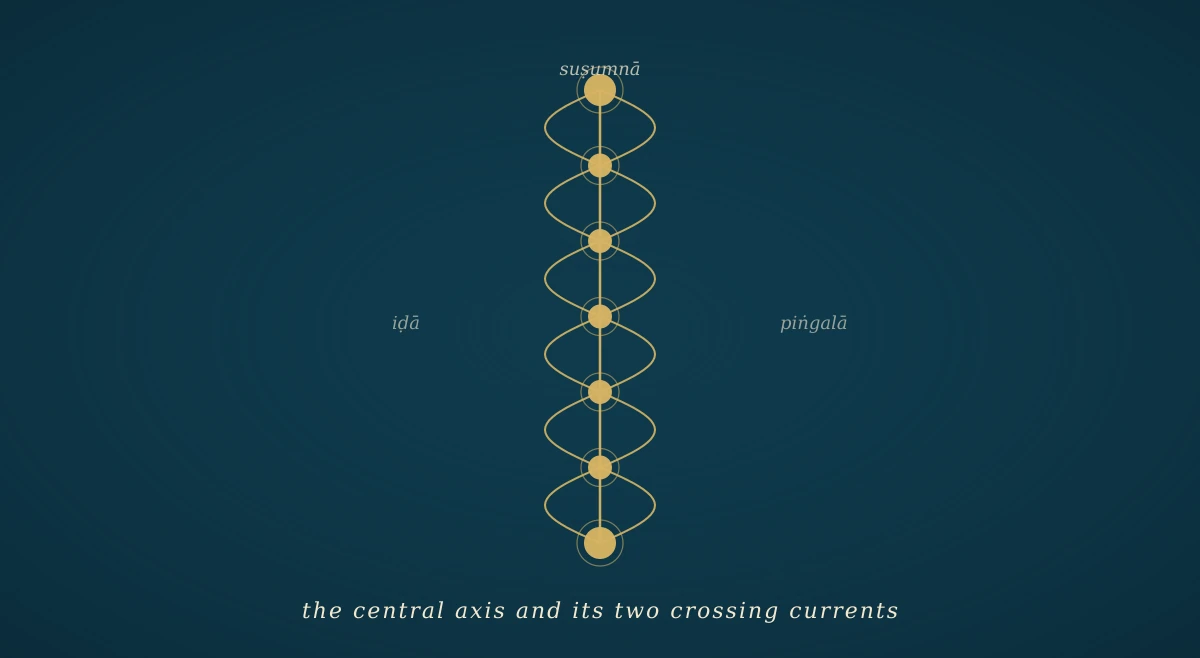
Of the thousands, three count. All three run along the spinal column, from the base to the head.
इडा Iḍā — “the cool one”
- Side: left
- Starts: left of the base, ends at the left nostril
- Quality: yin-like — cool, feminine, lunar (चन्द्र candra), receptive
- Mind: introversion, quiet, imagination, memory
- Excess: sluggishness, depression, withdrawal
पिङ्गला Piṅgalā — “the reddish one”
- Side: right
- Starts: right of the base, ends at the right nostril
- Quality: yang-like — warm, masculine, solar (सूर्य sūrya), active
- Mind: extroversion, action, logical analysis
- Excess: tension, exhaustion, aggression
सुषुम्णा Suṣumnā — “the most gracious”
- Position: the central axis, inside the spinal column
- Normally: closed, or nearly so
- Opens: when ida and pingala are balanced
- It is the only path the tradition is really interested in. Everything else is preparation for it.
The principle that holds the whole edifice
The sushumna does not open with effort. It opens with balance.
There is no technique called “open the sushumna”. There is only a technique called “balance ida and pingala” — and the sushumna opens as a consequence. This is the theoretical basis of nāḍī śodhana (alternate-nostril breathing) and the reason it is the most fundamental pranayama technique.
It is, you will notice, the same structure as “sculptor not builder” from chapter 2: you do not produce — you remove the obstacle.
The test you can do right now
Close one nostril, breathe. Then the other. They are not the same. One is more open.
This is a real, measurable phenomenon called the nasal cycle: the nostrils alternate dominance every ~90–240 minutes, through autonomic vasomotor regulation of the mucosa. It is documented in modern physiology and there is literature linking it to alternations in hemispheric activity and autonomic tone — with the usual methodological question marks.
The interesting thing is not that the tradition “was right about everything”. It is that it noticed a real phenomenon long before it was measured, named it, and built a technique on it. That deserves respect regardless of what you think about the rest.
The name “Haṭha” — and an honest correction
You will hear everywhere that हठ haṭha = ha (sun) + tha (moon), meaning “union of sun and moon”, meaning pingala + ida.
Historically, this is probably a later construction. The word haṭha in Sanskrit literally means “force, violence, insistence” — haṭha yoga = “the yoga of force”, in contrast to the gentler methods. The sun-and-moon interpretation appears in tantric commentaries and is esoteric reconstruction, not etymology.
Both meanings are useful. Just do not use the first in front of a philologist.
11. The Chakras — with all the caveats
Here the greatest care of the whole text is required, because here is the largest distance between what people think and what the texts say.
First, the historical truth
There is no “the” chakra system. Different Tantric texts give different numbers: 4, 5, 6, 7, 9, 12, 21. The Kaubjika-mata Tantra has one arrangement, the Nāth texts another, the Buddhist tantric traditions another (usually four or five).
The seven-chakra system everybody knows comes mainly from a single text of 1577, the Ṣaṭ-cakra-nirūpaṇa (“description of the six circles” — six, with the sahasrāra outside the count). It was translated into English in 1919 by Arthur Avalon (John Woodroffe) in The Serpent Power and became “the tradition” for the West because it happened to be the first available translation.
The rainbow colours (red→violet) that always accompany the diagrams are a 20th-century addition — the classical texts give entirely different colours (the ājñā is white, the maṇipūra is often described as the colour of a rain cloud). The correspondence with endocrine glands is also modern, from early-20th-century Theosophical literature.
And then what they really are
चक्र cakra = “wheel, disc”. In the texts themselves, the chakras are described as objects of meditative visualisation along the central axis. They have a number of “petals”, a seed syllable (बीज bīja), a geometric shape, an element, a deity. They are structured images for concentration, not organs.
This does not demote them. A tool for focusing attention on a specific bodily region, with a stable semantic charge, is exactly what you need for attention to work somatically. Just — this is what it is, not anatomy.
The table
| # | Chakra | Location | Element | Bīja | Theme (functionally) |
|—|—|—|—|—|—|
| 1 | मूलाधार Mūlādhāra “root-support” | Perineum / base of torso | Earth | लं laṃ | Survival, grounding, safety, structure |
| 2 | स्वाधिष्ठान Svādhiṣṭhāna “its own seat” | Sacrum / lower belly | Water | वं vaṃ | Fluidity, desire, creativity, reproduction |
| 3 | मणिपूर Maṇipūra “city of jewels” | Navel / solar plexus | Fire | रं raṃ | Will, digestion, identity, action |
| 4 | अनाहत Anāhata “unstruck sound” | Centre of sternum | Air | यं yaṃ | Relationship, receptivity, breath, compassion |
| 5 | विशुद्ध Viśuddha “purified” | Throat | Ether | हं haṃ | Expression, listening, truth, space |
| 6 | आज्ञा Ājñā “command” | Between the brows | Mind | ॐ oṃ | Discernment, oversight, insight |
| 7 | सहस्रार Sahasrāra “thousand-petalled” | Crown of head | — | — | (beyond) (silence) — not a chakra in the same sense; the destination |
The structural logic — which is the really worthwhile part
Notice how the sequence is built. It is not arbitrary:
The elements follow exactly the sequence of condensation of chapter 4, in reverse: earth → water → fire → air → ether → beyond-the-elements. That is, as you ascend the axis, you rarefy.
And the themes follow the same logic: survival → desire → will → relationship → expression → discernment. From the individual toward the relational toward the transindividual. It is, essentially, a hierarchy of levels of organisation — and it is strikingly close to what a modern developmental psychologist or a systems theorist would say about levels of integration.
The practical formulation: “you have the lower three so they do not preoccupy you”. A system fighting for survival has no resources for discernment. This is not metaphysical — it is resource allocation.
The warning
The classical instruction is explicit and is repeated in every serious text: you work from below upward. Premature and intensive concentration on the upper centres (ājñā, sahasrāra) is traditionally linked to over-stimulation, insomnia, headache, depersonalisation and mental instability.
This is not superstition. The modern literature on adverse effects of intensive meditation (studies on retreats, phenomena of depersonalisation/derealisation, the so-called “meditation-related adverse events”) describes almost the same symptoms. It is the exact equivalent of the Chinese 走火入魔 — see the Tibetan srog rlung essay for the parallel diagnostic category.
The instruction in one line: when in doubt, go lower.
12. The three Granthis: the knots
ग्रन्थि granthi = “knot”. Three points along the sushumna where the flow typically sticks.
This is the direct equivalent of the Chinese 三關 (three gates) — and, as there, they are located at points where the structure changes.
1. ब्रह्मग्रन्थि Brahma-granthi — the knot of the Creator
- Location: base, mūlādhāra region
- What it holds: attachment to survival, security, material identity. Inertia (tamas)
- In the body: tight pelvic floor, closed hips, inability to let weight down into the ground
- The passage: grounding without gripping — leaning without holding on
2. विष्णुग्रन्थि Viṣṇu-granthi — the knot of the Preserver
- Location: heart / solar plexus
- What it holds: attachment to relationships, roles, emotional identity, will. Rajas
- In the body: tight diaphragm, shoulders forward, “closed” chest, held exhale
- The passage: opening the thorax without projecting it — the difference between “opening” and “throwing out in front”
3. रुद्रग्रन्थि Rudra-granthi — the knot of the Destroyer
- Location: between the brows / ājñā
- What it holds: attachment to experiences, powers, spiritual identity. The subtlest ego: “I am someone who does practice”
- In the body: tension around the eyes and the neck, chin forward
- The passage: the hardest, because the very tool has become the bond
How to think of them together
They are three successive identifications: with the body, with the role, with the experience. And as in the Chinese system, the “untying” does not happen by force. You do not break a knot by pulling the rope.
13. The three Bandhas: the locks
बन्ध bandha = “binding, locking, restraint”. Here the system becomes extremely concrete and bodily — it is the most immediately applicable chapter of the text.
मूलबन्ध Mūla Bandha — the root lock
- Where: pelvic floor, perineum area
- How: a fine lift of the pelvic floor. Not glute squeeze. Not forcefully holding urine. The classical description talks about contraction, but reliable modern teaching stresses that it is tone, not contraction
- Function: retains the apāna so it does not escape downward; turns it upward
- The mistake: continuous strong clenching. Produces a hypertonic pelvic floor — a recognised clinical condition with real symptoms (pain, dysfunction). This is not a theoretical risk.
उड्डीयान बन्ध Uḍḍīyāna Bandha — “the one that flies upward”
- Where: lower belly, under the ribs
- How: only on full exhale, with empty lungs. The belly is drawn in and up — by the underpressure, not by muscular pull
- Function: massages the viscera, “lifts” the diaphragm, brings the apāna toward the centre
- Absolute contraindications: pregnancy, menstruation, hypertension, glaucoma, cardiac problems, recent surgery, full stomach
जालन्धर बन्ध Jālandhara Bandha — the net lock
- Where: throat
- How: the chin descends toward the sternum while the neck lengthens — it is not flexion, it is elongation with tilt
- Function: regulates the flow in the throat, protects from sudden rise of pressure in the head during retentions
महाबन्ध Mahā Bandha — all three together
The classical synthesis, in breath retention.
Why they work, without metaphysics
All three are pressure regulators. The body from the diaphragm to the pelvic floor is a closed container of variable pressure. Mūla bandha controls the bottom, uḍḍīyāna the middle, jālandhara the top.
Control of intra-abdominal pressure is the foundation of torso stability, lumbar protection, and efficient force transfer. The traditional language says “I retain the apāna”. Biomechanics says “I regulate intra-abdominal pressure”. They describe the same act.
The essential warning
The classical sequence is āsana → pranayama → bandha, with emphasis on supervision. This is not prudishness: bandhas with breath retention actually change intrathoracic pressure, venous return and cerebral perfusion. Without preparation, yes, they can do damage.
14. Kundalini: what the tradition does and does not say
कुण्डलिनी kuṇḍalinī — from kuṇḍala, “coil, earring”. “The coiled one”.
The classical image
A sleeping power, coiled three and a half times at the base of the spine. When it awakens, it rises through the sushumna, pierces the chakras and the granthis, and unites with consciousness at the sahasrāra. The union of Shakti (power) with Shiva (consciousness).
What you need to know
1. It is relatively late. Kundalini as such does not appear in the early Upaniṣads or in Patañjali. It is a tantric development, mainly from the 8th–12th century onward.
2. The tradition itself is extremely cautious. The texts that describe it are the ones that insist most on long preparation, a teacher, purification, ethical foundation, gradualness. There is no classical text that says “do it on your own, quickly”.
3. The “kundalini crisis” phenomenon is documented. The modern clinical literature contains descriptions of syndromes following intensive practice: uncontrollable muscular contractions, thermal sensations, insomnia, depersonalisation, acute anxiety. The term “spiritual emergency” was even entered in DSM-IV as a V-code (religious or spiritual problem).
The honest position: here is the point where the tradition makes the largest claims and has the least support. At the same time, it is the point where it issues the most serious warnings — and these deserve to be taken literally, whatever you think about the theory.
The practical stance the system itself proposes: do not aim at it. Do the work (ethical foundation, body, breath, attention). If the system is ready, what is to happen will happen; if it is not, pushing is the one thing that can spoil it.
PART D — THE MIND
Here the Indian system differs radically from the Chinese. Chinese medicine is organ-centric: the body explains the mind. Yoga is mind-centric: the mind is the field, and the body is the tool of access.
15. The definition: yogash chitta vritti nirodhah
The second verse of Patañjali’s Yoga Sūtra (~2nd–4th c. CE) is the definition of the whole thing:
योगश्चित्तवृत्तिनिरोधः yogaś citta-vṛtti-nirodhaḥ
“Yoga is the stilling of the whirlings of the mind.”
Four words, and each counts:
योग yoga — from the root yuj, “to yoke”. The same root as the Greek zygos and the English yoke. That is: yoking, connection, setting in function. Back to the chariot image: yoking the horses.
चित्त citta — the mind as a field, as a totality: memory, impressions, habits, reactions. Not “brain” and not “thought”. Closer to “psyche” or “mental substrate”.
वृत्ति vṛtti — from vṛt, “to turn”. Whirling, eddy, wave. The image is the surface of water: if it whirls, it does not reflect correctly.
निरोध nirodha — “restraint, quiet, cessation”. Not forceful suppression. The best rendering is not “I stop my thoughts” — that is both impossible and the wrong direction. It is “I let settle”.
The image that explains everything
A lake with a disturbed surface. You see neither the bottom nor your reflection.
Two ways to calm it:
- Beat the waves flat → impossible, you make it worse
- Stop throwing stones in, and wait → this is it
Patañjali does not say “empty the mind”. He says: stop producing turbulence, and clarity will emerge on its own, because it is the natural state.
This is, again, the same shape as chapter 2 and chapter 10: subtractive, not additive work. If you take one thing from the whole text, take this.
The five vrittis
Patañjali enumerates five kinds of mental motion, and adds that each can be beneficial or harmful (kliṣṭa / akliṣṭa) — they are not enemies:
- प्रमाण pramāṇa — right knowledge (perception, inference, testimony)
- विपर्यय viparyaya — wrong knowledge; you see a rope, you think it is a snake
- विकल्प vikalpa — imagination, conceptual construction without an object
- निद्रा nidrā — sleep (which is also a motion of mind, not an absence)
- स्मृति smṛti — memory
The essential point: even right knowledge is a vṛtti. The goal is not to think correctly — it is to not be swept away by thought, right or wrong.
16. The five Kleshas
क्लेश kleśa = “disturbance, affliction, torment”. The five roots of every dysfunction, according to Patañjali (2.3–2.9). They are arranged causally: each one gives rise to the next.
| # | Klesha | What it is | How it shows up in the body |
|—|—|—|—|
| 1 | अविद्या avidyā | Ignorance — not lack of information, but the fundamental confusion of identity: you take the temporary for the permanent, the not-self for the self. The root of the other four | — |
| 2 | अस्मिता asmitā | Identification with ego; “I am this” | Chronic posture of display or defence |
| 3 | राग rāga | Attraction, attachment to the pleasant | Chasing the “good” practice, the familiar sensation |
| 4 | द्वेष dveṣa | Aversion, repulsion of the unpleasant | Avoidance; the points you never approach |
| 5 | अभिनिवेश abhiniveśa | Attachment to life, fear of death. Patañjali notes it exists even in the sage | The holding of breath under pressure; inability to let a full exhale go |
The practical tool
The rāga/dveṣa pair is the most immediately observable thing in practice, and the most useful:
In every posture, observe: where are you rushing to, and what are you avoiding?
The posture that “doesn’t suit you” and the one that “is your favourite” are the same information with opposite sign. Both show you where preference is operating instead of observation.
The more mature formulation: the goal is not to love what you hate. It is to observe that preference precedes perception, and that this applies off the mat as well.
17. Abhyasa and Vairagya: the two wings
How is nirodha achieved? Patañjali answers in a single verse (1.12), and it is one of the most balanced things ever written about any practice:
अभ्यासवैराग्याभ्यां तन्निरोधः abhyāsa-vairāgyābhyāṃ tan-nirodhaḥ
“By practice and dispassion — both.”
अभ्यास Abhyāsa — practice
Defined (1.14) by three qualifiers, all three necessary:
- for a long time (dīrgha-kāla)
- without interruption (nairantarya)
- with seriousness (satkāra)
Effort. Steadiness. Showing up.
वैराग्य Vairāgya — dispassion
Literally: a-chromia (vi-rāga, “without pigment/passion”). Non-attachment to the outcome.
It is not indifference. It is not “I don’t care”. It is: I care about the act, not about the fruit.
Why both are needed
This is the most practical part of the whole text:
- Abhyasa without vairagya = obsession. You do practice to achieve something, you measure progress, you get disappointed, you intensify, you injure yourself. The practice becomes one more field of performance — that is, exactly what it was supposed to resolve.
- Vairagya without abhyasa = resignation in philosophical dress. “Nothing matters” — and you do nothing.
The classical image: two wings. A bird with one wing does not fly at half height. It makes circles on the ground.
The formulation worth keeping:
Work as if everything depended on you. Let the result go as if nothing depended on it.
This is essentially the central teaching of the Bhagavad Gītā on karma yoga — and it is perhaps the most exportable idea of the whole tradition, applicable to anything.
PART E — THE PRACTICE
18. The Eight Limbs (Ashtanga)
अष्टाङ्ग aṣṭāṅga = aṣṭa (eight) + aṅga (limb). Patañjali’s practical programme.
A note on the word: “limbs”, not “stages”. The difference is essential and continuously misunderstood. The limbs of a body do not come in order — they exist simultaneously and support each other. You do not finish the yamas and then start āsana.
| # | Limb | What it is |
|—|—|—|
| 1 | यम yama | Relation to others — five restraints |
| 2 | नियम niyama | Relation to self — five observances |
| 3 | आसन āsana | Posture, seat |
| 4 | प्राणायाम prāṇāyāma | Work with the breath |
| 5 | प्रत्याहार pratyāhāra | Withdrawal of the senses |
| 6 | धारणा dhāraṇā | Concentration — attention on one point |
| 7 | ध्यान dhyāna | Meditation — uninterrupted flow of attention |
| 8 | समाधि samādhi | Absorption — observer and observed no longer distinguished |
The five Yamas (2.30)
| Yama | Meaning | In the practice of the body |
|—|—|—|
| अहिंसा ahiṃsā | Non-harming | Do not push the body past the honest limit. “No pain, no gain” is explicitly opposed to the first yama |
| सत्य satya | Truthfulness | Do not pretend to a posture you do not have. The photo of the posture is not the posture |
| अस्तेय asteya | Non-stealing | Do not take from tomorrow (energy, sleep, reserves) for today’s practice |
| ब्रह्मचर्य brahmacarya | Restraint, moderation (lit. “to move in Brahman”) | Economy of vital resources. Not necessarily abstinence — measure |
| अपरिग्रह aparigraha | Non-accumulation | Do not collect experiences, techniques, certifications like a collection |
The five Niyamas (2.32)
| Niyama | Meaning |
|—|—|
| शौच śauca | Cleanliness — of body, space, food, impressions |
| सन्तोष santoṣa | Contentment with what is. The opposite of “a little more” |
| तपस् tapas | Lit. “heat”. The discipline that burns; voluntary difficulty |
| स्वाध्याय svādhyāya | Self-study — both the study of texts and observation of the self |
| ईश्वरप्रणिधान īśvara-praṇidhāna | Surrender to something larger. Patañjali deliberately leaves this open — he does not require a specific deity |
Notice the root tapas: “heat, burning”. The same logic as the agni of chapter 7. Discipline is fire — it transforms whatever enters it. Too little, nothing is digested. Too much, you burn.
The last three: Samyama
Limbs 6-7-8 (dhāraṇā, dhyāna, samādhi) are not separate techniques. They are degrees of intensity of the same thing, and together they are called संयम saṃyama:
- Dhāraṇā: you try to hold attention on one point, and it escapes, and you bring it back. Again and again.
- Dhyāna: you no longer have to bring it back. It flows.
- Samādhi: there is no longer anyone attending and something attended.
You do not decide to do dhyāna. You do dhāraṇā; dhyāna happens or does not happen. The third is not “done” by anyone in any way.
19. Āsana: what Patañjali actually says
This chapter is short because the original is short. In 195 verses, āsana gets three. And no posture is described.
The definition (2.46):
स्थिरसुखमासनम् sthira-sukham āsanam
“The posture is steady and comfortable.”
Two words. स्थिर sthira = steady, firm, unshakeable (yang-like). सुख sukha = comfortable, pleasant; literally “good space” (su-kha, from kha = aperture, space — its opposite, duḥkha, “bad space”, is the word for suffering).
Both at once, or it is not āsana. Steady without comfortable = tension. Comfortable without steady = collapse. This is the only criterion the text gives, and it is sufficient.
The method (2.47):
प्रयत्नशैथिल्यानन्तसमापत्तिभ्याम् prayatna-śaithilya-ananta-samāpattibhyām
“By relaxing effort and settling in the infinite.”
प्रयत्न prayatna = effort. शैथिल्य śaithilya = relaxation, loosening.
That is: the path toward the posture is not more effort — it is less. You remove what is unnecessary until only what holds remains. It is exactly the principle of 鬆 song in the Chinese system: not slackness, but the absence of unneeded tightening.
The result (2.48): the pairs of opposites (hot/cold, pleasant/unpleasant) cease to disturb.
And now the historical honesty
The postures people do today:
- Patañjali (~2nd–4th c.) describes none. Āsana there means practically a seat for meditation.
- The Haṭhayogapradīpikā (15th c.) describes 15. The Gheraṇḍa Saṃhitā (17th c.) describes 32. Most are seated or supine.
- The dozens of standing postures and flows — Surya Namaskar in its current form, the warriors, the sequences — appear in Mysore in the 1930s, in the school of Krishnamacharya (teacher of Iyengar, Pattabhi Jois, Desikachar). With documented influences from British military gymnastics, Scandinavian physical culture and Indian wrestling.
This is not an accusation. Modern āsana is an excellent system of physical education. It is simply:
Yoga inspired by the tradition, not ancient yoga. And anyone who tells you that the posture you are doing is 5,000 years old is saying something that is not true.
The irony is that the criterion remains the ancient one and holds absolutely: sthira-sukham. It applies to Sirsasana and to sitting in a chair.
20. Ten practical principles for the body
The Chinese text has the “Ten Essentials” of Yang Chengfu — a tight list from a single school. The Indian tradition has no corresponding canonical list. What follows is a synthesis: each principle is marked [classical] if it comes from the texts, or [modern] if it is a 20th-century teaching convention. I do not pretend this is an ancient catalogue.
1. स्थिरसुख — Steady and comfortable [classical, YS 2.46]
The only criterion. In every posture, ask both: “am I holding?” and “can I breathe freely here?” If the second answer is no, the posture is wrong — no matter how it looks.
2. The breath defines the limit [modern, with a classical basis]
The most practical test there is: the limit of a posture is not where it hurts. It is where the breath changes. If the breath has become choppy, shallow or held, you have already passed the limit — even if you can tolerate it comfortably. This connects directly to ch. 5: breath is the window into the autonomic. When it is distorted, the system has gone into defence, and in defence it learns nothing.
3. प्रयत्नशैथिल्य — Relaxation of effort [classical, YS 2.47]
In every posture, find what you are doing unnecessarily: clenched jaw, raised shoulders, held fingers, furrowed brow. Let it go. The posture usually improves when you subtract, not when you add.
4. The axis first [classical]
मेरुदण्ड merudaṇḍa, “the axis of mount Meru” — the spine as the central pillar of the world. Lengthening the axis always precedes flexion, rotation or extension. Length first, then shape. If the rotation happens at the cost of length, you are twisting a compressed column.
5. Root before flower [modern]
What touches the ground is organised first. Soles, sitting bones, palms. The strength of a shape comes from contact, not from the far end. (The direct Chinese correspondence: 其根在腳 — “the root in the soles”.)
6. Apāna down, prāṇa up, meet at the centre [classical]
The body is not one piece going in one direction. It is two opposing currents: weight and grounding downward, length and lightness upward. Both at once. “Pull up” without “sit down” produces a hovering, unstable body.
7. Fine tone, not clenching [classical, with a modern correction]
The mūla bandha and the deep core work in low, continuous tone — not maximum contraction. Maximum contraction does not stabilise; it immobilises. (Same principle as the 力 li / 勁 jìn distinction: raw local force versus organised whole-body force.)
8. Symmetry does not mean sameness [modern]
The two sides are not the same and are not going to become so. The goal is not to equalise the shapes — it is to work equitably on both sides. Pursuing visual symmetry produces injuries on the more mobile side.
9. अहिंसा — Non-harming toward this body [classical, YS 2.30]
The first yama has no exception for the self. Ambition inside a posture is the most common form of violence in practice, and the most easily justified. The test: if someone you loved were watching you, would you recommend they do what you are doing now?
10. The posture ends after the posture [modern, with a classical basis]
The information is in the moment just after: in the first breath after you come out. That is where it shows whether the system quieted or was aroused. A practice that leaves you more nervous than it found you, whatever it did in between, did not go well. (And this is why शवासन śavāsana, corpse pose, is not an interval at the end. It is where what happened gets digested — what does not get digested becomes āma, ch. 7.)
The essential about the essentials
They are not ten. They are one, seen from ten angles:
A posture is not a shape you impose. It is an organisation you permit.
If you break #1, you have already broken the other nine.
21. Pranayama: the mechanics of breath
प्राणायाम prāṇāyāma. Here there is a beautiful ambiguous etymology where both readings are correct and complementary:
- prāṇa + आयाम āyāma (“extension, lengthening”) → extension of prāṇa
- prāṇa + यम yama (“restraint, control”) → control of prāṇa
You extend by lengthening. You control by restraining. It is the same thing from two sides.
The four phases
The cycle has four parts, not two. And the tradition cares particularly about the two most people ignore:
| Phase | Name | Character |
|—|—|—|
| Inhale | पूरक pūraka | Uptake, stimulation, prāṇa-vāyu |
| Full retention | अन्तर कुम्भक antara kumbhaka | Assimilation, pressure, heat |
| Exhale | रेचक recaka | Release, calm, apāna-vāyu |
| Empty retention | बाह्य कुम्भक bāhya kumbhaka | The most powerful — and the most dangerous |
कुम्भक kumbhaka (from kumbha, “pot”). The Haṭhayogapradīpikā explicitly considers retention as the essence of pranayama; inhalation and exhalation are merely the way to get there.
The two fundamental techniques
नाडीशोधन Nāḍī Śodhana — “channel-cleansing” (alternate-nostril breathing). The most basic. Aim: equilibrate ida/pingala, hence open the sushumna (ch. 10). In practice: breath through one nostril at a time, alternating. No retention for the beginner. It is, as far as I know, the technique with the lowest probability of going wrong and the most robust documentation in autonomic-tone studies.
उज्जायी Ujjāyī — “the victorious”. A slight constriction of the glottis so that the breath becomes audible, like a low sound of sea. Mouth closed. Why it is clever: the sound turns the breath into an acoustic feedback signal. You hear immediately if it has been cut, if it has become uneven, if it has been held. It is, essentially, portable biofeedback without a machine — and that explains why it survived as the main breath in modern practice.
(There are many others: kapālabhāti, bhastrikā, śītalī, bhrāmarī. The first two are intense hyperventilations and have real contraindications.)
The warning, without hedging
The classical sequence is āsana before pranayama, and pranayama before kumbhaka. The Haṭhayogapradīpikā says explicitly that wrong pranayama practice causes illness instead of health, and recommends caution like the lion tamer with the wild animal.
And it is right for measurable reasons: intensive hyperventilation causes hypocapnia — drop in CO₂ — leading to cerebral vasoconstriction, paraesthesia, tetany, syncope. Prolonged retentions alter intrathoracic pressure and venous return.
Practical rules not to be violated:
- Never pranayama on a full stomach
- Never intensive techniques in pregnancy, hypertension, cardiac disease, glaucoma, epilepsy
- Never to the point of dizziness; dizziness is not a sign of progress
- If anxiety or panic sensation appears, stop — breath work can trigger panic in vulnerable individuals, and this is documented
22. Drishti and Pratyahara: the economy of attention
प्रत्याहार Pratyāhāra — withdrawal
The fifth limb, and the most misunderstood. Literally: prati (“against, back”) + āhāra (“food, intake”) → “reversed food”.
It does not mean to close the senses. It means: the senses stop pulling — whatever comes in no longer sweeps you.
The classical image: the tortoise withdrawing its limbs. It does not cut them off; it draws them in.
Why it is the key to the whole system: it is the bridge. Limbs 1–4 are external and you can “do” them. Limbs 6–8 are internal and you cannot “do” them. Pratyāhāra is the only crossing, and this is where most practice gets stuck.
And it is the most contemporary concept of the whole text. The term āhāra means “food” and the tradition uses it equally for what comes in through the eyes and ears. A system that describes impressions as food that must be digested, and over-consumption as production of āma, is describing something that in 2026 needs no explanation.
दृष्टि Dṛṣṭi — the point of gaze
[As a systematised catalogue, modern — from the school of Pattabhi Jois. The principle itself is classical; Patañjali speaks of concentration on a point, and the tantric texts have trāṭaka, steady gazing.]
In every posture, the gaze has a destination: tip of the nose, between the brows, navel, hand, toe, side, up.
Why it works, without metaphysics: three measurable things.
- The gaze determines the position of the neck, and the neck determines the tone of the whole chain — tonic neck reflexes, documented.
- A steady visual point immediately improves balance (reduces centre-of-pressure sway; this is why one-foot stands are so much harder with eyes closed).
- The most important: vision is the most demanding input channel. A steady gaze point drastically reduces visual noise — that is, it is pratyāhāra through the back door, without you having to “withdraw” anything by will.
And this is the essential: dṛṣṭi is the proof that the system prefers structural solutions to volitional ones. It does not tell you “don’t get distracted”. It gives you a point, and the problem disappears.
PART F — SYNTHESIS
23. How it all ties together
Let us pull the text into one path.
1. The chariot. There is a hierarchy of layers, and the passenger is not driving. The witness does not act; the nature acts and does not see.
2. The problem is confusion of identity, not deficiency. Puruṣa thinks it is Prakṛti. So the solution is subtractive: sculptor, not builder. This repeats at every level — nirodha (the lake settles), prayatna-śaithilya (effort relaxes), sushumna (opens from balance, not from pressure).
3. The matter is not binary but triadic. Sattva-rajas-tamas. So the question is not “where is the balance” but “which guna dominates now and what moves it toward the next state”. The sequence is one-way: tamas → rajas → sattva.
4. The body is read as layers, not as landscape. Five koshas, from coarse to subtle. The question each time: in which layer is the problem actually located? You work on the body not because it is more important, but because it is the only one with a handle on the outside.
5. The prāṇa is the bridge, and the breath is its handle. Five vayus; the critical pair prāṇa/apāna; their meeting at the centre. The three bandhas are precisely the mechanics of that meeting.
6. The axis is the one thing that counts. Ida and pingala are preparation; the sushumna is the road. The granthis are the three points where it sticks — and they are three successive identifications: with the body, with the role, with the experience.
7. The mind is the actual field. Vrittis, kleshas, and the two wings: abhyāsa (do the work) and vairāgya (let the result go). Without the second, practice becomes one more field of performance.
8. And the Eight Limbs are all this, executed.
- Yama/Niyama — the ethical foundation, which is not decorative: a system in conflict with itself does not quiet
- Āsana — sthira-sukham, the only criterion
- Prāṇāyāma — the only door from voluntary to involuntary
- Pratyāhāra — the bridge, and the point where most people get stuck
- Dhāraṇā/Dhyāna/Samādhi — degrees of intensity of the same thing; you only do the first
24. Indian and Chinese: the comparative table
If you have read the Chinese guide, the comparison is unavoidable. Let it be done well.
The surface correspondences
| Chinese | Indian | How close? |
|—|—|—|
| 氣 Qi | प्राण Prāṇa | Close, not identical. Qi is what everything is made of, in a spectrum of condensation. Prāṇa is the vital principle — and there is another word for matter (Prakṛti) |
| 經絡 Meridians | नाडी Nadis | Analogous, with different investment. The meridians are densely mapped with points and organs; the nadis are not — the Indian tradition invested in the central axis |
| 丹田 Dantian | चक्र Chakras | Misleadingly close. The dantian are three and are reservoirs/workshops. The chakras are six or seven and are objects of visualisation on an ascending axis |
| 精 Jing | ओजस् Ojas | Very close. Both: the dense capital of the organism, finite, spent by excess |
| 督脈/任脈 Du/Ren Mai | सुषुम्णा Sushumna | Structurally different. The Chinese is a closed loop (up the back, down the front). The Indian is a straight ascent |
| 三關 Three Gates | ग्रन्थि Granthis | Very close. Three points of impasse on the axis, with bodily and psychic dimensions |
| 鬆 Song | शैथिल्य Śaithilya | Essentially identical. Relaxation as subtraction of the unnecessary, not slackness |
| 走火入魔 | Kundalini crisis | Same phenomenon, same warning. Both systems warn against premature work on the upper centres |
The real differences — which are the interesting part
1. Two versus three. The Chinese is binary and relational: yin/yang, where nothing is yang in itself, only “yang relative to”. The Indian is triadic and situational: three gunas that coexist in proportion. The first describes oscillation; the second describes state with a direction.
2. Circular versus linear. The Chinese system is a circle: celestial orbit, organ clock, cycles of the five phases. The aim is good circulation. The Indian is an axis: lower to higher, coarse to subtle, ascent. The aim is liberation.
3. The destination. This is the deepest difference.
- The Chinese aims at harmony inside the world: longevity, balance with the seasons, regulation. The ideal is the sage who lives correctly here.
- The Indian aims at मोक्ष mokṣa, liberation from the cycle. The ideal is the recognition that you were never what you thought you were.
4. The body as what. In the Chinese, the body is a landscape — you have geography, rivers, seasons, weather, and you tend it. In the Indian, the body is a vehicle or a ladder — precious precisely because it is the sole means, but means.
5. The stance toward the mind. Chinese medicine puts the spirit (神 shen) inside an organ, the Heart. The Indian puts the body inside the mind (annamaya kosha as the outermost layer). They are inverse encapsulations — and this explains almost every other difference.
The methodological warning
The two traditions developed largely independently. There was contact through Buddhism (from the 1st c. CE onward, with real exchange in the tantric period), but they are not two dialects of one language.
The modern tendency to blend them into a single “Eastern energy system” is wrong — and it is the same mistake as putting Plato and Kant in the same box because both are “Western”.
At the same time, the convergences are real and not accidental. Two systems that observed the same object for millennia — the human body from the inside — ended at similar points of impasse (three knots/gates on the axis), similar principles (relaxation as subtraction), similar warnings (do not start from the head).
This is, if you think about it, a form of cross-validation. Not proof of the theory — proof that there is something stable in the experience that both tried to describe. (See the convergence-asymmetry essay for a longer treatment of what this does and does not establish.)
25. The final unfolding: Advaita
One last step, because without it the building is only half built.
We saw in chapter 2 that Sāṃkhya is dualism: Puruṣa and Prakṛti, two essentially separate. And we saw that this creates a problem: how do two things with nothing in common interact?
अद्वैत वेदान्त Advaita Vedānta — “non-dual”, as codified mainly by Śaṅkara (~8th c.) — gives the most radical answer:
There are not two. Not even two.
अद्वैत a-dvaita = “not-two”. Notice it does not say “one”. It says not-two — because “one” already presupposes someone counting.
There is only ब्रह्मन् Brahman, and the आत्मन् Ātman (what you are) is not something other than this:
तत्त्वमसि tat tvam asi — “that art thou” (Chāndogya Upaniṣad)
And the method of approach is purely subtractive:
नेति नेति neti neti — “not this, not this”
You are not the body. You are not the breath. You are not the emotion. You are not the thoughts. You are not the observer of the thoughts. You subtract until nothing remains to subtract — and what cannot be subtracted, because it is what is doing the subtracting, is the answer.
Why it enters a practical text about the body
Because it changes the meaning of every technique you have read.
- If you are a dualist, practice is a road: you go from here to there, from bound to free.
- If you are a non-dualist, practice does not go anywhere — because there is no “elsewhere”. Āsana does not take you somewhere. Breath does not give you something you do not have. All they do is rarefy the noise enough for what is already present to show.
The classical image: you do not light the sun. You dissipate the clouds.
And the honest note, again
Advaita is not “the” Indian philosophy. It is one school, and it has serious and equally traditional opponents: Rāmānuja’s Viśiṣṭādvaita (qualified non-dualism), Madhva’s Dvaita (pure dualism), the tantric schools which hold the world to be real and not phenomenal — and there, ironically, is where hatha yoga itself belongs.
The fact that Advaita is the best-known in the West owes to historical reasons (Vivekananda, 1893, Parliament of World Religions; neo-Vedānta as a response to colonialism; and the fact that it fitted well with the German idealism the West was already reading), not to any intrinsic supremacy of it within the tradition.
The last thought
The Chinese system closes with a methodological question: “in relation to what, right now?”
The Indian closes with another, and it is among the few questions that do not age:
“Who is asking?”
Everything else — the chakras, the nadis, the bandhas, the eight limbs — is scaffolding around this one question. Useful, well-made, time-tested scaffolding. But scaffolding.
And the tradition itself says so, with an image worth more than the rest of the text put together: the raft that got you to the other shore is not hoisted onto your back for the rest of the journey.
APPENDIX — Glossary and sources
Glossary
| Term | Devanāgarī / IAST | Meaning |
|—|—|—|
| Yoga | योग yoga | Yoking, union (root yuj, as in “yoke”) |
| Puruṣa / Prakṛti | पुरुष / प्रकृति puruṣa / prakṛti | Pure consciousness / nature-matter (includes the mind) |
| Guna | गुण guṇa | “Thread” — the three qualities of nature |
| Sattva / Rajas / Tamas | सत्त्व / रजस् / तमस् sattva / rajas / tamas | Clarity / motion / inertia |
| Prana | प्राण prāṇa | The motive vital principle; also the inhalation-vayu |
| Vayu | वायु vāyu | “Wind” — the five currents of prāṇa |
| Apāna | अपान apāna | The descending current; elimination, grounding |
| Nāḍī | नाडी nāḍī | Channel of prāṇa flow |
| Ida / Pingala / Sushumna | इडा / पिङ्गला / सुषुम्णा iḍā / piṅgalā / suṣumnā | Left-lunar / right-solar / central axis |
| Cakra | चक्र cakra | “Wheel” — centres of visualisation on the axis |
| Granthi | ग्रन्थि granthi | “Knot” — the three points of impasse |
| Bandha | बन्ध bandha | “Lock” — mūla, uḍḍīyāna, jālandhara |
| Kuṇḍalinī | कुण्डलिनी kuṇḍalinī | “The coiled one” — the latent power at the base |
| Kośa | कोश kośa | “Sheath” — the five layers of the person |
| Agni / Āma / Ojas | अग्नि / आम / ओजस् agni / āma / ojas | Digestive fire / undigested residue / vital essence |
| Doṣa | दोष doṣa | Vāta, Pitta, Kapha — the three functional principles |
| Citta | चित्त citta | The mind as field: memory, habit, impression |
| Vṛtti | वृत्ति vṛtti | “Whirling” — a motion of the mind |
| Nirodha | निरोध nirodha | Settling, quieting — not violent suppression |
| Kleśa | क्लेश kleśa | The five roots of disturbance |
| Avidyā | अविद्या avidyā | Ignorance as confusion of identity — the root of all |
| Abhyāsa / Vairāgya | अभ्यास / वैराग्य abhyāsa / vairāgya | Steady practice / dispassion — the two wings |
| Aṣṭāṅga | अष्टाङ्ग aṣṭāṅga | The eight limbs (not stages) |
| Yama / Niyama | यम / नियम yama / niyama | The five restraints / the five observances |
| Ahiṃsā | अहिंसा ahiṃsā | Non-harming — the first yama, with no exception for the self |
| Tapas | तपस् tapas | “Heat” — the discipline that transforms |
| Āsana | आसन āsana | Posture; sthira-sukham — steady and comfortable |
| Prāṇāyāma | प्राणायाम prāṇāyāma | Extension and restraint of prāṇa |
| Kumbhaka | कुम्भक kumbhaka | Breath retention |
| Pratyāhāra | प्रत्याहार pratyāhāra | “Reverse food” — withdrawal of the senses |
| Dṛṣṭi | दृष्टि dṛṣṭi | Gaze point |
| Dhāraṇā / Dhyāna / Samādhi | धारणा / ध्यान / समाधि dhāraṇā / dhyāna / samādhi | Concentration / meditation / absorption |
| Saṃyama | संयम saṃyama | The last three together |
| Mokṣa | मोक्ष mokṣa | Liberation — the final aim |
| Ātman / Brahman | आत्मन् / ब्रह्मन् ātman / brahman | The self / the absolute — and these are not two |
| Advaita | अद्वैत a-dvaita | “Not-two” |
| Neti neti | नेति नेति neti neti | “Not this, not this” — the subtractive method |
Main sources of the tradition
Ancient (before Patañjali)
- कठोपनिषद् Kaṭha Upaniṣad — the chariot image (~5th–3rd c. BCE)
- तैत्तिरीय उपनिषद् Taittirīya Upaniṣad — the five koshas
- छान्दोग्य उपनिषद् Chāndogya Upaniṣad — tat tvam asi
- सांख्यकारिका Sāṃkhya Kārikā of Īśvarakṛṣṇa (~4th c. CE) — the theoretical backbone
- भगवद्गीता Bhagavad Gītā — karma yoga, the gunas as psychology
Classical
- योगसूत्र Yoga Sūtra of Patañjali (~2nd–4th c. CE) — 195 verses; the canonical formulation
- Vyāsa’s commentary (Yoga Bhāṣya, ~5th c.) — inseparable from the original in practice
Haṭha / Tantric (medieval)
- हठयोगप्रदीपिका Haṭhayogapradīpikā of Svātmārāma (15th c.) — the basic manual
- घेरण्डसंहिता Gheraṇḍa Saṃhitā (17th c.)
- शिवसंहिता Śiva Saṃhitā (~15th–17th c.)
- षट्चक्रनिरूपण Ṣaṭ-cakra-nirūpaṇa (1577) — the source of the familiar chakra system
Āyurveda
- चरकसंहिता Caraka Saṃhitā and सुश्रुतसंहिता Suśruta Saṃhitā (~1st c. BCE – 4th c. CE)
For the historical critique — serious modern literature
- Mark Singleton, Yoga Body: The Origins of Modern Posture Practice (2010)
- James Mallinson & Mark Singleton, Roots of Yoga (2017) — translated primary sources
- Elizabeth De Michelis, A History of Modern Yoga (2004)
- Arthur Avalon (John Woodroffe), The Serpent Power (1919) — historically crucial, to be read as a period document
Related reading on this site
- Yin, Yang and the Chinese Body: A Complete Guide — the companion Chinese guide, with the comparative table in chapter 24.
- What Is Chi? A Systems Engineer’s Reframing — the main site argument for reading qi/prāṇa as the flow of organization.
- The Convergence Asymmetry — on where the maps of these traditions converge and where they diverge.
- The Tradition That Diagnosed Its Own Damage — the Tibetan parallel to the kundalini-crisis warnings of chapters 11 and 14.
- Traditions of the Body — the full set of guides and essays.
← Back to the Traditions of the Body guide
More in this pillar
- The Convergence Asymmetry
- The Tradition That Diagnosed Its Own Damage
- Why the Right Posture Feels Wrong
- Seven Points on the Ground
- The Body Is Not Given, It Is Made
- The Second Arrow
- Tumah Is Not Dirt
- The Past Is in Front
- Yin, Yang and the Chinese Body: A Complete Guide
- Pneuma, Tonos and the Greek Body: A Complete Guide
- Nahua Body-Knowledge: Tonalli and the Three-Soul SystemComing soon
- Andean Body-Knowledge: Camay, Animu, and the Ensouled PlaceComing soon
- Amazonian Body-Knowledge: Yuxin, the Dieta, and the Constructed BodyComing soon
- Tibetan Body-Knowledge: Rlung, Channels, and the Four TantrasComing soon
- Māori Body-Knowledge: Tapu, Noa, and the Binding of the PersonComing soon
- Yoruba Body-Knowledge: Ori, Ase, and the Head as DestinyComing soon
- Western Somatic Work: The Body as Recalibrated InstrumentComing soon
- Islamic Body-Knowledge: Salah, Taharah, and the Prostrating BodyComing soon
- Theravāda Body-Knowledge: Kaya, Vedanā, and the Four Foundations of MindfulnessComing soon
- Jewish Body-Knowledge: Mitzvot, Tumah, Mikveh, and the Bound TextComing soon
The other pillars
Be first to know
The book is in its final editing stage. Leave your email and you will hear when it is ready.