Traditions of the Body·Essay
Pneuma, Tonos and the Greek Body: A Complete Guide
A complete guide, from zero, to the Greek body: pneuma, tonos, krasis, what the four humours got wrong, the Stoic passions, and the hesychast method.
How to read this text
You do not need any prior knowledge. Every term is explained the first time it appears.
An honest note before we start — and it is different from what you would expect
In this text the danger is not that you will not understand. It is that you will think you understood.
The words are all familiar: pathos, diet, spirit, habit, crisis, energy, nepsis, tonos. You use them every day. And almost none of them means today what it meant then.
- Diet is not food. It is the whole regimen of life.
- Pathos is not emotion. It is the excessive judgement that gives rise to it.
- Energy is not force in the physical sense. It is being-in-operation.
- Apatheia is not insensibility. It is not being swept away by passion.
Pseudo-familiarity is the main obstacle in this guide. I will flag it every time.
Second note: this is not one tradition, but two
The text covers two branches separated by about seven hundred years and a religious break:
- The philosophical–medical branch (c. 5th century BCE – 3rd century CE): the Hippocratics, Aristotle, the Stoics, the Alexandrian anatomists, Galen.
- The ascetic–hesychast branch (4th – 14th century CE): Evagrius, John Climacus, Nikephoros, Palamas.
There is real continuity between them — the vocabulary carries over almost unchanged — but there is also a rupture. The text will always say who is speaking.
Third note, the hardest
Part of this system is provably wrong, in a testable way. The theory of the four humours is not a metaphor — it is a claim about the matter of the body, and the claim has been refuted. And it was not innocent: it produced phlebotomy (bloodletting), a practice that for two millennia harmed and killed people.
I will not rehabilitate it. Chapter 4 and chapter 24 say explicitly what died and why. What this text keeps, it keeps because it stands — not because it is ours.
A short introduction to Greek thought, for the reader who is new
Before any of the technical material lands, it helps to have five things in mind. If you already know them, skip to the Contents.
Where this comes from, in time and place
Greek has a written record going back about 3,500 years, to the Mycenaean Linear B tablets of the second millennium BCE. The language has evolved continuously since — Mycenaean, Classical, Koine, Byzantine, Modern — but a modern Greek reader can still work through Plato with effort. The textual record of what we usually call “Greek thought” begins with Homer and Hesiod in the 8th century BCE and runs without a complete break into the present.
The thinking in this guide belongs to roughly two periods inside that long span:
- The Classical and Hellenistic philosophical–medical tradition (c. 500 BCE – 300 CE), centred on Athens, Alexandria, and later Rome. This is where the Hippocratic Corpus, Plato, Aristotle, the Stoics and Galen belong.
- The Byzantine ascetic tradition (c. 300 – 1400 CE), centred on the Egyptian desert, Palestine, Sinai, and from the 10th century Mount Athos. This is the hesychast strand.
Unlike the Chinese and Indian traditions, which have been continuously practised to the present as living medical and spiritual systems, the Greek tradition has not. The medical branch mutated into modern Western biomedicine (which is Greek-rooted but no longer Greek). The ascetic branch survives only in Eastern Orthodox monastic practice, mostly on Mount Athos and in a few other centres. Most of what you read here is reconstructed from texts rather than observed in a living community of practitioners.
There is no “the” Greek tradition
Greek philosophy has at least five main streams that disagree sharply with one another:
- Pre-Socratics (6th–5th c. BCE) — Thales, Heraclitus, Parmenides, Empedocles, Democritus. The first systematic attempts to explain the world without appeal to the gods. Empedocles gives us the four elements.
- Classical (5th–4th c. BCE) — Plato (the chariot of the soul, the three parts, the Timaeus); Aristotle (hexis, dynamis, energeia, the Nicomachean Ethics).
- Hellenistic schools (4th c. BCE onward) — Stoics, Epicureans, Skeptics. The Stoics (Zeno, Chrysippus, Epictetus, Seneca, Marcus Aurelius) are the dominant source of the body-and-mind material in this guide.
- Medical — the Hippocratic Corpus (c. 5th–4th c. BCE), the Alexandrian school (Herophilos, Erasistratos, c. 300 BCE), and Galen (c. 2nd c. CE), who synthesised almost everything previous and dominated European medicine for the next 1,400 years.
- Christian / Byzantine ascetic (4th–14th c. CE) — the Desert Fathers, Evagrius, John Climacus, Maximus the Confessor, and the full hesychast codification in Nikephoros and Gregory Palamas. This is a theologically distinct world, but one that inherited and continued the Classical and Stoic vocabulary almost unchanged.
Classical Greek thought is not Christian; Byzantine ascetic thought is Christian. The continuity between them is a vocabulary and a method; the rupture is a theology and a goal.
What kind of body-knowledge this is
The body material in this guide comes from three sources:
- Hippocratic medicine (c. 5th–4th c. BCE) — the first systematic Greek medicine; the source of the four humours, the diet-as-regimen framework, the Hippocratic Oath. See the texts On the Nature of Man, On Regimen, On the Sacred Disease.
- Stoic physics and ethics (c. 300 BCE – 180 CE) — the source of tonos as cosmological principle, pneuma as the material-but-subtle animating medium, and the systematic analysis of the mind: hegemonikon, phantasia, synkatathesis, horme, pathos.
- Galen (c. 129–216 CE) — the great synthesiser; his On Temperaments, On the Preservation of Health, On the Opinions of Hippocrates and Plato, and On the Use of the Small Ball are the backbone of the medical-practice material in Parts C and E.
- The Hesychast corpus (4th–14th c., anthologised in the Philokalia of 1782) — Evagrius’ Praktikos, John Climacus’ Ladder, Nikephoros’ On Watchfulness and the Guarding of the Heart, Gregory Palamas’ Triads in Defence of the Holy Hesychasts. The source of the attention-technology material in Part D and the hesychast prayer method in chapter 20.
What this material is not
It is not a living working medical system. Modern biomedicine descends from it, but has superseded almost all of its specific physiology. The humours do not exist; the heart does not generate the pulse by active dilation; the arteries do not carry pneuma. This is covered honestly in chapters 4, 9, 11, and 24, which name what failed and why.
It is not a safe practice without supervision, especially the ascetic branch. The hesychast tradition’s own warnings against plani (self-deception) — chapter 22 — are unusually explicit and should be taken seriously by anyone attempting the techniques of chapter 20.
It is not a continuous tradition in the sense the Chinese and Indian are. The practical lineage of hesychast prayer survives only in a few Eastern Orthodox monasteries; the classical medical lineage transformed into something else. This asymmetry is itself informative and is addressed in chapter 24.
A word on names
Ancient Greek is written in the Greek alphabet with polytonic accents (ἃ, ἅ, ά, ἀ, ἂ, ἄ, ῆ, ῃ) that were simplified to monotonic (ά, ή, ό, ώ) in Modern Greek orthography in 1982. This guide uses polytonic throughout, as the sources themselves do, with English transliteration alongside: pneuma (πνεῦμα), tonos (τόνος), krasis (κρᾶσις).
Pronunciation note: Modern Greek is pronounced differently from the reconstructed Classical pronunciation, and both differ from the Erasmian pronunciation used in Anglo-American classrooms. The letters are the same; the sounds are not. For reading purposes, approximate English equivalents are given on first use where the word is unfamiliar.
Most importantly: many of these Greek words have also had careers in English, where they now mean something different. Pneuma in English suggests “spirit” (immaterial); in Stoic Greek it is material. Energy in physics is a conserved quantity; energeia in Aristotle is being-in-operation. The glossary at the end flags every one of these shifts.
With that in hand, the material below should be legible without prior training.
Contents
PART A — The foundational idea
- The chord
- Pneuma: what they really meant
- Krasis: why there is no “correct” body
- The four elements and the four humours — and what collapsed
PART B — The material of the system
- The three pneumata
- Pepsis: the central function
- The four qualities: hot, cold, dry, wet
- Dynamis, energeia, hexis
PART C — The geography
- Alexandria: the tradition that opened the body
- The three centres
- Arteries, veins, nerves
- Where the mind dwells: the great debate
INTERLUDE — How we pass from Galen to the Philokalia
PART D — The mind
- The hegemonikon and the chain of action
- The passions as judgements
- The eight logismoi
- Nepsis, prosoche, diakrisis
PART E — The practice
- Diaita: the six factors
- Gymnasion and anatripsis
- Askesis: the Stoic method
- Hesychia: the bodily method of prayer
- Ten practical principles
- Plani: the warning
PART F — Synthesis
APPENDIX — Glossary and sources
PART A — THE FOUNDATIONAL IDEA
1. The chord
The word says it before any philosophy does.
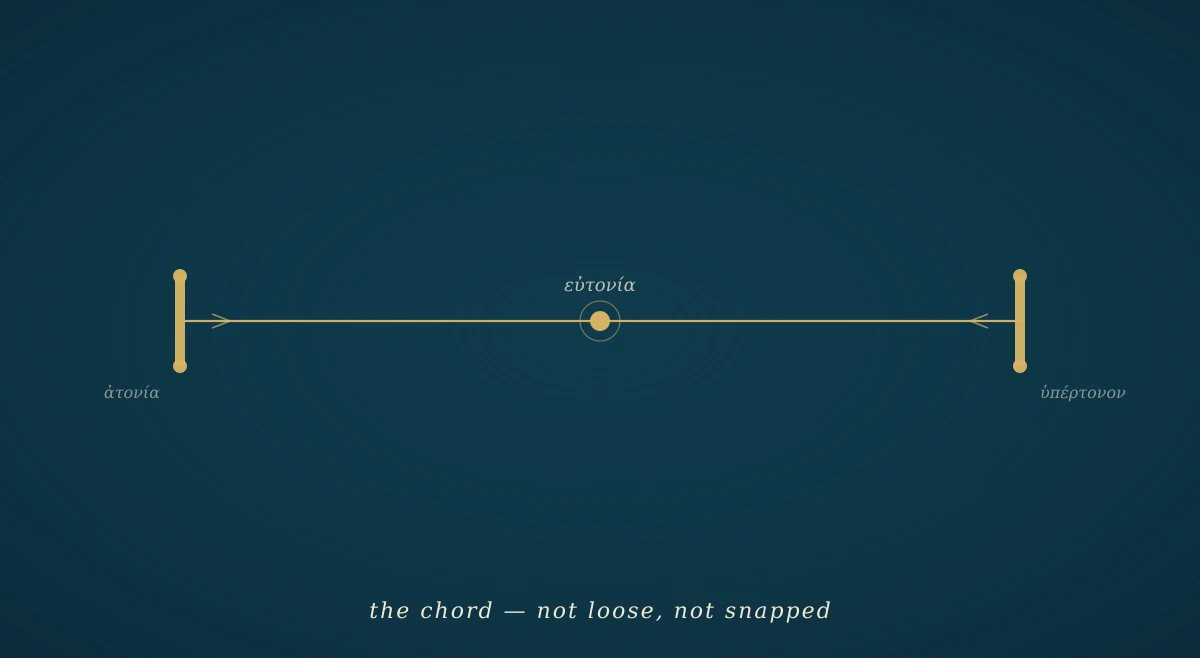
τόνος tonos — from the verb τείνω teinō (to stretch, to tension). Literally: stretching, tension. The word is born on the lyre and the bow, not in metaphysics. The tonos of a string is how taut it is.
Hold on to this image, because everything comes out of it. Three things fall out immediately.
First, there are two ways to fail, not one.
- ἀτονία atonia — the slack chord. It does not sound. Flabbiness, lethargy, collapse.
- ὑπέρτονον hyperonon — the over-tightened chord. Sounds shrill, and breaks. Tension, exhaustion, rupture.
This is completely different from “more is better”. Health is not at one extreme. It lies in correct tension — and correct means neither too little nor too much.
Second, the correct tension has a name.
εὐτονία eutonia — good tone. The state in which the chord sounds clearly. The Stoics use the word literally for virtue, and atonia for vice: the bad soul is not bad, it is slack. It does not hold.
Third, one chord does not make music.
ἁρμονία harmonia — from ἁρμόζω harmozō, “to join, to fit”. The word is a woodworker’s term before it becomes a musical one: the right joining of parts. Harmony is not that all the chords agree — it is that each one is in its own correct tension, so that together they produce something.
The foundational idea in one line: Health is not quantity. It is correct tension, and correct relation.
And now the cosmology
The Stoics took this image and made it physics. The foundational thing in the universe is, for them, a τονικὴ κίνησις tonikē kinēsis — a continuous pulsating tension that holds every thing and makes it what it is.
And they had a remarkable idea: the same force is present everywhere, at different degrees of tension. Four degrees:
| Degree | Greek | What it holds together |
|—|—|—|
| 1 | ἕξις hexis | The inanimate — stone, wood, bone. Simple cohesion |
| 2 | φύσις physis | Plants. Cohesion + growth + nutrition |
| 3 | ψυχή psyche | Animals. + sensation + impulse |
| 4 | λογικὴ ψυχή logikē psyche | The human. + reason |
Notice what this scale does: there is no cut between the inanimate and the animate, between the body and the mind. There is a continuous spectrum of tension. Mind is not a different thing from stone; it is the same thing at a much higher tone.
You will find this working in every chapter below.
2. Pneuma: what they really meant
πνεῦμα pneuma — from πνέω pneō, to blow. Literally: that which blows; breath, wind.
The word today means “mind” or “immaterial substance”, and that is completely misleading. In ancient usage pneuma is material. The Stoics define it clearly: a mixture of air and fire — that is, warm air under tension.
It is not the immaterial against the material. It is the subtle inside the coarse.
How it works
The pneuma pervades matter at every point (the Stoics call this κρᾶσις δι’ ὅλων krasis di’ holōn, total mixture) and gives it tone. Without pneuma, matter is a heap. With pneuma, it becomes a thing.
In the body, the pneuma:
- is generated by breath and heat
- moves through the arteries and nerves
- carries sensation toward the centre and movement from the centre to the limbs
Why breath is central
The word itself says it, and the tradition exploits this systematically: breath is the point where pneuma enters and leaves.
This is not metaphor. In the model, you literally inhale the raw material of vitality. And because breath is the only vital function that is simultaneously automatic and voluntary, it is the only point where will touches the involuntary.
This observation will become the foundation of the whole practical method of chapter 20 — and it is correct, independently of what they thought about the matter of the pneuma. Control of the respiratory rhythm is in fact the most direct voluntary input to the autonomic nervous system, and this is measurable today.
The honest position
Pneuma as substance does not exist. There is no subtle warm fluid flowing in the arteries — the arteries carry blood, and Harvey proved it in 1628.
Pneuma as principle holds up better: the idea that there is a continuous, measurable-degree “functional tension” that distinguishes the living from the dead and the alert from the suppressed, and that this has a direct relation to breath, is not nonsense. We just call it something else today.
How to take it practically: wherever the text says “pneuma”, read “the state of functional readiness of the system right now”. You lose the metaphysics and keep all the utility.
3. Krasis: why there is no “correct” body
κρᾶσις krasis — from κεράννυμι kerannumi, to mix. Literally: the mixing. The same root as κρατήρ kratēr, the vessel in which wine was mixed with water.
And here lies one of the best ideas in the whole tradition.
There is no one correct body. There is your mixture, and the question is whether it has deviated from its own balance.
Two words:
- εὐκρασία eukrasia — good mixture. Health.
- δυσκρασία dyskrasia — bad mixture. Disease.
But — and this is critical — the “good mixture” is not the same for everyone. Galen writes a whole treatise on this (On Temperaments) and defines nine types of krasis: one balanced, four simple (warmer, cooler, drier, wetter), four combined.
And he goes further: each organ has its own krasis, not just the person as a whole. The same body can have a hot stomach and cold limbs.
The practical consequence — and it is enormous
The same food, the same climate, the same exercise, the same schedule are not correct for two people. Treatment, in the model, is not “what works for condition X” but “what returns this person to his own mixture”.
Galen considers it professional failure to give the same instruction to two different kraseis. The instruction must come from the combination: krasis + age + season + climate + occupation + habit.
Habit is explicitly part of the calculation — there is a classical Hippocratic rule that a worse practice to which you are accustomed can be less harmful than a better one imposed abruptly. The speed of change matters as much as its direction.
The test
You do not need to believe anything about the humours to use the tool. Ask:
- Do I tend to feel hot or cold compared to those around me?
- Do my skin and mouth tend toward dry or wet?
- Do I digest quickly and get hungry often, or slowly and heavily?
- Do I start fast and burn out, or slowly and sustain?
This does not produce a diagnosis. It produces a baseline — and the baseline is the only thing you need to observe deviation, which is what is really interesting.
4. The four elements and the four humours — and what collapsed
Let us take it in order: first what they said, then what holds up.
The four elements
From Empedocles (5th c. BCE), “four roots”: πῦρ pyr (fire), ἀήρ aēr (air), ὕδωρ hydōr (water), γῆ gē (earth). Aristotle rebuilds them on two pairs of qualities:
| | Dry | Wet |
|—|—|—|
| Hot | Fire | Air |
| Cold | Earth | Water |
This is cleverer than it looks: the elements are not primary. The qualities are, and the elements emerge from combinations. This is why they can transform into one another by changing a single quality.
The four humours
The Hippocratic On the Nature of Man takes the next step, matching the elements with four bodily fluids:
| Humour | Qualities | Element | Season | Organ |
|—|—|—|—|—|
| Αἷμα haima (blood) | Hot + Wet | Air | Spring | Heart |
| Φλέγμα phlegma (phlegm) | Cold + Wet | Water | Winter | Brain |
| Ξανθὴ χολή xanthē cholē (yellow bile) | Hot + Dry | Fire | Summer | Liver |
| Μέλαινα χολή melaina cholē (black bile) | Cold + Dry | Earth | Autumn | Spleen |
Health = right proportion and right mixing. Disease = excess, deficiency, or isolation of a humour.
Now the truth
Black bile does not exist. It is not “poorly understood” — there is no such fluid in the body. It probably arose from observations of clotted blood in stools or vomit.
Phlegm is not a humour. It is a mucous secretion, not a fundamental constituent.
The correspondence with the seasons was theoretically imposed, not observed. The numbers had to come out as four because the elements were four.
And worst of all: the theory produced phlebotomy. If disease is excess, you remove it. Bloodletting was applied systematically for two millennia, on a vast scale, and in countless cases killed the patient. It is not a theoretical error with academic interest. It is the most lethal medical mistake in history.
And a second cost, less visible: the four-fold scheme was so elegant that it became a filter. Observations that did not fit into the four were not recorded. A closed, complete system is excellent at explaining everything and terrible at correcting itself.
What we keep, then
Three things, and they are real:
1. The principle of mixture rather than substance. That the state of a system is described by proportions rather than by the presence or absence of one thing is a sound intuition and is today the rule (hormonal profiles, electrolytes, microbiome).
2. The question “what kind of body is this?” before “what does it have?” This survived as idiosyncrasy and returns today as personalised medicine.
3. The four qualities as a language of sensation. Hot/cold, dry/wet are four axes you can actually feel in a body, your own or another’s. As phenomenology they work. As chemistry, no. Chapter 7 picks them up again with exactly this restriction.
PART B — THE MATERIAL OF THE SYSTEM
5. The three pneumata
Galen (2nd c. CE) organises the body around three levels of function, each with its own centre, its own network, and its own pneuma.
| | Centre | Network | Pneuma | Function |
|—|—|—|—|—|
| Φυσικόν physikon | Liver | Veins | πνεῦμα φυσικόν | Nutrition, growth, metabolism — everything that happens without you |
| Ζωτικόν zōtikon | Heart | Arteries | πνεῦμα ζωτικόν | Heat, pulse, vitality, drive |
| Ψυχικόν psychikon | Brain | Nerves | πνεῦμα ψυχικόν | Sensation, voluntary movement, thought |
The logic of the scale
Notice that it is a scale of refinement. Food becomes chyle in the liver (coarse), chyle becomes warm blood in the heart (finer), blood is worked in the brain into psychic pneuma (finest).
And it is a scale of voluntariness. The first level you do not control at all. The second partially and indirectly. The third directly.
This is not a theoretical detail — it is the map of what you can grasp. The whole practice of Part E rests here: you work where you have a handle, and you wait for the rest to follow.
The honest note
The tidy table of the “three pneumata” is partly later systematisation. Galen himself expresses explicit doubt about whether a physikon pneuma even exists — for him, the certainly existing one is the psychic, and with less certainty the vital. The clean triad owes more to his commentators than to him.
The fact that we know this is itself owed to him: he was honest enough to record his uncertainty — and that, ironically, is his most modern feature.
6. Pepsis: the central function
πέψις pepsis — from πέσσω pessō, to cook, to ripen. The same word is used for food in the stomach, for fruit ripening on the tree, and for an abscess “ripening” before it bursts.
It does not mean “breakdown”. It means cooking, conversion of the raw into the digestible. And the central metaphor is heat: the body has an innate heat (ἔμφυτον θερμόν emphyton thermon), and this is what cooks.
The three pepseis
The system does not stop at the stomach:
- First pepsis — stomach/intestines. Food becomes chyle.
- Second pepsis — liver. Chyle becomes blood and humours.
- Third pepsis — in the tissues themselves. Blood becomes flesh — it is actually assimilated.
And at each stage, there is a residue: περιττώματα perittōmata (literally “the superfluous”). Sweat, urine, bile, phlegm — all residues of digestions.
Why this is the really useful chapter
Because it changes the question.
It is not enough what you put in. What matters is what the system can cook.
The same food, two people, two completely different outcomes — depending on the state of the innate heat. And there is a clear classical diagnosis of ἀπεψία apepsia (indigestion): heaviness after food, belching, bad odour, fogginess, tongue coating, morning sluggishness.
The instruction that follows is counter-intuitive to a modern mind: when digestion is weak, the solution is not better food — it is less food. The Hippocratic rule puts it savagely: the more you feed an impure body, the more you harm it.
And it extends. The same logic applies explicitly to recovery, to fatigue, and — in the ascetic branch of chapter 15 — to impressions. Whatever enters and is not digested, settles.
7. The four qualities: hot, cold, dry, wet
Chapter 4 showed what collapsed in the humoral theory. This chapter keeps the part that works: the four qualities as a language of description.
Two pairs, four axes. And the key point: they are relational. Nothing is hot in itself — it is hotter relative to something. Galen insists on this: the “hot” of a drug is always judged relative to the krasis of the one taking it.
| Quality | How it appears in the body | Excess |
|—|—|—|
| Hot | Liveliness, good digestion, quick reaction, redness | Inflammation, irritability, exhaustion, insomnia |
| Cold | Calm, slow rhythm, endurance | Sluggishness, stagnation, numbness, depression |
| Dry | Vigour, clean lines, lightness | Stiffness, cracks, insomnia, restlessness, dry skin |
| Wet | Suppleness, softness, nourishment | Heaviness, oedema, mucus, flabbiness |
The therapeutic principle
τὰ ἐναντία τῶν ἐναντίων ἰήματα — “opposites are the cures of opposites”.
This is the central allopathic principle, and its directly applicable generalisation is simple: if you have excess, go toward the opposite — gently.
The most useful diagnosis
The two axes are often confused, and the distinction changes the intervention:
- Dry/hot — you feel “burned up”. Tension, choppy breath, irritability → you need cool, moist, slow, quiet.
- Wet/cold — you feel “heavy”. Sluggishness, fogginess, difficulty starting → you need movement, warmth, lightness.
- Dry/cold — you feel “empty and tight”. Anxiety, insomnia, joint creaks, cold extremities → you need warmth and nourishment and rhythm. This is the most misread: it looks like low energy and is given the wrong treatment (stimulants, intensity), which makes it worse.
This is not a diagnosis. It is a vocabulary. And vocabulary is the first thing missing when you try to observe a state: if you have no words, you cannot see differences.
8. Dynamis, energeia, hexis
Three Aristotelian terms that are at the core, and all three have been distorted in modern Greek — and in English translation.
δύναμις dynamis — potentiality
To be able, without doing it now. The seed has the dynamis of the tree. The sleeper has the dynamis to see.
ἐνέργεια energeia — being-in-operation
From ἐν + ἔργον en-ergon, “being-at-work”. It does not mean “energy” in the physical sense — the translation of energy by this word is a 19th-century borrowing and has caused enormous confusion. Energeia is potentiality in act: the eye that is seeing right now.
ἕξις hexis — possession, settled disposition
From ἔχω echō, “to have”. A stable disposition that you have acquired and now possess. In Modern Greek it survives as exi (“habit”), but it is stronger: not simply what you do often, but what you have become able to do without struggle.
Why this may be the most practical chapter of the text
Because it answers the question “how does one change?” — and the answer is clear and unpleasant:
Hexis is built only by repeated acts. Not by understanding, not by intention, not by intensity.
Aristotle says this explicitly for virtue: we become just by doing just things. We do not do just things because we are just. The order is the reverse of what we assume.
And medicine uses the same terms for the body:
- εὐεξία euexia — good hexis. The body that has acquired good condition.
- καχεξία cachexia — bad hexis. The term survives almost unchanged as a medical term today.
The consequence for practice: health and capacity are not things you have or acquire at some point. They are states maintained by repeated function — and they decay the moment the function stops. There is no attainment. There is only maintenance.
And the other half: the small, repeatable act beats the large, non-repeatable one. Always. This is not consolation for the weak — it is the mechanical conclusion.
PART C — THE GEOGRAPHY
9. Alexandria: the tradition that opened the body
Here this tradition does something unusual, and it is worth seeing clearly: instead of staying with what someone feels from inside, it opened the body and looked.
In Alexandria, around 300–260 BCE, two men perform systematic dissection of human bodies — for a brief, unique window of a few decades, with the royal permission of the Ptolemies.
Herophilos of Chalcedon
- Distinguished nerves from tendons. Before him, neuron meant anything white and fibrous. Herophilos showed that some of them end in the brain and are related to sensation and movement — and separated them into sensory and voluntary (motor).
- Named the duodenum (δωδεκαδάκτυλον), measuring it: twelve fingers’ length.
- Studied the pulse quantitatively, with a water clock. This is one of the first attempts to time a physiological function.
- Mapped the ventricles of the brain and the venous confluence still called torcular Herophili.
Erasistratos of Keos
- Described the valves of the heart and understood that they allow flow in only one direction.
- Distinguished cerebrum from cerebellum and observed that the convolutions are more complex in more intelligent animals.
- Rejected the humours. Preferred mechanistic explanations.
- And made a large mistake: he believed that the arteries carry pneuma, not blood — because in a dead body the arteries are found empty.
The ethical issue, without prettification
Celsus reports that the two of them performed vivisection on condemned prisoners, by royal grant. The source is late and there is scholarly debate about its reliability.
If it is true, it is monstrous. And the window closed quickly — for the next seventeen centuries, human anatomy stopped in the Mediterranean world.
Galen and the consequence
Galen, four centuries later, no longer had access to human bodies. He dissected Barbary macaques, pigs, goats and extrapolated to humans.
And this is why he made errors that lasted a thousand four hundred years:
- The rete mirabile at the base of the brain, where according to Galen the psychic pneuma was produced: exists in hoofed animals, does not exist in humans.
- The pores in the interventricular septum of the heart, through which blood was supposed to pass from the right to the left ventricle: do not exist.
And here is the chapter’s lesson, which is essentially methodological:
The tradition did not go wrong because it thought wrong. It went wrong because it lost access to the data — and continued to infer with the same confidence.
The error was not in the logic. It was in forgetting how indirect the material was.
10. The three centres
The structure Galen inherits from Plato, and tries to ground anatomically, is tripartite. In the Timaeus, Plato places three parts of the soul in three regions of the body, separated by real anatomical boundaries:
| Part | Location | Boundary | What it does |
|—|—|—|—|
| λογιστικόν logistikon | Head | Above the neck | Thought, judgement, discernment |
| θυμοειδές thymoeides | Thorax, heart | Between neck and diaphragm | Impulse, anger, honour, courage |
| ἐπιθυμητικόν epithymētikon | Abdomen, liver | Below the diaphragm | Hunger, thirst, desire, nourishment |
Why this is not arbitrary
The divisions are real anatomical boundaries — the neck and the diaphragm. And the three regions correspond to three groups of functions that genuinely cluster together:
- Above the neck: all the specialised senses and the brain.
- Thorax: heart and lungs — the two organs that react immediately to emotion.
- Below the diaphragm: digestion and reproduction — what is most autonomous and most “animal”.
And the language confirms it to this day: when you are afraid, you feel it in the chest. When you want something intensely, you feel it in the belly. The topography did not come from theory — it came from observation of where sensation localises, and only then was theorised.
The principle that holds it all
The mind does not govern automatically. The fact that the logistical part is “higher” does not mean that it prevails — it means that it must prevail, and that this is work.
Plato uses the image of the charioteer with two horses: one noble (thymoeides), the other unruly (epithymētikon). And the essence of the image is that the charioteer does not have the strength of the horses. He has only the reins. He governs by skill, not by force.
This idea — that control is a skill of direction and not superiority of strength — runs through the whole practice of Part E.
11. Arteries, veins, nerves
The network of the body, as this tradition saw it. And here, in contrast to the preceding, we are talking about structures that really exist.
φλέβες phlebes — veins
Carry the blood produced in the liver and nourish the tissues. In the Galenic model, blood is consumed in the limbs — it does not return.
Wrong. Harvey (1628) showed with a simple quantitative argument that it is impossible: the quantity of blood passing through the heart in one hour exceeds the weight of the whole body. So it is not consumed — it circulates.
This is an excellent example of how a system falls: not with a better theory, but with a measurement that no one had made.
ἀρτηρίαι artēriai — arteries
The word means, characteristically, “airway” (ἀήρ + τηρέω, aēr + tēreō) — because this is exactly what they thought it was. They carry, in the model, vital pneuma and heat from the heart.
The pulse is thought to be an active dilation of the artery itself, not a pressure wave — and it is the main diagnostic tool, with extraordinarily detailed descriptive taxonomy.
νεῦρα neura — nerves
Here the model gets very close. The nerves start from the brain and spinal cord, carry the psychic pneuma, and are two-way: they bring sensation inward and movement outward.
And Galen proved it experimentally. In a public demonstration, he ligated the recurrent laryngeal nerve of a live pig: the animal continued to struggle, but stopped crying out.
This is a real experiment, with a clear hypothesis and a clear result. It shows in one move that voice passes through a specific nerve, that the nerve comes from the brain, and that damage to the nerve abolishes only its own function. The mechanism he imagined (pneuma in tubes) was wrong. The structural relation he showed was right, and is still right.
12. Where the mind dwells: the great debate
One of the longest open questions of the tradition, and it is worth seeing because it shows how a dispute is resolved — and how it is not.
The cardio-centrics
- Aristotle: the heart is the first organ formed and the last to stop; it is warm; the senses converge there; the brain is a cooling organ that balances the heat of the heart.
- The Stoics: the hegemonikon resides in the heart. Argument: the voice comes from the chest; emotion is felt there; one gestures there when saying “I”.
The brain-centrics
- Alcmaeon of Croton (~5th c. BCE): the first. Observed that the sensory channels end in the brain.
- Hippocratic On the Sacred Disease: the most impressive text. Says that epilepsy is not divine but a disease of the brain, and that from the brain come joy, sorrow, laughter, lamentation and madness.
- Herophilos and Galen: with anatomical and experimental arguments.
How it was decided
Galen settled it not with a better argument but with a cut. In demonstrations, he showed that:
- Pressure on a specific point of the brain abolishes sensation, while the heart continues
- Severance of the spinal cord at different heights paralyses different sections, with clear correspondence
So: sensation and movement depend on the brain and spinal cord, not on the heart.
And the critical lesson: the question was not settled by whoever had the most elegant theory. It was settled because someone found an intervention that gave a different result depending on the answer.
At the same time — and this shows how resilient an image is — the cardio-centric intuition did not die. Language keeps it alive (we learn things “by heart”, par cœur), and the ascetic branch of chapter 20 will build its whole method on the heart as the seat of the mind — not out of ignorance of anatomy, but because it works on a different level of description.
INTERLUDE — How we pass from Galen to the Philokalia
The text now changes world, and it is worth saying how and why, otherwise the second half will look like another book.
The continuity is real, and it is linguistic above all.
The people who wrote the ascetic texts of the 4th century are educated Greeks. They have read Plato, the Stoics, and medicine. They do not invent vocabulary — they inherit the existing one and use it almost unchanged:
- pathos and apatheia come directly from the Stoics
- hegemonikon, phantasia, synkatathesis, prosochē — Stoic technical terms, all of them
- logismos has the same structure as the Stoic phantasia
- diakrisis, hexis, krasis — carried over unchanged
- The hesychast vocabulary itself borrows from medicine: the ascetic is explicitly called ἰατρὸς ἑαυτοῦ iatros heautou (physician of himself), the passions are called noses (diseases), the method is called θεραπεία therapeia (treatment).
There is even an explicit connecting figure: Nemesius of Emesa writes around 390 a work titled Περὶ φύσεως ἀνθρώπου Peri physeōs anthrōpou — the same title as the Hippocratic one — and uses Galen and Aristotle extensively within a Christian frame.
The rupture is also real, and it is threefold.
1. The aim changes. The medical branch aims at eukrasia: to live well and long. The ascetic branch aims at θέωσις theōsis (deification): a relation with something outside the system. Health becomes the means, not the end. The first regulates; the second transforms.
2. The locus changes. Galen works with observables: pulse, urine, colour, anatomy. The ascetic branch works with introspection: what you observe is your own mental motion, and you are simultaneously the instrument and the object. This is methodologically far more precarious, and the tradition itself knows it — which is why it insists so hard on external supervision (chapter 22).
3. The aetiology changes. In Galen the cause of dysfunction is dyskrasia. In the ascetic branch it is will and attachment. The first is corrected by regulation; the second only by choice.
How to read the rest of the text
In Parts D and E the vocabulary will look familiar, because it is — but the aim for which it is used is a different one.
And you will find something that does not exist in the first branch: an exquisitely detailed technology of attention. Galen has nothing to say about how you observe your own mind. Evagrius has a whole system.
This is the offering of the second branch, and it is real — independently of what one believes about its theological frame.
PART D — THE MIND
13. The hegemonikon and the chain of action
ἡγεμονικόν hegemonikon — from ἡγέομαι hēgeomai, to lead. The governing part. The Stoic term for the centre where the senses converge, the judgement is made, and the decision issues.
And the Stoics analysed it with unusual precision. The chain has four stages:
1. φαντασία phantasia — the impression
Whatever appears. A sensation, a thought, a memory, an impulse. You do not control it. It comes.
2. συγκατάθεσις synkatathesis — assent
To say internally “yes, this is so”. To accept the impression as true.
This is the sole point of freedom in the whole chain. It is the key of the entire system.
3. ὁρμή hormē — the impulse toward action
Once you accept the impression, movement toward or away is born automatically.
4. πρᾶξις praxis — the act
The example
You receive a curt message from a colleague.
- phantasia: “he dismissed me”
- synkatathesis: you accept it as fact
- hormē: anger, need to respond
- praxis: you respond
The system says: you cannot prevent the first. You cannot stop the thought from coming to you. The third and fourth follow almost mechanically once the second has happened.
The one place where you exist as agent is the second step.
And the Stoic distinction completes the picture: there are ἐφ’ ἡμῖν eph’ hēmin (what depends on us) and οὐκ ἐφ’ ἡμῖν ouk eph’ hēmin (what does not). Epictetus opens the Enchiridion precisely with this, and his list is harsh: to us belong judgement, impulse, desire, aversion. The body, reputation, property and other people — not.
Propatheia — a crucial detail
Seneca introduces the term προπάθεια propatheia (primus motus): the first automatic reactions — the startle at a loud noise, the blush, the clench in the stomach.
These are not passions, because they have not passed through assent. They are plain physiology, and the sage has them too.
This is important, because it forestalls the most common error: you are not being asked to feel nothing. You are being asked not to take the first reaction for a verdict.
The practical tool
The resulting tool is one, and it is simple to state and hard to execute:
Between the impression and the assent, put a delay.
Epictetus recommends literally speaking to the impression: “you are an impression, and not that which you appear to be” — and then examining it.
It is not metaphysical. It is the observation that judgement happens so fast that it looks like perception, and that slowing it down returns it to the field of choice.
14. The passions as judgements
πάθος pathos — from πάσχω paschō, to suffer, to undergo. Literally: what you undergo. It is passive: something happens to you.
And here Chrysippus makes the most radical move of Stoic psychology:
The pathos is not an emotion that follows a judgement. The pathos IS the judgement.
That is: fear is not a sensation that arises from the belief “something bad is coming”. Fear is the belief “something bad is coming and it is unbearable”, in a state of excessive tone.
And pathos is defined as ὁρμὴ πλεονάζουσα hormē pleonazousa — impulse that has exceeded measure. It is, exactly, the over-tightened chord of chapter 1: the same motion that at right tension is healthy, out of measure becomes passion.
The four generic passions
Two axes: good/bad and present/future.
| | Perceived good | Perceived bad |
|—|—|—|
| Present | ἡδονή hēdonē (pleasure) | λύπη lypē (distress) |
| Future | ἐπιθυμία epithymia (desire) | φόβος phobos (fear) |
All the others (anger, jealousy, shame, despair) are species of these four.
And the three εὐπάθειαι eupatheiai
A detail almost always omitted, without which the system looks inhuman: the Stoics accept three good emotional states, the eupatheiai — χαρά chara (joy), βούλησις boulēsis (reasonable wish), εὐλάβεια eulabeia (reasonable caution).
Pleasure is not missing; distress is missing, because there is no reasonable form of it.
So the aim is not coldness. It is the same emotional range at the right tone.
Ἀπάθεια apatheia — the most misunderstood word
It does not mean insensibility. The a- is privative of pathos in the above technical sense: absence of excessive, judgement-based impulses.
The impassible Stoic loves, fears reasonably, rejoices. He simply does not get swept away.
The best English rendering is not “apathy” — it is something like “non-swayability”.
The practical consequence
If the pathos is a judgement, then it changes by examination of the judgement, not by suppression of the sensation.
The question is not “how do I stop being angry?” but:
“What exactly do I believe right now, which if I did not believe I would not be angry?”
And almost always there is a hidden proposition of the form “this should not be happening” or “this is unbearable” — and neither of them withstands examination.
It is a functional tool, not a theory. And it is the part of the tradition that held up best (see chapter 24).
15. The eight logismoi
Evagrius of Pontus (345–399), an ascetic in the Egyptian desert with a philosophical education, does something that had not been done: he systematically classifies the ways attention is scattered.
λογισμός logismos — does not mean “thought” in general. It means a persistent, charged thought that demands assent. It is structurally the Stoic phantasia — an impression waiting to be accepted.
The eight
| # | Logismos | What it is, functionally |
|—|—|—|
| 1 | γαστριμαργία gastrimargia | The relation to food as mood regulator |
| 2 | πορνεία porneia | The sexual impulse as a continual distraction |
| 3 | φιλαργυρία philargyria | Security through accumulation |
| 4 | λύπη lypē | Grief for what was lost or did not come |
| 5 | ὀργή orgē | Persistent internal argument |
| 6 | ἀκηδία akēdia | See below |
| 7 | κενοδοξία kenodoxia | The need to be seen |
| 8 | ὑπερηφανία hyperēphania | The belief that you did it on your own |
Ἀκηδία akēdia — the most important
ἀ-κηδία: “non-caring”. Evagrius calls it the “demon of the midday” and devotes the longest description to it, because he considers it the heaviest.
His description is so accurate it is unsettling: the monk looks out of the window; looks at the sun and it seems not to move; calculates how much time is left; he thinks that elsewhere things would be better; remembers his former life with bitterness; finds faults in those around him; and in the end it is not that he wants something else — it is that he wants nothing, and cannot bear to stay.
There is no clean English word. It is something between boredom, disappointment, restlessness, a sense of futility and the desire to escape — all at once.
And it is the exact equivalent of a very contemporary condition. Evagrius describes a person who cannot stay with one thing, who constantly checks whether time has passed, who imagines that elsewhere it would be more interesting, and who in the end has done nothing and feels worse. In the year 399 CE, without a phone.
The treatment he proposes is counter-intuitive and probably correct: do not leave. Akedia promises to be solved by change of place — and is never solved that way, because it reconstitutes itself in the next place. It is resolved by remaining, small manual work, and rhythm.
What is really useful here
Evagrius’s deepest tool is not the list. It is the structure he describes:
The logismos is not an enemy. It is a proposition. And the only question is whether you will sign.
It is essentially the chain of chapter 13 applied to introspection. And the method he proposes has three stages:
- Observe that it has come — to see it as a separate object, not as “I”
- Name it — this is why the list exists; naming reduces identification
- Do not argue with it — conversation with the logismos is already defeat
The third is the substantively counter-intuitive one, and the most frequently ignored.
16. Nepsis, prosoche, diakrisis
Three terms that are the core of the ascetic branch.
νῆψις nēpsis — sobriety / watchfulness
From νήφω nēphō, “to be sober, not drunk”. The opposite of intoxication.
The image is precise and not decorative. The drunk is not insensible — he is swept along: he does not discern clearly, reacts disproportionately, does not remember where he is, and worst of all, does not know he is drunk.
Nepsis is the opposite state: to know what is happening to you at the moment it is happening.
And the basic diagnosis of the tradition is that the ordinary person is not sober — he lives in a mild, continuous, unrecognised state of being swept.
προσοχή prosoche — attention / guarding
From προσέχω prosechō, “to keep the mind directed toward”. In the hesychast tradition it is a technical term for the continuous monitoring of input: what enters the mind.
The classical image is military: the guard at the gate. He does not fight with those who come in; he recognises them before they enter.
And here the ascetic branch again meets the logic of chapter 6: impressions are considered food. What enters is digested or settles. And quantity matters as much as quality.
διάκρισις diakrisis — discernment
The ability to tell what is what: whether what you felt is fatigue or akedia; whether what you want is need or habit; whether this impulse is inspiration or vanity.
It is considered unanimously the highest virtue and at the same time the hardest, because:
Discernment is not taught by text. It is built from mistakes recognised as mistakes.
That is, it is a hexis in the exact sense of chapter 8 — an acquisition of repetition, not of understanding. And it explains why the whole tradition insists on the experienced third party: not out of authoritarianism, but because the instrument of observation is the same as the object, and an instrument does not calibrate itself.
PART E — THE PRACTICE
17. Diaita: the six factors
δίαιτα diaita — from διαιτάομαι diaitaomai, “to live, to conduct one’s life”. It does not mean nutrition. It means the whole regimen of daily life. The contraction of the word to “what I eat” is modern and is perhaps the single largest loss of meaning in the whole vocabulary.
The medicine of this tradition is above all dietetic. Drug and knife come later — and only if the diaita has failed.
The six factors
The list is systematised in Galen and later codified as six factors that must be regulated because they are neither natural givens nor pathological:
| # | Factor | What it covers |
|—|—|—|
| 1 | Ἀήρ καὶ τόπος aēr kai topos | Climate, season, air quality, light, living space |
| 2 | Σιτία καὶ ποτά sitia kai pota | Food and drink: kind, quantity, time, rhythm |
| 3 | Κίνησις καὶ ἡσυχία kinēsis kai hēsychia | Exercise and rest — as a pair, not separately |
| 4 | Ὕπνος καὶ ἐγρήγορσις hypnos kai egrēgorsis | Sleep and wakefulness, with emphasis on regularity |
| 5 | Ἔκκρισις καὶ ἐπίσχεσις ekkrisis kai epischesis | Excretion and retention: digestion, sweat, all cycles of elimination |
| 6 | Τὰ πάθη τῆς ψυχῆς ta pathē tēs psychēs | The emotional state |
Why this is the most important chapter for practice
Three reasons, and the third is the weightiest.
First, four of the six are pairs of opposites. Not “exercise” but “motion and rest”. You cannot optimise one side. The system does not ask you how much you exercise — it asks you whether the ratio of motion and rest is right for you, now.
Second, you regulate variables, not symptoms. None of the six is a treatment. They are all conditions. Health, in the model, is not constructed — it is allowed to arise when the conditions are right. It is, again, physis as healer.
Third — and this is the really notable one — the emotional state is a factor of equal standing. Not an appendix, not a “psychological factor”. The sixth factor sits in the same list as air and food, because it is held to have the same type of effect: it changes heat, pulse, digestion, sleep.
The unification of body and emotion is not a modern discovery. It is a structural element of a two-thousand-year-old system that simply had no reason to separate them.
The practical tool
It is, I think, the best checklist this tradition produced. When something is not going well, run through all six in order, before you look at anything else:
Air and space? Food? Motion and rest? Sleep and its regularity? The elimination cycles? The emotional state?
In the overwhelming majority of cases, the answer is in these six — and usually in two or three at once.
18. Gymnasion and anatripsis
Galen wrote the most extensive ancient texts on exercise — and some are startlingly modern.
The definition
Galen defines γυμνάσιον gymnasion with one criterion, and it is physiological:
Exercise is movement that changes the breath.
Movement that does not alter the respiratory rhythm is not exercise, however tiring. And what intensity is required to change the breath depends on the person — so the criterion is self-regulating.
The three stages
And here is the most impressive thing. Galen defines three mandatory stages:
- παρασκευή paraskeuē — warm-up. Mild movement and rubbing with oil, until the body heats and the colour of the skin changes.
- γυμνάσιον gymnasion — the main exercise.
- ἀποθεραπεία apotherapeia — cool-down. Mild movement and massage until breath and pulse return.
The third stage is not optional in his system: he holds that abrupt cessation leaves “undigested residues” in the muscles — which is, in the language of chapter 6, exactly the description of delayed-onset muscle soreness.
The tripartite scheme warm-up — main work — cool-down is today a basic principle of sports science. It is the most directly confirmed piece of the inheritance.
The best exercise
Galen writes a whole treatise on the ball — Περὶ τοῦ διὰ μικρᾶς σφαίρας γυμνασίου — and explains why he considers it the best form of exercise. His criteria:
- Moves the whole body, not isolated parts
- Self-regulated — can be gentle or intense
- Requires skill, not just strength: it trains attention along with the body
- Is pleasant — and he mentions this explicitly as an advantage
- Is safe and cheap
- Does not deform
The critique of athletes — and it is fierce
Galen attacks professional athletes openly: he considers them unhealthy. The argument: excessive food, excessive exercise, development of oversized muscular mass that serves no vital function, a life that leaves no time for anything else, and a rapid collapse once they stop.
There is also an older example the tradition cites repeatedly: Herodicos of Selymbria, a trainer who became sickly himself and devised a regime of exercise so demanding that, according to the charge, he prolonged his life without being able to do anything else within it.
The principle is clear: exercise serves life. When life begins to serve exercise, something has been reversed.
Ἀνατριψίς anatripsis — massage
Massage is a full therapeutic tool, not a luxury. It is classified into hard (tightens tissues), soft (relaxes), and symmetrical, and in much/little/moderate — and the combination is chosen on the basis of the krasis and the purpose.
It is used in warm-up, cool-down, convalescence, and in the elderly. Olive oil is the main medium.
19. Askesis: the Stoic method
ἄσκησις askēsis — from ἀσκέω askeō, originally “to work material with skill” (Homer uses it for leather and metal). Then it crosses into athletic training, and from there into ethical work.
The origin is important: it does not mean deprivation. It means working-up. Deprivation is one tool among others, not the aim.
The three fields of Epictetus
Epictetus organises the practice into three topoi (fields), with a clear order of priority:
1. Ὁ περὶ ὀρέξεις — what you desire and what you avoid
The first and most urgent. Goal: not to want what does not depend on you. In practice: each time you are disappointed, ask whether you had placed your expectation on something you do not control.
2. Ὁ περὶ ὁρμάς — how you act
Duty, relation, action. Goal: to act rightly and with reservation — to pursue the outcome without demanding it.
3. Ὁ περὶ συγκαταθέσεις — what you accept as true
The subtlest and last. Goal: not to assent automatically to impressions.
The order is explicitly didactic and Epictetus insists on it: students want to start from the third, because it is the most impressive and looks like logic. And it is the most useless if the first has not come first.
Three concrete techniques
προσοχή prosochē — continuous attention. Epictetus answers the objection “I cannot pay attention all the time”: neither does the craftsman pay attention all the time, but when he is working, he pays attention. And “the work” here is every moment you are awake.
προμελέτη τῶν κακῶν promeletē tōn kakōn — the premeditation of adversity. To think ahead about what can go wrong, calmly and specifically. It is not pessimism. The purpose is double: it reduces the surprise force of the event when it happens, and it restores appreciation for what is now. A warning: the technique has a limit. In someone with already high anxiety or a tendency to anxious rumination, repeated rehearsal of catastrophes feeds rather than relieves. The tradition itself intends it as a brief, periodic tool — not a habit.
ἐφήμερος ἐξέτασις ephēmeros exetasis — the evening review. Seneca describes it as a daily habit: before sleep, he reviews the day and asks what he did well, what wrong, what can change. The critical thing in his formulation: it is done without self-punishment. He himself stresses that he speaks to himself like a judge who has already given pardon. Guilt is not a tool of correction — it is noise that prevents observation.
20. Hesychia: the bodily method of prayer
Here is the only explicitly bodily technique of concentration this tradition produced. And here the greatest historical accuracy of the whole text is required.
The honest dating
The μονολόγιστη εὐχή monologistē euchē — the repetition of a short phrase as a means of concentration — is ancient. Attested from the 4th–5th century in the Desert Fathers.
The connection with the breath appears in the 7th century: John Climacus writes the famous instruction to unite the memory [of the Name] with the breath. One phrase, with no technical detail.
The full bodily technique — body posture, head position, direction of gaze, regulation of breath, descent of the mind into the heart — is attested only in the 13th–14th century:
- Nikephoros the Hesychast (13th c.), On Watchfulness and the Guarding of the Heart
- The text Method of Holy Prayer and Attention, attributed to Symeon the New Theologian but almost certainly not his (Pseudo-Symeon)
- Gregory of Sinai (~1265–1346)
That is: the technique is not apostolic nor early Christian. It is late Byzantine — a thousand years after.
And it was not accepted without opposition. Barlaam of Calabria attacked it openly, mocking the ascetics as ὀμφαλόψυχοι omphalopsychoi — “those whose soul is in the navel”. The dispute was serious and theologically crucial; Gregory Palamas defended the method in the Triads in Defence of the Holy Hesychasts, and the Constantinopolitan synods (1341, 1347, 1351) vindicated his position.
And one more thing, for completeness: the Philokalia itself as a corpus is an editorial undertaking of 1782 — an anthology compiled by Nikodemos the Hagiorite and Makarios of Corinth. The fact that we read these texts as a unified “tradition” owes largely to their selection.
The technique
As described in the texts of the 13th–14th century:
- Place and time. Quiet, dark, without stimuli. A set hour.
- Posture. Sit on a low chair. The seat is deliberately low and uncomfortable: it allows neither over-stimulation nor sleep.
- Head and gaze. The chin toward the chest, the gaze directed toward the centre of the body. (This is the detail that caused the mockery. Functionally it is simple: it removes visual input and closes the stance inward.)
- Breath. Slowing and regulation of rhythm; coupling of the phrase to the inhalation–exhalation cycle.
- Descent of the mind into the heart. The attention moves from the head to the chest. This is the central element and the name of the whole: νοερὰ προσευχή noera proseuchē — prayer that is done with the nous, not with the lips.
- The prayer. A short phrase, repeated, without variety and without elaboration.
- Ἀφαντασία aphantasia — and this is the most important rule. The prayer is explicitly without images. No visualisation, no scene, no form. If images, lights, voices or sensations appear, the instruction is not to accept them (see chapter 22).
Why it works, without metaphysics
Five things, all measurable:
- The slowing of the breath alters autonomic tone — this is well documented today.
- The removal of visual input drastically reduces the most demanding sensory channel.
- The repetition of a stable phrase occupies the verbal resources that feed rumination.
- Shifting attention to the chest turns attention to an interoceptive signal — and the thoracic region is indeed where emotional change is first located.
- The uncomfortable but steady posture maintains a middle level of arousal.
Whatever one believes about the frame, the mechanics are plausible and consistent.
21. Ten practical principles
There is no canonical list of this kind in the tradition. The following is a synthesis. Each principle is marked [ancient] if it comes from the philosophical–medical branch, [patristic] if from the ascetic, [modern] if it is my own formulation from the above.
1. Eutonia, not strength [ancient]
There are two ways to fail. Before correcting anything, find which extreme you are at: slack chord or over-tightened? The same instruction in opposite states does harm. Most people automatically assume they need more tightening — and often it is the opposite.
2. The criterion is the breath [ancient, Galen]
Exercise is movement that changes the breath. The limit of an effort is not where it hurts, but where the breath becomes choppy or is held. It is the only criterion that self-regulates to each person and to each day.
3. Never cold entry, never cold exit [ancient, Galen]
Paraskeuē — gymnasion — apotherapeia. The third is not optional. The same holds beyond exercise: abrupt entry into and exit from any intense state costs.
4. Measure — and exercise serves life [ancient]
Excess is not a greater virtue. The test is functional: if your practice begins to demand that you sacrifice everything else, the purpose has been inverted.
5. Know what body this is [ancient]
There is no right programme — there is right for this krasis, in this age, in this season, with these habits. And the speed of change matters as much as its direction: the best advice imposed abruptly can be worse than the mediocre one you already follow.
6. Hexis, not intensity [ancient, Aristotle]
You become what you do repeatedly. So the small, repeatable act beats the large, non-repeatable one — always. Not as consolation, but as a mechanical consequence. And there is no attainment — there is only maintenance.
7. Emotion is a dietetic factor [ancient]
The passions of the soul are in the same list as air and food. When something is not well in the body, the sixth factor is checked together with the other five — not afterward, and not by someone else.
8. The locus of freedom is assent [Stoic]
You do not control what comes to you. You control what you sign for. Put a delay between the impression and its acceptance — and examine what exactly you believe at that moment. Almost always there is a hidden proposition that does not withstand examination.
9. Name, do not argue [patristic]
When a persistent thought appears: observe it as an object, give it a name, and do not enter into conversation with it. Arguing with the logismos is already assent in another form.
10. Do not chase experiences [patristic]
The pursuit of impressive states is considered in this tradition the main sign of the wrong road, not of progress. The criterion is not what you felt during. It is how you behave afterward, and how others find you (see chapter 22).
The essential about the essentials
They are not ten. They are one, seen from ten angles:
You do not construct health or attention. You regulate the conditions and let them arise.
The verb is not “to make”. It is “to fit together” — harmozō, whence also the harmonia of chapter 1.
22. Plani: the warning
πλάνη planē — from πλανάομαι planaomai, to wander, to lose one’s way. (A planet is literally “the wandering star”, the one that does not keep a stable position.)
Plani is the self-deception of the practitioner — and the tradition treats it as the chief danger of the practice, not as a marginal case.
The signs
The hesychast texts give an extremely specific list:
- Visions, lights, voices, pleasant sensations. The instruction is absolute: do not accept them. Even if they are genuine, to seek them or rely on them is equally harmful
- Certainty that you are progressing. Considered among the heaviest signs
- Belief that you have a special gift or mission
- Contempt for those who do not do the same — the most reliable sign of all, because it is visible from outside
- Refusal of supervision. The argument “they do not understand, I know what is happening to me”
- Premature isolation from people and obligations
The three protective mechanisms
1. Aphantasia. The prayer is explicitly without images. The reason is functional: a practice that produces images has no way to distinguish what is fantasy and what is not. By closing the channel, the main source of error is closed.
2. Obedience / referral to a third party. Whatever happens is reported to an experienced person. It is not discipline for discipline’s sake — it is calibration: the measuring instrument is the same as the measured, so external reference is needed (chapter 16).
3. The criterion of fruits. The value of a state is judged not by the state but by what the person became afterward: more patient or more irritable? easier to live with or harder?
The scale of the danger
The most interesting element is that the tradition considers plani more dangerous than failure. The person who achieves nothing knows it, and can correct. The person in plani has lost the very instrument with which he would recognise his error.
And the essential thing: the signs the list gives are not internal but social and behavioural. It does not ask you to examine what you feel — it asks you to observe how you speak to the people around you.
This is methodologically extremely clever: it moves the criterion outside the system that may be faulty.
PART F — SYNTHESIS
23. How it all ties together
Let us pull the text into one path.
1. The chord. Tonos: there are two ways to fail, not one. Health is not quantity but correct tension — eutonia — and correct joining of parts — harmonia.
2. There is no cut between body and mind. The Stoic scale (hexis → physis → psyche → logikē psyche) is continuous. This is why the sixth dietetic factor — the passions of the soul — sits in the same list as air and food.
3. There is no correct body. There is krasis, and the question is not “what does it have?” but “what kind of body is this, and where has it deviated from its own balance?”. An instruction that does not take into account the krasis is, in the model, a wrong instruction.
4. The central function is conversion. Pepsis: the issue is not what goes in but what can be cooked — and what is not digested, settles. This applies to food, fatigue, and impressions with the same logic.
5. The body has three levels of decreasing autonomy. Liver / heart / brain; natural / vital / psychic. You work where you have a handle and wait for the rest to follow.
6. This tradition insisted on looking. Herophilos, Erasistratos, the ligation of the nerve: the question “where does the mind dwell?” was resolved not by a better argument but by an intervention that gave a different result depending on the answer. This is the most valuable methodological bequest — and the reason the system was eventually able to correct itself.
7. The mind is analysed in a chain, and the chain has a single point of freedom. Phantasia → synkatathesis → hormē → praxis. The pathos is not an emotion but a judgement out of measure — so it changes by examination of the judgement, not by suppression of the sensation.
8. The ascetic branch added a technology of attention. Nepsis (to know what is happening to you at the moment it is happening), the eight logismoi as a taxonomy of distraction, and a specific bodily method: posture, gaze, breath, descent of the mind into the heart, phrase without images.
9. Practice is the regulation of conditions, not the construction of a result. The six dietetic factors, the three stages of exercise, the hexis that is built by repetition. Health is not made; it is allowed to arise.
10. And there is an explicit warning, with a criterion outside the system: plani is recognised not by what you feel but by what you have become.
24. What failed, what survived, and why this branch left
This chapter exists because, uniquely, this tradition did not continue as a tradition — it transformed into something else. And how that happened is the most instructive part of it.
What failed — without hedging
1. The four humours. Wrong as a claim about matter. Black bile does not exist.
2. Phlebotomy. The lethal consequence. Applied systematically for two millennia, denied blood to patients who needed it, and is probably the practice with the largest cumulative death toll in the history of medicine. It does not admit the reading “they were right about some of it”.
3. The circulatory model. Blood consumed, arteries with pneuma, pores in the interventricular septum, the rete mirabile. All wrong, all overturned between 1543 and 1628.
4. And the deepest error, which is methodological: the elegance of the system became a filter. A scheme that explains everything cannot be falsified by anything — and therefore cannot learn. The four humours survived not because they were confirmed, but because there was no observation that did not fit into them.
How it fell
Two blows, both from data, not theory:
- 1543 — Vesalius dissects human bodies and publishes the differences from Galen. Shows that Galen was describing a monkey.
- 1628 — Harvey makes a simple volume calculation and shows that the blood must circulate. The pneumatic model collapses entirely.
The humours held on for another two centuries and died definitively with cellular theory and the biochemistry of the 19th century.
What survived — and it is more than you would expect
1. The method itself. Anatomy, experiment, measurement, clinical observation, record-keeping, public demonstration with checkable result. This tradition did not just produce wrong theories — it produced the mechanism that corrected them. Vesalius is a consistent continuation of Galen, not a rupture: he does exactly what Galen did, with better material.
2. The vocabulary. Diagnosis, prognosis, symptom, syndrome, crisis, chronic, acute, therapy, cachexia, neuron, artery, duodenum. Medicine still speaks Greek.
3. Diet as regimen of life. The six factors return almost unchanged in modern lifestyle medicine: environment, nutrition, exercise and rest, sleep, enteric/excretory function, mental state.
4. Krasis as idiosyncrasy. The question “what kind of organism is this?” returned as personalised medicine — with different tools and different content, but the same structure of question.
5. The three stages of exercise. Warm-up, main work, cool-down. Essentially unaltered.
6. Physis as healer. The recognition that many things resolve on their own and that excessive intervention harms, is today a central clinical principle.
7. And the most striking: the cognitive model of the passions. The Stoic position — that the emotional reaction is produced by the judgement about the event and not by the event, and that by examining the judgement the reaction changes — is the foundation of cognitive-behavioural therapy.
And this is not vague “influence”: the founders of the field explicitly cite Epictetus as source. It is documented, declared lineage — and today the most widely trialled psychotherapeutic approach.
And what was lost on the way
Two things, and they deserve naming.
First, unity. The system this text described was one: the krasis, the sleep, the exercise, the fear and the ambition were terms of the same equation, and the same person handled them. The current system is incomparably more precise and has split them into specialities that often do not speak to each other. The attempt to re-stitch them — psychosomatic medicine, lifestyle medicine, integrated care — is essentially the effort to recover something that had been lost.
Second, the practice. The ascetic branch developed a detailed technology of attention — and when Western thought cut its religious root, it threw away the technique along with the frame. Nepsis, prosoche, diakrisis, the naming of logismoi, the evening review: all are functional tools, independent of what one believes about their metaphysics.
The last thought
One thing runs through both branches, the medical and the ascetic, and it is not a doctrine but a stance:
Both take it for granted that the human being does not know himself — and that this is corrected only by method, not by intention.
Galen does not trust the patient’s opinion of his own condition; he wants pulse, colour, urine, history. Evagrius does not trust the ascetic’s opinion of his own progress; he wants naming, record, external supervision, fruits.
Both, that is, say the same thing with different material: self-observation without method and without a reference point outside itself produces certainty, not knowledge.
If you keep one thing from the whole text, perhaps that is the most durable — because it does not depend on the humours, nor on the pneuma, nor on theology. It stands on its own, and still stands.
APPENDIX — Glossary and sources
Glossary
Emphasis on the words that mean something different today.
| Term | Greek | Root | Meaning in the tradition |
|—|—|—|—|
| Tonos | τόνος | teinō | Tension, degree of stretch — literally, as on a string |
| Eutonia / Atonia | εὐτονία / ἀτονία | ” | Right tone / slackness. The two poles of failure, together with hypertonon |
| Harmonia | ἁρμονία | harmozō | Right joining of parts — a woodworker’s term before a musical one |
| Pneuma | πνεῦμα | pneō | Fine material mixture of air and fire; what gives tone to matter |
| Krasis | κρᾶσις | kerannumi | The mixture; the idiosyncrasy. Eukrasia = health, dyskrasia = disease |
| Pepsis | πέψις | pessō | Cooking, conversion of the raw into the assimilable |
| Perittomata | περιττώματα | perisseuō | The residues of each digestion |
| Emphyton thermon | ἔμφυτον θερμόν | — | The innate heat that performs the digestion |
| Dynamis | δύναμις | dynamai | Potentiality — not strength |
| Energeia | ἐνέργεια | en + ergon | Being-in-operation — not “energy” in the physics sense |
| Hexis | ἕξις | echō | Acquired, settled disposition. Euexia / cachexia |
| Hegemonikon | ἡγεμονικόν | hēgeomai | The governing part of the soul |
| Phantasia | φαντασία | phainomai | The appearing impression — not “fantasy” in the modern sense |
| Synkatathesis | συγκατάθεσις | synkatatithemai | Assent to the impression. The sole locus of freedom |
| Hormē | ὁρμή | hormaō | The impulse toward action |
| Pathos | πάθος | paschō | Hormē pleonazousa: judgement out of measure — not “emotion” |
| Propatheia | προπάθεια | — | The first automatic reaction; not a pathos |
| Eupatheiai | εὐπάθειαι | — | The three “good” emotions: joy, reasonable wish, reasonable caution |
| Apatheia | ἀπάθεια | — | Non-swayability — not insensibility |
| Eph’ hēmin | ἐφ’ ἡμῖν | — | What depends on us: judgement, impulse, desire, aversion |
| Prosochē | προσοχή | prosechō | Continuous guarding of what enters the mind |
| Logismos | λογισμός | — | Persistent charged thought that asks for assent |
| Akēdia | ἀκηδία | a + kēdos | Non-caring; boredom + futility + desire for escape |
| Nepsis | νῆψις | nēphō | Sobriety: knowing what is happening at the moment it happens |
| Diakrisis | διάκρισις | — | The ability to tell what is what. The highest virtue |
| Diaita | δίαιτα | diaitaomai | The whole regimen of life — not nutrition |
| Gymnasion | γυμνάσιον | — | Movement that changes the breath |
| Paraskeuē / Apotherapeia | παρασκευή / ἀποθεραπεία | — | Warm-up / cool-down — the two mandatory ends |
| Anatripsis | ἀνατριψίς | — | Massage as therapeutic tool |
| Askēsis | ἄσκησις | askeō | Working-up of material with skill — not deprivation |
| Hesychia | ἡσυχία | — | The state and the method of inner prayer |
| Noera proseuchē | νοερὰ προσευχή | — | Prayer with the nous, without images |
| Plani | πλάνη | planaomai | Wandering: the self-deception of the practitioner |
| Physis | φύσις | phyō | Both nature and the healing tendency of the organism |
Main sources of the tradition
Hippocratic (5th–4th c. BCE)
- Περὶ φύσιος ἀνθρώπου (On the Nature of Man) — the theory of the four humours
- Περὶ διαίτης (On Regimen, Books 1–4) — the most extensive ancient work on the regimen of life
- Περὶ ἱερῆς νούσου (On the Sacred Disease) — epilepsy as a disease of the brain
- Ἀφορισμοί (Aphorisms), Ἐπιδημίαι (Epidemics)
Philosophical
- Plato, Timaeus (the three parts of the soul), Phaedrus (the charioteer)
- Aristotle, Nicomachean Ethics (hexis), On the Soul, Metaphysics (dynamis / energeia)
- Chrysippus, On Passions — preserved fragmentarily, mostly through Galen
- Epictetus, Discourses and Enchiridion (ed. Arrian)
- Marcus Aurelius, Meditations
- Seneca, Epistulae, De ira (the propatheia, the evening review)
Medical
- Galen: On Temperaments, On the Preservation of Health, On the Use of Parts, On the Opinions of Hippocrates and Plato, Thrasybulus, On the Exercise with the Small Ball
- Herophilos and Erasistratos — preserved only through later authors (mainly Galen and Celsus)
- Nemesius of Emesa, On the Nature of Man (~390) — the connecting work
Ascetic / hesychast
- Evagrius of Pontus, Praktikos, On the Thoughts, Antirrhetikos
- John Climacus, The Ladder (7th c.)
- Maximus the Confessor, Chapters on Love
- Nikephoros the Hesychast, On Watchfulness and the Guarding of the Heart (13th c.)
- Pseudo-Symeon, Method of Holy Prayer and Attention (13th–14th c.)
- Gregory of Sinai (~1265–1346)
- Gregory Palamas, Triads in Defence of the Holy Hesychasts
- Philokalia of the Holy Niptic Fathers, Venice 1782 — anthology by Nikodemos the Hagiorite & Makarios of Corinth
For the historical critique
- Andreas Vesalius, De humani corporis fabrica (1543)
- William Harvey, De motu cordis (1628)
- Vivian Nutton, Ancient Medicine (2013)
- Pierre Hadot, Philosophy as a Way of Life
- Heinrich von Staden, Herophilus: The Art of Medicine in Early Alexandria (1989)
Related reading on this site
- Yin, Yang and the Chinese Body: A Complete Guide — the companion Chinese guide. Note the striking convergences on song/śaithilya-like relaxation, on the organ–emotion links, and on the warnings against premature attention to upper centres.
- Prana, Nadis and the Indian Body: A Complete Guide — the Indian companion, with directly parallel chapters on breath-as-handle (prāṇāyāma), on judgement as the source of passion (chapters 15–17 of that guide), and on the warning against plani-like self-deception.
- What Is Chi? A Systems Engineer’s Reframing — the main site argument for reading pneuma / qi / prāṇa as the flow of organization.
- The Convergence Asymmetry — on where the maps of these traditions converge and where they diverge.
- The Tradition That Diagnosed Its Own Damage — the Tibetan parallel to the hesychast warnings of chapter 22.
- Traditions of the Body — the full set of guides and essays.
← Back to the Traditions of the Body guide
More in this pillar
- The Convergence Asymmetry
- The Tradition That Diagnosed Its Own Damage
- Why the Right Posture Feels Wrong
- Seven Points on the Ground
- The Body Is Not Given, It Is Made
- The Second Arrow
- Tumah Is Not Dirt
- The Past Is in Front
- Yin, Yang and the Chinese Body: A Complete Guide
- Prana, Nadis and the Indian Body: A Complete Guide
- Nahua Body-Knowledge: Tonalli and the Three-Soul SystemComing soon
- Andean Body-Knowledge: Camay, Animu, and the Ensouled PlaceComing soon
- Amazonian Body-Knowledge: Yuxin, the Dieta, and the Constructed BodyComing soon
- Tibetan Body-Knowledge: Rlung, Channels, and the Four TantrasComing soon
- Māori Body-Knowledge: Tapu, Noa, and the Binding of the PersonComing soon
- Yoruba Body-Knowledge: Ori, Ase, and the Head as DestinyComing soon
- Western Somatic Work: The Body as Recalibrated InstrumentComing soon
- Islamic Body-Knowledge: Salah, Taharah, and the Prostrating BodyComing soon
- Theravāda Body-Knowledge: Kaya, Vedanā, and the Four Foundations of MindfulnessComing soon
- Jewish Body-Knowledge: Mitzvot, Tumah, Mikveh, and the Bound TextComing soon
The other pillars
Be first to know
The book is in its final editing stage. Leave your email and you will hear when it is ready.