Body Knowledge·Essay
Rlung, Rtsa and the Tibetan Body: A Complete Guide
A complete guide, from zero, to the Tibetan body: rlung and the ten winds, the three channels, the Four Tantras, tummo as measured, srog rlung as diagnosis.
How to read this text
You need no prior knowledge. Every term is explained the first time it appears.
Four honest notes before we start
First: this tradition declares, itself, that it borrowed
We do not need to discover it — the tradition says so, with names and dates.
The Tibetan translators (lotsāwa) are national heroes. Marpa (1012–1097) travelled three times to India and returned with texts and instructions. Atisha came from Bengal in 1042. The medical tradition explicitly names foreign physicians at the king’s court.
The system of channels and winds you are about to read is late Indian tantric material, carried to Tibet and worked over there for eight centuries.
What matters, then, is not originality. What matters is what a culture does when it consciously borrows, records this with precision, and then works it systematically for eight hundred years.
Second: this is material taught under conditions
Much of what follows — especially Parts B, C and F — belongs traditionally to restricted transmission: with initiation, with a teacher, with graded preparation.
The text describes. It does not instruct. You will find no execution instructions here, and that is not prudishness: chapter 16 explains, in clinical terms, what goes wrong when these techniques are done unsupervised.
Third: here, uniquely, there are laboratory data
One practice of this tradition — tummo — has been measured in published studies, with clear results. Chapter 22 presents them, together with what they do and do not show.
Fourth, and the hardest
In its transfer to the West, this tradition has a serious and documented problem of abuse. These are not rumours and not isolated incidents; there are independent investigations, public admissions, and institutional judgements.
And the worst of it: the mechanism that is supposed to protect against deviation is the same one that covered it up. Chapter 27 examines this as a structural issue, not a scandal.
Pronunciation guide — needed here
Tibetan is written with many silent letters. The scholarly transliteration (Wylie) records what is written, not what is heard. The differences are dramatic:
| Written | Pronounced | Meaning |
|—|—|—|
| rlung | lung | wind |
| rtsa | tsa | channel |
| thig le | tigle | drop |
| gtum mo | tummo | “the fierce one” |
| ‘khrul ‘khor | trul-khor | “magical wheel” |
| rdzogs chen | dzogchen | “great completeness” |
| bar do | bardo | intermediate state |
| srog rlung | sok-lung | vital wind |
| rgyud bzhi | gyü-shi | “Four Tantras” |
| bla | la | vital force |
| sngon ‘gro | ngöndro | preliminaries |
| blo sbyong | lojong | mind training |
In the text I give both. Do not try to pronounce the written form.
A short introduction to Tibetan thought, for the reader who is new
Before any of the technical material lands, it helps to have five things in mind. If you already know them, skip to the Contents.
Where this comes from, in time and place
The Tibetan Plateau averages 4,500 m in elevation. The climate is cold and dry; the great passes are closed for months of the year. This matters: much of the medicine, and the whole emphasis on inner heat, is a response to specific environmental pressures.
Buddhism arrived in two waves. The first propagation was in the 7th–9th centuries, under the Yarlung dynasty, principally from India. The second propagation began in the 10th–11th centuries and is the one that produced the tradition described here: Marpa, Milarepa (1052–1135), Atisha (990–1055), and the four main schools (Nyingma, Sakya, Kagyu, Gelug) that organised Tibetan Buddhism from then on.
The medical tradition was systematised in the 12th century with the Four Tantras. The tantric practice system came together over the same centuries.
1959 is the dividing line. After the Chinese occupation, most monasteries were destroyed; the tradition largely survived in exile, in India and Nepal (chapter 29).
There is no “the” Tibetan tradition
The guide uses “Tibetan” for the plateau and its diaspora, but the schools are not interchangeable. Where a specific detail is school-specific, it is named.
- Nyingma — the “ancient ones”, holding to the first propagation; the main custodians of Dzogchen.
- Sakya — scholarly tradition, strong philosophical lineage.
- Kagyu — oral-transmission schools, descended from Marpa and Milarepa; the main custodians of Mahāmudrā and the Six Yogas of Nāropa.
- Gelug — the “virtuous ones”, founded by Tsongkhapa (14th–15th c.); the school of the Dalai Lamas.
- Bön — a separate tradition, structurally close to Nyingma, with its own Dzogchen (chapter 8).
What kind of body-knowledge this is
The body material in this guide comes from four kinds of source:
- The tantric corpus — Guhyasamāja, Cakrasaṃvara, Hevajra, Kālacakra, and the practice systems built around them (above all the Six Yogas of Nāropa).
- The medical tradition — the Four Tantras (rGyud bzhi), c. 12th c.; the commentarial literature; the great 17th-c. medical paintings; and the two medical schools, Chakpori (1696) and Men-Tsee-Khang (1916).
- The practical manuals — on ngöndro, trul-khor, tummo, dream yoga, bardo practice.
- Modern laboratory and clinical research — above all the tummo measurements (Benson, Kozhevnikov) and the srog rlung psychiatric literature.
What this material is not
It is not a continuous indigenous tradition. It is Indian tantric material and Chinese and Greco-Arab medical material, synthesised in Tibet over eight centuries. The tradition says so itself (chapter 8 isolates what is genuinely indigenous).
It is not safe to practise unsupervised. Chapter 16 documents this in clinical detail. The guide gives no instructions.
It is not above criticism. Chapter 27 covers the documented abuse cases in Western Tibetan Buddhism directly, as a structural problem of the transmission system.
A word on names
The Wylie transliteration tries to be a one-to-one transcription of the Tibetan script, which means it records letters that are not pronounced. Where it would mislead, this guide gives the Wylie form once and then the pronunciation (so rlung once, then lung; bla once, then la). Where common English spellings exist (tummo, ngöndro, bardo, Dalai Lama), the guide uses them.
With that in hand, the material below should be legible without prior training.
Contents
PART A — The foundational idea
- The mind rides the wind
- The three: rtsa – rlung – thig le
- Coarse, subtle, very subtle body
- Why all this
PART B — The material
- The ten winds
- Thig le: the white and the red drop
- Drod: heat as the sign of life
- Bön — and what is really indigenous
PART C — The geography
- The three channels
- The wheels: four or five, not seven
- The knots
- The heart and the indestructible drop
INTERLUDE — Two different professions → Interlude
PART D — The medicine
PART E — The mind
PART F — The practice
- Ngöndro: the hundred thousands
- Trul khor
- Tummo — and what the measurements show
- Sleep and dream
- The dissolution
- Bardo
- Ten practical principles
- The two warnings
PART G — Synthesis
APPENDIX — Glossary and sources
PART A — THE FOUNDATIONAL IDEA
1. The mind rides the wind
The image is not exotic. It is printed on prayer flags and every Tibetan knows it.
rlung rta (lung-ta) — “wind-horse”. On the flags it is a galloping horse with three jewels on its back. And the word means, in everyday language, “fortune, morale, vital drive, having things go your way”.
You say someone has “high lung-ta” as you would say they have momentum.
And the principle behind it
The classical axiom, repeated in every tantric text:
The mind rides the wind.
It is not metaphor. It is a functional claim: consciousness does not move by itself. It is carried. And its vehicle is the rlung — whatever moves inside the body.
The traditional image makes it more precise:
The rider is blind. The horse is lame.
The mind sees but cannot go anywhere alone. The wind moves but does not know where. Only together do they function — and only together can they be trained.
The practical consequence, which is the whole system
If the mind rides the wind, then:
You do not work on the rider. You work on the horse.
That is: you do not try to control thought with thought. You change where and how the wind moves — with breath, posture, muscle tone, point of focus — and the mind follows obligatorily.
It is, explicitly, a somatic approach to a psychic problem. And it explains why this tradition developed such detailed mapping of movement inside the body: not out of interest in anatomy, but because that is where the handle is.
2. The three: rtsa – rlung – thig le
The “subtle body” of this tradition has exactly three components. Collectively they are called rdo rje’i lus (dorje lü), “adamantine body” or “vajra body”.
| Term | Pronunciation | Literally | What it is |
|—|—|—|—|
| rtsa | tsa | “root, vein, channel” | The pathways — where something can move |
| rlung | lung | “wind” | The movement — what flows, and what carries the mind |
| thig le | tigle | “drop, moment, dot” | The payload — the condensed essence, the fuel |
The analogy that explains them
Think of them as an irrigation system:
- The channels are the network. They can be open, blocked, twisted, or disused.
- The wind is the flow. It can be strong, weak, chaotic, or going into the wrong channel.
- The drops are the precious material itself. They can be abundant or exhausted, concentrated or dispersed.
The three are interdependent. An open channel without wind does nothing. A strong wind in a blocked channel does damage — and that is, literally, the diagnosis of chapter 16.
Where this body is located
Nowhere, in the anatomical sense. The channels are not vessels and will not be found at autopsy. The tradition does not claim this: it describes them as structures that become functional through practice, not as pre-existing anatomy.
The useful way to take it: as a map of places where attention and breath can work together, with predictable results. On that reading, the system works independently of what you believe about its ontology.
3. Coarse, subtle, very subtle body
The tradition distinguishes three levels, and the distinction is functional:
| Level | Tibetan | Includes | What happens to it at death |
|—|—|—|—|
| Coarse | rags pa | Flesh, bones, organs, the five senses | Dissolves |
| Subtle | phra ba | Channels, winds, drops, the emotional states | Dissolves |
| Very subtle | shin tu phra ba | The very subtle wind and the very subtle mind, together, in the heart | Continues |
The critical detail
The very subtle level is not mind without body. It is wind and mind together, inseparable — and this is the most consistent point of the whole cosmology.
There is, in this system, no pure spirit. What knows, moves. What moves, knows. Even at the subtlest possible level, the two do not separate.
The practical consequence
The gradation also gives the order of the work:
- You have direct access to the coarse — posture, movement, breath
- Indirect to the subtle — through breath and focus
- No direct access to the very subtle
That is why there is no technique called “reach the very subtle”. There is only gradual thinning: as the coarse wind quiets, the subtler becomes accessible.
And there are, according to the tradition, three states where this happens by itself, without practice: deep sleep, the moment of orgasm, and death.
All three become fields of practice, exactly for this reason (chapters 22–24).
4. Why all this
Before we go into detail, the purpose has to be stated — because otherwise the whole system is read wrong.
The body is not here an object of care
In popular Western reception, these practices are presented as wellness: calm, balance, health.
In the texts, the purpose is different. The subtle body is worked on because it is an organ of cognition: the means by which something normally inaccessible can be approached.
Health is a precondition, not the goal. A sick or exhausted body cannot do the work — which is why Part D exists.
The basic diagnosis
The starting point is that the ordinary mind operates at the coarse level, where the winds move in the side channels, irregularly, pulling attention outward.
The goal is to gather the winds into the central channel (chapter 9), at which point the mind shifts to subtler functioning.
And that is all. The channels, the drops, the wheels, the knots, the tummo — all serve this one transition.
The warning that follows immediately
If the system explicitly says it works with the wind, and if the wind is what carries the mind, then wrong work with the wind harms the mind directly.
This is not theoretical risk. It is the predictable consequence of the very principle of chapter 1 — and it has a name, symptoms and treatment (chapter 16).
PART B — THE MATERIAL
5. The ten winds
The rlung differentiates into ten currents: five root winds (rtsa ba’i rlung) and five branch winds (yan lag gi rlung).
The five root winds
| Wind | Pronunciation | Seat | Direction | Function |
|—|—|—|—|—|
| srog ‘dzin | sok-dzin | Heart | Central | “The life-holder”. Consciousness, vitality, the fact that you exist |
| thur sel | thur-sel | Lower abdomen | Downward | Excretion, reproduction, childbirth, grounding |
| me mnyam | me-nyam | Navel | Central | “Companion of fire”. Digestion, metabolism, heat |
| gyen rgyu | gyen-gyu | Throat, chest | Upward | Speech, swallowing, voice, alertness |
| khyab byed | khyab-je | Everywhere | Diffuse | “The pervader”. Movement of the limbs, joints, coordination |
The five branch winds
Operate the five senses: sight, hearing, smell, taste, touch. Subtler, less important in practice, and named differently depending on the tantra.
The central couple
The practice condenses into one relation: the upper wind descends, the lower ascends, they meet at the navel.
This is the mechanics of the vase breath (bum pa can, bumba-chen, “like a vase”): inhalation, slight lowering of the diaphragm, slight lifting of the pelvic floor, and the air is “closed” in the abdomen as in a vessel.
And in purely somatic terms: this is regulation of intra-abdominal pressure by coordinated action of diaphragm and pelvic floor. The old language calls it “union of the winds”. Biomechanics says the same thing with other words.
The test
No technique required. Observe, while sitting:
- On the inhalation, what moves first? If the shoulders rise and the abdomen stays still, the upper wind is working without the lower.
- On the exhalation, is there any participation from the pelvis, or is it entirely silent?
The observation alone changes the pattern within a few breaths. This is not mysticism — it is motor control.
6. Thig le: the white and the red drop
thig le (tigle) — “drop, dot, sphere”. The third component: the condensed essence.
The two drops
The model says that every human receives two essences at conception:
- White drop (thig le dkar po) — from the father. Seat: crown of the head. Quality: cool, bliss, energy.
- Red drop (thig le dmar po) — from the mother. Seat: navel. Quality: warm, vitality, heat.
The central mechanics
In tummo (chapter 22), the sequence is:
- Heat is kindled at the navel — the red drop is activated
- The heat rises up the central channel
- It melts the white drop at the crown
- The white drop descends, passing through the wheels
And each stage of the descent is associated with an increasing state of bliss — the so-called four joys.
The same structure in death
What is striking: the same movement is described in the dying process — but reversed and involuntary: the white drop descends from the crown, the red ascends from the navel, they meet in the heart (chapter 24).
That is: the higher practice is voluntary rehearsal of what will happen obligatorily. This is the logic that unifies Part F.
The honest note
This material has an explicit sexual dimension in the texts, and is often either suppressed or inversely over-emphasised in Western presentation.
Two things deserve precision:
First, in the overwhelming majority of cases the practice is visualisation, not somatic — done alone, with an imagined consort.
Second, the rhetoric of “tantric sexuality” in the West is largely a modern construction, and has been used as a pretext in documented cases of abuse (chapter 27).
7. Drod: heat as the sign of life
drod (drö) — heat. And it is, in this system, the basic sign of life.
In medicine
The me drod (me-drö), “the fire of heat”, is the digestive capacity — and all Tibetan dietetics is organised around it. Weak heat means food is not transformed, however good it is.
In the climate of the Tibetan plateau — high altitude, dry, cold — this is not theory. Cold is the main pathogen.
In practice
Heat is the sign of success. In the texts, the signs of progress in tummo are somatic and verifiable: cold tolerance, warmth in the extremities, the capacity to stay with minimal clothing.
And there is a whole title for it: ras pa (repa), “the one dressed in cotton” — the one who does not need wool. The most famous yogi of the tradition, Milarepa, carries the epithet in his very name.
And the connection
Note the coherence:
- The red drop is warm and sits at the navel
- The wind me mnyam (digestion) sits at the navel
- Tummo ignites at the navel
The navel is, in this system, the furnace — both medically and tantrically. There is no separation between the heat that digests and the heat that transforms. It is the same heat, in different degrees.
8. Bön — and what is really indigenous
Here precision is required, because there is much confusion in circulation.
The myth
The popular version: Bön (pön) was the ancient shamanic religion of Tibet before Buddhism, with drums, ecstasies and sacrifices, and Buddhism replaced it.
The scholarly picture
Organised Bön is roughly contemporary with the second propagation of Buddhism — that is, it was formed as a recognisable tradition around the 10th–11th century.
It has monasteries, canon of scriptures, monastic discipline, philosophical scholasticism, and its own Dzogchen tradition — and is structurally very close to the Nyingma school of Buddhism.
It regards as its founder Tonpa Shenrab, from the land of Zhangzhung (western Tibet) and ultimately from Tazig (somewhere west — possibly a reflection of Persian contact).
The image of the “pre-Buddhist shamanic Bön” is largely a construction: in part from Buddhist polemic that wanted a primitive opponent, in part from 19th–20th century Western romanticism.
What then is genuinely indigenous
There is a real pre-Buddhist substratum, and it is not what people think. It is less spectacular and much more everyday:
1. Worship of local beings. yul lha (gods of the place), sa bdag (lords of the earth), klu (lu, water beings), btsan (tsen). The landscape is inhabited and has rights. Before you build, dig, or change anything, you ask.
2. The lha bsangs (la-sang) — the smoke offering from juniper branches. The most everyday ritual in Tibet, to the present day.
3. And most important for this text: the bla.
The bla — an indigenous vital force
The bla (la) is a concept that does not come from Buddhism and does not fit well with it.
It is a vital force that:
- inhabits the body but can leave it
- departs from terror, from shock, from loss
- can be captured by spirits
- its loss causes wasting, torpor, melancholy, illness
- moves inside the body according to the day of the month — there are tables with its position
And there is a whole ritual of recovery: bla ‘gugs (la-guk, “calling the la”) and bla bslu (la-lu, “ransoming the la”) — where a ransom is offered to what holds it, a garment of the person is used, and there is a bla rdo, a “stone of the la” that functions as an anchoring point.
This is the most clearly indigenous part of the system — and it coexists with Buddhism without ever being fully incorporated into it. Buddhism has no place for a soul that is lost and ransomed.
The structural resonance across cultures is sharp. See the Andean guide, chapter 15, on mancharisqa and despacho — the ransom paid to the land to recall what was taken by shock. The convergence is noted in the Convergence Asymmetry.
PART C — THE GEOGRAPHY
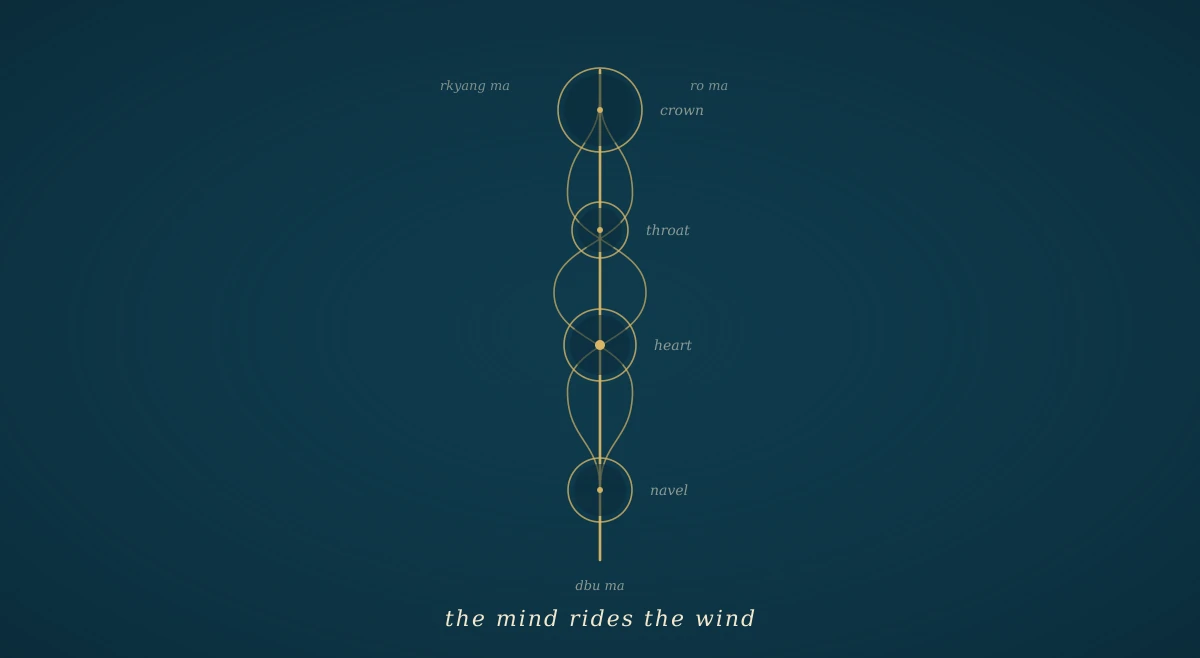
9. The three channels
Of the thousands of channels the texts mention, three count.
| Channel | Pronunciation | Position | Character |
|—|—|—|—|
| dbu ma | uma | Central, in front of the spine | The goal. Normally closed |
| ro ma | roma | Side | Solar, warm |
| rkyang ma | kyang-ma | Side, opposite | Lunar, cool |
The two side channels wind around the central one, constrict it at certain points, and end at the nostrils.
And now the honest correction
You will see everywhere neat diagrams with “right = solar, left = lunar”. The reality in the sources is murkier, and this deserves to be said.
- The correspondences differ by tantra. The Guhyasamāja system does not fully agree with the Kālacakra.
- The sides are reversed for women in several traditions. This is not a detail — it means the system does not correspond to fixed anatomy.
- Even the number of channels varies depending on the text.
What does this discrepancy mean? That the map is not measurement. It is a working tool within a specific system of practice — and it works because the system is internally consistent, not because it describes pre-existing structure.
The tradition, at its best moments, says it: the channels are created by the practice; they are not discovered.
The foundational principle
The winds normally move in the side channels. The goal is for them to enter, remain and dissolve in the central one.
And the method is not force. It is balancing the two side channels — at which point the central opens as a consequence.
It is the same shape as chapter 1: you do not command the mind. You regulate the conditions of the wind, and the mind follows.
10. The wheels: four or five, not seven
‘khor lo (khor-lo) — “wheel”. Points along the central channel where channels branch and form nodes.
The Tibetan list
| Wheel | Position | Tibetan | Meaning |
|—|—|—|—|
| Of great bliss | Crown of head | bde chen | Seat of the white drop |
| Of enjoyment | Throat | longs spyod | Speech, dream state |
| Of Dharma | Heart | chos kyi ‘khor lo | The centre: the indestructible drop |
| Of emanation | Navel | sprul pa’i ‘khor lo | The fire, the tummo |
Some systems add a fifth, at the lowest point.
Three differences that must be said
1. It is not seven. The seven-fold system that circulates in the West is not this one.
2. There are no rainbow colours. Nor correspondences to endocrine glands. These are modern additions from elsewhere.
3. The centre is not the crown — it is the heart. And this is structurally critical: the system is not ascending toward the crown. The crown is a storehouse; the heart is the place where everything is judged (chapter 12).
The “petals”
Each wheel is described with a specific number of branches (32 at the crown, 16 at the throat, 8 at the heart, 64 at the navel, in the most common version).
The numbers differ by tantra — and this is, again, an indication that we are dealing with a structured object of visualisation, not with anatomical measurement.
11. The knots
rtsa mdud (tsa-dü) — “channel knot”. The points where the two side channels squeeze the central one and obstruct the flow.
The sources differ on the number — three, six, or more — but agree on the essential: the tightest and most critical is in the heart.
What “knot” means
It is not an obstacle you break. The text insists: knots are untied, not broken — and they are untied when the winds can gradually enter, not when they are pressed.
And the correspondence with the psychic is explicit: each knot is connected with a form of tightening of identity — attachment to something you take to be self.
The practical point
This explains why the tradition insists so strongly on order and gradualness.
A strong wind in a tight channel does not open it. It presses it. And the result has a name: chapter 16.
12. The heart and the indestructible drop
mi shigs pa’i thig le — “the indestructible drop”. At the centre of the heart wheel, described as the size of a mustard seed: white in the upper half, red in the lower.
Inside it dwells the very subtle level of chapter 3 — the very subtle wind and the very subtle mind, inseparable.
Why the heart and not the head
This is one of the most stable points of the tradition, and has clear logic:
- In deep sleep, the winds gather in the heart
- In death, the two drops meet there
- In the completion of practice, there they enter and dissolve
The heart is the point to which the system returns every time it simplifies.
The structural consequence
This separates the system from any ascending model. The movement is not “bottom-up”. It is periphery-to-centre.
You do not ascend. You gather.
INTERLUDE — Two different professions
Before we enter the medicine, a clarification is needed that otherwise creates confusion throughout the rest of the text.
The word rlung is used by two different professions, with different technical meanings.
The yogi
For the ascetic, rlung is the vehicle of consciousness within a subtle body of channels. He works with ten winds, three channels, drops, wheels. His purpose is cognitive.
The physician
For the sman pa (menpa), rlung is one of the three functional principles of the organism — the one that governs every movement: breath, circulation, nervous function, excretion, and the functioning of the mind. He works with pulse, urine, diet, medicines. His purpose is therapeutic.
These are not confusion — these are different levels of description
The Tibetans themselves did not mix them. A monk could be both, but he knew which hat he was wearing.
The best analogy: an engineer and a physician both use the word “pressure”, and mean related but not identical things.
And the point at which the two meet
There is one point at which the two professions necessarily speak to each other: when a practitioner falls ill from his practice.
Then the physician is called to treat something caused by the yogi. And the medical tradition has a ready category for this, with a name and a protocol.
It is chapter 16, and it is the reason this document exists.
PART D — THE MEDICINE
13. The Four Tantras
rgyud bzhi (gyü-shi) — “the Four Tantras”. The foundational medical text, in continuous use from the 12th century to the present.
The medical tradition is called gso ba rig pa (sowa rigpa), “the science of healing” — and is officially one of the five great knowledges.
The four parts
- Root — synopsis; the image of the three trees
- Explanatory — anatomy, physiology, embryology, dietetics
- Instructional — the most extensive; nosology and treatments
- Subsequent — pulse, urine, pharmacology, external treatments
The disputed origin
The traditional position: taught by the Buddha in the form of the Medicine Teacher, and translated from Sanskrit.
The scholarly position: composed or redacted in Tibet by Yuthok Yönten Gönpo the Younger (1126–1202), from multiple sources.
And what is noteworthy: the dispute is internal. Tibetan scholars argued already long ago that the text is a Tibetan composition and not an Indian revelation — a position with heavy cost, because it undercut its prestige.
What they synthesised
Here is what is really interesting:
| Element | Origin |
|—|—|
| Three functional principles, seven constituents, plant pharmacology | Indian |
| Detailed pulse diagnostics, moxibustion | Chinese |
| Uroscopy, certain theoretical schemes | Greco-Arab |
| High-altitude diet, local plants, animal products | Tibetan |
Uroscopy — the detailed examination of urine as a main diagnostic tool — is a signature of Galenic-Islamic medicine and not of Indian. Its presence is one of the strongest indications of Western influence.
And the Tibetan medical histories themselves name foreign physicians invited to the court in the 8th century, among them names that point to the Greek tradition.
The paintings
In the 17th century, the regent Desi Sangye Gyatso commissioned 79 painted panels (thangka) illustrating the entire medical system: anatomy, embryology, medicinal plants, surgical instruments, pulse types, stages of decomposition.
They are, in essence, a visual medical encyclopaedia — and one of the most impressive educational tools produced by any pre-modern medicine.
In 1696 the medical school of Chakpori was founded in Lhasa. In 1916 the Men-Tsee-Khang.
14. The three nyes pa
nyes pa (nyepa) — literally “defect, fault, injury”. Not “humour”.
The word is important: these are named not as constituents but as problems. They are the three principles that, when deranged, produce every illness.
| Principle | Pronunciation | Elements | Function | When deranged |
|—|—|—|—|—|
| rlung | lung | Air | Every movement: breath, circulation, nerves, excretion, and the mind | Anxiety, insomnia, palpitation, dryness, pain that migrates |
| mkhris pa | tripa | Fire | Every transformation: digestion, heat, sight, judgement | Inflammation, fever, anger, yellowing, acidity |
| bad kan | beken | Earth + Water | Every structure: cohesion, lubrication, stability, sleep | Heaviness, mucus, torpor, oedema, stasis |
The critical peculiarity
Note where the mind goes: into rlung.
Tibetan medicine has no separate chapter of psychiatry. Psychic disturbance is, in the overwhelming majority, a disturbance of wind — that is, a somatic condition with psychic symptoms, treated with food, heat, oil and regulation.
This is the most directly applicable idea in the whole document, and it returns in chapter 16.
The three roots and the nine branches
The first tantra organises everything into an image of a tree with three roots:
- The root of physiology and pathology — what is health and what is illness
- The root of diagnosis — observation, palpation, questioning
- The root of treatment — diet, behaviour, medicines, external treatments
The order of treatment — and it is clear
First diet. Then behaviour. Then medicines. Last, interventions.
Medicine is not given if the first two have not been tried. And the first two are not supplementary — they are the main treatment.
15. Pulse and urine
The diagnostic technology, and it is impressively standardised.
The pulse
The physician places three fingers on the radial artery of each wrist. Each finger “reads” different organs, and each finger reads at two depths — superficial (hollow organs) and deep (solid organs).
The preconditions are strict and explicitly recorded:
- The patient must not have eaten — the examination is done at dawn
- The previous day they should have avoided alcohol, heavy food, intense exercise, sexual activity, strong emotion
- The physician must also be sober and calm
This is not ritual. It is control of variables — recognition that the signal is sensitive to noise.
The urine
Examined at dawn, from the first urination, in a white container, in natural light. Recorded:
Colour · steam (how much and how long) · smell · bubbles (size, duration) · suspended particles · surface film
And the characteristic: the sample is stirred with a stick and observed as it changes while cooling — in three phases, hot, warm, cold.
The honest assessment
What stands: the methodological rigour (standardised conditions, control of confounders), the systematic recording, and the fact that certain findings in urine have real diagnostic value — smell in diabetes, colour in jaundice, foam in proteinuria.
What does not stand: the correspondence of specific fingers with specific organs has no anatomical basis, and the reproducibility of the fine pulse distinctions between different examiners has not been documented.
16. Srog rlung: the illness of excessive practice
This is the chapter for which the document was written.
srog rlung (sok-lung) — “vital wind”, or more precisely the disturbance of the wind that holds life.
And the critical thing: this is not a warning. It is a diagnostic category, in a medical textbook, with aetiology, symptomatology and therapeutic protocol.
The symptoms
As recorded:
- Anxiety, restlessness, sense of impending catastrophe
- Palpitation, awareness of the heartbeat in the chest
- Tightness or pain in the sternum and between the shoulder blades — the most characteristic
- Insomnia, light and agitated sleep
- Galloping, uncontrollable thought
- Dizziness, buzzing, sensation of a lump in the throat
- Frequent sighs
- Sadness without cause, irritability, crying
- Loss of appetite, dryness
The causes — and here is the striking thing
The texts name explicitly, among the causes:
- Excessive or wrongly performed meditation
- Much solitary practice without adequate support
- Intense breath work
- Grief, shock, loss
- Overwork, insomnia
- Insufficient or too light food
- Cold, wind, dryness
- Excessive speech and excessive thought
That is: the tradition records the damage from its own practice as a recognised occupational risk, and trains physicians to treat it.
Not many systems do this.
The treatment — and it is counter-intuitive
The protocol goes against what a Westerner would assume:
1. Heavy, fatty, nourishing food. Bone broth, meat, butter, dark sugar, garlic, nutmeg, warm milk. Not a light diet, not fasting, not cleansing.
2. Heat. Warm room, warm drinks, do not let the back get cold.
3. Oil. Massage with warm oil, especially the back and the scalp.
4. Company. Explicitly: do not let them stay alone. Calm human company.
5. Quiet, darkness, sleep.
6. And most important: reduction or cessation of practice.
Sometimes moxibustion at points on the upper back is added.
Why it matters today
First, there is contemporary clinical literature. Srog rlung has been studied in Tibetan refugee populations, where it correlates with experiences of trauma and displacement, and its symptomatology overlaps significantly with generalised anxiety, panic attacks, and post-traumatic manifestations.
Second, the literature on adverse effects of meditation has recorded, in Western practitioners, a very similar set: anxiety, insomnia, hyperarousal, depersonalisation — especially after intensive practice in isolation.
Third, and the most useful: the principle.
If the practice produces anxiety, palpitation and insomnia, the problem is not your resistance. The problem is the practice.
And the answer is not more discipline, more fasting or more isolation. It is food, heat, sleep, human company, and less practice.
It is one of the few times a tradition explicitly prescribes less of itself.
This chapter has its own companion essay on this site: The Tradition That Diagnosed Its Own Damage, which reads srog rlung against the modern meditation-adverse-effects literature.
PART E — THE MIND
17. Sems, rnam shes, rig pa
Three terms that all translate as “mind” or “consciousness”, and are not the same thing.
sems (sem) — mind
The ordinary mind: the one that thinks, wants, remembers, is troubled. The word also has the meaning “intention, disposition”.
In the texts there also appears sems nyid — “the nature of mind itself”, which is different from its contents.
rnam shes (nam-she) — consciousness
Technical Buddhist term: differentiated awareness, in six or eight kinds (five sense-consciousnesses, mental consciousness, and in some systems two more).
It is always consciousness of something. There is no rnam shes without an object.
rig pa (rigpa) — awareness
The most difficult. Technical term of Dzogchen: a non-conceptual, non-dual awareness that is not consciousness of an object and is not constructed by practice.
The classical distinction: sems is the waves; rig pa is the water. And the mistake described continuously in the texts is to take a calm state of mind for rig pa — that is, to confuse serenity with the nature.
The practical consequence
The system explicitly says that you can have the deepest serenity and nothing has changed. Calm is a state, and every state passes.
That is why the tradition systematically distinguishes between:
- zhi gnas (shi-nay) — calm abiding, stabilisation of attention
- lhag mthong (lhak-tong) — penetrating vision, seeing what is
The first without the second is considered, explicitly, inadequate — and even dangerous, because it produces satisfaction without change.
18. Five poisons, five wisdoms
dug lnga (duk-nga) — the five poisons. The fundamental distortions.
And here lies the most characteristic move of the entire tantric approach.
| Poison | Tibetan | Transforms into |
|—|—|—|
| Ignorance, confusion | gti mug | Wisdom of reality as it is |
| Attachment, desire | ‘dod chags | Wisdom of discernment — seeing what distinguishes each thing |
| Anger, aversion | zhe sdang | Mirror-like wisdom — reflects without distortion |
| Pride | nga rgyal | Wisdom of equality |
| Envy, competition | phrag dog | Wisdom of accomplishment |
The move: transformation, not elimination
The non-tantric approach treats the poisons as things to be removed: you give up anger, you combat desire.
The tantric says something different and bolder:
The energy of the poison is exactly the energy of the wisdom. Direction changes, not quantity.
Anger has clarity, immediacy, precision — this is why the angry person sees sharply what is wrong. The problem is not the sharpness; it is that it serves the defence of the self.
Desire has attention to detail, interest, attractive force. The problem is not the interest; it is the graspingness.
Why this is serious — and why it is dangerous
The serious: it explains why suppression fails. A system that tries to remove intensity removes vitality at the same time, and the result is a person calmer and less alive.
The dangerous: this exact rhetoric — “I don’t suppress, I transform” — is the easiest excuse for unrestrained behaviour. And it has been used exactly that way (chapter 27).
The tradition knows this, and that is why it places this material after years of preliminary work — not out of elitism, but because the distinction between transformation and self-justification is not easy and does not happen by itself.
19. Lojong
blo sbyong (lojong) — “mind training”. A body of short sayings, used as tools of daily work.
The lineage starts with Atisha (11th c.) and is codified by Chekawa (12th c.) in the Seven Points of Mind Training — about sixty sayings.
Their character
They are short, memorable and operational. They do not explain; they direct. Indicatively, in their spirit:
- Whatever you encounter, use as material of practice
- Do not expect gratitude
- Do not make the misery of others the measure of your own success
- Do not study the faults of others
- Work first with your greatest fault
- Do not wait for the right moment
Tonglen — the central technique
gtong len (tonglen) — “giving and taking”.
Connected to the breath, and it reverses the intuitive direction:
- On the in-breath, you take in the pain — your own or someone else’s — imagined as dark, heavy, hot
- On the out-breath, you give relief, coolness, spaciousness
Every instinct says the opposite: keep the bad out, keep the good in.
Why it works, independent of metaphysics: the basic pattern of avoidance is tightening and refusing contact. Tonglen systematically trains the capacity to approach the unpleasant without closing — and does so with the breathing cycle as structure, which keeps it somatic rather than intellectual.
And the warning, which must go here
Some of these sayings — especially the ones that say “put the blame on one thing”, i.e. on your own self-grasping — have been used to silence people who were being abused.
The instruction “do not blame others” is a tool of inner work. It is not a rule for how you react when someone harms you.
Chapter 26, principle 10, makes this an explicit limit.
PART F — THE PRACTICE
20. Ngöndro: the hundred thousands
sngon ‘gro (ngöndro) — “that which precedes”. The preliminaries.
And it is one of the most somatic practices any tradition has produced.
What it includes
Four practices, of 100,000 repetitions each (in practice 111,111, to cover errors):
- Refuge with full prostrations — full-body, with the body falling entirely to the ground
- Purification mantra
- Mandala offerings — with piles of rice on a metal plate, with specific hand movement
- Guru yoga
The somatic scale
A hundred thousand full prostrations is, on average, six months to three years of daily work.
It is real endurance training: hundreds of repetitions a day, with weight on hands and knees, in repeated motion.
And the tradition knows the problems: injuries of knees, shoulders and wrists are recognised, and practitioners use wooden boards, gloves and aprons.
Why it exists
Three reasons, and they are all practical:
1. It is a filter. The number is not symbolic. Someone who is not willing to do three years of repetitive somatic work before approaching the advanced material will not have the persistence that material requires.
2. It changes the body before the mind. Repetition on this scale installs a hexis — and the tradition considers this a precondition, not a warm-up.
3. It exhausts a specific form of enthusiasm. The person who is interested in spectacular experiences rarely endures the hundred-thousandth prostration. And this, from the standpoint of chapter 27, is a feature, not a bug.
21. Trul khor
‘khrul ‘khor (trul-khor) — literally “magical wheel” or “mechanism”. The word is also used for machines.
Full name: rtsa rlung ‘khrul ‘khor — “the mechanism of the channels and the winds”.
What it is
Dynamic movements performed while the breath is held.
This is the structural characteristic and what distinguishes it from other somatic systems. The sequence is:
- Inhalation and holding in “vase” (bum pa can)
- Movement — turns, bends, rotations, some intense
- Often a drop (beb) — a controlled sitting with force into position
- Exhalation
It is not static postures. The movement happens inside the retention.
The documentation
The most striking visual evidence is in the Lukhang, the small temple behind the Potala in Lhasa: 17th-century wall paintings depicting series of yogis in these positions, with clear sequences.
There is also the line called Yantra Yoga, attributed to the translator Vairotsana (8th c.) and known in the West mainly through Namkhai Norbu.
The warning
Retentions with movement really change intra-thoracic pressure, venous return and cerebral perfusion. The tradition places them after years of preparation and transmits them with supervision.
The contraindications are the expected ones and are not negotiable: hypertension, cardiac conditions, glaucoma, epilepsy, pregnancy.
22. Tummo — and what the measurements show
gtum mo (tummo) — “the fierce one”, “the furious woman”. The most famous practice of the tradition, and the only one in this whole field that has been measured in the laboratory.
The practice, in general outline
(Description, not instruction.)
- Posture, with tightening of the lower muscles
- Vase breath — strong inhalation, retention, pressure downward from above and upward from below, so that the air is “closed” in the lower abdomen
- Visualisation of a flame at the navel, small and very hot
- With each breath, the flame grows and rises up the central channel
- It reaches the crown, melts the white drop
- The white drop descends, passing through each wheel, with increasing bliss
The test
The classical verification: the practitioner sits on a freezing night and dries wet sheets with the heat of their body. The number of sheets measures the success.
And the title ras pa (repa), “dressed in cotton”, is exactly this — proof by garment.
The data
Benson et al., Nature, 1982. Measurements on practitioners in Upper Dharamsala. Recorded increases of finger and toe temperature of up to ~8°C, without change in core temperature.
Benson et al., 1990. Observations of monks at low temperatures, drying wet sheets.
Kozhevnikov et al., PLoS ONE, 2013. The most important. Studied nuns in eastern Tibet and Western practitioners. Findings:
- Rise in core temperature — not only extremities — to levels of mild fever, sustained
- The mechanism was analysed in two components: the forced breathing produces the heat (thermogenesis through muscular activity and increased metabolism); the visualisation sustains it
- Western practitioners, without the monastic training, achieved the thermogenesis but not the sustaining
How to read it
The phenomenon is real. Not fraud and not mythology.
The mechanism is ordinary. Isometric muscular contraction, forced breathing, increased metabolic rate, peripheral vasodilation. Nothing exotic is required.
And this does not diminish it. The noteworthy thing is not that heat is produced — it is that it is produced voluntarily, targeted, and sustained through mental work. The voluntary control of a function considered autonomic is the finding.
And it shows something broader: a tradition can have wrong theory and correct technique. The flame at the navel does not exist; the visualisation of it does something measurable.
23. Sleep and dream
Chapter 3 noted that there are three states in which the mind thins by itself. Sleep is the one that comes every night, for free — and the tradition considered it unjustifiable to waste it.
Two practices
rmi lam (milam) — dream yoga. The goal: to recognise inside the dream that you are dreaming, and then to work within it — change the content, verify it is fabricated, use it as a field.
‘od gsal (ö-sel) — yoga of clear light, or yoga of sleep. More difficult: maintaining awareness in deep, dreamless sleep.
Why
The explicit reason is chapter 24: the dying process has the same structure as the entry into sleep — withdrawal of the senses, dissolution, and finally a state without content.
So sleep is a daily, harmless rehearsal. Every night, at no cost.
The modern convergence
Lucid dreaming is a confirmed phenomenon. The group of Stephen LaBerge showed experimentally that sleepers in REM can execute pre-arranged eye movements as a signal — that is, communicate from inside.
And the techniques used today — reality checks, dream journals, intention before sleep — are functionally the same as those of the texts.
It is the second case in this document where the tradition described something correctly long before it was measured.
24. The dissolution
Here is perhaps the most detailed phenomenology of death that any tradition has recorded.
The four outer dissolutions
| Dissolution | Outer sign | Inner sign |
|—|—|—|
| Earth → Water | Heaviness, body “sinks”, loss of strength, blurred vision | Vision like a mirage |
| Water → Fire | Dry mouth, cessation of secretions, blurred hearing | Vision like smoke |
| Fire → Wind | Loss of heat, from extremities toward centre; no longer recognises | Vision like fireflies |
| Wind → Consciousness | Breathing stops; clinical death | Vision like a lamp flame |
And here the tradition says something unusual: here it is not finished.
The three inner phases
| Phase | Tibetan | What happens | How it is described |
|—|—|—|—|
| White appearance | snang ba | White drop descends from crown | Whiteness, like moonlight in clear sky |
| Red increase | mched pa | Red drop rises from navel | Reddishness, like sunlight |
| Black near-attainment | nyer thob | The two meet in the heart | Black; loss of consciousness |
And then, ‘chi ba’i ‘od gsal — the clear light of death. The very subtle state, naked.
Why it matters
First, the educational argument. All the higher practice — the tummo with the drops, the yoga of sleep — is rehearsal for this sequence. The practitioner has voluntarily passed through similar states, so that when they come obligatorily they do not find them unknown.
Second, the honest assessment. A portion of the outer signs corresponds to observable clinical reality: the peripheral withdrawal of circulation, the drop in temperature from the extremities, the dryness, the loss of senses in a specific order, the agonal breathing patterns. These are recorded in palliative care.
The inner phases are not — they are not observable and cannot be verified.
Third, and the most practically useful: independent of what happens after, having a detailed, named, expected mapping of the dying process changes how you meet it. It is the difference between falling into unknown darkness and walking into a room whose map you have seen.
25. Bardo
bar do (bardo) — simply “between two”. Intermediate state.
The six bardos
The word does not mean only “after death”. The Nyingma tradition enumerates six:
- Of life — from birth to death. And this is an intermediate state too
- Of dream
- Of meditation
- Of death — the process of chapter 24
- Of reality — the visions after death
- Of becoming — toward the next birth
That life itself is a bardo is the essential point, and is usually lost in popular presentations.
The text — and the necessary corrections
The famous book is called in Tibetan Bar do thos grol chen mo — “The Great Liberation Through Hearing in the Intermediate State”.
Five things that must be said:
1. It is not called “The Tibetan Book of the Dead”. The title is Evans-Wentz’s 1927 invention, made by analogy to the “Egyptian Book of the Dead” to sell to a Western audience.
2. Evans-Wentz did not read Tibetan. The translation was done by Kazi Dawa Samdup; Evans-Wentz edited and added heavy Theosophical framing that is not in the original.
3. It is a terma. That is, a “hidden treasure”, revealed by Karma Lingpa in the 14th century. It is not an ancient text in the usual sense — and the whole terma tradition is itself internally disputed.
4. It is one text, not the Tibetan book on death. There are dozens, from different schools, with different details.
5. It is a liturgical text, not a doctrinal one. It is read aloud, to the dying or dead person, as real-time guidance. It is not a theory of the afterlife; it is a script for a specific occasion.
The practical part
Regardless of what one believes, the text does something few cultures do: it gives the living a role and words to say beside a person who is dying.
And the accompanying instructions are explicitly practical: do not make noise, do not weep loudly, do not move the body abruptly, speak calmly, use their name.
This is, in essence, a protocol of palliative care — and modern palliative protocols say very similar things, by another route.
26. Ten practical principles
There is no such list in the tradition. The following is synthesis. Each principle is marked: [tantric], [medical], [lojong], [modern].
1. Work the horse, not the rider [tantric]
Do not try to control thought with thought. Change the breath, posture, tone, focus — and the mind follows. It is the foundational principle of chapter 1 and the only one you need to remember if you forget the rest.
2. What you do with the breath, you do to the mind [tantric]
And vice versa. There is no “just a breathing exercise”. Every change in the wind is a change in the mental state — which is why breath work is never neutral and is never done inattentively.
3. Periphery to centre, not bottom to top [tantric]
The system does not aim at ascent. It aims at gathering. When you feel scattered, the movement is not “higher” — it is inward, toward the heart.
4. Transformation, not elimination [tantric]
The intensity of an emotion is not the problem; its direction is. A system that removes intensity removes vitality too. With an explicit limit: this is for inner work, not permission for behaviour (see #10).
5. Heat is life [medical]
Cold — in the body, in the relationship, in the space — is the basic pathogen of this system. Torpor, sadness and stiffness want warmth, oil, weight and food, not analysis.
6. If the practice produces anxiety, the problem is the practice [medical]
The most important principle in the document. Palpitation, insomnia, tightness in the chest and galloping thought after intense practice are not signs of progress or “resistance”. They are srog rlung. The answer is not more discipline.
7. When the wind rises, eat heavy [medical]
The treatment of the stimulated nervous system in this system is fatty food, warm liquids, sleep and company — not fasting, not cleansing, not isolation. And explicitly: the person should not remain alone.
8. The preceding first, and the number is not symbolic [tantric]
Ngöndro exists because repetition on a large scale does something that understanding does not. The small, repeatable act over years beats the intensive experience.
9. Take in the unpleasant [lojong]
Tonglen reverses the instinct of avoidance, and does so with the breathing cycle so that it stays somatic. You train the capacity to approach without closing.
10. And the limit: no saying holds to silence someone being harmed [modern]
“Do not blame others”, “everything is practice material”, “your resistance is the obstacle” — are tools of inner work. They are not answers to abuse. When a saying is used by someone with power to justify their behaviour, it has ceased to be spiritual guidance. Chapter 27 explains why this is not hypothetical.
The essential about the essentials
They are not ten. They are one, seen from ten angles:
The mind is not commanded. It is carried. Change the vehicle and the payload, and the passenger goes elsewhere.
27. The two warnings
This tradition has two distinct dangers. The first is clinical, and the tradition knows it. The second is institutional, and for decades it did not recognise it.
A. The clinical
This is chapter 16, and does not need repetition — only the connection with the modern data.
The literature on adverse effects of meditation has matured in the last decade. The most extensive qualitative study (Britton et al.) documented a spectrum of difficulties in practitioners: hyperarousal, insomnia, anxiety, depersonalisation, emerging traumatic material, loss of functionality.
The risk factors that emerge are exactly those named in chapter 16: intensity, duration, isolation, insufficient food and sleep, absence of supervision.
The useful thing here is not the warning. It is the protocol. Tibetan medicine does not simply say “be careful” — it says what to eat, how warm to be, who to have beside you, and how much to reduce.
B. The institutional
This must be said directly, because without it the text would be dishonest.
The facts
In the transfer of this tradition to the West there are multiple, independently documented cases of serious abuse by recognised teachers:
- In 2017, eight students published an open letter against Sogyal Rinpoche (founder of the Rigpa network and author of one of the most popular books in the field), with charges of physical, sexual and psychological abuse. An independent legal investigation that the organisation itself commissioned confirmed the charges.
- In 2018, independent reports led to the stepping down of the leader of Shambhala after charges of sexual abuse, and brought to light systemic issues in the organisation.
- Earlier, the successor to the founder of Shambhala knowingly transmitted HIV to students, with fatal consequences — and the leadership knew.
- There are other cases, with varying degrees of documentation.
In 2017, a group of Western students presented the issue directly to the Dalai Lama. His position was clear and public: he had already stated it in 1993, and his guidance was that students should publicise abuse, by name.
And now the structural issue
The important thing is not the list. It is why it was so difficult to speak.
Four elements of the tradition itself, each with sense in its place, combine into a mechanism of silence:
1. dam tshig (dam-tsik, samaya) — the sacred bond with the teacher. Its violation is described in the heaviest possible terms. And “violation” includes criticism.
2. Devotion to the teacher — in guru yoga, the student systematically trains to see the teacher’s actions as perfect. It is a real technique with a real purpose. It is also the perfect recipe for not recognising abuse.
3. “Crazy wisdom” — the idea that a realised teacher may behave incomprehensibly for didactic reasons. And chapter 18: “I do not suppress, I transform”.
4. Secrecy — tantric material is not discussed outside context. So there is no outside witness.
And here is the bitter point: the mechanism that was supposed to protect against deviation — the bond with the teacher as guarantee of correct guidance — is exactly the one that covered it up.
The conclusion, without varnish
This is not “a few bad apples”. It is a structural problem of power: a system with absolute hierarchy, internal judgement, secrecy, and theologically-ensured non-contestation has no mechanism of self-correction.
And this is not a judgement on the technique. Tummo works, srog rlung is a correct diagnosis, tonglen does something real. The problem is not the content — it is the structure of transmission.
The practical criterion that follows is simple and requires no metaphysics:
Any system that explains to you why your discomfort with someone’s behaviour is your own problem has already removed the organ with which you would recognise the harm.
PART G — SYNTHESIS
28. How it all ties together
-
The mind rides the wind. The rider is blind, the horse lame. So you do not work thought with thought — you work the movement, and the mind follows.
-
Three components: channels, winds, drops. Pathways, flow, payload. The three are interdependent — a strong wind in a closed channel does not open it, it presses it.
-
Three levels of body, with decreasing accessibility. And at the very subtlest, wind and mind do not separate: there is no pure spirit in this system.
-
The movement is not ascending but centripetal. Four wheels, not seven; and the centre is the heart, not the crown. You do not ascend — you gather.
-
Heat is the sign of life, medically and tantrically. The navel is the furnace for both digestion and tummo: the same heat, in different degrees.
-
And there is an indigenous layer that comes from nowhere else: the bla, a vital force that is lost from terror and ransomed by ritual. Buddhism never fully incorporated it.
-
The mind is not purified — it is transformed. Five poisons, five wisdoms: the energy is not removed, it changes direction. With an explicit limit, because the same rhetoric justifies anything.
-
Medicine puts the mind inside the body. Psychic disturbance is, principally, a disturbance of wind — and is treated with food, heat, oil, sleep and company.
-
And the tradition records damage from its own practice as a recognised illness with a treatment. Srog rlung is the rarest thing in such a system: an explicit prescription for less of itself.
-
Sleep and death are fields, not interruptions. The same structure of dissolution, one each night and one at the end — so one is rehearsal of the other.
-
And there is a second danger that the tradition had not foreseen: not in the body but in the structure of power that transmits the knowledge.
29. 1959 and after
The catastrophe
In March 1959 the Lhasa uprising is suppressed; the Dalai Lama escapes to India with tens of thousands of Tibetans.
In the years that followed, and especially in the Cultural Revolution, the overwhelming majority of Tibet’s monasteries were destroyed — from approximately six thousand, few remained functional. Libraries burned, woodblock printing plates were destroyed, monks were imprisoned.
The medical school of Chakpori, founded in 1696, was levelled in 1959.
What happened next
The tradition survived because it left. And this is a historical irony that deserves to be told in full:
- The Men-Tsee-Khang was reconstituted in Dharamsala in 1961. It functions today as an educational and therapeutic institution.
- Monasteries were rebuilt in India and Nepal, with their lineages intact.
- And the texts were saved in an unexpected way: an American librarian, Gene Smith, working in India under an American surplus-distribution programme, organised the republication of thousands of Tibetan volumes by Tibetan refugees, with American funding. He later founded the archive that has now digitised millions of pages.
A significant part of this tradition exists today because of a librarian.
And the meeting with science
In 1987 the Mind and Life Institute was founded, by the neuroscientist Francisco Varela, the entrepreneur Adam Engle, and the Dalai Lama. From there began most of modern meditation research.
It is not a neutral undertaking and has received criticism for conflict of interest and selective emphasis on positive findings. But it is why the data of chapter 22 exist — and, in part, the literature of chapter 27.
The paradox
This tradition became globally known precisely because it was destroyed in its own place.
Without 1959, there would be no lamas in the West, there would be no Mind and Life, there would be no measurements, and there would also be no chapter 27 — because the abuse that was documented occurred in Western institutions, with Western students, and became visible because there was an outside world to report it.
The last thought
The most unusual thing about this tradition is not tummo, nor the channels, nor the phenomenology of death.
It is that it has a medical category for the damage its own practice causes, with name, symptoms and prescription — and the prescription is food, warmth, sleep, company, and less practice.
A system that can say “do less of me” has something most do not have.
And at the same time, chapter 27 shows where exactly this capacity failed: the tradition could recognise harm to the practitioner’s body, but not harm from the person who guides it.
Both findings hold together, and to keep only one is the easy mistake — in either direction.
APPENDIX — Glossary and sources
Glossary
First column: written form. Second: pronunciation.
| Written | Pronounced | Meaning |
|—|—|—|
| rlung | lung | Wind; and one of the three medical principles |
| rlung rta | lung-ta | “Wind-horse” — fortune, vital drive |
| rtsa | tsa | Channel; and “pulse” in medicine |
| thig le | tigle | Drop — the condensed payload |
| rdo rje’i lus | dorje lü | “Adamantine body” — the subtle body |
| dbu ma | uma | The central channel |
| ro ma / rkyang ma | roma / kyang-ma | The two side channels |
| ‘khor lo | khor-lo | “Wheel” — the centres |
| rtsa mdud | tsa-dü | “Knot” — point of constriction |
| mi shigs pa’i thig le | — | The indestructible drop, in the heart |
| bum pa can | bumba-chen | “Like a vase” — breath retention |
| drod | drö | Heat — the sign of life |
| me drod | me-drö | The digestive heat |
| bla | la | Indigenous vital force; lost from terror |
| bla bslu | la-lu | “Ransoming the la” — the recovery rite |
| gso ba rig pa | sowa rigpa | “The science of healing” — the medicine |
| rgyud bzhi | gyü-shi | “The Four Tantras” |
| nyes pa | nyepa | “Defect” — the three principles; not “humour” |
| mkhris pa | tripa | The principle of transformation, fire |
| bad kan | beken | The principle of structure, earth+water |
| srog rlung | sok-lung | The illness of the vital wind |
| sman pa | menpa | The physician |
| sems / sems nyid | sem / sem-nyi | Mind / nature of mind |
| rnam shes | nam-she | Differentiated consciousness |
| rig pa | rigpa | Non-conceptual awareness (Dzogchen) |
| zhi gnas / lhag mthong | shi-nay / lhak-tong | Calm abiding / penetrating vision |
| dug lnga | duk-nga | The five poisons |
| blo sbyong | lojong | “Mind training” — the sayings |
| gtong len | tonglen | “Giving and taking” — the breath technique |
| sngon ‘gro | ngöndro | The preliminaries — the 100,000s |
| ‘khrul ‘khor | trul-khor | Movement with held breath |
| gtum mo | tummo | “The fierce one” — the heat practice |
| ras pa | repa | “Dressed in cotton” |
| rmi lam / ‘od gsal | milam / ö-sel | Dream yoga / clear light yoga |
| bar do | bardo | “Between two” — and life itself is one |
| gter ma | terma | “Hidden treasure” — revealed text |
| dam tshig | dam-tsik | The sacred bond with the teacher (samaya) |
| lha bsangs | la-sang | The juniper smoke offering |
Sources
Tantric foundations (of Indian origin, in the Tibetan corpus)
- The tantras Guhyasamāja, Cakrasaṃvara, Hevajra, Kālacakra
- The Six Yogas of Nāropa — transmitted by Marpa (1012–1097)
Tibetan
- rGyud bzhi (Four Tantras) — composition attributed to Yuthok Yönten Gönpo the Younger (1126–1202)
- Desi Sangye Gyatso, Blue Beryl (1688) and the 79 medical paintings
- Bar do thos grol chen mo — terma of Karma Lingpa (14th c.)
- Chekawa Yeshe Dorje, Seven Points of Mind Training (12th c.)
- Tsongkhapa, commentaries on the completion stage (14th–15th c.)
- Lukhang wall paintings, Lhasa (17th c.) — for trul khor
Western translations and studies
- Evans-Wentz (tr. Kazi Dawa Samdup), The Tibetan Book of the Dead, 1927 — historically critical, to be read as a document of its era
- Gyurme Dorje / Graham Coleman (tr.), The Tibetan Book of the Dead, 2005 — complete, modern
- E. M. Dargyay and others, for the system of channels and winds
- Geoffrey Samuel, Civilized Shamans (1993) — for the relation of monastic and indigenous
- Per Kvaerne, Samten Karmay — for Bön
- Frances Garrett, Janet Gyatso (Being Human in a Buddhist World, 2015) — for the medicine and its relation to the religious
Laboratory
- Benson H. et al., Nature 295 (1982) — temperature of extremities
- Benson H. et al., Behavioral Medicine (1990)
- Kozhevnikov M. et al., PLoS ONE 8(3) (2013) — core temperature; mechanism analysis
- LaBerge S., for lucid dreaming
- Britton W. et al., The Varieties of Contemplative Experience (2017) — adverse effects
For chapter 27
- The independent Lewis Silkin investigation of Rigpa (2018)
- The Buddhist Project Sunshine reports on Shambhala (2018)
- Rob Hogendoorn, Mary Finnigan & Rob Burnett, Sex and Violence in Tibetan Buddhism (2019)
Related reading on this site
- Yin, Yang and the Chinese Body: A Complete Guide — the direct comparison. Tibetan medicine took its detailed pulse diagnostics from Chinese medicine; the three nyes pa and the Chinese six excesses are structurally different but functionally comparable.
- Prana, Nadis and the Indian Body: A Complete Guide — the direct ancestor. The channels and winds you read about above are late Indian tantric material. The nāḍīs and prāṇas are the originals; what Tibet did was work them systematically for eight centuries.
- Pneuma, Tonos and the Greek Body: A Complete Guide — the surprising connection. Uroscopy in Tibetan medicine is one of the clearest traces of Greco-Arab Galenic influence on the plateau; the Four Tantras acknowledge foreign physicians at the 8th-century court.
- Camay, Ayni and the Andean Body: A Complete Guide — the bla parallel. The Tibetan bla (chapter 8) and the Andean animu / mancharisqa have the same structure: a vital force that is lost from terror and ransomed back by ritual, in two traditions that had no contact.
- Yuxin, Rao and the Amazonian Body: A Complete Guide — the opposite case. Where Tibet built the most elaborate internal map produced by any tradition, Amazonia built no internal map at all. The Convergence Asymmetry essay addresses what this does and does not mean.
- The Tradition That Diagnosed Its Own Damage — the companion essay on srog rlung (chapter 16) and the modern meditation-adverse-effects literature.
- Body Knowledge — the full set of guides and essays.
← Back to the Body Knowledge guide
More in this pillar
- The Convergence Asymmetry
- The Tradition That Diagnosed Its Own Damage
- Why the Right Posture Feels Wrong
- Seven Points on the Ground
- The Body Is Not Given, It Is Made
- The Fascia and the Flow of Organization
- The Second Arrow
- Tumah Is Not Dirt
- The Past Is in Front
- Yin, Yang and the Chinese Body: A Complete Guide
- Prana, Nadis and the Indian Body: A Complete Guide
- Pneuma, Tonos and the Greek Body: A Complete Guide
- Tonalli, Teyolia and the Nahua Body: A Complete Guide
- Camay, Ayni and the Andean Body: A Complete Guide
- Yuxin, Rao and the Amazonian Body: A Complete Guide
- Māori Body-Knowledge: Tapu, Noa, and the Binding of the PersonComing soon
- Yoruba Body-Knowledge: Ori, Ase, and the Head as DestinyComing soon
- Western Somatic Work: The Body as Recalibrated InstrumentComing soon
- Islamic Body-Knowledge: Salah, Taharah, and the Prostrating BodyComing soon
- Theravāda Body-Knowledge: Kaya, Vedanā, and the Four Foundations of MindfulnessComing soon
- Jewish Body-Knowledge: Mitzvot, Tumah, Mikveh, and the Bound TextComing soon
The other pillars
Be first to know
The book is in its final editing stage. Leave your email and you will hear when it is ready.