Body Knowledge·Essay
Tonalli, Teyolia and the Nahua Body: A Complete Guide
A complete guide, from zero, to the Nahua body: tonalli, teyolia, ihiyotl, the 260-day calendar, susto, temazcal, and the ethics of debt.
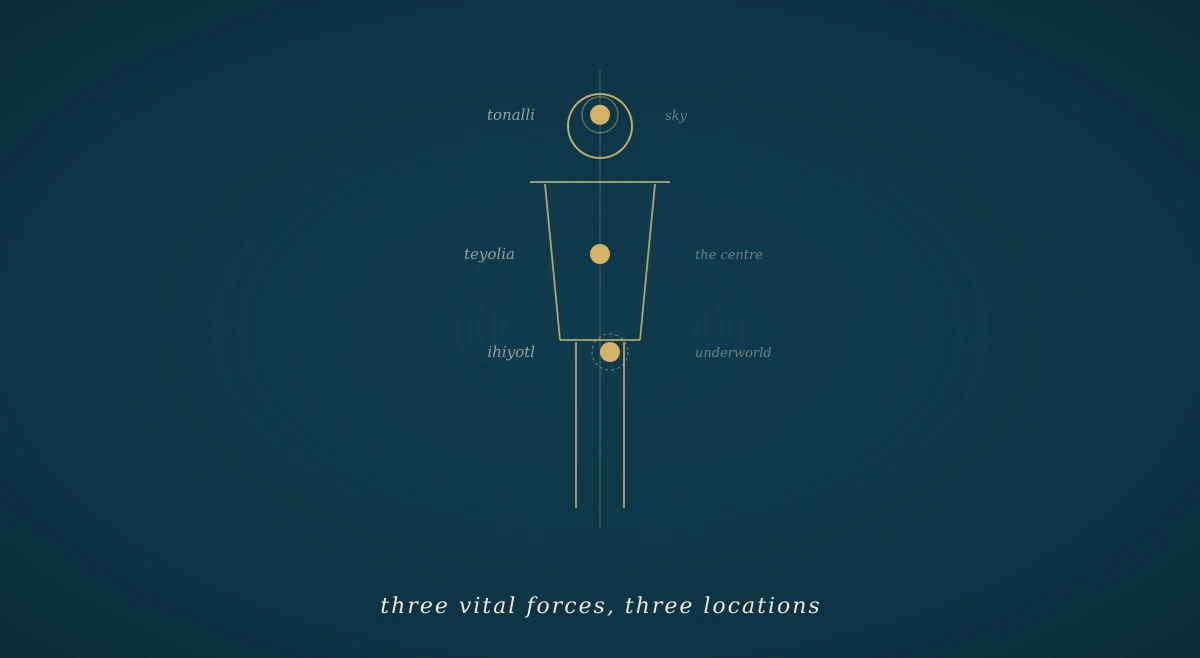
How to read this text
You do not need any prior knowledge. Every term is explained the first time it appears.
An honest note before we start — and here it is threefold, and heavier than usual
First: the sources were written by those who destroyed the system
Almost everything we know was recorded after the 1521 conquest, in the Latin alphabet, under Spanish oversight, by people whose stated purpose was to identify and eliminate what they were recording.
The Franciscan Bernardino de Sahagún says it himself: the physician must know the disease in order to treat it. His encyclopaedic work is a tool of missionary work.
This does not invalidate it — it is extraordinarily detailed, written bilingually, and the actual authors are to a large extent Nahua themselves (chapter 0). But it means every page passed through a filter, and sometimes you can see where.
Second: the tidy ordering is modern
The clean, symmetrical system you will read — three entities, three locations, three functions — is not found gathered anywhere in the sources. It is a synthesis by 20th-century scholars, mainly Alfredo López Austin, from scattered material.
And the sources are not fully consistent with one another. I will mark this where it matters.
Third, and the most important: this is not a dead culture
There are today approximately 1.7 million Nahuatl speakers in Mexico — the largest indigenous language of the country, with living communities in the Huasteca, Guerrero and Puebla.
Concepts in this text — tonalli, its loss, temazcal, cleansing — are not archaeology. They are used today.
This changes the character of the whole document. We are not writing about something that ended, and we have no right to speak as if it had.
A short introduction to Nahua thought, for the reader who is new
Before any of the technical material lands, it helps to have five things in mind. If you already know them, skip to the Contents.
Where this comes from, in time and place
Mesoamerica — roughly modern Mexico and northern Central America — has a continuous cultural tradition going back about 4,000 years, through a sequence of civilisations that shared a 260-day calendar, a cosmology of multiple directions and layers, and a cultic focus on blood and maize: Olmec (c. 1500–400 BCE), Teotihuacan (c. 100 BCE – 650 CE), Classic Maya (c. 250–900 CE), Toltec (c. 950–1150 CE), and the Nahua world of the Postclassic (c. 1200–1521 CE).
The thinking in this guide belongs to the last of these. The Mexica of Tenochtitlan, who founded their city on an island in Lake Texcoco around 1325 CE and formed the Triple Alliance with Texcoco and Tlacopan in 1428, were the dominant Nahua polity when the Spanish arrived in 1519. Tenochtitlan fell in 1521.
But “Nahua” is wider than Mexica. The Nahuatl language is spoken by dozens of city-states (altepetl), often at war with one another. The language belongs to the Uto-Aztecan family — related to Hopi and Comanche — meaning the Nahua came, originally, from the north.
Unlike the Chinese, Indian and Greek material in the companion guides, which has long written traditions that reach back to the sources, the Nahua written record in Nahuatl begins only after the conquest, in the Latin alphabet — the pre-conquest pictorial codices are a separate kind of record. This is a central methodological fact of the material.
There is no “the” Nahua tradition
Even within the Nahuatl-speaking world there is no single system:
- Mexica of Tenochtitlan — the imperial centre; the most heavily documented source
- Texcoco — the second city of the Triple Alliance; famous for its school of tlamatinime (sages) and the poet-king Nezahualcoyotl (though see chapter 26 on the uncertainty of attribution)
- Tlaxcalans — long-standing enemies of the Mexica; the Spanish allies in 1521
- Cholula — ancient pilgrimage city, centre of the cult of Quetzalcoatl
- The Nahua of the Huasteca (northeastern Veracruz, Hidalgo, San Luis Potosí) — a distinct variant, continuously documented from the colonial period to the present
- The Nahua of Guerrero and Puebla — today the largest living communities
The sources that survive come overwhelmingly from the Mexica and Texcoco, because the colonial scholarship was done in and around Mexico City. The guide follows that bias but marks it.
What kind of body-knowledge this is
The body material in this guide comes from four kinds of source:
- Post-conquest encyclopedic works by Franciscans working with Nahua collaborators — above all the Florentine Codex of Sahagún (c. 1545–1590), twelve bilingual books, with substantial Nahua authorship (see chapter 0).
- The one strictly indigenous medical text — the Libellus de Medicinalibus Indorum Herbis (1552), written by the Nahua physician Martín de la Cruz and translated into Latin by Juan Badiano. The only medical treatise authored by a Nahua.
- Inquisition manuals that recorded native practices in order to suppress them — above all Hernando Ruiz de Alarcón’s Tratado de las supersticiones (1629), which preserves healing invocations verbatim. Invaluable material, hostile purpose.
- Living ethnography from the 20th and 21st centuries — Sandstrom’s Corn Is Our Blood (1991), among others — which shows that the key concepts (tonalli, cleansing, susto, temazcal) are not reconstructions. They are used today.
The 20th-century synthesis that organises all this — the one you will read as if it were “the Nahua system” — is above all the work of Alfredo López Austin, whose Cuerpo humano e ideología (1980) is the foundational modern study. He assembled the three-fold scheme of tonalli / teyolia / ihiyotl from hundreds of scattered references. The scheme is useful. It is also his.
What this material is not
It is not a continuous written tradition in the sense that the Chinese and Indian ones are. The pre-conquest codices do not record philosophical or medical texts in a form we can read directly; the written tradition in Nahuatl begins after the catastrophe, under supervision.
It is not a dead culture. This has to be repeated because the usual framing — “the ancient Aztecs” — invites exactly the wrong tense. Nahuatl is spoken by about 1.7 million people today; susto is diagnosed in Mexican clinics; the temazcal operates; tonalli is a word in current use.
It is not safe to practise unsupervised. The one practice in this guide that a reader might be tempted to try is the temazcal — a steam bath in a confined space (chapter 18). It has killed people when run outside the tradition. The chapter marks this explicitly.
It is not a repository of psychedelic practice, whatever recent popular writing has suggested. Ayahuasca is Amazonian, not Nahua. Peyote is of the northern Mexican peoples, not Nahua. The actual Nahua use of psychoactive substances was for divination and diagnosis, not personal experience — chapter 20 is explicit about the distinction and why it matters.
A word on names
Classical Nahuatl is written in the Latin alphabet with Spanish-based orthography, as it has been since the 16th century. This guide uses that orthography throughout: tonalli, teyolia, ihiyotl, huehuetlatolli. A short pronunciation guide, which you do not need to memorise but which helps:
| Letter | Pronunciation | Example |
|—|—|—|
| tl | One sound, not two. Something like English “tl” with no vowel between them | nahuatl = NA-watl |
| x | sh (not “ks”) | Mexica = me-SHEE-ka |
| hu / uh | Semi-vowel w, as in English water | huehue = WEH-weh |
| cu / uc | kw | cuauhtli = KWAW-tli |
| z | s | tlazolli = tla-SO-lli |
| ll | Not a Spanish ll; two separate l sounds | tonalli = to-NA-lli |
Stress: almost always on the second-to-last syllable. tonalli = to-NA-lli.
Important: many of these words have had careers in English where they now mean something distorted. Shaman is a Siberian loan that lumps together roles the Nahua kept distinct (chapter 0). Aztec is a 19th-century label nobody used of themselves. Ceremony evokes ecstasy; the Nahua emphasis is on precision and measure. The guide uses the Nahua terms, in Nahua orthography, with the gloss on first use.
With that in hand, the material below should be legible without prior training.
Contents
0. The words you bring with you — a necessary clearing
PART A — The foundational idea
- The bones and the blood
- Teotl: not god, but process
- The inamic pairs
- Three ways of motion: olin, malinalli, nepantla
PART B — The material of the system
- Tonalli — the heat that leaves
- Teyolia — the heart that stays
- Ihiyotl — the breath that harms others
- What binds the three — and what we do not know
PART C — The geography
- The body as a vertical axis
- Hot and cold — with a caveat
- Tlazolli: pollution as relation
- Nahualli and transformation
PART D — Time
PART E — The practice
- The ticitl
- Susto: loss and recovery
- Temazcal: the bath as technology
- Where one goes after death — and why it is not judged
- The medicines of the gods
- Huehuetlatolli: the words of the elders
- In ixtli, in yollotl: face and heart
- Ten practical principles
- The sacrifice
PART F — Synthesis
- Difrasismo: why truth is said with two words
- Neltiliztli: truth as rootedness
- How it all ties together
- Nepantla: what happened after
APPENDIX — Glossary and sources
0. The words you bring with you — a necessary clearing
On most subjects, the reader starts with a little knowledge. Here, the reader starts with wrong knowledge, which is worse — because wrong knowledge leaves no room.
Four words need clearing before we begin.
“Aztecs”
They never existed. The term was spread in the 19th century, by Alexander von Humboldt and the historian William Prescott. Nobody called themselves that.
The correct terms:
- Nahua — all the peoples who speak Nahuatl. Dozens of city-states (altepetl), often at war with each other. The language belongs to the Uto-Aztecan family — related to Hopi and Comanche; that is, they came from the north.
- Mexica — the specific people of Tenochtitlan. Mexico takes its name from them.
- Triple Alliance (1428) — Tenochtitlan, Texcoco, Tlacopan. This is the “empire”.
The text concerns the Nahua in general, with the material coming mainly from the Mexica and from Texcoco, because that is where most of it survives.
“Shaman”
This is a Tungusic word, from Siberia (šamán, from the Evenki people), that 19th- and 20th-century anthropology generalised to the whole planet.
The Nahua had distinct terms for distinct roles, and merging them into one is exactly the distortion to avoid:
| Term | Literally | What they did |
|—|—|—|
| ticitl | — | Healer. Practical: herbs, midwifery, bone-setting, massage, diagnosis |
| tlamatini | “one who knows something” | Sage, teacher, keeper of the texts. The closest to a philosopher. Does not perform rites |
| tonalpouhqui | “one who counts the tonalli” | Calendar specialist. A technical role, not an ecstatic one |
| nahualli | — | The transformer. Often dangerous, often accused |
The ticitl and the nahualli do not do the same job. The tlamatini does neither.
“Ceremony”
The Western image is of ecstasy, drums, personal experience. The weight in the sources falls elsewhere: on fasting, continence, cleanliness, precision of timing, and correct speech.
It is far closer to a liturgical calendar than to a personal experience. And the central verb is not “I feel” but “I pay” (chapter 1).
“Psychedelics”
Say it once clearly here, and we will develop it in chapter 20:
Ayahuasca is not Nahua. It is Amazonian — Peru, Ecuador, Colombia, Brazil. Different peoples, thousands of kilometres away. The Nahua did not know it.
Peyote is not Nahua. It is of the northern Mexican peoples — Huichol, Rarámuri.
The Nahua had other substances, with another function: mainly divination and diagnosis, not experience and not personal growth. And not at the centre of the system.
PART A — THE FOUNDATIONAL IDEA
1. The bones and the blood
Every system starts from an image. Here it is, from the Leyenda de los Soles (1558):
The world has already been destroyed four times. Four previous humanities have been lost. Quetzalcoatl descends to Mictlan, the underworld, to ask for their bones.
The lord of Mictlan sets him tests, deceives him, sends quail. Quetzalcoatl stumbles; the bones fall and break. That, the text says, is why human beings are not all the same height.
He gathers them broken. They are taken to Cihuacoatl, who grinds them in a clay bowl. And then Quetzalcoatl bleeds himself over them.
From that blood, human beings are made.
What falls out of this
First: humans were not created — they were acquired at a price. And the language keeps this in a striking way.
The word for the common person is macehualli. It connects with the verb macehua, which means “to acquire something through penance, sacrifice, or merit”.
A human being, in Nahuatl, is literally “the one won through sacrifice”.
You are not a creature. You are an acquisition — and someone paid.
Second: debt is the foundational relation. The term for sacrifice is nextlahualli — “payment, settlement of a debt”. It is not a gift, not an atonement, not worship. It is a bill.
Third: the body is not yours. It is on loan, temporary, from material that belongs elsewhere and is returned.
And why this changes everything
A system that starts from debt does not ask the same questions as a system that starts from balance or from perfection.
It does not ask “how do I become better?”. It asks:
“What do I owe, to whom, and am I aware of it?”
Health is not cultivated — it is restored. Disease is not dysfunction — it is an open account. And treatment, almost always, is a form of settlement or return.
Hold on to this. You will find it in chapter 11 (pollution), chapter 17 (loss of tonalli), chapter 24 (sacrifice) — and it is why this document is called what it is.
2. Teotl: not god, but process
teotl — the word the Spanish translated as dios, “god”. And here the difficulty begins.
In the texts, teotl is used for things that are not gods in the Western sense: for the sun, for a sacred mountain, for a person chosen for sacrifice, for something astonishing or terrifying. The Spanish were first called teteo (the plural).
The reading that is gaining ground
The philosopher James Maffie (Aztec Philosophy, 2014) argues that teotl is not an entity but a process: a continuous, self-generating, self-transforming sacred power of which everything that exists is made.
That is: there are not many gods acting upon the world. There is one thing in constant motion, and the “gods” are faces, masks, modes of its manifestation.
The fact that the figures of the gods continually overlap, swap attributes, and are sometimes the same god under another name, supports this reading. So does one of the names of Tezcatlipoca: Yohualli Ehecatl — “Night, Wind”. That is: invisible and tangible at once.
The honest note
This is an interpretation, not a source. Maffie is disputed: he is accused of over-systematising, and of importing concepts of Western process philosophy (Heidegger, Whitehead) into material that does not have them explicitly.
The most likely position is that both existed — a popular religion with faces and names, and an esoteric discussion in the schools of the nobility (calmecac) that tended toward unification. Exactly as happens in every developed tradition.
How to take it practically: when the text says “god”, do not imagine a person on a throne. Imagine a force in operation — and a relationship with it that has terms.
3. The inamic pairs
inamic — “the counterpart, the opposite, the match”. Used for the spouse, for the enemy, and for the price of a commodity (what counterbalances it).
And here is the structural principle that runs through the whole system:
Opposites do not fight for one to prevail. They are simultaneously necessary, and reality arises from the tension between them.
The basic pairs:
- life ↔ death
- male ↔ female
- dry ↔ wet
- sun ↔ moon
- light ↔ darkness
- order ↔ disorder
- sky ↔ earth
- hot ↔ cold
The image that best shows it
The highest thing in the cosmology is not a god. It is a couple: Ometeotl or, more accurately, Ometecuhtli and Omecihuatl — “Lord Two” and “Lady Two”, who dwell in Omeyocan, “the Place of Duality”.
Ome means “two”. The principle of all things is, by name, the two.
(Note: the form “Ometeotl” as a single name has been contested — there is an argument that it is largely a construction of Miguel León-Portilla. The dual structure, however, is securely attested.)
The crucial difference from “balance”
It is not balance in the calm sense. It is unresolved antagonism.
The sun must defeat the night every day, again, and there is no guarantee. The present world — the Fifth Sun — is the fifth because the four preceding ones failed. And this one too will be destroyed, by earthquakes.
There is no stability. There is only maintenance — and it is strenuous, collective, and precarious.
This is the strangest idea of the system for a modern mind, and the most important. The world does not stand on its own.
4. Three ways of motion: olin, malinalli, nepantla
If teotl is continuous motion, the question becomes: what kind of motion?
Maffie identifies three recurring patterns, each with a name that is simultaneously a day of the calendar and a natural process. (Again: this is his systematisation, not an explicit category of the sources. The names themselves and their meanings, however, are genuine.)
olin — oscillation
ollin = motion, earthquake, pulse. The same root as yollotl, “heart”, and as olli, the rubber from which the ball of the ritual game was made.
It is the oscillating motion around a centre: the heartbeat, the breath, the ball that bounces, the sun that rises and sets, the earthquake.
Its shape is the four with a centre — four directions and a middle. And the present world is called Nahui Ollin, “Four-Motion”.
malinalli — twisting
malinalli = twisted grass, the thread that is spun. The motion of the spiral: two fibres that twist around each other and become a rope — stronger than their sum.
It is the motion of conversion: life into death and back, food into flesh, plant into thread. The image of the double helix appears continually in the iconography.
nepantla — the in-between
nepantla = “in the middle, between”. The motion of weaving: two threads that constantly pass through one another and produce cloth, without either being lost.
It is the most interesting of the three, and it returns in the last chapter — because after the conquest the same word described the position of the Nahua themselves.
Why it matters for the body
Because all three exist inside you:
- olin — heart, breath, rhythm, the up-and-down of the day
- malinalli — digestion, nutrition, ageing, the becoming-flesh
- nepantla — relation, being between people, the coexistence of opposites in you
The body is not a thing in this model. It is three motions happening simultaneously.
PART B — THE MATERIAL OF THE SYSTEM
Warning, again: the clean threefold scheme that follows is López Austin’s synthesis from scattered material. The sources do not present it this way, and they do not always agree with one another. Chapter 8 says exactly what we do not know.
5. Tonalli — the heat that leaves
tonalli — from the verb tona, “to warm, to emit heat”. The same root as Tonatiuh, the sun.
The word means, simultaneously — and this is not a coincidence:
- heat, solar warmth
- the day of birth and the point of the calendar
- fate, portion, destiny
- the vital force inside the body
Where it is located
In the head, especially the crown — in the region of the fontanel, where the infant’s skull has not yet closed.
That is why the hair of the crown was important: it protected the tonalli. One did not cut the crown hair of young children. And in war, to seize a captive by the crown hair was not merely practical — it was seizing his force.
Its characteristics
-
It is hot. It warms the body and makes it alive.
-
It can leave — and this is the critical thing. The tonalli is not fixed in place. It departs:
- in sleep (which is why one does not wake someone abruptly, and why dreams are real journeys)
- in drunkenness
- in the sexual act
- in terror — and here the illness of chapter 17 is rooted
- in violent emotion -
It is not of fixed quantity. It grows with age, with achievements, with office. A ruler has more; an infant very little, and that fragile.
-
It is not only human. Animals have tonalli, so do mountains, days, cities, cult objects.
-
It is set by the day of birth. See Part D.
Why this is the most important concept of the document
Because it changes what “ill” means.
In the previous systems, illness is a disorder within a system. Here, a whole part of you can no longer be there — can be left somewhere on the road, can be held by someone, can have fallen in water.
And so treatment is not regulation. It is recovery.
6. Teyolia — the heart that stays
teyolia — from the root yol-, “to live”. Related to yollotl, heart, and to ollin, motion.
(The heart, in Nahuatl, is by name “that which moves”. The same pattern as chapter 4.)
Where it is located
In the heart. And in contrast to tonalli, it does not leave while you live.
What it does
- Memory and thought. In Nahuatl, cognition is located in the heart, not in the head.
- Emotion and character.
- What makes someone what they are — the particularity, the talent, the inclination.
The language shows it: a crowd of expressions for mental states are built on yollotl. Confession is called neyolmelahualiztli — literally “the straightening of the heart” (chapter 11).
What happens after death
The teyolia is what travels. It leaves and goes to the destination determined by the manner of death (chapter 19).
And for certain people — rulers, great artists, priests — the teyolia could be deified, become teotl itself.
The contrast that holds the system together
| | tonalli | teyolia |
|—|—|—|
| Location | Head, crown | Heart |
| Nature | Heat, force | Consciousness, identity |
| Leaves while alive? | Yes, often | No |
| After death | Disperses / stays in the bones | Travels |
| Source | The day of birth | Life itself |
The first is what keeps you alive. The second is what makes you you. And the first is far more fragile than the second.
7. Ihiyotl — the breath that harms others
ihiyotl — “breath, exhalation, emanation”. The third, the most unusual, and the one on which the sources are least consistent.
Where it is located
In the liver.
What it is
Described as a luminous gas that resides in the liver and can be emitted. Related to:
- passion, drive, vitality
- appetite, desire
- courage or cowardice
- influence over others
And here the unique idea
Your ihiyotl can harm those around you — without your willing it.
The ihiyotl was considered dangerous in:
- an angry person
- a person in a state of pollution (tlazolli, chapter 11)
- the dead
- certain physiological states, such as menstruation and the puerperium — and here it has to be said plainly that this is the kind of belief that produces social stigmatisation of women, as in many traditions
The vulnerable are infants and small children, who have little and unstable tonalli.
From this cycle of ideas comes the modern folk term mal aire, “bad air”.
Why this is not superstition in the easy sense
Whatever one believes about the mechanism, the structure of the idea is serious and unusual:
Your internal state is not a private matter. It has a physical effect on the people around you, especially the weakest.
There is no “what I feel inside is my own business”. Your anger is in the room.
And it connects directly with chapter 11: pollution in this system does not primarily harm the one who caused it — it harms his dependants.
8. What binds the three — and what we do not know
The structure
| | tonalli | teyolia | ihiyotl |
|—|—|—|—|
| Location | Head | Heart | Liver |
| Literally | Heat | Life | Breath |
| Domain | Force, fate | Identity, cognition | Passion, influence |
| Danger | Lost | — | Harms others |
| At death | Dissolves | Travels | Scatters, dangerous |
| Correspondence | Sky, sun | The middle | Underworld |
Balance of all three is health. And each can be disturbed independently — so the system distinguishes at least three different types of illness:
- Loss of tonalli → weakness, sadness, lethargy, wasting (chapter 17)
- Disturbance of teyolia → confusion, loss of self, “not the same person”
- Attack of another’s ihiyotl → sudden illness, especially in children
And now what we do not know
This has to be said explicitly, because the table above looks more certain than it is:
1. No source presents them together. López Austin assembled them from hundreds of scattered references in medical, religious and linguistic contexts.
2. The sources do not agree. Other texts give other locations, others are silent, others use the terms in overlapping ways.
3. The very question may be foreign. “How many souls does a person have and where are they?” is a question of European theology. Nahua informants were answering questions put to them by Franciscans — and the form of the question shapes the answer.
4. The dividing line was probably more blurred. The most plausible reading is that there was a spectrum of vital forces with overlapping functions, and that the threefold tidying is our own reading tool.
Use it as a map. Do not take it for a photograph.
PART C — THE GEOGRAPHY
9. The body as a vertical axis
The body corresponds to the structure of the world — and the correspondence is not decorative, it is functional.
The world
- Thirteen levels of sky, above
- The earth, the surface — which is a vast creature, Tlaltecuhtli, lying face up
- Nine levels of underworld, the Mictlan
And four directions with colour, tree, bird, god — plus the centre, which is the fifth. The olin shape of chapter 4.
The body
| Zone | Entity | Correspondence | Quality |
|—|—|—|—|
| Head | tonalli | Sky, sun | Hot, bright, dry |
| Heart / thorax | teyolia | The surface, the centre | The middle, the meeting-place |
| Belly / liver | ihiyotl | Underworld | Cold, dark, wet |
Two things that stand out
First, down is not bad. The underworld is dark, wet, cold — and it is the source of fertility and of seeds. Its gods are not demons. The ihiyotl is not your “lower part”; it is your vitality.
Second, the centre is the place of work. The heart is where sky and underworld meet — and the human work is to hold the meeting. The human does not try to climb. He tries to stand in the middle.
This is, again, the nepantla of chapter 4 — and the reason the last chapter closes with it.
10. Hot and cold — with a caveat
In modern Mexican folk medicine there is an extensive classification system of foods, illnesses and treatments into hot and cold. It is alive and widely spread.
The question: is it pre-Hispanic?
The disagreement, honestly
George Foster argued that it is a Spanish import — the Hippocratic-Galenic theory of qualities, which reached Spain via the Arabs and from there New Spain. Arguments: modern systems are not internally consistent, vary greatly from region to region, and the pre-Hispanic evidence is thin.
López Austin argued that there is a genuine pre-Hispanic core: tonalli is by definition hot, the underworld is cold, the hot-cold axis is structural in the cosmology and independent of the Greeks.
The most likely answer is “both”: there was an indigenous hot/cold polarity, it met an extraordinarily compatible European system, and the two merged so deeply that they are no longer separable.
What we can safely say
Pre-Hispanic for certain:
- Tonalli is heat — the etymology leaves no room
- The underworld is cold and wet; the sky hot and dry
- Excessive heat (fever, anger, drunkenness) is dangerous because it can displace the tonalli
- The temazcal (chapter 18) is heat therapy, and is attested as pre-Hispanic
The detailed table of “which food is hot and which is cold” I will not give, because we do not know how much of it is Nahua and how much is Galen in Spanish translation.
11. Tlazolli: pollution as relation
tlazolli — “trash, waste, discarded material, mess”. Literally the dry leaves and residues you sweep.
And it became the central concept for something much wider: moral and bodily pollution.
The goddess
Tlazolteotl — “the goddess of tlazolli”. She is simultaneously the one who causes sexual transgression and the one who forgives it: she is called tlaelcuani, “she who eats the filth”. She swallows pollution and cleanses.
That the same person does both is, exactly, the logic of the inamic of chapter 3.
Confession
There was a rite, neyolmelahualiztli — “the straightening of the heart”. The person went to a priest and declared his transgressions, especially sexual ones.
Two differences from Christian confession, and they are large:
- It was done once in a lifetime. Usually in advanced age, because after it no new transgression could be cleansed.
- It had legal force. What was declared there could not be prosecuted by the state. It was simultaneously a ritual and a legal cleansing.
And now the structural particularity
The tlazolli does not primarily harm the one who caused it. It harms his dependants.
A man’s sexual transgression manifested as illness in his wife or children. One person’s pollution harmed the house, the harvest, the community.
This is not guilt. Guilt is internal and individual. Tlazolli is external, transmissible and relational — closer to contagion than to sin.
And the mechanism of transmission is the ihiyotl of chapter 7.
Why it matters
Because it is the second major divergence of this system from familiar models.
There is no private moral life. There is no “I am harming no one”. Your state leaks — and the victims are not you.
12. Nahualli and transformation
nahualli — from a root related to “hidden, covered, disguised”.
The word means two connected things:
- The person who can transform — usually into an animal (jaguar, eagle, coyote, dog), but also into a phenomenon (lightning, a ball of light).
- The animal-companion itself — a creature that shares your fate, is born with you and dies with you. (In later ethnography this is often distinguished as tonal, from tonalli.)
The critical point: it is not a positive figure
The Western image of the “spirit animal” is warm and protective. In the sources, the nahualli is primarily a threat.
Sahagún classes him with the harmful sorcerers. The relevant descriptions concern people who harm, steal, frighten, or sicken others.
There was a positive version too — the ruler, the priest, the warrior with a powerful nahualli — but the dominant use is cautionary, and after the conquest it became a charge of witchcraft with real consequences.
How it connects
The nahualli is the logical consequence of the three preceding chapters:
If the tonalli can leave the body (chapter 5), and if the ihiyotl can be emitted and affect others (chapter 7), then a person with a powerful tonalli can send it elsewhere, with a form.
Transformation is not an exception in the system. It is the system, at its extremes.
PART D — TIME
This part has no counterpart in other body systems, and it is necessary here: for the Nahua, your body is determined by the day you were born. Time is not a frame within which the body exists. It is a constituent of it.
13. The tonalpohualli: the 260 days
tonalpohualli — “the counting of the tonalli”. Notice the word: it is not called “counting of the days”. It is called the counting of the vital forces.
How it works
Two cycles that turn simultaneously:
- 20 signs (names)
- 13 numbers
They combine: 1-Crocodile, 2-Wind, 3-House… up to 13-Reed, and then the number restarts from 1 while the signs continue.
The cycle closes at 20 × 13 = 260 days, and each combination appears exactly once.
The twenty signs
| | Nahuatl | English |
|—|—|—|
| 1 | Cipactli | Crocodile |
| 2 | Ehecatl | Wind |
| 3 | Calli | House |
| 4 | Cuetzpalin | Lizard |
| 5 | Coatl | Snake |
| 6 | Miquiztli | Death |
| 7 | Mazatl | Deer |
| 8 | Tochtli | Rabbit |
| 9 | Atl | Water |
| 10 | Itzcuintli | Dog |
| 11 | Ozomatli | Monkey |
| 12 | Malinalli | Grass |
| 13 | Acatl | Reed |
| 14 | Ocelotl | Jaguar |
| 15 | Cuauhtli | Eagle |
| 16 | Cozcacuauhtli | Vulture |
| 17 | Ollin | Motion |
| 18 | Tecpatl | Flint |
| 19 | Quiahuitl | Rain |
| 20 | Xochitl | Flower |
The second cycle
Running in parallel was the xiuhpohualli, the solar year: 18 “months” of 20 days = 360, plus 5 nemontemi days — “the vainly filled”.
These five days were considered dangerous and empty. Nothing significant was done. Whoever was born then had a hard fate.
And the great cycle
The two counts coincide every 52 years — the xiuhmolpilli, “the binding of the years”.
At the end of each 52-year period came the Ceremony of the New Fire: all the fires of the empire were extinguished, utensils were broken, people waited in the dark. The priests climbed a hill and lit a new fire.
If it did not light, the world ended. This was not symbolism — it was the stated fear. The last was performed in 1507, twelve years before the Spanish arrived.
This is, in the most concrete way, the principle of chapter 3: the world does not stand on its own.
14. The day you were born
The day of birth gives the tonalli. It does not “influence” it — it gives it.
Book IV of the Florentine Codex is, essentially, a catalogue: for every combination of sign and number, what it means.
A sample of the tone:
- 1-Crocodile — favourable
- 2-Rabbit — tendency toward drunkenness; Rabbits are connected with pulque
- 1-Death — a good sign, paradoxically; under the protection of Tezcatlipoca
- 1-Rain — dangerous; connected with witches
- 4-Dog — favourable, prosperity
- 1-Deer — unstable, cowardice, tendency to flee
And the tonalpouhqui (chapter 0) was the specialist who read it. He was called immediately after birth.
What it determined
Far more than one would expect:
- Occupation — merchant, warrior, priest, craftsman
- Temperament
- Vulnerable illnesses
- Luck
- Manner of death — which determined the destination after death (chapter 19)
That is: this is not astrology in the decorative sense. It is the core of what you are.
15. Why it is not fatalism
If you read it only like that, out comes a system of absolute predetermination. It is not — and the two escape mechanisms are remarkably interesting.
First: shifting the ceremony
The child did not receive its tonalli at the moment of birth, but at the naming and bathing ceremony, a few days later.
And if the day of birth was bad, the tonalpouhqui would shift the ceremony to a neighbouring, more favourable day.
Fate was negotiable — technically, by a specialist, with method.
This is far closer to engineering than to destiny.
Second, and heavier: behaviour overrides
Book IV itself repeats, again and again, a position that cancels the fatalistic reading:
A good sign does not save the lazy. A bad sign does not condemn the diligent.
The sign gives tendency, not decision. And it is repeatedly stressed that one born under a favourable sign who lives disorderly loses the benefit.
The formulation that holds it
The system says, in effect:
You are born with a specific force, not a specific outcome. And the force can be squandered.
It is in fact closer to constitution than to horoscope. Your day tells you what body and what inclinations you got. What you do with them is another matter — and it is yours.
PART E — THE PRACTICE
16. The ticitl
ticitl — the healer or, very often, the female healer. The abundance of women in this role, especially in midwifery, is explicitly recorded.
What they did
Sahagún gives a catalogue of abilities that is strikingly practical:
- Herbal medicine — extensive; hundreds of plants with names, uses and modes of preparation
- Midwifery (temixiuitiani) — prenatal care, delivery, massage, foetal rotation
- Bone-setting — reduction of fractures, splints
- Surgery — sutures, drainage of abscesses, bloodletting with an obsidian blade
- Massage and hydrotherapy
- Diagnosis — observation, questioning, palpation, and divinatory techniques
The divinatory techniques
Used for diagnosis — that is, to find the cause:
- Tossing kernels of maize on a cloth and reading the arrangement
- Measuring the forearm with the hand — if the length “did not come out”, tonalli was missing
- Reading in water
- Observing the pulse
The critical point for understanding the whole system
In this tradition there is no separation between “real medicine” and “magic”. The same person set the fracture and called back the tonalli, and both were techniques, and both had specific procedures.
The separation is ours, and we project it onto a system that does not have it.
And the honest assessment
A significant part was effective. The Nahua herbal was among the richest in the world; several plants have confirmed action; their bone-setting and midwifery were, according to the testimony of the Spanish themselves, in some respects superior to the European practice of the time.
Another part was not. And the aetiology — loss of tonalli, attack of ihiyotl, punishment by a deity — did not identify infectious disease. In 1520 and 1545 the epidemics killed, by current estimates, a vast proportion of the population, and the system had no answer.
European medicine of the same period had none either.
17. Susto: loss and recovery
The most characteristic illness of this system, and the only one that is alive today across the whole of Latin America.
Nahuatl: nemouhtiliztli, from mauhtia, “to frighten”. Spanish: susto or espanto.
What it is
Loss of tonalli from terror. A fall, a sudden plunge into water, an encounter with something frightening, a violent emotion — and the tonalli leaves and stays at the spot.
The symptoms
And they are strikingly consistent across the sources and modern ethnographic records:
- Anorexia, weight loss
- Pallor
- Lethargy, weakness
- Insomnia or disturbed sleep
- Sadness, withdrawal
- In children: crying, wasting, “not the same child”
The treatment
It is not medication. It is recovery, and it has a clear procedure:
- Return to the spot where the terror occurred
- Calling the tonalli by the person’s name, repeatedly
- Water — sprinkling, or an offering at the spot
- The person’s clothing, which is laid out or shaken so the tonalli recognises it and follows
- A cleansing (limpia) with plants, egg or incense, as the tonalli returns
- Often an offering — because something was holding the tonalli, and it is paid off
The invocation, in the records of Ruiz de Alarcón, is addressed directly to the tonalli in the second person: it tells it to come, scolds it for leaving, reminds it where it belongs.
How to read it
Two readings, and both are reasonable.
The cultural: susto is a recognised culturally-bound syndrome in the medical literature. The symptoms overlap with depression, post-traumatic reaction, and somatoform manifestations — and there are studies that correlate a susto diagnosis with measurably worse health.
The structural, which is the interesting one: the model says that after trauma, a piece of you is missing, and is still at the place of the event. And that treatment requires return to the spot, naming, and ritual closure.
You do not need to believe anything to recognise that this description of trauma is functionally accurate — and that modern approaches converge on a similar shape from another road.
18. Temazcal: the bath as technology
temazcalli — from tema (“to bathe in steam”) + calli (“house”). The house of steam.
What it is
A low domed structure of stone or clay, with a small entrance. Fire-heated stones, water with herbs poured on them, steam. Striking with bundles of plants.
It is attested as pre-Hispanic, with archaeological remains at many sites.
Where it was used
- The puerperium — the main use. The mother enters with the midwife, repeatedly, in the weeks after birth
- Joints, skin, respiratory conditions
- Cleansing from tlazolli
- Preparation before important events
The deity
The temazcal is associated with Toci, “our grandmother”, who is also called Temazcalteci — “the grandmother of the bath”. The entrance is often depicted as her body.
The image is clear and explicit: you enter the womb and are reborn. The low dome, the darkness, the heat, the humidity, the stooping to come out.
How it ties to the preceding
It is heat therapy — that is, therapy that works directly on the tonalli (chapter 5), which is heat.
And it is simultaneously a cleansing — removal of tlazolli (chapter 11). In the same step, you warm the vital force and wash off the pollution.
The warning
Hot ceremonies in a confined space have killed people when performed without the tradition’s knowledge. The best-known incident is in Sedona, Arizona in 2009: three deaths and dozens of medical evacuations at a decontextualised “ceremony” with paid participants.
The mechanism is not mysterious: hyperthermia, dehydration, electrolyte imbalance — and social pressure not to leave.
In the tradition, the person who controls duration and brings people out is part of the technique.
19. Where one goes after death — and why it is not judged
This is perhaps the most foreign chapter for a reader with a Christian or karmic background, and it deserves attention.
The destination after death is determined by the MANNER of death. Not by the life you lived.
There is no judgment. There is no reward for virtue, nor punishment for vice.
The four destinations
1. Mictlan — the ordinary death. For those who died of illness, old age, anything ordinary. The teyolia makes a four-year journey through nine levels, with trials: a river crossed with the help of a dog, mountains that clash, a wind of obsidian knives.
At the end it arrives at the lord of Mictlan — and ceases to exist. It is not hell; it is dissolution.
2. Tlalocan — death by water. For those who drowned, were struck by lightning, or died of “wet” illnesses (dropsy, gout, certain skin conditions).
It is a place of abundance: green, with water, plants, song. The closest thing to a paradise.
3. Tonatiuh ilhuicac — the sun’s heaven. And here the most remarkable detail. There go:
- Warriors who fell in battle
- Captives who were sacrificed
- And women who died in childbirth
Death in childbirth was considered death in battle. The woman had “captured” a creature and fell doing so. They were called cihuateteo, “woman-goddesses”.
The distribution is symmetric: the warriors accompany the sun from dawn to noon; the women from noon to dusk.
4. Chichihualcuauhco — the tree of nourishment. For infants who died before weaning. A tree from whose branches hang breasts that drip milk. The children feed there until they are born again.
Why it matters
Because it shows something about the whole system:
Ethics is not accounting with a reckoning at the end.
The good life is not an investment with a payout after death. It is an obligation here: you pay your debt to the community and the gods while you live (chapter 1). What happens afterward is a question of how you left, not how you behaved.
And this has a direct consequence for the logic of chapter 24.
20. The medicines of the gods
Here, as warned in chapter 0, more care is needed than elsewhere — because there is a great deal of confusion.
This chapter gives no instruction for use, no dosage and no method. It is not a manual. These substances are dangerous, largely illegal, and outside their context they do not do what is described here.
First, what is NOT Nahua
Ayahuasca. Amazonian — Peru, Ecuador, Colombia, Brazil. Other peoples (Shipibo, Shuar, Tukano), thousands of kilometres away. The Nahua did not know it.
And the ritual forms a Westerner meets today are largely modern: Santo Daime was founded in 1930, the União do Vegetal in 1961, and the paid retreat model is more recent still. Amazonian vegetalismo has a genuine system — with plantas maestras each in a different role, and dietas of isolation and restriction. It is real. It is simply from another tradition.
Peyote. Northern Mexico — Huichol, Rarámuri. The Nahua knew it by hearsay as something of the northern peoples, not as their own. The Native American Church was founded in 1918.
What they did have
| Name | What it is | Use in the sources |
|—|—|—|
| teonanácatl | Psilocybin mushrooms, “flesh of the gods” | Divination in specific contexts; Sahagún describes use at a merchants’ banquet |
| ololiuhqui | Seeds of Turbina corymbosa, with ergot-like alkaloids | Divination and diagnosis — the most frequent reference |
| picietl | Nicotiana rustica, a very strong tobacco | The most important of all. Daily, sacred, everywhere |
| toloatzin | Datura | Medical, mostly external. Dangerous, and they knew it |
| octli | Pulque, fermented agave juice | Ritual — and strictly regulated |
Picietl, which nobody expects
Strong tobacco was the ubiquitous sacred substance. Priests continually carried a gourd of tobacco (yetecomatl) as a symbol of office. It was used chewed, rubbed on the body, as a protective, as a tonic, as an offering.
In the invocations recorded by Ruiz de Alarcón, tobacco is addressed directly, in the second person, as an auxiliary.
If any substance was central in this tradition, it was this one — not the mushrooms.
Pulque, and what it tells us
The octli is associated with the Centzon Totochtin, “the Four Hundred Rabbits” — deities of drunkenness, one for each degree of it.
But the critical thing is how strictly it was regulated:
- For the ordinary citizen, public drunkenness carried severe penalties, up to death for repetition
- It was permitted to the elderly (generally after 52, the closing of the great cycle)
- And at specific festivals, where it was not only permitted but mandatory
The system’s stance toward drunkenness is neither prohibition nor celebration. It is regulation: when, who, how much.
And now the connection with the rest of the structure — which is the essential point
In the sources, the substances are not used for experience, therapy or personal growth. They are used for divination and diagnosis:
- Where is the lost object?
- Who stole?
- Why did this person fall ill?
And the last question connects directly with Part B:
Where did his tonalli go? Whose ihiyotl struck him? What tlazolli exists in this house?
That is: it is a diagnostic instrument. The question is not “what will I feel” but “what happened, and who owes what” — which is, exactly, the central idea of chapter 1.
The modern reading — inner journey, personal therapy, the plant as teacher for you — is Western individualism placed onto a system that was communal and reciprocal.
María Sabina
She was not Nahua — she was Mazatec, from Huautla in Oaxaca. But her story belongs here, because it is the clearest argument for everything above.
In 1955 she received the American banker R. Gordon Wasson in a mushroom ceremony. In 1957 Life published his report. There followed a wave of foreigners in her village.
What happened to her afterward:
- The community held her responsible for the invasion
- Her house was burned
- Her son was murdered
- She was interrogated by the authorities
- She died in poverty in 1985
And she stated that from then on the mushrooms had lost their power — because, as she put it, from the moment the foreigners came they ceased to function as they had before.
Whatever one believes about the pharmacology, the historical fact stands: the extraction of a practice from its context is not a neutral act, and the cost is paid by specific people.
21. Huehuetlatolli: the words of the elders
huehuetlatolli — huehue (“old, ancient”) + tlatolli (“word, speech”). “The old word.”
This is a body of formalised rhetorical speeches delivered at set moments: birth, naming, entry into school, marriage, assumption of office, death. Book VI of the Florentine Codex is full of them.
What they really are
They are the moral education of the tradition, in oral form. And they are extraordinarily specific.
The speech of the father to the son, or the mother to the daughter, does not say “be a good person”. It says, indicatively: how to walk in the street — neither too fast nor too slow. How to speak — neither too loud nor whispering. How to eat. What not to look at. How to dress — neither showily nor sloppily. How to listen without interrupting.
The central moral concept
And it is not purity, not courage, not piety. It is measure and decency: not to shame your own, not to stand out improperly, to keep your place with dignity.
The central fear expressed again and again is the shame you bring on the family and the community — not personal guilt.
This is exactly consistent with chapter 11: ethics is relational. The question is not the state of your soul; it is your effect on others.
The recurring tone
The most striking element of the huehuetlatolli is the insistence on the brevity of life and on uncertainty. The earth is described as a place where nobody stays, as a slippery passage.
This is not pessimism in the modern sense. It is the direct consequence of chapter 1 and chapter 3: the body is on loan and the world is precarious. So the stance that fits is attention, gratitude and seriousness — not certainty.
22. In ixtli, in yollotl: face and heart
The phrase in ixtli, in yollotl — “the face, the heart” — is the way to say “the complete human being”.
It is a difrasismo: two words that together mean a third thing (chapter 25).
What each means
- ixtli (face) — the personality, the identity, what you are in the eyes of others. Not the look; the form you have taken.
- yollotl (heart) — the will, the motive, the dynamic interiority (chapter 6).
So education, ixtlamachiliztli, is literally “to give wisdom to someone’s face”.
The tlamatini
Book X describes the sage with a series of images: he is light and torch, mirror, road and guide; he causes others to acquire a face, he gives them a mirror to see themselves in.
And there is the inverse description, of the bad sage: one who hides things, misleads, makes people lose their face.
The mirror metaphor is central — and not accidental: the greatest god is called Tezcatlipoca, “Smoking Mirror”. Knowledge is represented as reflection, not as possession.
And the aim of education
Contrary to what one would expect, the goal is not information, not skill, not even virtue in the abstract sense.
It is: that the person acquire a stable face and a stable heart — that is, become someone specific, recognisable, with a steady will, who is not swept away.
And the fundamental verb here is “to take root” — which takes us directly to chapter 26.
23. Ten practical principles
There is no such list in the tradition. The following is a synthesis. Each principle is marked [source] if it comes directly from the texts, [ethnography] if from living practice, [modern] if it is my own formulation.
1. Ask what you owe, not what you lack [source]
The foundational question of the system is not “how do I become better?” but “what do I owe, to whom, and am I aware of it?”. It is a different question and it produces different acts.
2. The world does not stand on its own [source]
Nothing is guaranteed — not even the sun. Whatever exists, exists because it is actively maintained, and the maintenance is collective. The assumption that things will continue on their own is, in this system, the foundational error.
3. The centre, not the peak [source]
The human work is not ascent. It is to stand in the middle — between sky and underworld, between opposites that are not reconciled. Nepantla.
4. Your state leaks [source]
The ihiyotl does not stay inside you. Your anger, your disturbance, your pollution are in the room, and they strike the weakest first. There is no “my own business”.
5. After terror, return to the spot [ethnography]
The logic of susto: after trauma, something stayed there. The procedure includes return to the place, naming of what happened, and explicit closure. Avoiding the spot preserves the loss.
6. Your day gives you force, not an outcome [source]
You get a specific constitution and specific tendencies. You do not get a result. And the force can be squandered by negligence — the calendar book itself says this explicitly.
7. Heat for what has been exhausted [source/ethnography]
The tonalli is heat. Lethargy, sadness, wasting are treated with warmth, steam, rhythm and contact — not with analysis. The temazcal is a therapy that works on the body, not on thought.
8. Regulation, not prohibition nor freedom [source]
The stance toward drunkenness is exemplary: neither forbidden nor free — when, who, how much. The same for fasting, for sexuality, for joy. The system does not subtract; it places.
9. Do not stand out improperly [source]
The central moral measure of the huehuetlatolli is moderation in public conduct: how you walk, how you speak, how you dress. Neither display nor neglect. Dignity is visible and it is a responsibility to your own.
10. Acquire face and heart [source]
The ultimate aim is not knowledge, not ecstasy. It is to become someone specific, with a stable will, who is not swept away — and to be a mirror for others.
The essential about the essentials
They are not ten. They are one, seen from ten angles:
You are not the owner of your body or of your state. You are the holder of a loan, inside a network, and what happens to you concerns others as well.
24. The sacrifice
It cannot be omitted, it cannot be hidden in a footnote, and it should not be sensationalised.
The logic
It is not bloodthirst. It is the consistent consequence of the cosmology of chapter 1:
The gods bled themselves so that humans could exist. The sun moves because a god was sacrificed. The world is the fifth and will collapse.
So there is a debt, and it is paid in the same currency: blood and life.
The term is nextlahualli — “the settlement”. The blood is called chalchiuhatl, “precious water”.
And the principle was applied first to oneself: autosacrifice with agave thorns or stingray spines was daily, mandatory for priests and nobles, and painful. There was no “I sacrifice others instead of myself”.
The scale — what we know and what we do not
The Spanish sources inflate. The figure of 80,400 victims at the inauguration of the Great Temple (1487) given by some sources is arithmetically impossible: it would require a rate of dozens of deaths per minute for days without interruption. It is propaganda.
Archaeology, however, confirms substantial reality. The excavations of the huei tzompantli — the great skull rack beside the Great Temple — begun in 2015, have revealed a tower and racks with hundreds of skulls in the excavated section, of men, women and children, with clear traces of ritual death. And Offering 48 at the Great Temple contained the remains of dozens of small children, sacrificed to Tlaloc.
So: real, systematic, institutionalised, on a scale of thousands over decades. Not tens of thousands in four days.
Two things that must not be confused
First, the Spanish use of the argument. Human sacrifice was used as a justification for the conquest by people who were simultaneously conducting massacres, imposing forced labour that killed uncounted numbers, and burning people in Europe over doctrinal differences.
Second — and this is important — this does not cancel the first. The fact that the accuser was a hypocrite does not make the act acceptable. Children were killed. It was real, and it was terrible.
And the philosophically interesting point
Sacrifice is not a deviation from the Nahua cosmology. It is its strictly consistent consequence.
If the world stands only through active maintenance, and if the currency of maintenance is life, then mass sacrifice is not an excess — it is correct calculation within given premises.
And here is the lesson, which concerns not only the Nahua:
An internally consistent system with a wrong starting point does not self-correct. Consistency drives it deeper.
The very thing that made this cosmology impressively organised is the same thing that led it there.
PART F — SYNTHESIS
25. Difrasismo: why truth is said with two words
The term is from the scholar Ángel María Garibay: difrasismo — the pairing of two words to indicate a third thing, which is not their sum.
It is not ornament. It is a structural feature of the language, and it appears everywhere:
| Pair | Literally | Means |
|—|—|—|
| in atl, in tepetl | the water, the mountain | The city (hence altepetl) |
| in ixtli, in yollotl | the face, the heart | The complete human |
| in xochitl, in cuicatl | the flower, the song | Poetry, art, truth |
| in petlatl, in icpalli | the reed mat, the seat | Authority |
| in cueitl, in huipilli | the skirt, the blouse | The woman |
| in mitl, in chimalli | the arrow, the shield | War |
| in topco, in petlacalco | in the bag, in the box | The secret |
| in tlilli, in tlapalli | the black ink, the red | Writing, wisdom, tradition |
Why this is the key to the whole document
Because it is the linguistic form of the principle of inamic (chapter 3).
If reality arises from the tension of two opposites of which neither prevails, then you cannot say anything true with one word. The one word lies by being one.
Truth requires two handles, because the thing has two sides that are not resolved.
And notice the most beautiful one: the city is “the water and the mountain” — the place where wet meets dry, the below meets the above. Even human settlement is defined as a meeting-point of opposites.
This is not poetic mood. It is the same cosmology, brought down to the level of the lexicon.
26. Neltiliztli: truth as rootedness
The word for truth is neltiliztli, from the root nelli, “true”.
And the critical thing: the same root connects to nelhuayotl — “root, foundation, what lies at the bottom”.
What this means
In the Western tradition, the dominant concept of truth is correspondence: a proposition is true if it matches the facts.
In Nahuatl, truth seems to be rooted, deeply founded, well-anchored.
The true is not what corresponds. It is what stands.
And this connects directly to the preceding: in a world that is continuous motion (chapter 2) and does not stand on its own (chapter 3), the most precious thing is not accuracy — it is stability.
And the way to approach it
The speeches preserved in the Cantares Mexicanos return to a question: is there anything true here? Are we real, or are we dreaming? What we say, what we make, does it last?
And the answer they often give is in xochitl in cuicatl — “the flower and the song”.
That is: art is the closest approximation to truth, because it imitates the very way the world works — with pairs, with rhythm, with something that blooms and withers and blooms again.
A note of honesty, however. Many of these poems are traditionally attributed to Nezahualcoyotl, the poet-king of Texcoco. The attribution is largely later and uncertain, the manuscripts are 16th-century, and the romantic picture of the “Aztec philosopher-king” owes much to León-Portilla. The texts are genuine Nahua. The signatures, less so.
27. How it all ties together
-
The bones and the blood. Humans are macehualtin, “the ones won through sacrifice”. So the foundational relation is not ownership but debt, and the body is on loan.
-
Everything that exists is one process in motion. Teotl is not a person; it is force in operation, and it manifests through pairs of opposites that are not resolved — the inamic.
-
So the world is precarious. Fifth Sun, four previous failures, New Fire Ceremony every 52 years. Nothing stands on its own.
-
The body has three vital forces in three locations. Tonalli in the head (heat and fate, and can leave), teyolia in the heart (identity, and stays), ihiyotl in the liver (passion, and harms others).
-
Pollution is relation, not guilt. The tlazolli does not strike the one who caused it — it strikes his dependants, via the ihiyotl. There is no private moral life.
-
The body is also temporal. The tonalpohualli gives you your tonalli. But fate is negotiable — technically, by shifting the ceremony, and ethically, through behaviour.
-
Treatment is recovery and settlement, not optimisation. Susto is cured by returning to the spot and calling the name. The temazcal works with heat, because heat is tonalli.
-
And death is not judged. The destination depends on how you died, not how you lived. So ethics is not an investment with a payout — it is an obligation here.
-
Truth is said with two words (difrasismo), because reality has two sides that are not reconciled. And true means rooted, not corresponding.
-
And the aim is not ascent. It is the centre — to acquire face and heart, to take root, and to stand in the middle.
28. Nepantla: what happened after
The Dominican Diego Durán, around 1570, scolds a Nahua man who, in his opinion, lives neither Christianly nor in the old way.
The man answers with one word: nepantla. We are in the middle.
Durán is horrified and records it as a confession of the failure of Christianisation.
But the word was already there
Nepantla was not a word of crisis. It was, from before, one of the three foundational motions of the world (chapter 4): the in-between, the weaving, the passing of the threads through one another.
The man did not say “I am lost”. He said, in the language of his own system, “I am in the position where cloth is being made”.
And he was right about what was coming. The Nahua culture did not vanish and was not absorbed: it was woven. The Virgin of Guadalupe stands on a hill that was sacred to Tonantzin. The Dead visit. Susto is diagnosed. The temazcal works. The word tonalli is spoken.
And today
Approximately 1.7 million Nahuatl speakers, in the Huasteca, Guerrero, Puebla, Veracruz. It is the largest indigenous language of Mexico and it is not a remnant — it has dialects, new literature, educational programmes, and speakers who disagree with each other about what the words mean.
Ethnography in the Huasteca records continuity of concepts, not reconstruction: the tonalli, cleansing, offerings, the perception that illness is a disturbed relationship.
And the word has travelled. The writer Gloria Anzaldúa took it in the 1980s to describe the position of the person who lives between languages, borders and identities — and it became a central term in a whole field of thought.
The last thought
Systems described in texts like this are usually read as closed: something that completed, collapsed, and we study.
This one does not read that way, and should not.
What is here reached us through a catastrophe, was recorded by those who caused it, was reconstructed by scholars four hundred years later — and simultaneously continues to be used by people who do not need our reconstruction to know what they are saying.
The stance that fits is neither admiration of the exotic nor appropriation. It is the one the system itself proposes from its first chapter:
Know what you got, from whom, and that it is not yours.
APPENDIX — Glossary and sources
Glossary
| Term | Literally | Meaning |
|—|—|—|
| macehualli | “the one won through sacrifice” | The common person — and all humans |
| nextlahualli | — | Settlement of a debt; the term for sacrifice |
| teotl | — | Sacred force in operation; not “god” in the Western sense |
| inamic | “the counterpart, the opposite” | The necessary opposite pair |
| Omeyocan | “the Place of Two” | The highest level; the principle is a pair |
| ollin | motion, earthquake | Oscillation around a centre; and the name of the present world |
| malinalli | twisted grass | The motion of twisting and conversion |
| nepantla | “in the middle” | The in-between; weaving; and the position after the conquest |
| tonalli | “heat” (< tona) | Vital heat in the head; fate; day of birth. Can be lost |
| teyolia | < yol-, “to live” | In the heart; identity, memory, thought. Travels after death |
| ihiyotl | “breath” | In the liver; passion and influence. Can harm others |
| tlazolli | “trash, mess” | Pollution — relational and transmissible, not individual guilt |
| neyolmelahualiztli | “the straightening of the heart” | The rite of confession; once in a lifetime |
| nahualli | “the hidden” | The transformer; and the animal-companion. Usually a threat |
| ticitl | — | Healer. A practical role |
| tlamatini | “one who knows something” | Sage, teacher. The closest to a philosopher |
| tonalpouhqui | “one who counts the tonalli” | Calendar specialist |
| tonalpohualli | “the counting of the tonalli” | The 260-day cycle |
| xiuhpohualli | “the counting of the years” | The 365-day solar year |
| nemontemi | “the vainly filled” | The 5 dangerous days at the end of the year |
| xiuhmolpilli | “the binding of the years” | The 52-year cycle and the New Fire Ceremony |
| nemouhtiliztli | < mauhtia, “to frighten” | The loss of tonalli from terror; susto |
| temazcalli | “house of steam” | The steam bath |
| huehuetlatolli | “the old word” | The formalised speeches of moral education |
| in ixtli, in yollotl | “the face, the heart” | The complete human being |
| ixtlamachiliztli | “wisdom to the face” | Education |
| difrasismo | (modern term) | Two words that indicate a third thing |
| neltiliztli | < nelhuayotl, “root” | Truth as rooted, not as correspondence |
| Mictlan | — | The underworld; destination of ordinary death |
| Tlalocan | — | The place of Tlaloc; destination of death by water |
| cihuateteo | “woman-goddesses” | Women who died in childbirth; accompany the sun |
| altepetl | “water-mountain” | The city-state |
| calmecac | — | The school of the nobles and priests |
Sources
Pre-conquest (pictorial)
- The Borgia Group of codices (Borgia, Vaticanus B, Cospi, Fejérváry-Mayer, Laud) — ritual-divinatory, from the Puebla-Tlaxcala region. Dating and provenance debated
The main post-conquest sources
- Bernardino de Sahagún, Historia general de las cosas de Nueva España — the Florentine Codex, c. 1545–1590, twelve books, bilingual. Collaborators and effective co-authors: Antonio Valeriano, Martín Jacobita, Alonso Vegerano, Pedro de San Buenaventura and others, from the College of Tlatelolco
- Martín de la Cruz (Nahua physician) and Juan Badiano (translator), Libellus de Medicinalibus Indorum Herbis, 1552 — the only medical text written by a Nahua
- Hernando Ruiz de Alarcón, Tratado de las supersticiones…, 1629 — Inquisitorial manual; preserves the invocations verbatim. Invaluable material, hostile intent
- Diego Durán, Historia de las Indias de Nueva España, c. 1581 — the source of the nepantla anecdote
- Toribio de Benavente (Motolinía), Andrés de Olmos (collection of huehuetlatolli, 1547)
Nahua texts in the Latin alphabet
- Leyenda de los Soles (1558) — the myth of the bones
- Anales de Cuauhtitlan, Historia Tolteca-Chichimeca
- Cantares Mexicanos and Romances de los señores de la Nueva España — poetic collections of the 16th century
Modern scholarship
- Alfredo López Austin, Cuerpo humano e ideología: las concepciones de los antiguos nahuas (1980) — the foundational work for chapters 5–8
- James Maffie, Aztec Philosophy: Understanding a World in Motion (2014) — chapters 2–4; interpretation, with debate
- Miguel León-Portilla, La filosofía náhuatl (1956) — foundational, with explicit caution regarding its romantic tendency
- Ángel María Garibay, on difrasismo
- Louise Burkhart, The Slippery Earth (1989) — on tlazolli and the encounter with Christianity
- Alan Sandstrom, Corn Is Our Blood (1991) — ethnography of living Nahua in Veracruz
- George Foster, on the thesis of the Spanish origin of hot/cold
Related reading on this site
- Yin, Yang and the Chinese Body: A Complete Guide — the Chinese companion. Note the convergent attention to the body as a vertical axis with distinct zones, and the shared refusal to separate the physiological from the social.
- Prana, Nadis and the Indian Body: A Complete Guide — the Indian companion. The tonalli-at-the-crown has an interesting resonance with the crown chakra, with very different metaphysics attached.
- Pneuma, Tonos and the Greek Body: A Complete Guide — the Greek companion. Compare the Stoic pathos as judgement out of measure with the Nahua ihiyotl as emission that affects others: two different structural answers to the same observation that mental states have social-physical reach.
- What Is Chi? A Systems Engineer’s Reframing — the main site argument for reading these vital-force vocabularies as the flow of organization.
- The Convergence Asymmetry — the meta-essay on where the body-maps converge and where they diverge. The tonalli model is a sharp case: the operational description of trauma (chapter 17) converges with modern findings; the metaphysics does not.
- The Body Is Not Given, It Is Made — the Amazonian dieta companion. The dieta framework is the clearest adjacent example of a body built by procedure, and it is explicitly not the same tradition as the Nahua one — see chapter 20 above.
- The Tradition That Diagnosed Its Own Damage — the Tibetan parallel to the warnings in chapter 18 (the temazcal risk) and chapter 20 (decontextualised use).
- Body Knowledge — the full set of guides and essays.
← Back to the Body Knowledge guide
More in this pillar
- The Convergence Asymmetry
- The Tradition That Diagnosed Its Own Damage
- Why the Right Posture Feels Wrong
- Seven Points on the Ground
- The Body Is Not Given, It Is Made
- The Fascia and the Flow of Organization
- The Second Arrow
- Tumah Is Not Dirt
- The Past Is in Front
- Yin, Yang and the Chinese Body: A Complete Guide
- Prana, Nadis and the Indian Body: A Complete Guide
- Pneuma, Tonos and the Greek Body: A Complete Guide
- Camay, Ayni and the Andean Body: A Complete Guide
- Yuxin, Rao and the Amazonian Body: A Complete Guide
- Tibetan Body-Knowledge: Rlung, Channels, and the Four TantrasComing soon
- Māori Body-Knowledge: Tapu, Noa, and the Binding of the PersonComing soon
- Yoruba Body-Knowledge: Ori, Ase, and the Head as DestinyComing soon
- Western Somatic Work: The Body as Recalibrated InstrumentComing soon
- Islamic Body-Knowledge: Salah, Taharah, and the Prostrating BodyComing soon
- Theravāda Body-Knowledge: Kaya, Vedanā, and the Four Foundations of MindfulnessComing soon
- Jewish Body-Knowledge: Mitzvot, Tumah, Mikveh, and the Bound TextComing soon
The other pillars
Be first to know
The book is in its final editing stage. Leave your email and you will hear when it is ready.