Body Knowledge·Essay
Camay, Ayni and the Andean Body: A Complete Guide
A complete guide, from zero, to the Andean body: camay as verb, ayni as law, apu and pachamama, susto as ransom, the body of altitude, and the past in front.
How to read this text
You do not need any prior knowledge. Every term is explained the first time it appears.
An honest note before we start — and here it is fourfold
First: there was no writing
This is the heaviest methodological problem in the whole guide, and it cannot be worked around.
The Andean world — the largest civilisation of pre-Columbian America — did not produce written text. It produced khipu, systems of knots on cords, which demonstrably recorded numbers, inventories and tribute. Whether they also recorded narrative remains an open question, and for now they cannot be read as text.
So: for thought, cosmology and the body, we depend on what was recorded after the conquest, in the Latin alphabet.
Second: the richest sources are prosecution files
The one extensive source in Quechua itself is the Huarochirí Manuscript (c. 1608) — and it was collected under Francisco de Ávila, who was professionally charged with the eradication of idolatry.
The same holds for most of the rest of the material: it comes from 17th-century trial records in which villagers were interrogated about exactly what they did, where, with whom, and how often.
It is extraordinarily detailed material, with completely hostile intent — and often extracted under threat.
Third: much of what circulates as “the Andean system” is post-1980
I will say it in the same terms I would say it of any other system: the dualist energetic model of sami / hucha as taught today is not pre-Hispanic in the form in which it is presented.
It is not a fraud — it is a living practice, taught by real Andeans. But its systematised form was shaped from the 1980s onward. Chapter 9 dates it.
Fourth, and most important: we are talking about living people
There are today between eight and ten million Quechua speakers (Peru, Bolivia, Ecuador, Argentina, Colombia) and two to three million Aymara speakers.
Quechua is a co-official language in Peru and Bolivia. The concepts of this text have entered constitutional documents (chapter 27).
We are not writing about something that ended.
A short introduction to Andean thought, for the reader who is new
Before any of the technical material lands, it helps to have five things in mind. If you already know them, skip to the Contents.
Where this comes from, in time and place
The Andean cultural tradition is deep. The high plateau has been continuously inhabited for at least 12,000 years, with permanent high-altitude settlement for at least 7,000. Civilisations in sequence: Caral-Supe (c. 3000 BCE, among the oldest in the world); Chavín de Huántar (c. 1200–500 BCE); Nazca and Moche (c. 100 BCE – 700 CE); Tiwanaku and Wari (c. 500–1100 CE); the Inca (c. 1200–1532 CE), whose brief but vast imperial expansion created the political framework the Spanish encountered.
Tawantinsuyu — “the four regions joined” — was the Inca name for their empire. At its height in the late 15th century it stretched roughly 4,000 km north-to-south and administered perhaps 10 million people with no written language and no wheel. The conquest in 1532 was a political cataclysm; the cultural tradition survived it.
Unlike the Chinese, Indian, Greek and Nahua guides on this site, which draw on long written records, the Andean guide depends almost entirely on oral tradition reconstructed from post-conquest Latin-alphabet documents, plus living ethnography (chapter 23 onward).
There is no “the” Andean tradition
Even within the Andean world there is no single system:
- Quechua and Aymara — the two major living language families, unrelated to each other. Aymara around Lake Titicaca, Quechua spread much more widely.
- Highland vs. coastal vs. selvatic (eastern lowlands) — three different ecological and cultural zones with very different practices. The mesa traditions of the north coast (chapter 19) are not the same as the highland paqo traditions (chapter 20).
- Pre-Inca regional cultures persisted under Inca rule and persist today — the Aymara polities of the altiplano, the Chachapoya of the eastern cloud-forest, the coastal valley traditions.
- The Q’ero of the Ausangate region — a specific Quechua-speaking community whose practices became the main vector of what is now taught internationally as “Andean spirituality” (chapters 9, 27).
This guide draws on highland Quechua and Aymara material; the north-coast wachuma tradition is covered separately in chapter 19.
What kind of body-knowledge this is
The body material in this guide comes from four kinds of source:
- The Huarochirí Manuscript (c. 1608) — the single extensive narrative source in Quechua; collected under Francisco de Ávila for the Extirpation of Idolatries.
- Spanish chroniclers: Pedro Cieza de León, Juan de Betanzos (married to an Inca noblewoman), Polo de Ondegardo, Cristóbal de Molina, Bernabé Cobo (whose Historia of 1653 is the source for the ceque system), Pablo José de Arriaga, and the extensive Extirpation of Idolatries trial archives (17th c.).
- The Vocabulario of Diego Gonçález Holguín (1608) — the foundational Quechua-Spanish dictionary, which anchors the honest reading of chapter 9.
- Modern ethnography: Gerald Taylor on camay; Catherine Allen’s The Hold Life Has (1988) on daily practice; Tristan Platt on tinku in Macha; Tom Zuidema on the ceque system; Catherine Allen, Michael Sallnow, Joseph Bastien on landscape and body; and the altitude-adaptation work of Cynthia Beall and others.
What this material is not
It is not continuous written tradition. The written record in Quechua or Aymara begins after the conquest, under supervision.
It is not a single pre-Hispanic system. Much that is now presented as “ancient Andean” (above all the sami / hucha energetic model and the chakana cosmological scheme) was systematised from the 1980s onward. Chapters 9 and 25 date this explicitly.
It is not a dead tradition. The specific concepts here — ayni, despacho, mancharisqa, apu, pachamama — are in daily use across millions of people today, and some have been written into the Bolivian constitution of 2009.
It is not a monolithic reading. The living Andean world contains sharp internal disagreements about what is “truly Andean”, about whether the Q’ero international circuit represents the tradition well, and about the political uses of indigenous cosmology. This guide stays with what is best documented.
A word on names
Quechua is written in the Latin alphabet with a Spanish-based orthography. There are three vowels (a, i, u); the e and o you sometimes see are allophones that appear next to q. A short pronunciation guide:
| Letter | Pronunciation |
|—|—|
| k | plain k |
| k’ | ejective k (with glottal closure) |
| kh | aspirated k |
| q | uvular k (deep in the throat) — and it “colours” the adjacent vowel |
| ll | lli, as in Italian figlio |
| ñ | ni, as in Spanish mañana |
| ch’ / p’ / t’ | ejective versions of ch, p, t |
Stress: almost always on the second-to-last syllable.
This is why the capital of the Incas is written Cusco, Cuzco, and Qosqo: it is the same word, with the q turning the u into something close to o.
Many Quechua and Aymara terms have entered Spanish and from Spanish entered English with distortions. The guide uses the Quechua or Aymara term in its proper orthography, with the gloss on first use.
With that in hand, the material below should be legible without prior training.
Contents
PART A — The foundational idea
- The confluence
- Camay: a verb, not a noun
- Ayni: reciprocity as law
- Hanan / hurin and yanantin
- Pacha: one word for space, time, and world
PART B — The material
- Sonqo: the heart as the place of thought
- Animu: the force that leaves
- Wind, hot and cold
- Sami and hucha — and what we actually know
PART C — The geography
PART D — Time
PART E — The practice
- Despacho: offering as transaction
- Coca
- Wachuma: the oldest documented
- The healer and the guinea pig
- Mancharisqa: when the land takes you
- Tinku: when the fight is a rite
- Ten practical principles
PART F — Knowledge
PART G — Synthesis
APPENDIX — Glossary and sources
PART A — THE FOUNDATIONAL IDEA
1. The confluence
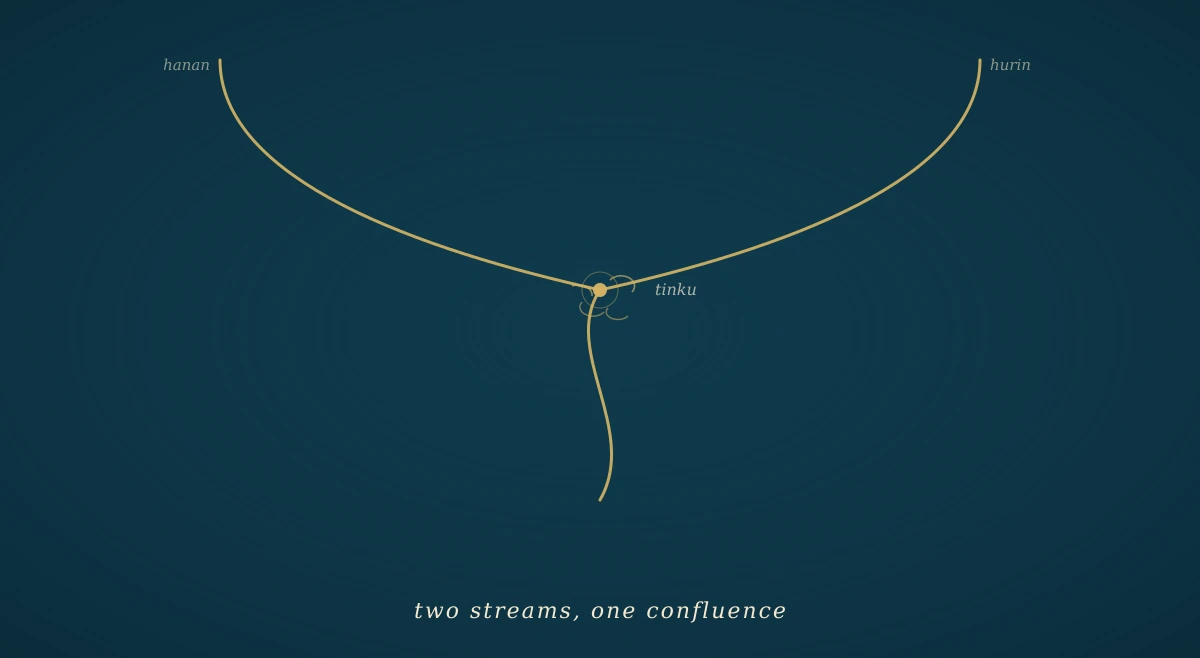
The image is not a philosophical construct. It is a place, and you can go there.
Where two rivers meet, the Andes see something particular. Confluences are places of offering, places of healing, places you go to wash yourself or to leave something.
The word is tinku — from the verb tinkuy, “to meet, to join, to collide”.
What the image shows
First: the two streams do not vanish. Neither dissolves into the other. For a stretch, in the larger rivers, you can see the two waters flowing side by side with different colours.
Second: what comes out is stronger. The meeting produces.
Third, and crucial: the meeting is violent. At a confluence there is turbulence, foam, eddies. The word tinku means both joining and ritual combat (chapter 22) — and these are not two meanings. They are one.
The foundational idea in one line: opposites do not reconcile and do not merge. They meet — and from the tension something arises that neither had on its own.
And why this is different from “balance”
Balance implies calm, equilibrium, neutrality. Tinku does not.
Two things standing together, each intact, with friction at the point of contact — this is the Andean shape, and you will find it everywhere: in the organisation of the city, in marriage, in agriculture, in the relation with the dead, and in the body.
2. Camay: a verb, not a noun
Here lies the most important concept in the whole document, and it is difficult precisely because it is not a thing.
camay — a verb. Colonial lexicographers translated it as “create”, and this was a mistake that lasted centuries. The linguist Gerald Taylor showed that it means something else:
Camay is to continuously give form and force to something that already exists.
Not creation from nothing. Continuous animation.
The three forms of the word
| Form | Meaning |
|—|—|
| camay | The act of continuously animating |
| camac | The one who animates — the source |
| camasca | What is animated — the charged |
How it works
Each class of things has its own camac: llamas, maize, a specific community, a person.
And the relation is continuous. This is not about a creative act in the past that produced an autonomous being. The camac animates now, and will keep animating, and if it stops, the thing stops.
The Huarochirí Manuscript explicitly describes a celestial camac of llamas — a dark region of the Milky Way, considered the form of the llama in the sky, on which the flourishing of the herds depends.
Why this changes everything
Because it inverts the question.
You do not ask “what is this?”. You ask: “from what is it animated, and is the relation in good condition?”
A person does not have life as a property. He is animated — by his place, by his ancestors, by his mountain, by his community. And when he falls ill, the first question is not what happened to the body, but which relation was cut.
You will find this working in every chapter below: in the animu that leaves (chapter 7), in mancharisqa (chapter 21), and in why every therapy includes an offering.
The structural consequence
A world in which everything is continuously animated is a world without inert matter.
The mountain is not stone with symbolic significance. The spring is not water we treat as sacred. They are active, animating beings with whom you have a relationship — and the relationship has terms.
Which terms? The next chapter.
3. Ayni: reciprocity as law
ayni — reciprocity, return.
Here you must be careful, because the word translates easily and is misunderstood immediately. Ayni is not a virtue. It is not “be good to others”. It is a description of how the world works.
In the village
The basic, daily form: today I work in your field, tomorrow you work in mine. It is not a favour and it is not a wage. It is an account that stays open — and the relationship is maintained because it stays open.
Alongside it:
- mink’a — collective work for a community project, with food and drink from the organiser
- mit’a — rotating labour obligation to the state
And about mit’a, something must be said. The Spanish kept the institution and perverted it: the colonial mita rotated villagers into the mines, principally Potosí, where conditions were deadly. An institution of reciprocity became a machine of forced labour — and it is one of the clearest examples of how a conquest uses the structures it finds.
In the world
The same shape applies to mountains and land (chapter 10).
- The land gives you harvest. So you owe it.
- You pay it with offering — literally, with food (chapter 17).
The Spanish word used today is pago: payment.
The crucial difference from other systems
This is not worship. You do not bow to the mountain because it is superior. You transact with it because you are in relation.
And the relation is asymmetric but reciprocal: the mountain is much larger than you, but it too expects something, and asks for it, and is displeased if it does not get it.
The practical consequence
The question this system produces is not “am I a good person?” nor “am I healthy?”. It is:
“Which accounts do I have open, and with whom?”
And illness, misfortune, bad harvest are first read as answers to unpaid debt — to a person, to a place, to an ancestor.
4. Hanan / hurin and yanantin
Andean society is organised in pairs, and the pair is not a metaphor — it is administrative structure.
Hanan / hurin — upper and lower
Each community divides into two halves: hanan (upper) and hurin (lower). Cusco itself was divided into Hanan Qosqo and Hurin Qosqo, with the Inca dynasty itself divided accordingly.
The two halves:
- have different ritual obligations
- exchange spouses
- compete institutionally — and in tinku they literally fight (chapter 22)
This is not hierarchy in the Western sense. “Upper” is not better; it is the upper half. And without it there is no lower, so there is no community.
Yanantin — the complementary pair
yanantin — from yana, “helper, companion, pair”. It names two things that belong together precisely because they differ.
The classical image: the two eyes, the two hands. They are mirror-image, not identical — and one hand alone does not do the job of two hands.
It is distinguished from masintin, which is two identical things.
The essential: the yanantin is not resolved. It does not merge into a third. They remain two, and their relation is the unit.
The honest note
Hanan / hurin is securely documented in the colonial sources and in the archaeology.
Yanantin as a developed philosophical concept owes much to modern anthropology — in particular to Tristan Platt’s ethnography in the Bolivian region of Macha (1976), which is serious fieldwork. The word and its basic sense are genuine; the philosophical elaboration is partly ours.
5. Pacha: one word for space, time, and world
pacha — and there is no English word for this, because English, like every European language, splits what the word joins.
Pacha means simultaneously:
- earth, ground
- world
- time
- epoch, period
- moment
It is not five meanings. It is one concept that our language breaks into five.
What this means
That in this system space and time are not two things. A place is also an epoch. A moment is also a region.
The phrase kay pacha means both “this world” and “this epoch” — and the ambiguity is not an error to be resolved.
The three pacha
| Term | Position | What it is |
|—|—|—|
| hanan pacha | Above | The sky: sun, moon, constellations, lightning |
| kay pacha | Here | The surface: humans, animals, mountains, the living |
| uku pacha | Inside / below | The interior: seeds, the dead, springs, metals, origin |
Two corrections
First, uku pacha is not hell. The “inside” is where the seed sprouts, where water emerges, where ancestors emerged from. It is the source of fertility, not of punishment. Its identification with evil is a Christian overlay.
Second, the tidy triadic scheme you see everywhere in diagrams is partly a product of the colonial encounter: the missionaries needed correspondences with heaven–earth–hell, and the Andean categories were pressed to fit.
The three levels exist in the sources. Their clean symmetry is more suspect.
PART B — THE MATERIAL
6. Sonqo: the heart as the place of thought
sonqo (also sunqu) — heart.
And in Quechua, the heart thinks.
The vocabulary
The whole psychological vocabulary is built on this word. From the colonial dictionaries and from the living language:
| Expression | Literally | Means |
|—|—|—|
| sonqoyoq | “one who has heart” | Prudent, kind-hearted, with judgement |
| sonqo nanay | “pain of the heart” | Sorrow, grief |
| hatun sonqo | “big heart” | Proud, arrogant |
| sonqo suwa | “heart-thief” | Charming, one who wins you over |
| sonqo p’itiy | “heart-breaking” | Despair |
| iskay sonqo | “two hearts” | Hesitant, undecided |
Memory, decision, judgement, desire — all are located in the chest.
What it means, and what it does not
It does not mean they did not know where the head is. It means the system does not separate thought from feeling — and therefore has no reason to place them in different organs.
“Judgement” in this scheme is not cold calculation. It is a stance toward something, and a stance always has an emotional dimension. So it belongs where you feel.
The practical consequence
The question “what are you thinking?” and the question “what are you feeling?” are the same question in this vocabulary.
And a decision taken only logically, without “sitting” in the chest, is considered unfinished — not wrong, but not yet yours.
7. Animu: the force that leaves
Here linguistic honesty is needed before anything else.
The problem of the word
The term you will hear today across the Andes is animu — and it is a loanword from the Spanish ánimo.
The pre-Hispanic terms recorded in the colonial dictionaries are others: camaquen (from the root camay of chapter 2) and upani.
That is: the word is Spanish, the content is not. An indigenous concept found a Spanish vehicle and survived inside it. This is characteristic of the whole Andean world after the conquest.
What it is
A vital force that inhabits the body but can leave it.
Characteristics, as recorded in modern ethnography:
- It leaves from terror, from sudden shock, from a fall
- It leaves in deep sleep — which is why you do not wake someone abruptly
- It can be held by a place (chapter 21)
- Its absence causes wasting, pallor, anorexia, sadness, lethargy
- In children it is fragile, and so children are particularly protected
And alongside it: kawsay
kawsay — “life, being alive”. Used also as a noun for vital force in general.
In contemporary neo-Andean vocabulary the phrase kawsay pacha, “the living universe”, appears — and here it should be noted that this phrase as a technical term is recent, even if the words are old.
The structural connection
Note the consistency with chapter 2:
If nothing has life but is animated by relation, then it is perfectly consistent that the vital force can be detached — because it was never your property.
You do not lose something of yours. A relation is interrupted.
8. Wind, hot and cold
Wayra
wayra — wind. And as in many systems, the wind is simultaneously a natural phenomenon and a pathogen.
Mal viento or wayra as illness: sudden affliction by “bad air” at specific sites — canyons, ruins, graves, places where something has happened, transitional hours (dusk, noon).
The symptoms are sudden: headache, nausea, facial distortion, weakness. And it is particularly dangerous for children, pregnant women and the weakened.
Note the common structure: the danger is not random. It is linked to place and time. You suffer something because you were in the wrong place, at the wrong time, without protection — that is, because you entered a relation you did not regulate.
Hot and cold — with the same caveat
There is an extensive and living system of classifying foods, illnesses and treatments into hot and cold.
And the same question applies: how much of it is pre-Hispanic?
The thesis that it is a Spanish import — Hippocratic-Galenic quality theory, transferred through the Iberian peninsula — is serious and has been argued: modern systems vary greatly from region to region and are not internally consistent.
The opposite position points out that there is a genuine Andean thermal polarity, independent: altitude, day and night, upper and lower, sun and water.
The most likely answer is “both”, with the two systems so fused that they can no longer be separated.
I will not give the detailed table of “which food is hot” for the same reason.
9. Sami and hucha — and what we actually know
Here the greatest accuracy of the whole document is needed, because here lies the greatest distance between what circulates and what is documented.
What circulates
A clean dualist energetic system: sami = light, good, vital energy; hucha = heavy, dense, dysfunctional energy. With processing techniques (saminchakuy, hucha mikhuy — “the eating of heavy energy”), with energy centres in the body, and with a hierarchy of initiates (pampamisayoq and altomisayoq).
What the sources say
In the colonial dictionaries, hucha does not mean “heavy energy”.
In the great dictionary of Gonçález Holguín (1608) and in related sources, hucha means sin, fault, debt, obligation, matter, legal case, issue to be settled.
It is, characteristically, the word the missionaries chose to translate “sin” — precisely because it already had the sense of the open account. That is, it connects directly with the ayni of chapter 3.
Sami means luck, happiness, blessing, good fortune; and it has a specific material use, for the foam or essence of chicha (maize beer).
What happened
The systematised form taught today was shaped from the 1980s onward, through the encounter of Andean paqo — mainly from the Q’ero communities — with anthropologists and Western students, and spread internationally in the 1990s and 2000s.
A central role was played by the work of anthropologist Juan Núñez del Prado — son of the anthropologist who led the 1955 expedition to the Q’ero (chapter 27) — and of a series of Western authors who disseminated it.
How to take it
Neither as fraud nor as antiquity.
It is living practice, taught by real Andeans, with real techniques developed in a real context. It has genuine roots: ayni, the idea of the open account, the processing of weight.
It is also a contemporary synthesis, with a clear date, and not “the ancient system of the Inca”.
And the critical point: Andean continuity does not require this claim. Chapters 2, 3, 10, 17 and 21 describe things with much deeper and more secure documentation.
PART C — THE GEOGRAPHY
10. Apu and Pachamama
If chapter 2 says that everything is animated by relation, here is with what.
Apu
apu — literally “lord”. The mountains.
And they are not deities on the mountains. They are the mountains themselves, as beings.
Characteristics:
- They have hierarchy, broadly proportional to their size and significance. Ausangate and Salkantay are among the greatest in the Cusco region
- They have personality: one strict, one generous, one dangerous
- They eat. And they expect to be fed (chapter 17)
- They answer — in certain practices, through the healer
- They are local: each community has its own, and who is significant depends on where you stand
Pachamama
Pachamama — “Mother Pacha”, that is, mother-earth-time-world.
Two corrections:
First, she is not “Mother Nature”. The Western ecological reading makes her a mild, benevolent feminine archetype. In the Andes she is demanding: she is hungry, she asks, and if she is not given, she takes for herself (chapter 21).
Second, the unification is partly later. Historically, the earth is worshipped also as a local entity — this field, this slope. Pachamama as a unified, pan-Andean goddess is to some extent a product of the colonial and modern period.
The structure of the relationship
It is, again, ayni:
- The mountain sends water. So you owe it.
- The land gives harvest. So you owe it.
- You pay before and after: before ploughing, before building, before travelling, after harvest.
And the first act in any drink is the ch’alla: you pour a little on the ground before you drink yourself.
It is the most everyday Andean rite, is performed everywhere, and requires no priest.
11. Wak’a and paqarina
Wak’a
wak’a (Spanish huaca) — and the word is difficult precisely because it is so broad.
A wak’a can be: a mountain, a rock, a spring, a lake, a temple, a mummy, a statue, a boundary marker, newborn twins, a person with an unusual form.
The common denominator is not “sacred”. It is something like:
Whatever is charged, singular, un-ordinary — and therefore has power and requires relation.
The wak’a had property: land, herds, servants, priests. They spoke, through oracles. They had disputes among themselves. The Huarochirí Manuscript is, in large part, a narrative of the relations and conflicts among wak’a.
The ceque system
And here lies one of the most striking things in the Andean world.
From the Qorikancha, the central temple of Cusco, 41 notional straight “paths” (ceque) radiated outward in all directions. On them lay 328 wak’a.
Each ceque was assigned to a specific kinship group, which was responsible for maintenance and offerings for its own wak’a.
And the number is not accidental. 328 equals twelve sidereal lunar months of approximately 27.3 days.
That is: a calendar inscribed in the landscape, with its maintenance distributed as a social obligation.
(The reconstruction is due mainly to Tom Zuidema, from the description of the chronicler Cobo. The details are debated; the basic structure is broadly accepted.)
Paqarina
paqarina — from paqariy, “to dawn, to emerge, to be born”. The place from which your group emerged.
A cave, a spring, a lake, a rock. Each ayllu (kin-territorial group) has its own.
And it is where you return when you die.
This is critical for understanding what the conquest did: when the Spanish forcibly concentrated populations into new villages (reducciones), they did not simply move people. They cut them off from the place that animated them.
In the terms of chapter 2: they interrupted the camay.
12. Mallki: the dead who held land
mallki. And the word means simultaneously “mummified ancestor” and “sapling, a plant for transplanting”.
This is not coincidence. The ancestor is the root from which the group grows — and the language says it directly.
The practice
The dead did not leave. They were preserved — by natural desiccation, which the Andean climate favours exceptionally — and:
- Kept in caves (machay) or towers (chullpa)
- Brought out for festivals, dressed, adorned
- Fed and watered — literally
- Consulted for decisions
- Held land and herds
The last point is not metaphor. It is legal reality.
And the structural consequence in the empire
Dead Inca kings kept their palaces, their estates and their staff. The group that maintained them was called panaqa.
So the new Inca inherited nothing. He took the title, but his predecessor’s property remained with his predecessor.
And therefore he had to acquire his own — by conquest.
One of the most serious proposed motives for the dizzying expansion of the Inca empire is that the dead did not relinquish their property.
It is perhaps the clearest example in the document of how a conception of death produces political economy.
Why their eradication was targeted first
The 17th-century “extirpation of idolatries” campaigns focused with particular ferocity on finding and burning the mallki.
It was not fanaticism without logic. It was accurate understanding of the system: if you destroy the root, the group loses its camac.
And the Andeans knew it too — which is why they hid them, moved them, and buried them again elsewhere.
13. The body of altitude
This chapter breaks the form of the whole series, and deliberately.
In every previous system, “the body as a place” was metaphor or model. Here it is measurable fact.
The problem
At 4,000 metres, the partial pressure of oxygen is approximately 60% of the sea-level value. Andean settlements have been permanently at these altitudes for thousands of years — the plateau has been inhabited for at least 12,000 years, with permanent high-altitude settlement for at least 7,000.
The Andean solution
Andean populations show:
- Higher haemoglobin concentration — more oxygen carriers per unit of blood
- Larger lung volumes and larger chest
- Higher tissue oxygen saturation at a given altitude
- A developmental component: part of this is shaped by growing up at altitude, not only genetically
And the Tibetan solution, which is different
Tibetan populations, at roughly the same altitude, have:
- Normal haemoglobin — not elevated
- Higher resting ventilation rate
- Higher nitric oxide levels, meaning greater flow
- Genetic variants in specific genes that regulate the hypoxia response
Two populations, the same problem, two independent evolutionary solutions. The Andes: more carrier. Tibet: more flow.
And the Andean solution has a cost
High haemoglobin increases blood viscosity. And there is a recognised disease, chronic mountain sickness (Monge’s disease): excessive erythrocytosis, cyanosis, headache, dyspnoea, cardiovascular strain.
It is clearly more frequent in Andean populations than in Tibetan. The Tibetan solution appears more efficient in the long run — and a plausible explanation is that Tibet has been inhabited at high altitude for longer.
Why I include it in this document
Two reasons.
First, because it is the one place in the whole series where the phrase “the body is shaped by place” is not philosophy.
Second, because it gives a real substrate to things that otherwise are read only culturally: why breath, the rhythm of work, walking and resting have such central place; why weight and heat matter so much; and why coca (chapter 18) became the plant it became.
PART D — TIME
14. Pachakuti: the world that turns
pachakuti — from pacha (chapter 5) + kuti, “turn, inversion, return”.
The overturning of the world.
What it means
Not gradual change. Inversion: the upper becomes lower, the lower becomes upper, one epoch ends and another begins.
A pachakuti is catastrophic and regenerative. It is not the end of the world; it is its turning.
Where it appears
- As a cosmological period: the world has already turned and will turn again
- As a name: the great expander of the empire was named Pachakuti Inca Yupanqui — “the one who overturns the world”
- As an interpretation of the conquest: 1532 was read by many Andeans exactly this way
- As an expectation: the idea that there will be another, and that the upper will become lower again, runs through four centuries of Andean resistance — from the Taki Onqoy (chapter 27) to the uprising of Túpac Amaru II (1780)
- And as a contemporary political term, alive in Bolivian and Peruvian politics
The structural significance
A world that turns is neither cyclical nor linear.
It does not repeat identically. It does not progress straight. It overturns — and the form that emerges is new, but made of the same materials in the inverse position.
It is, if you think about it, the tinku of chapter 1 at the scale of an epoch: two states that collide and produce a third.
15. The past in front
And here lies the strongest empirical finding in the whole series.
The linguistic datum
In Aymara — a language of a different family from Quechua, with 2–3 million speakers around Lake Titicaca:
| Word | Means | And also |
|—|—|—|
| nayra | eye, face, in front | past |
| qhipa | back, behind | future |
That is: the past is in front, the future is behind.
The logic — which is unarguably good
The past you have seen. So it is in front of your eyes. The future you have not seen. So it is behind your back.
The organising principle is not the direction of the flow of time. It is knowledge: what is known is visible, what is unknown is not.
And it is, if you examine it, more consistent with human experience than the Western scheme.
And now the datum that makes it strong
One might say this is fossilised metaphor — words that once meant something and are now said mechanically. Just as we say “we have difficulties ahead of us” without meaning anything spatial.
Rafael Núñez and Eve Sweetser tested the gesture. They videotaped Aymara and Spanish speakers and analysed what their hands did while they talked about time.
The result, published in Cognitive Science (2006):
- Spanish speakers point forward for the future, backward for the past
- Aymara speakers — especially older ones, with stronger command of the language — point forward for the past and backward for the future
Gesture is largely unconscious. You do not control it and you do not stage it. The fact that it follows the language means the correspondence is not a dead metaphor — it is an active way the body organises time.
(The finding has been discussed and there is dialogue about how strong a conclusion it supports. The gesture data themselves have not been substantively challenged.)
Why it belongs in a document about the body
Because it is the cleanest demonstration in the whole series that a cosmology does not stay in the head.
A person who believes the past is in front moves differently. His hand goes elsewhere. And he does it without knowing it.
This is, in the most precise possible way, “the body as a place where a worldview lives.”
See also the dedicated essay The Past Is in Front.
16. The cycle: the calendar is the field
The Andean calendar is not abstract. It is the agricultural year, and it is inseparable from it.
The axes
Life on the high plateau is governed by two seasons, not four:
- The wet (roughly November–March) — rains, growth, vegetation
- The dry (roughly April–October) — frost, harvest, storage, processing
And two critical points: the June solstice (winter in the southern hemisphere, the great festival of the sun — Inti Raymi) and the December solstice.
Observation of the sky
Andean astronomy has a peculiarity that sets it apart: it also observes the dark.
Alongside the constellations of stars, the Andeans recognise “dark constellations” — the dark nebulous regions within the Milky Way, which in the clear high-plateau sky appear clearly as forms: the llama, the serpent, the fox, the partridge.
And the llama (Yacana) is, in the Huarochirí Manuscript, the camac of the earthly llamas — the source that animates them (chapter 2).
Note the logic: the celestial is not a symbol of the terrestrial. It is its source. And therefore observation of the sky is not theory — it is monitoring the state of the relation.
The practical consequence
Time in this system is not measurement. It is obligation.
Each point of the year has its own work and its own offering. August is, in living practice, the month in which the earth “opens” and is most hungry — and it is the month of the great offerings (chapter 17).
It is not a calendar of festivals. It is a schedule of payments.
PART E — THE PRACTICE
17. Despacho: offering as transaction
The central ritual act of the Andean world. Names: despacho (Spanish, “dispatch”), haywarisqa (“that which is offered”), pago a la tierra (“payment to the earth”).
What it is
A bundle, built in layers on paper, wrapped, and then burned or buried.
The content varies, but typically includes:
- Coca leaves in trios (k’intu — chapter 18), placed with orientation
- Llama fat (wira) — the most nutritious, the “food”
- Seeds of various species
- Sweets, sugar in shapes
- Mullu — Spondylus shell
- Gold and silver paper
- Wool in colours, wine, alcohol
The mullu, which deserves comment
Spondylus is a bivalve that lives only in the warm waters of the Equator — hundreds of kilometres north of the central Andes.
And it is found archaeologically, in enormous quantities, in all periods, up to the high plateau and the southern coast.
That is: a whole trade network of thousands of kilometres operated for millennia for an offering material. It is among the clearest testimonies for how central the act was.
The logic
It is not prayer. It is food.
The apu and Pachamama are hungry, and the offering is a meal. That is why it contains fat, sweetness, alcohol, the best leaves.
And because it is ayni (chapter 3), the act has direction and recipient. The healer names, one by one, the apu to whom it is addressed — starting from the great ones and descending to the local.
The offering is addressed. It does not go “to the universe”.
The everyday version
You do not need a rite. The ch’alla — a few drops to the ground before you drink — is done by everyone, everywhere, daily.
And the k’intu of three coca leaves, with a breath toward the mountain, is the smallest complete form of the same act.
18. Coca
kuka. And it must be said plainly from the start:
The coca leaf is not cocaine.
The leaf contains very low concentrations of alkaloids, along with vitamins and trace elements. Chewing the leaf has a mild stimulant effect, comparable in order of magnitude to coffee. Cocaine is a chemically isolated and concentrated derivative, a product of 19th-century European chemistry.
The confusion of the two is, in the Andes, a political issue with real consequences.
How old
Archaeological evidence of coca chewing reaches approximately 8,000 years on the Peruvian coast. It is among the longest uninterrupted plant practices in the world.
How it is used
The leaves are chewed into a bolus in the cheek, with the addition of an alkaline substance (llipta, from plant ash or lime) that releases the alkaloids.
The four uses — and not in the order you would expect
1. Social. And this is the first. The offering of coca opens every interaction: a meeting, an agreement, a visit, a funeral. To refuse is a serious offence. It functions like a round of drinks, but with ritual weight.
2. Work. Reduces the sense of hunger and fatigue, helps mildly at altitude, and regulates rhythm: work is measured in “chews”.
3. Ritual. The k’intu — three perfect leaves, held together, their smooth faces upward. You breathe (phukuy) on them toward the apu you are addressing, and then chew them or offer them.
4. Divinatory. Throwing leaves on cloth and reading how they fall: which upward, which torn, what pattern.
And the structural place
Note that coca is not a psychoactive tool in this system. It is the medium of relation.
It is what you give to a person, to a mountain, to the earth, to the dead. The same material, the same gesture, every recipient.
That is, it is the material form of ayni.
19. Wachuma: the oldest documented
wachuma, also known as San Pedro (Echinopsis pachanoi) — a columnar cactus of the Andes, which contains mescaline.
This chapter gives no instruction for use, dosage or method. It is not a manual.
The depth
And here lies something remarkable.
At Chavín de Huántar, a temple complex of the central Andes that flourishes approximately 1200–500 BCE, the stone sculpture includes a figure holding a columnar cactus. There are additional analytical findings supporting the use of psychoactive plants at the site.
The complex itself is constructed in a way that seems designed for altering perception: underground galleries, total darkness, channels that convey the sound of water, and at the centre the Lanzón, a 4.5-metre monolith in a narrow corridor.
This is the oldest adequately documented ritual complex of psychoactive substances in the Americas — with a depth of approximately three millennia.
And a second
At Tiwanaku and in the broader area, snuff trays and inhalation tubes for psychoactive powder from Anadenanthera seeds (vilca) are found. Many, finely worked, in burials — that is, personal equipment of specialists.
Contemporary practice
Wachuma is used today mainly in the northern Peruvian Andes — in the Huancabamba area and at the Huaringas lakes — within the mesa ceremonies.
The mesa is an arranged field of objects on the ground, divided into sides (dark, light, middle), where each object has position and function. The healer works upon it.
And the function, as in the rest of the chapters, is diagnostic and therapeutic: to find the cause — who sent the harm, which place is holding the animu, what debt is open.
This is northern coastal tradition, distinct from the southern highlands of the previous chapters. It is not one thing.
20. The healer and the guinea pig
The roles
As elsewhere, the word “shaman” covers and conceals distinct roles:
| Term | What they do |
|—|—|
| paqo | Ritual specialist; handles the relations with apu and Pachamama |
| hampiq | Healer with herbs and manipulations |
| watuq | Diviner — from watuy, “to guess, to divine” |
| curandero | The general Spanish term of contemporary practice |
And there is a category of selection: in many regions it is held that one becomes a paqo if one survives a lightning strike — the lightning “marks” him.
The guinea pig
The most characteristic Andean diagnostic technique, alive today: the cuy (Cavia porcellus), the guinea pig — which in the Andes is a domestic animal and food, not a pet.
The procedure (jubeo or sobada de cuy):
- A live cuy is passed systematically over the whole body of the patient
- The animal is killed
- It is opened and its organs are examined
- The lesions in the animal’s organs are read as corresponding to lesions in the patient
How to read it
The logic is clear and consistent with the whole document: the animal takes on the person’s condition. It is simultaneously diagnostic instrument and carrier — the illness moves into it.
That is, it is ayni in another form: something is given in your place.
And the honest assessment: there is limited published literature examining whether the “diagnoses” correspond to anything. The findings are sparse and do not permit a conclusion — and there is a clear alternative explanation: the healer has already seen, listened to, and palpated the patient before the act.
The practice is real and widely performed. The claim of diagnostic correspondence is not documented.
21. Mancharisqa: when the land takes you
The same family of illness you meet throughout Latin America — but with a distinctly Andean mechanism.
Quechua: mancharisqa (“frightened”), from mancharikuy, “to be frightened”. Spanish: susto, espanto.
The Andean particular
In the Andean version, the animu does not simply leave. The land takes it.
The expressions are clear: jap’iqa, pacha jap’isqa — “the land caught him”, “the place seized him”.
It happens at charged sites: a spring, a ruin, a confluence, a pass, a wak’a. And often at transitional hours — dusk, noon.
And why this is structurally different
Because it is not loss. It is seizure.
If the animu was lost, you look for it. If someone is holding it, you have to negotiate.
And the therapy reflects this exactly:
- Return to the spot where it happened
- Calling by the person’s name, repeatedly, often at dusk
- The person’s clothing — laid out, shaken, or the patient sleeps with it
- And — the critical thing — offering to the place (chapter 17)
- Cleansing (limpia) with egg, plants or cuy
Step 4 is the Andean signature. You do not plead and you do not exorcise. You pay ransom.
It is, in the clearest possible way, the ayni of chapter 3 applied to illness: the land took something from you because you owed it. You give what you owe, and you get it back.
The assessment
Susto is a recognised culturally-bound syndrome, with symptomatology overlapping depression, anxiety and post-traumatic manifestations — and there is literature correlating it with measurably worse health.
And independently of this, the structure is functionally accurate: after trauma, something stayed at the place; recovery requires return, naming and explicit closure.
22. Tinku: when the fight is a rite
We return to the image of chapter 1 — now as practice.
What it is
In certain areas, mainly in northern Potosí in Bolivia, the two halves of a community (hanan and hurin, chapter 4) meet on fixed dates and fight physically.
It is organised: with music, with dance, with costume, with preparatory consumption of alcohol, with rules for who fights whom.
And it is real violence. There are serious injuries. There have been, and continue to be, deaths.
The logic — and it should neither be romanticised nor silenced
The explicit interpretation, as recorded in the ethnography (mainly Tristan Platt in Macha):
- The blood that falls on the ground is an offering. The land is hungry and is fed.
- The fertility of the next year depends on it.
- Death in tinku, locally, was not treated as murder — it was considered that the land took what it asked for.
- And the confrontation reproduces the relation of the two halves rather than dissolving it: after the fight there is food together.
The direct assessment
The logic is internally consistent. If ayni demands payment, and if the land is fed by blood, then ritual combat is not a deviation from the system — it is correct calculation within it.
And people died. They still die. The state has repeatedly tried to regulate or restrict the practice, with partial success and the familiar tensions of any such intervention.
The lesson is not new, but it is worth repeating:
A consistent system with a specific starting point does not self-correct. Consistency drives it deeper.
The same internal coherence that makes the Andean cosmology impressively organised leads it here too. The same observation closes the chapter on sacrifice in the Nahua guide — a convergence worth noting.
23. Ten practical principles
There is no such list in the tradition. The following is a synthesis. Marking: [source] from the colonial texts, [ethnography] from living practice, [modern] my own formulation.
1. Ask which accounts are open [source]
The foundational question is not “what is happening to me?” but “with whom do I have an open account, and since when?” — with a person, a place, a family, an obligation.
2. Nothing has life; everything is animated [source]
Your condition is not a property you possess. It is a relation that is maintained. When something weakens, the question is not what broke inside you, but which supply was interrupted.
3. Pay before, not only after [ethnography]
The Andean offering is made before ploughing, before building, before travelling. The recognition of the obligation precedes the benefit. This is a different stance from after-the-fact gratitude.
4. The pair does not resolve [source]
Two opposites standing together, each intact, with friction at the point of contact. Do not look for the synthesis. The tension is the function, not the problem to be solved.
5. Thought sits in the chest [source]
A decision taken only logically, without “sitting” there, is unfinished. Not wrong — unfinished. The question “what am I thinking” and “what am I feeling” are, in this vocabulary, one question.
6. The past is in front [source, with data]
What you have seen is visible; what you have not seen is not. Organise time by knowledge, not by direction — and note that this scheme makes the unknown future less obligatorily “the goal”.
7. After terror: return, name, and pay [ethnography]
The procedure has four parts, not two. Return to the place, calling by name, explicit closure — and offering. The Andean contribution is the fourth: something is holding what you lost, and you negotiate.
8. The place has hours and sites [ethnography]
Danger is not random: it concentrates at transitional sites (passes, confluences, ruins, thresholds) and transitional hours (dusk, noon). At points of transition, you regulate before you cross.
9. The offering is addressed [ethnography]
In the despacho, the healer names one by one. It does not go “to the universe”. The generalised, anonymous intention is not, in this system, an act — because it does not create a relation with anyone.
10. And the caveat: whatever is presented to you as ancient, date it [modern]
The tradition itself does not need the claim of antiquity to stand. When someone insists on it, it is worth asking why.
The essential about the essentials
They are not ten. They are one, seen from ten angles:
You are not a self-sustaining unit. You are a node in a network of obligations — and whatever happens to you is read first there.
PART F — KNOWLEDGE
24. The cloth and the khipu
If a civilisation does not write, the question is not “how did it remember?” but “where did it put the structure?”
The Andean answer: in the threads.
The cloth
In the Andean world, cloth was more valuable than gold. This is not rhetoric: the Inca state used textiles as the main gift, as payment, as offering, and as mark of hierarchy. The highest-quality category (qumpi) was produced by specialised artisans under state control.
And the designs (pallay) are not decoration. They encode community, family, position, region — and are read by those who know.
Weaving is, structurally, the Andean language of order: two sets of threads, warp and weft, that pass through each other and produce something neither alone is.
It is the yanantin of chapter 4, in material form.
The khipu
Bundles of spun cords with knots. Variables: the type of knot, its position along the length, the colour, the direction of the ply, the hierarchy of sub-cords.
What we know with certainty:
- They encoded numbers, in a decimal positional system
- They were used for censuses, tribute, inventories, calendars
- There were professional operators (khipukamayuq)
What we do not know:
- Whether there were khipu that encoded narrative
Colonial sources report that from the khipu “were read” histories and genealogies. Contemporary research has proposed that certain elements — ply direction, colours, material — may carry linguistic information. A study of a khipu set from the community of Collata proposed that certain bundles encode names of lineages.
The honest position: an open question, with interesting indications and no decipherment.
And the essential
The point is not whether the khipu was “writing”. It is that in this civilisation:
Information is not stored in symbols that represent sounds. It is stored in structure — position, relation, direction.
It is consistent with everything preceding. A system that thinks in pairs, positions and relations (chapter 4), that puts its calendar in lines across the landscape (chapter 11), and that names the city “upper and lower” — stores its knowledge in form, not in text.
25. Chakana — what is ancient and what is not
You will meet it everywhere as “the Andean cross”, with a complete cosmological system. It needs separation.
What is securely ancient
The stepped motif — the stepped shape in the form of a cross — is genuine and widely documented:
- In the stonework and reliefs of Tiwanaku
- In textiles of many periods
- In ceramics, in architecture, in masonry
It is among the most stable design motifs of the Andean world, for millennia.
And the word chakana exists: from chaka, “bridge”, with the sense of “ladder, crossing, what bridges”.
What is not
The full cosmological system — with twelve points, correspondences to three pacha, animals, virtues, alignment with the Southern Cross, names of the steps — does not come from the sources.
It was shaped mainly from the 1980s onward, largely through the work of Peruvian authors, and spread rapidly in neo-Andean literature and in tourism.
How to take it
Same stance as chapter 9: neither as fraud nor as antiquity.
The motif is ancient and significant. Its interpretation is contemporary and has a date. And the Andean tradition does not need the confusion of the two to be impressive — the ceque system, the khipu and the textiles are far more impressive, and are documented.
PART G — SYNTHESIS
26. How it all ties together
-
The confluence. Opposites do not merge. They meet, with friction, and produce. Tinku — joining and combat with one word.
-
Nothing has life. Camay is a verb: every thing is continuously animated by something else. So there is no inert matter, and no self-sufficient entity.
-
So the foundational relation is the account. Ayni is not a virtue; it is description. You work in my field, I work in yours; the land gives you, you owe it.
-
The organisation is paired. Hanan/hurin, yanantin: two halves that compete institutionally and do not resolve into a third.
-
Space and time are one word. Pacha is not divided — and so a place has hours, and an epoch has a place.
-
Thought sits in the chest. Sonqo does not separate judgement from feeling, because it has no reason to.
-
The vital force can be seized. And this is logically necessary from #2: if it was never your property, someone else can hold it. So therapy is negotiation and ransom.
-
The landscape is beings with demands. The apu eat. The Pachamama is hungry. And the 328 wak’a of Cusco were simultaneously calendar and distribution of obligations.
-
The dead did not leave — and they held their land, with consequences that reached the geopolitics of the empire.
-
The body was really shaped by place. Chapter 13 is not metaphor: Andean adaptation to hypoxia is measurable, distinct, and has a cost.
-
Time is organised by knowledge, not by direction — and the hands show it, without the speaker knowing.
-
And knowledge is stored in structure, not in symbols: in the threads, in the lines of the landscape, in the pairs.
27. Taki Onqoy and after
The resistance that passed through bodies
Around the 1560s, thirty years after the conquest, there appeared in the central highlands a movement called Taki Onqoy — “the dance sickness”.
The message: the wak’a did not die. They were defeated, but they are regrouping. They will return, will defeat the Christian god, and the world will turn — pachakuti (chapter 14).
And the form of the movement was bodily:
The wak’a entered the bodies of people. The possessed trembled, danced, spoke with another voice.
Participants rejected Spanish names, Spanish clothes, Spanish food, the churches.
The movement was suppressed — the Inquisitor Cristóbal de Albornoz built his career on it, and his trial records are a large part of what we know.
And note what this says for the whole document: when this civilisation resisted, it did not do so with doctrine or with text. It did so with bodies — because that is where the wak’a lived, and that is where the field was.
The Q’ero
In 1955, an expedition from the University of Cusco, led by anthropologist Óscar Núñez del Prado, visited a remote community on the slopes of Ausangate. The Peruvian press presented them as “the last Incas”.
The reality was less romantic and more interesting: the Q’ero were a known community, under a system of serfdom on a hacienda, and they had themselves approached authorities seeking intervention. The “discovery” was, in part, their own initiative. In 1963 they acquired rights to their land.
From the 1980s onward, Q’ero paqo began travelling internationally. Around them developed a whole market: seminars, trips, trainings, books.
And here the comparison with other such encounters is worth making. The result was not the same: the Q’ero organised, negotiated, set terms to some degree, and some acquired real economic basis.
It is not a rosy story: there is commodification, there are inequalities within the community, there are people who present themselves as Q’ero without being so, and there is disagreement among themselves about what is right.
But they negotiated. And that is a substantial difference from the alternative — compare the parallel chapter in the Nahua guide on the fate of María Sabina.
And today
Eight to ten million Quechua speakers. Two to three million Aymara. Co-official languages in Peru and Bolivia.
And something that has no parallel in any of the previous traditions of the series: the concepts of this text have entered constitutional and legislative documents.
The Bolivian Constitution of 2009 incorporates suma qamaña (Aymara) / sumak kawsay (Quechua) — “the good life” — as a foundational state principle. And Bolivian Law 071 of 2010 recognises rights of Mother Earth as a legal subject.
One can debate — and it is debated intensely, by indigenous populations themselves — whether these are applied or function as political rhetoric. The fact stands: an Andean cosmological concept became state law.
The last thought
The Andean answer to the question “what are you?” is neither “body”, nor “soul”, nor “the relation of body and mind”.
It is:
You are the point where things meet that do not belong to you — and the question is not what you have, but what you owe and to whom.
A river is not its water. It is the confluence.
APPENDIX — Glossary and sources
Glossary
| Term | Language | Meaning |
|—|—|—|
| tinku / tinkuy | Quechua | Confluence of rivers; meeting; and ritual combat |
| camay | Quechua | Verb: to continuously animate. camac = the one who animates; camasca = the animated |
| ayni | Quechua | Reciprocity — a law, not a virtue |
| mink’a / mit’a | Quechua | Collective work / rotating obligation |
| hanan / hurin | Quechua | Upper / lower half — community structure |
| yanantin | Quechua | The complementary pair that does not merge |
| pacha | Quechua / Aymara | Space + time + world + epoch, together |
| kay / hanan / uku pacha | Quechua | This world / the upper / the interior |
| pachakuti | Quechua | The overturning of the world |
| sonqo | Quechua | Heart — and the place of thought |
| animu | Quechua (loan) | Vital force that leaves. Pre-Hispanic: camaquen, upani |
| kawsay | Quechua | Life, vital force |
| wayra | Quechua | Wind — and pathogen |
| sami / hucha | Quechua | Blessing / debt, fault, open matter |
| apu | Quechua | “Lord” — the mountains as beings |
| Pachamama | Quechua | The mother-earth — demanding, not mild |
| wak’a | Quechua | Whatever is charged and requires relation |
| ceque | Quechua | The 41 radiating lines of Cusco with 328 wak’a |
| paqarina | Quechua | The place of emergence of your group |
| ayllu | Quechua | The kin-territorial group |
| mallki | Quechua | Mummified ancestor — and “sapling” |
| panaqa | Quechua | The group that maintained a dead Inca and his property |
| chullpa / machay | Quechua | Funerary tower / burial cave |
| despacho / haywarisqa | Spanish/Quechua | The offering bundle |
| ch’alla | Quechua / Aymara | The sprinkling of drink on the earth |
| k’intu | Quechua | Three coca leaves together |
| phukuy | Quechua | The breath onto the offering |
| llipta | Quechua | The alkaline substance accompanying coca |
| mullu | Quechua | Spondylus shell — offering material |
| wachuma | Quechua | The San Pedro cactus |
| paqo / hampiq / watuq | Quechua | Ritual specialist / healer / diviner |
| mancharisqa | Quechua | Frightened — the loss of animu |
| jap’iqa | Quechua | “The land caught him” |
| khipu | Quechua | The system of knots |
| pallay | Quechua | The designs of the textiles |
| chakana | Quechua | The stepped motif; from chaka, “bridge” |
| suma qamaña / sumak kawsay | Aymara / Quechua | “The good life” — in current constitutional text |
Sources
In the indigenous language
- Huarochirí Manuscript (~1608) — the single extensive source in Quechua; collected under Francisco de Ávila. Editions: Taylor (1987), Salomon & Urioste (1991)
Indigenous and mestizo authors
- Felipe Guamán Poma de Ayala, Nueva corónica y buen gobierno (~1615) — ~1,200 pages, ~400 drawings; addressed to Philip III, never delivered; found in Copenhagen in 1908
- Garcilaso de la Vega el Inca, Comentarios Reales (1609) — with explicit caution: written decades later, from Spain, with strong idealisation
Spanish sources
- Pedro Cieza de León, Juan de Betanzos (married to an Inca noblewoman), Polo de Ondegardo, Cristóbal de Molina
- Bernabé Cobo, Historia del Nuevo Mundo (1653) — late but systematic; the source of the ceque system
- Pablo José de Arriaga, Extirpación de la idolatría del Perú (1621), and the archives of the extirpation trials
- Diego Gonçález Holguín, Vocabulario de la lengua general (1608) — the foundational dictionary; the base for chapter 9
Modern scholarship
- Gerald Taylor, on camay (1974 onward) — foundational for chapter 2
- Catherine Allen, The Hold Life Has (1988) — ethnography of the Sonqo community; coca, animu, daily practice
- Tristan Platt, Espejos y maíz (1976) and works on tinku in Macha
- R. Tom Zuidema, for the ceque system
- Frank Salomon, The Cord Keepers (2004) — khipu in living use
- Gary Urton, Sabine Hyland — on the encoding of khipu
- Michael Sallnow, Thomas Abercrombie, Joseph Bastien (Mountain of the Condor, 1978) — landscape and body
- Douglas Sharon, for the mesa of the north coast
- Rafael Núñez & Eve Sweetser, Cognitive Science 30 (2006) — the gesture data of Aymara
- Cynthia Beall, Tatum Simonson, Abigail Bigham — adaptation to altitude
- Steve Stern, Luis Millones — on Taki Onqoy
Related reading on this site
- Yin, Yang and the Chinese Body: A Complete Guide — the Chinese companion. Compare the tinku / confluence image with the Chinese yin-yang: both are irreducible pairs, but the shapes they produce are different.
- Prana, Nadis and the Indian Body: A Complete Guide — the Indian companion. The animu that leaves has an interesting resonance with the Indian treatment of vital force as something that can be lost through specific channels.
- Pneuma, Tonos and the Greek Body: A Complete Guide — the Greek companion.
- Tonalli, Teyolia and the Nahua Body: A Complete Guide — the closest companion piece. The parallels are striking: both treat the body as node in a network of debt, both have a ransom-based model of trauma (susto / mancharisqa), both arrive at ritual violence as the logical consequence of their cosmology (chapter 24 there, chapter 22 here), and both are living traditions. The differences are also sharp: no indigenous script here, and far stronger continuous political presence.
- The Past Is in Front — the dedicated essay on the Aymara time-and-gesture finding of chapter 15.
- What Is Chi? A Systems Engineer’s Reframing — the main site argument.
- The Convergence Asymmetry — the meta-essay on where the body-maps converge and where they diverge.
- Body Knowledge — the full set of guides and essays.
← Back to the Body Knowledge guide
More in this pillar
- The Convergence Asymmetry
- The Tradition That Diagnosed Its Own Damage
- Why the Right Posture Feels Wrong
- Seven Points on the Ground
- The Body Is Not Given, It Is Made
- The Fascia and the Flow of Organization
- The Second Arrow
- Tumah Is Not Dirt
- The Past Is in Front
- Yin, Yang and the Chinese Body: A Complete Guide
- Prana, Nadis and the Indian Body: A Complete Guide
- Pneuma, Tonos and the Greek Body: A Complete Guide
- Tonalli, Teyolia and the Nahua Body: A Complete Guide
- Yuxin, Rao and the Amazonian Body: A Complete Guide
- Rlung, Rtsa and the Tibetan Body: A Complete Guide
- Māori Body-Knowledge: Tapu, Noa, and the Binding of the PersonComing soon
- Yoruba Body-Knowledge: Ori, Ase, and the Head as DestinyComing soon
- Western Somatic Work: The Body as Recalibrated InstrumentComing soon
- Islamic Body-Knowledge: Salah, Taharah, and the Prostrating BodyComing soon
- Theravāda Body-Knowledge: Kaya, Vedanā, and the Four Foundations of MindfulnessComing soon
- Jewish Body-Knowledge: Mitzvot, Tumah, Mikveh, and the Bound TextComing soon
The other pillars
Be first to know
The book is in its final editing stage. Leave your email and you will hear when it is ready.