Body Knowledge·Essay
Yuxin, Rao and the Amazonian Body: A Complete Guide
A complete guide, from zero, to the Amazonian body: yuxin, the body as garment, the dieta that builds a healer, kené, the darts, and the ethic of predation.
How to read this text
You do not need any prior knowledge. Every term is explained the first time it appears.
Four honest notes before we start — and the first one changes the kind of text this is
First: there is no map of the body here
If you are looking for channels, centres, currents or points — you will not find them, and they are not missing.
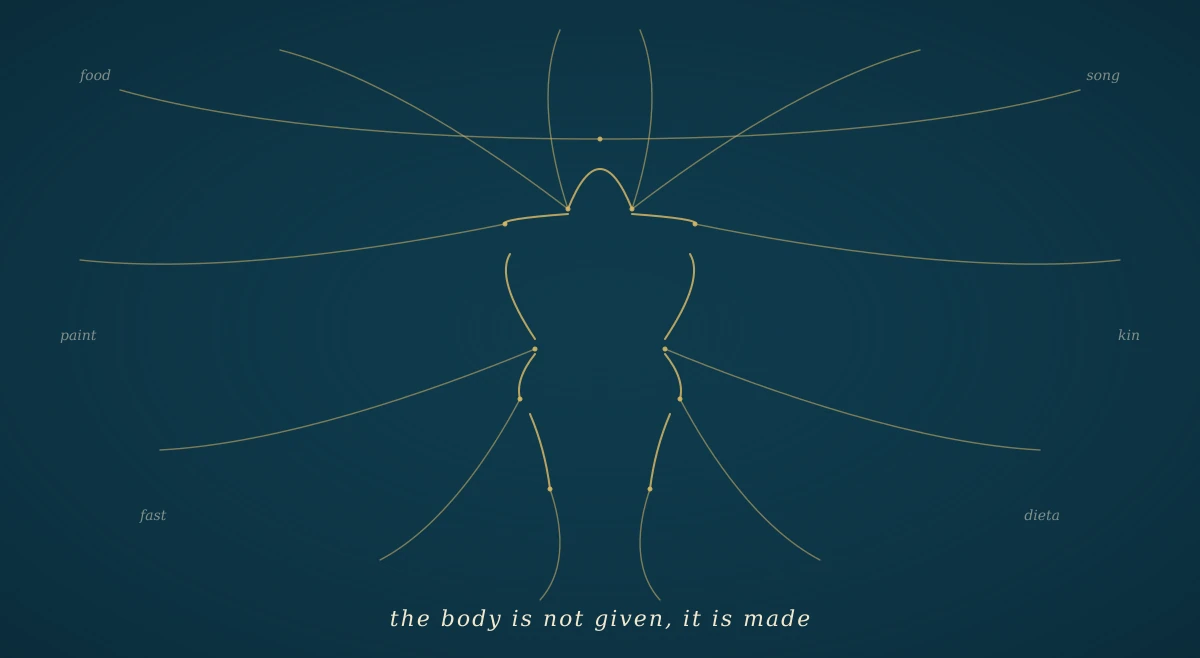
The Amazonian world did not produce an energetic anatomy. The body here is not mapped; it is built. It is not a thing with internal structure to be explored, but the outcome of acts — what you ate, who fed you, who you slept near, what design is on your skin, what you fasted from, what was sung over you.
This is not an absence. It is a different answer to the same question, and chapter 4 explains why it is coherent.
Second: the sources are almost all modern
There are no colonial manuals, no Inquisition records, no writing.
What we know comes almost exclusively from ethnography of the 20th and 21st centuries — that is, from anthropologists who lived in communities and recorded.
And here is a heavy problem. The epidemics that followed European contact killed, by current estimates, over 90% of the Amazonian population — and did so largely before the ethnographers arrived, often before Europeans themselves reached many areas, through transmission.
What 20th-century anthropology described is society after catastrophe.
Small, dispersed groups in a landscape that once supported something far larger (chapter 9). Forgetting this produces the image of the “eternal hunter-gatherer”, which is historically wrong.
Third: “Amazonia” is not a civilisation
It is a region of six million square kilometres, with approximately four hundred indigenous peoples and dozens of language families that are not related to each other — Pano, Tupi, Carib, Arawak, Tucano, Jivaroan, and dozens of language isolates.
The text will name who, each time. Where I generalise, I will say so.
A note on names: several of what circulates in English are exonyms, often pejorative. I write Awajún (not “Aguaruna”), Wampís (not “Huambisa”), and I speak of the Jivaroan language family without using that term as an ethnonym, because it is offensive to the people themselves.
Fourth: these communities are under pressure now
This is not a note of sensitivity. It is context: deforestation, illegal gold mining, mercury in the rivers, oil spills, murders of land defenders.
What you read here describes living people in conflict, not a cultural reserve.
A short introduction to Amazonian thought, for the reader who is new
Before any of the technical material lands, it helps to have five things in mind. If you already know them, skip to the Contents.
Where this comes from, in time and place
The Amazon basin covers approximately 6 million km² across nine modern countries (Brazil holds about 60%; then Peru, Colombia, Bolivia, Venezuela, Ecuador, Guyana, Suriname, French Guiana). Permanent human occupation reaches back at least 12,000 years. Densely populated societies with substantial earthworks, roads, monumental architecture and intensively managed landscapes existed from at least 500 BCE to the European contact (chapter 9).
The population crash after 1500 was catastrophic. Current estimates put the pre-contact population at 8–10 million; the trough, reached in the early 20th century, is around 1 million. Everything the 20th-century ethnographic record describes is downstream of that.
Today there are approximately 1.5 million indigenous people in the Amazon basin, across about 400 peoples, with several dozen groups in voluntary isolation — people who have decided not to make contact, whose territories are routinely violated by illegal mining and logging.
There is no “the” Amazonian tradition
The language families most referenced in this guide:
- Pano — Shipibo-Konibo, Huni Kuin (Kaxinawa), and others in eastern Peru and western Brazil
- Jivaroan — Shuar, Achuar, Awajún, Wampís at the Peru-Ecuador border
- Tupi-Guarani — the family that gave the lingua franca of lowland Brazil
- Carib — northern Amazon
- Arawak — scattered across the whole basin
- Tucano — Vaupés region, Colombia-Brazil border
Plus Yanomami, Munduruku, Kayapó, Marubo, Matsigenka, and dozens of unrelated isolates.
The guide uses “Amazonian” as a geographic term, not an ethnic one. Where a specific people’s practice is at stake, the people is named. Where the ethnography generalises across many peoples (as the perspectivist chapters do), this is marked.
What kind of body-knowledge this is
The body material in this guide comes from four kinds of source:
- Modern ethnography of specific peoples — above all Eduardo Viveiros de Castro (Araweté, Yudjá), Philippe Descola (Achuar), Carlos Fausto (Parakanã), Anne Christine Taylor (Jivaroan), and the Shipibo-Konibo ethnographies of Angelika Gebhart-Sayer, Luis Eduardo Luna and Bernd Brabec de Mori.
- Anthropological synthesis, especially the perspectivism of Viveiros de Castro (1996) and Tânia Stolze Lima (1996) and the parallel four-ontologies scheme of Descola (2005). The guide treats these as theoretical tools, not as indigenous doctrine (chapter 2).
- The Shipibo-Konibo material on kené (geometric design), ikaro (healing song) and the dieta is unusually well-documented. The guide covers it carefully, but marks explicitly where the systematisation is 20th-century (chapters 11, 13).
- The literature on vegetalismo and ayahuasca churches — treated separately in chapter 18 because conflating these with indigenous practice is one of the central errors in the field.
What this material is not
It is not a continuous written tradition. The written record of indigenous Amazonian thought begins essentially in the 20th century, in Portuguese, Spanish and English.
It is not a single system. The Shipibo-Konibo dieta is not the Shuar vision-quest for arutam; the ikaro of Peruvian vegetalismo is not the Yanomami epena practice. Chapter 17 and chapter 18 draw these distinctions carefully.
It is not safe to practise unsupervised, and this guide gives no instructions for the use of any substance. Chapter 22 is a dedicated safety chapter, and it is the one chapter in this series that is not optional.
It is not an archaic survival. These are living, contemporary peoples under acute political pressure.
A word on names
The Amazonian languages use the Latin alphabet with largely IPA-like orthography; spelling varies between countries and between academic conventions. This guide uses the orthography the communities themselves use where it is settled, and the Spanish or Portuguese ethnographic form where it is not. Diacritics are included.
Many Amazonian terms have entered Spanish and from Spanish entered English with distortions. The most important of these — ayahuasca, dieta, shaman — are addressed in dedicated sections (chapters 16, 11, 10, 24). “Shaman” in particular is a loan from Tungusic Siberian languages, generalised by 19th-century anthropology and now applied globally; the Amazonian peoples themselves distinguish several distinct roles (chapter 10).
With that in hand, the material below should be legible without prior training.
Contents
PART A — The foundational idea
- The jaguar drinks beer
- Perspectivism — and why it is a theory
- Yuxin: an interiority that is not only human
- The body as garment
PART B — The body is made
- Kinship is not born; it is cooked
- Couvade: why the father fasts
- Food, taboo, and how much an animal is like you
- The skin: kené, paint, ornament
- The garden that looks like forest
PART C — The specialists
- Onanya, meraya, uwishin
- The dieta: how a healer is made
- Ikaro: the song as instrument
- The aesthetic of healing
- The darts
PART D — The substances
PART E — Violence
PART F — Practice and cost
PART G — Synthesis
APPENDIX — Glossary and sources
PART A — THE FOUNDATIONAL IDEA
1. The jaguar drinks beer
The image comes from the sources, not from philosophical construction.
When the jaguar catches its prey and drinks the blood, it does not see blood. It sees manioc beer — the same drink you drink at your festival, from the same kind of cup.
It sees its den as a house. Its kin as relatives. Its claws as weapons and ornaments. Itself as a human being.
And it sees you as an animal — as prey.
What the image says
This is not an illusion. The jaguar is not mistaken. It sees correctly — from where it stands.
And it is not a metaphor for “every creature has its own point of view”. It is something stricter:
All beings see themselves as humans. What differs is what their body can see.
And the consequence that inverts everything
If all beings have the same interiority — the same intentions, the same social form, the same sense of “I” — then the soul does not distinguish you from anything.
What distinguishes you is the body.
The soul is the common. The body is the difference.
And therefore the body is not the trivial shell. It is the one thing that defines who and what you are — and so the thing that must be built, maintained, protected, and that can change.
The whole of Part B comes out of this.
2. Perspectivism — and why it is a theory
The conception above has a name: perspectivism (perspectivismo ameríndio).
The formulation
It was formulated in the mid-1990s, principally by the Brazilian anthropologist Eduardo Viveiros de Castro, with parallel work by Tânia Stolze Lima.
The central scheme, in its most condensed form:
| | Western scheme | Amazonian scheme |
|—|—|—|
| How many natures? | One — one world, one body, one biology | Many — each species has its own body, so its own world |
| How many cultures? | Many — different representations of the same nature | One — all are persons, with houses, festivals, chiefs |
| Where is the difference? | In the mind / culture | In the body |
The first is called multiculturalism. The second, in Viveiros de Castro’s term, is multinaturalism.
And now the necessary note
This is anthropological theory, not indigenous doctrine.
No Amazonian sits down to explain perspectivism to you. It is a synthesis researchers constructed from scattered data: myths, hunters’ statements, ritual practices, dream narratives.
And it has received serious criticism:
- That it flattens local differences — it works well for certain peoples and not for others
- That it imports a structuralist framework onto material that does not have one explicitly
- That it is formulated as an inversion of the Western scheme, and so dependent on it
There is a related but distinct model, Philippe Descola’s “animism” — same interiority, different corporeality — which is formulated more cautiously and is often preferred.
How to use it
As a reading tool, not as the truth of the region.
The criterion is pragmatic: it explains strikingly well why Amazonians do what they do with the body — why food is dangerous, why skin is painted, why the healer fasts for years, why the hunter sings to the prey.
If something it does not explain, I do not force it.
3. Yuxin: an interiority that is not only human
If the body is the difference, what is the common?
Different peoples name it differently. Indicatively:
- yuxin or yushin — in Pano languages (Shipibo, Huni Kuin and others)
- wakan — in Jivaroan languages
- and dozens of other terms, which do not perfectly correspond to each other
What it is not
It is not a “soul” in the Western sense: something individual, permanent, immortal, belonging exclusively to humans.
What it is, approximately
Something closer to: the capacity to be a subject — to have intention, perspective, will, agency.
Characteristically, as it emerges from ethnography:
- Animals have it — some more, some less
- Certain plants have it, especially the powerful ones (chapter 11)
- Certain objects and places have it
- The dead have it, and it is dangerous
- It is not one: many peoples describe multiple interiorities in the same person — one connected with the eye and thought, another with the body, another that leaves in dreams
- It can detach, be lost, be taken by someone
The structural significance
The critical thing is not the detail, but the distribution:
Interiority is cheap. The body is expensive.
In systems where the soul is the rare and precious thing, morality organises around its salvation or its cultivation.
Here, where everything has it, morality organises around the management of relations with other subjects — who happen to be your dinner.
4. The body as garment
The Amazonian image for the body, as it appears in a multitude of myths and narratives, is the garment: the costume, the skin, the feathers.
The jaguar “wears” its hide. The eagle its feathers. The shaman “dresses” in the form of the animal.
And the trap
The Western reader reads this immediately as disguise: underneath there is the “real” being, and the body is a costume.
It is exactly the opposite.
The garment here does not hide; it equips. It is like a diver’s suit: it does not disguise you as a fish, it gives you the capacity to function in water.
The body is not what you appear to be. It is what you can do.
A jaguar body has a jaguar’s tools — claws, teeth, night vision — and so the jaguar’s world: what is food, what is home, who is kin.
The three consequences that hold the whole text
1. The body is made. If the body is equipment, then it is constructed and maintained — with food, with fasting, with paint, with song. This is Part B.
2. The body can change — and that is a danger. If you eat like a jaguar, if you behave like a jaguar, if your body takes on jaguar properties, you can start to see like a jaguar.
Illness, in many Amazonian descriptions, is exactly this: the beginning of a transition. The animal or spirit calls you, shows you its house, offers you its food — and if you accept, you change sides. That is, from the side of your own people, you die.
3. So the greatest work is the maintenance of difference. Not union with nature. The preservation of the human body as human — which is active, daily, laborious work.
And this is perhaps the most foreign point for a modern Western reading that expects “harmony with nature”.
PART B — THE BODY IS MADE
5. Kinship is not born; it is cooked
In most Western conceptions, kinship is a fact: you were born from someone, so you are their kin, definitively.
In Amazonia, kinship is a process.
How it is made
The mechanisms recorded repeatedly:
- Common food — systematically eating the same food, from the same household
- Feeding — especially the act of feeding someone
- Co-residence — sleeping in the same space
- Bodily care — washing, painting, de-lousing
- Common fasts and restrictions
The common element: shared substance is created, not inherited.
A child is not your kin because it came biologically from you. It becomes your kin because you fed it, you held it, you shared substance.
And the inverse consequence
If kinship is made, it can also be un-made.
Someone who leaves, who eats elsewhere, who stops sharing, gradually ceases to be kin — not through a renunciation ceremony, but through atrophy.
And conversely: a stranger can become kin, if they eat enough, long enough, with you. This is fundamental and returns in chapter 20.
Multiple paternity
Among a number of South American peoples, there is recorded the conception that the embryo is built through repeated conjugal acts — and therefore, if a woman has had relations with more than one man, the child has more than one father, all acknowledged, all with obligations.
The phenomenon has been systematically studied and is real, though it is not pan-Amazonian and its social consequences vary greatly.
(There is a stronger claim — that children with multiple fathers survive more often — which has been debated and is not as secure.)
The structural significance holds either way: even biological parenthood here is cumulative act, not momentary event.
6. Couvade: why the father fasts
The phenomenon is one of the most widely spread in the Amazonian region, and it is the clearest proof of the preceding chapter.
What happens
After the birth of a child, the father also undergoes restrictions — often stricter and longer than the mother’s:
- He does not hunt, or does not hunt specific animals
- He does not eat certain meats
- He does not do heavy work, does not lift, does not strike
- He does not have sexual relations
- He stays near the house, sometimes in semi-isolation
- He does not handle sharp tools
The duration varies: days, weeks, in some peoples months.
Why
The logic is absolutely consistent with chapter 5:
Father and newborn share substance. So whatever enters the father’s body enters the child’s body.
The newborn has an incomplete and fluid body. It has not yet stabilised as human. It is, in the terms of chapter 4, in a state where the garment has not yet been sewn.
And so it is extremely vulnerable: if the father eats jaguar meat, the child may take on jaguar properties. If the father wounds something, the child may be wounded.
Why it is not a curiosity
The Western literature treated it for decades as an exotic oddity — “the father who acts as if he is giving birth.”
It is not that. It is the necessary consequence of a coherent theory: if kinship is shared substance, and if substance is transmitted through food and act, then child-rearing begins at the parent’s body, not the child’s.
And the critical point for understanding the whole document: the construction of a human body is collective work, with real cost to specific people.
7. Food, taboo, and how much an animal is like you
If animals are persons (chapters 1–3), then food is a problem.
The problem
You eat something that, from its own perspective, is a human. That has family, home, chief. That would prefer not to be eaten.
And that — this is critical — can retaliate. Its interiority does not vanish with the death of its body.
Many Amazonian illnesses are attributed exactly there: to the revenge of an eaten animal or to the “master” of its species.
The solutions
These societies developed an extensive technology of de-personalising food:
- Fire. Cooking is not only digestion — it is conversion from person to food. Raw meat is dangerous precisely because it is still “someone”.
- The way of butchering and the parts that are not eaten
- Songs and invocations before or after
- In some peoples, the hunter does not eat his own kill — he gives it, and eats from another’s. The distance between killer and consumer is part of the solution.
The scale of danger
And here there is clear logic, which is not arbitrary:
The more an animal resembles you, the more dangerous it is to eat.
At the top of the danger scale, typically:
- The jaguar and the great predators — because they are hunters, like you
- Monkeys — because they have hands, face, social life
- The harpy eagle, the boa, the river dolphin
- Animals with powerful interiority or unusual behaviour
At the base: small fish, birds, rodents — “weak”, safe.
And the tightenings of the scale
Restrictions tighten in states where the body is fluid:
- Pregnancy and the puerperium (chapter 6)
- Adolescence and initiation
- Illness
- Mourning
- Training of a healer (chapter 11)
And a note on manioc
The basic food of a large part of Amazonia, bitter manioc, contains cyanogenic compounds: it is, raw, poisonous.
And it is processed through a complex sequence — grating, pressing in a woven elastic press (tipiti), washing, baking.
That is: they domesticated a poisonous plant and built a detoxification technology around it — and made it the base of their diet.
It is among the most underestimated technological achievements of the region, and a useful counterweight to any image of “simple life in nature”.
8. The skin: kené, paint, ornament
If the body is the difference (chapter 1), then its surface is the field where the difference becomes visible.
Paint
Two plants predominate across the region:
- Huito or jagua (Genipa americana) — gives black-blue, appears after hours, lasts about two weeks
- Achiote or urucum (Bixa orellana) — gives red, surface-level, washes off easily
And the paint is not festive. It is daily, functional, with clear purposes: protection from spirits and insects, declaration of state (mourning, readiness, illness), marking of identity.
Ornament
And here is one of the cleanest findings of Amazonian ethnography.
Among a number of central Brazilian peoples, the basic body ornaments are placed at specific sites, and the sites are not accidental:
- Lip disc → speech, rhetorical ability, public oration
- Ear disc → hearing, that is, understanding and obedience
- And analogously, in the nose, the eyes
Ornaments do not decorate the body. They mark the capacities that make someone a social person.
That is: the piercing declares and reinforces that this body can speak and listen as it should.
It is, in material form, the whole position of chapter 4.
Kené
Kené — the geometric designs of the Shipibo-Konibo of eastern Peru.
Dense, symmetrical, curvilinear-and-rectangular grids, without centre and without beginning. They appear on textiles, pottery, paddles, houses — and formerly extensively on the skin and the face.
Produced primarily by women, transmitted from mother to daughter. In 2008 they were officially recognised as cultural heritage of Peru.
The claim that made them famous: that the designs are simultaneously songs — that the healer “sees” the song and “hears” the design, and heals by placing the correct design upon the patient.
Chapter 13 examines what of this holds up.
9. The garden that looks like forest
A chapter about something that is not the body, but without which nothing further is read correctly.
The image that collapses
The dominant image of Amazonia — virgin forest, “the lungs of the planet”, small groups of hunters in an unchanged environment — is largely wrong.
What the data show
The black earth. Across Amazonia there are tracts of anthropogenic soil — dark, extremely fertile, full of charcoal, pottery fragments and organic residues. Created by long-term habitation, hundreds to thousands of years ago, and clearly richer than the natural soils around it.
The composition of the forest itself. A major study (Levis et al., Science 2017) showed that species that have been domesticated or managed by humans — manioc, peach-palm, Brazil nut, cacao, açaí — are disproportionately dominant near archaeological sites.
That is: the composition of the forest itself bears a human signature.
And the structures. Geoglyphs in Acre. Raised fields, roads and canals in the Bolivian Mojos plains. Artificial mounds on Marajó. And in recent years, LIDAR scans have revealed under the vegetation extensive settlement complexes with plazas, embankments and roads — some two and three millennia deep.
The vindication of an old testimony
In 1542, the Dominican Gaspar de Carvajal, on the first European descent of the Amazon, described dense settlements along the river, with roads, cultivations and large populations.
For centuries this was considered exaggeration or fiction — the forest, it was said, cannot support such populations.
Archaeology has largely vindicated him.
And the heavy conclusion
Between Carvajal’s description and the arrival of the ethnographers intervened the collapse: epidemics that killed the overwhelmingly greater part of the population, often before direct contact.
So: “virgin forest” is not an original state. It is, in part, an abandoned garden.
And what you read in the rest of the chapters describes societies that survived a catastrophe — not societies that have remained the same from the beginning of time.
The practical consequence for reading: do not read these systems as “primitive stages”. They are contemporary, adapted answers, from people with a long and largely lost history.
PART C — THE SPECIALISTS
10. Onanya, meraya, uwishin
The word “shaman” — which comes from Siberia and was generalised by anthropology — merges roles that the peoples themselves distinguish.
Indicative terms
| Term | People | Meaning |
|—|—|—|
| onanya | Shipibo-Konibo | “One who knows” (< onan-, “to know”). The general term |
| meraya | Shipibo-Konibo | “One who finds/meets”. The higher grade — rare, and widely considered nearly extinct |
| raomis | Shipibo-Konibo | Specialist of medicine-plants (rao); often a woman |
| uwishin | Shuar, Achuar | Healer — and sender of darts (chapter 14) |
| iwishin | Awajún | The equivalent |
| payé | widely, from Tupi | The widespread term in Brazil |
The distinction that matters most
Among peoples of the northwestern Amazon, two completely different kinds of specialist are distinguished:
- The priest-chanter: keeper of knowledge, of myths, of genealogies, of life-cycle ceremonies. Non-aggressive, respected, safe.
- The jaguar-shaman: one who travels, who fights, who attacks and defends. Dangerous, feared, necessary.
The first does not do the second’s job, and vice versa.
The practical conclusion
When someone presents themselves as “an Amazonian shaman”, the question “which exactly?” is not pedantry.
It is the difference between a keeper of oral tradition, a herbalist, a midwife, and someone whose primary ability is attack.
11. The dieta: how a healer is made
This is the central educational institution of the region, and systematically the first thing omitted in Western versions.
What it is
dieta in Spanish; samá and related terms in indigenous languages.
Isolation in a hut in the forest, for weeks, months or years, with:
- Extremely restricted food — typically plantain, rice, small fish. Without salt, without sugar, without fat, without spice
- Sexual abstinence — strict
- Minimal human contact
- Avoidance of strong smells, sounds, lights
- And ingestion of a specific plant, regularly
The teacher-plants
rao (Shipibo) / plantas maestras (Spanish). Dozens of species, each with its own character and its own teaching.
Indicative names you will meet: ajo sacha, chiric sanango, bobinsana, piñón blanco, chuchuhuasi, ushpawasha sanango, as well as tobacco (chapter 15) and the ayahuasca vine itself.
And there are the dangerous ones, foremost toé (Brugmansia) — on which see chapter 22.
The rule that explains everything
One plant at a time.
You do not combine. You do not do parallel diets. The reason given is clear: plants are subjects with will (chapter 3), and two at the same time conflict — they “cut” each other.
The same applies to salt, sugar, fat and sex: all are considered strong presences that cancel the diet.
The logic — and this is the essential point
The dieta is not a purge and is not an endurance test.
It is the construction of a body.
You do not learn information. You build a body capable of being in relation with the plant.
And it is absolutely consistent with Part A: if the body is what determines what you can see (chapter 4), then the acquisition of a new perceptual capacity requires a change of body — and change of body is done through food, isolation and abstention (chapters 5–7).
It is not mysticism. It is the same theory, applied.
The ending
The dieta closes with ritual, it does not simply stop. The “breaking” of the diet has protocol, and to break it wrongly is considered to cancel or reverse the result.
And the connection with the present
The training of an onanya is measured in years of isolation and deprivation.
This is worth keeping in mind reading chapter 18: what “shaman” means in this tradition has a unit of measure, and it is not the weekend.
12. Ikaro: the song as instrument
First the terminology
ikaro — the term you will meet everywhere. It derives from a verb meaning “to blow smoke, to enchant with blowing”, and belongs mainly to the mestizo tradition of chapter 18.
The Shipibo themselves have their own system of categories — different kinds of song with different names, different functions and different styles: some for healing, some for festival, some for attraction, some for attack.
That all of these were merged internationally into the word “ikaro” is already a sign of what happens when a tradition passes into a market.
How they are acquired
The songs are given by the plants, within the dieta (chapter 11). They are not composed and they are not taught in the ordinary way — they “come”.
A healer has a repertoire, and the repertoire is his biographical résumé: each song corresponds to a diet he has done.
How they are used
- Sung over the patient, often with the mouth close to the head or the chest
- Whistled — and the whistle is often considered stronger than the word
- Blown with tobacco onto the body, the crown, the hands
- Addressed to a specific person, for a specific purpose
The function
And here is the essential point:
The song does not express. It organises.
It is not musical accompaniment to healing. It is the healing. The healer sings order into a body that has become confused — and the categories he uses are aesthetic: clear, bright, straight, dense, tangled, murky.
It is, that is, direction with sound. And it is absolutely addressed — to this body, now, from this person.
13. The aesthetic of healing
Here lies the most famous claim about Shipibo healing, and it needs care.
The claim
As formulated in the 1980s by Angelika Gebhart-Sayer and since become the standard:
The healer, in the working state, sees luminous geometric designs. These designs are the songs — their visual and acoustic form are two faces of the same thing. Illness appears as a design that is tangled or faded, and healing consists of the correct design descending onto the patient and being restored.
The honest note
This claim was enormously influential — it fed the whole international image of the Shipibo and a significant portion of their art market.
And it has been seriously contested, principally by the ethnomusicologist Bernd Brabec de Mori, who argues that:
- The strong “synaesthetic” version is not confirmed by broader fieldwork
- The scheme was co-constructed in the encounter between researchers and informants
- And today it is retroactive: Shipibo artists and healers do indeed speak this way — partly because that is what the literature says and what the market wants
This does not make it false. It makes it datable. It is a living, real practice with a date of formation — as many things in many traditions.
What stands independently
The durable finding is not synaesthesia. It is something more basic and more interesting:
In this system, healing is an aesthetic category.
The terms with which health and illness are described are not energy, flow, blockage or balance. They are: design, cleanliness, brightness, alignment — and opposite: tangle, murk, knot, noise.
The sick body is not a body with damage. It is a body with a damaged design.
14. The darts
And this is the chapter that corrects the greatest Western misunderstanding.
What they are
tsentsak in Jivaroan languages; virote in regional Spanish.
Invisible, microscopic projectiles — described as thorns, needles, insects, small worms — that:
- Reside inside the healer’s body, typically in the chest or throat, in a phlegmy substrate that holds and feeds them
- Are emitted against someone, causing illness
- Are extracted from the patient — usually by sucking by the healer, who then vomits them or shows them
- Are collected and added to the healer’s arsenal
The structural consequence
The same person heals and kills. And not as a deviation — necessarily.
The logic is tight: to extract a dart you have to know what it is, where it came from, who sent it and how it is made. And that knowledge is exactly the capacity to send it.
There is no healer who cannot harm. Such a one would be, in the system’s terms, incompetent.
So illness is often attack
In much of Amazonia, the first question in serious illness is not “what does he have?” but:
“Who did this to him?”
And the therapy is counter-attack: identification, extraction, and often return of the dart to the sender.
The direct assessment
This has real consequences, and they should not be romanticised:
- Healers are feared as much as respected
- Witchcraft accusations are frequent
- And they lead to real violence, including murder — and this holds today, not only historically (chapter 23)
The Western image of the shaman as a benevolent healer who connects with Mother Nature is not a bad translation of this tradition. It is a different thing, constructed elsewhere (chapter 24).
PART D — THE SUBSTANCES
The following chapters describe. They give no instructions for use, dosage or method, and chapter 22 is a mandatory complement to them.
15. Tobacco
And it comes first, because that is where it belongs.
The plant
Nicotiana rustica — not commercial tobacco. It is many times more concentrated in nicotine, and in some uses deliberately approaches toxic levels.
The uses — and there are many
- Chewed, often with ash or alkaline material
- Inhaled as snuff
- Smoked in cigars and pipes
- Drunk — concentrated juice, in several peoples through the nose; it is extremely powerful and dangerous
- Blown over the patient (soplar) — the most basic therapeutic gesture of the region
- Smeared on the skin
- Used in initiation, in the dieta (chapter 11), and as offering
There is a whole category of specialist defined by it: the tabaquero.
The argument
It has been systematically argued — principally by Johannes Wilbert, based on decades of work mainly with the Warao of Venezuela — that:
Tobacco, not ayahuasca, is the foundational shamanic plant of South America.
The arguments: it is far more widely spread, is used by far more peoples, appears everywhere while ayahuasca is regionally restricted, and in these doses produces by itself intense states — up to near-death.
And the inversion
The Western image has inverted the hierarchy. Tobacco is considered auxiliary; ayahuasca central.
In the region, in most of it, the opposite holds.
And tobacco in these doses is really dangerous. Deaths from nicotine poisoning have been recorded, including in tourist contexts where it was offered without adequate knowledge.
16. Ayahuasca
What it is
A decoction of at least two plants:
- The vine — Banisteriopsis caapi. Contains β-carbolines (harmine, harmaline, tetrahydroharmine), which are monoamine oxidase inhibitors (MAOIs).
- The additive — usually chacruna (Psychotria viridis) or chaliponga (Diplopterys cabrerana). Contains DMT.
The chemistry
DMT by mouth is inactive: the monoamine oxidase enzyme in the gut and liver breaks it down before it can act.
The vine’s β-carbolines inhibit this enzyme. So the DMT passes.
Without the first plant, the second does nothing orally. The combination is the whole thing.
The names
ayahuasca — from Quechua, aya (“dead, spirit”) + waska (“rope, vine”): “the vine of the dead”.
Elsewhere: yagé (Colombia), natem (Shuar, Achuar), nishi and relatives (Shipibo), caapi (Brazil), hoasca and daime (in the churches of chapter 18).
And now the difficult question: how old?
The usual narrative — “thousands of years, across the whole Amazon” — is not as safe as it sounds.
What exists in favour of antiquity: in an archaeological find in Bolivia, a ritual bundle approximately a thousand years old was chemically analysed and found to contain harmine and DMT together, along with other substances (Miller et al., PNAS, 2019). This is direct evidence that the combination was known at least that long ago.
What exists on the other hand:
- The first European description is from the 19th century — Richard Spruce’s observation around 1851 and Villavicencio’s published report of 1858
- There is serious ethnomusicological and linguistic work (principally by Brabec de Mori) that argues that in many western Amazonian peoples the ayahuasca complex — songs, terminology, ritual form — spread relatively recently, probably during the rubber period (late 19th – early 20th century), when populations were violently moved and mixed in plantation camps
The honest position
It is not debunking. It is dating.
The most likely scenario, based on what we know:
- The use of the vine is old
- The combination was known at least a thousand years ago in some regions
- But its wide spread in today’s peoples, in today’s form, is largely a phenomenon of the last two centuries, and is connected with the violent restructuring that colonialism brought
And this does not make it less genuine. It is a living tradition with a history — which is what all traditions are.
17. Arutam: the other system
Needs its own chapter, because it undoes the idea that Amazonia is organised around ayahuasca.
The peoples of the Jivaroan family — Shuar, Achuar, Awajún, Wampís, at the Peru-Ecuador border — have a different centre.
Arutam
arutam — a vision-soul. And the critical thing: you are not born with it; you acquire it.
A person without arutam is vulnerable, weak, exposed to violent death. A person with arutam has strength, courage, clear thought, and protection.
How it is acquired
The classical process, as recorded:
- Journey to a sacred place — typically a waterfall
- Fasting and isolation, for days
- Ingestion of a powerful substance — typically maikua (Brugmansia, extremely potent and dangerous) or concentrated tobacco juice
- A terrifying vision appears — two jaguars fighting, a huge figure, a ball of fire
- And you must run toward it and touch it
If you touch it, the arutam enters.
The characteristics
- It is lost. It is not a permanent acquisition; it leaves and must be reacquired
- It is cumulative: the more you have, the stronger you are
- Historically it was directly connected with readiness for raid and with the warrior’s standing
And the dreams
Among the same peoples, the interpretation of dreams is a daily technique, not a special rite.
It is recorded that in the morning dreams are discussed and from them practical information is drawn — whether to go out hunting, what you will meet, whether there is danger. There is a taxonomy of dream types, with different reliability for each.
The conclusion
Ayahuasca (natem) is used here too. But it is not the centre.
The centre is the arutam, the waterfall, the fast, the Brugmansia, the dream — and a conception of personal power as something you acquire, lose, and reacquire.
Amazonia is not one system.
18. Vegetalismo and the churches
The most common error in contemporary discussion is to conflate four different things. Let us distinguish them.
1. Indigenous practice
What chapters 10–17 describe: within a specific people, language, kinship and landscape. The healer is a member of the community, treats his own, and his work includes attack and defence (chapter 14).
2. Vegetalismo
Mestizo healing tradition of the Peruvian Amazon — Iquitos, Pucallpa, Tarapoto.
It emerged from the encounter of indigenous, mestizo and Catholic elements, largely during and after the rubber period. It has its own categories of specialist: vegetalista, ayahuasquero, tabaquero, perfumero, palero.
It is a real tradition, with apprenticeship, with dieta, with repertoire of songs, with internal coherence, about a century old.
It is not indigenous, and it is not fake. It is a third thing.
3. The Brazilian churches
Religious organisations with ayahuasca as sacrament, founded in the 20th century:
- Santo Daime — 1930, by Irineu Serra, in Acre
- Barquinha — 1945
- União do Vegetal — 1961, by Gabriel da Costa
Syncretic: ayahuasca + Christianity + Afro-Brazilian elements + spiritism. Legal in Brazil since the late 1980s, with a clear regulatory framework. The UDV won judicial recognition of religious use in the United States.
They have liturgy, hymns, hierarchy, members, children who grow up inside them. They are religions, not therapeutic practices.
4. The retreat model
The tourist-therapeutic model: paid package, international participants, few days, no apprenticeship, no community, with the “shaman” in the role of service provider.
Developed from the 1990s and became an industry in the 2010s.
It has continuity with none of the three above. It is a new institution, with its own motivations and its own problems (chapters 22–23).
Why the distinction matters
Because when someone says “traditional use”, the question “which of the four?” radically changes the answer — about age, about safety, about legality, about what one is entitled to expect.
PART E — VIOLENCE
19. Tsantsa
It must be said, because it is the most famous and the most poorly understood element of the region.
What they are
The peoples of the Jivaroan family produced, from the heads of enemies killed in raid, the tsantsa — miniaturised heads, with removal of the skull, shrinkage of the skin with hot sand, and stitching of the lips.
The victims were from another group, with another language — never from the same community.
Why — and it is not a trophy
The interpretation that emerges from ethnography:
The one killed leaves behind a vengeful power (muisak). The tsantsa traps it — hence the stitched lips — and the whole ritual sequence that follows, a series of festivals of great cost and duration, converts it into fertility and productivity for the killer’s household: harvest, children, herds.
And the proof that it was not a trophy is simple: after the completion of the ritual, the tsantsa lost its value. It was discarded, lost, or given away.
The value was in the process, not in the object.
And now the part that is omitted
From the late 19th century, European and North American collectors began to buy tsantsa.
The price is often cited as a rifle per head.
The consequences are documented:
- Increase in killings beyond any ritual logic
- Production of counterfeits on a large scale — from unclaimed corpses in morgues, from animal skin
- Prohibitions of the trade by Ecuador and Peru in the 1930s–40s
- And today, repatriations from museums to Ecuador
The assessment
The practice was real and it was lethal. People were killed, systematically, over generations.
And Western demand multiplied it. To remember only the first produces the image of the savage. To remember only the second produces a different, equally convenient distortion.
Both are true.
20. Predation and familiarisation
One last structural element, which explains the preceding and much else.
The principle
In Amazonia, the valuable is on the outside.
Names, songs, rites, spouses, children, power, knowledge — are not produced internally. They are acquired from the Other: from another group, from the animals, from the spirits, from the dead.
A community that takes nothing from outside does not reproduce.
The mechanism
The movement has two tempos, and the second is the essential one:
- Predation — you seize: you kill the enemy, you catch the animal, you take the child
- Familiarisation — you convert it into your own: you feed it, you name it, you make it kin
And the second tempo is exactly the process of chapter 5: common food, care, co-residence.
The examples
Pet-animals. Almost every Amazonian village has domesticated animals — monkeys, parrots, peccaries. And they are almost always orphans of prey: you killed the mother, took the young, you feed it. The same double movement, at small scale.
The tsantsa. Exactly this: you seize the enemy’s power and convert it into fertility of your house (chapter 19).
The historical ritual anthropophagy of certain coastal peoples followed the same structure: the captive lived in the village, was given a spouse, became almost a member — and was then ritually killed. The point was the relationship, not the food.
And the consequence for reading
This is the definitive counterweight to any romantic reading.
This is not a cosmology of harmony. It is a cosmology of predation.
The world consists of subjects who eat each other — and the human participates in this as predator and as potential prey.
The ethic is not “do no harm”. It is “take correctly, and convert well.”
The same closing observation holds here as it does in the Nahua guide and the Andean guide: a consistent system with a specific starting point does not self-correct. The internal coherence that makes this cosmology impressive leads it here too.
PART F — PRACTICE AND COST
21. Ten practical principles
There is no such list in the region. Synthesis. Marking: [ethnography] from recorded practice, [theory] from anthropological synthesis, [modern] my own formulation.
1. The body is not given; it is made [ethnography]
What you are is the outcome of acts — what you ate, who fed you, what you fasted from, what was sung over you. And so it can be built better or allowed to decay. Its maintenance is work, not datum.
2. Kinship is act, not fact [ethnography]
You become someone’s kin by eating with them, caring for them, sharing substance — and you stop, if you stop. A relation that is not fed, atrophies. No rupture is needed to end something.
3. What enters does not stop at you [ethnography]
The logic of couvade: what you do to your body reaches those who share substance with you — and the most fragile first. The private choice is, in this scheme, less private than you think.
4. The skin is where the body becomes social [ethnography]
Paint, design, ornament: declare and reinforce what this body can do and in what state it is. The surface is not superficial.
5. Learning requires the construction of an instrument [ethnography]
The dieta does not add information — it builds a body capable of perceiving. For what really matters, the question is not “what should I learn?” but “what do I need to become in order to see this?”
6. One thing at a time [ethnography]
The strictest rule of the dieta. Two strong presences at once cut each other, and the result is not the sum but nothing.
7. Sound organises; healing is aesthetic [ethnography]
The categories are not energy and blockage, but design, cleanliness, alignment, tangle. And the song does not express — it directs, to a specific person, for a specific purpose.
8. The one who heals can harm [ethnography]
And not as a deviation: the capacity to extract is the same as the capacity to send. Do not seek kindness as certification of ability — and do not assume that ability implies kindness.
9. The valuable comes from outside — and must be converted [theory]
Nothing significant is produced purely internally. But seizure without conversion produces nothing: the second tempo — the feeding, the naming, the incorporation — is where the work is done.
10. And the limit: ask which tradition is being offered to you [modern]
Indigenous practice, mestizo vegetalismo, Brazilian church, or tourist retreat — four different things with different ages, different rules and different levels of protection. The question is not rudeness. It is the minimum.
The essential about the essentials
They are not ten. They are one, seen from ten angles:
You do not have a body. You make it — with others, from materials you took from elsewhere, and only for as long as you keep making it.
22. Safety
This chapter does not give instructions for safe use. It lists risks.
Drug interactions — the most serious
The β-carbolines are monoamine oxidase inhibitors. This creates real risk of serotonin syndrome, which can be fatal, in combination with:
- SSRIs and SNRIs (antidepressants) — the most frequent dangerous case
- Tricyclics, other MAOIs
- Tramadol, triptans for migraine
- Dextromethorphan (in common cough suppressants)
- Stimulants, amphetamines, cocaine, MDMA
And there is a second mechanism: MAOIs in combination with tyramine-rich foods (aged cheeses, cured meats, fermented products, certain wines) can cause hypertensive crisis.
Discontinuation of antidepressants is not a simple matter and is not done alone — the discontinuation itself has its own risks.
Cardiovascular
Transient increase in blood pressure and heart rate. Significant for people with hypertension, arrhythmia or heart disease.
Psychiatric
- Risk of triggering a psychotic or manic episode in individuals with personal or family history of psychotic or bipolar disorders
- Documented prolonged difficult reactions — anxiety, depersonalisation, insomnia, weeks or months later
- And the obvious: the experience is often intensely unpleasant, and there is no way to stop it
Toé
Toé (Brugmansia) contains tropane alkaloids (scopolamine). It is a deliriant, not a psychedelic: it produces real confusion with loss of contact, not altered perception with preserved judgement.
The margin between active and toxic dose is narrow. And there is a documented problem: it is sometimes added to preparations without informing participants, because it “strengthens the visions”.
Tobacco
Doses of Nicotiana rustica used in some practices can cause severe nicotine poisoning. Deaths have been recorded.
Deaths
There are documented deaths in tourist contexts in Peru and Ecuador — from drug interactions, from added substances, from medical emergencies without care, and in at least one case from violence during the ceremony.
A characteristic recurrent pattern: the centres are in remote locations, hours from medical help, without medical personnel, without screening of history, without emergency protocol.
In one known case, the death of a participant was concealed and the body was buried before anyone was notified.
23. Abuse and conflict
The institutional vacuum
The field of paid ceremonies operates, largely, without any regulation:
- No certification. The title “shaman” is checked by no one
- No oversight. There is no body to appeal to
- Maximally asymmetric relation. The participant is in a foreign country, in isolation, in a state of altered perception, without language, without transport
- And often has paid in advance and invested emotionally in the expectation
Sexual assaults
There are multiple documented reports of sexual abuse by individuals presenting themselves as healers, in ceremonies, against female participants.
Organisations working in the field have published safety guides and informational materials precisely about this — that is, the problem is recognised within the field, not an external accusation.
And the silencing mechanism is predictable: the victim is in a state where her own perception is contested, where the frame defines the experience as “therapeutic”, and where there is no one to report to.
Economic distortion
A healer can earn from one foreign visitor many times what he earns from his entire community.
The consequences are measurable: local patients are priced out; an incentive is created for the manufacture of credentials; and the long apprenticeship of chapter 11 becomes an obstacle rather than a prerequisite.
The Arévalo case
In April 2018, Olivia Arévalo Lomas, an elderly healer and cultural leader of the Shipibo-Konibo, known for her knowledge of the songs, was murdered in the Ucayali region of Peru.
A Canadian visitor was accused. Before he could be tried, he was lynched by a crowd — and his death was filmed and circulated.
The motives of the first murder remained contested.
The case became emblematic precisely because it does not permit a clean reading: a community under pressure, a stranger in search of healing, two deaths, and no institutional framework anywhere.
And intra-community violence
This does not concern only foreigners. Chapter 14 has direct consequences:
Witchcraft accusations lead to murders — documented, today, in many Amazonian regions. A healer deemed responsible for deaths can be killed by relatives of the victim.
And the greatest conflict
It is none of the above. It is the land.
Illegal gold mining and mercury contamination of rivers; oil spills; deforestation; and murders of land defenders, with Latin American Amazonia appearing consistently among the deadliest regions in the world for this activity.
In 2009, in Bagua in northern Peru, confrontation between Awajún and Wampís protesters and police — over decrees opening indigenous lands to investment — left over thirty dead on both sides.
This is the real context within which everything else in this document happens.
24. Harner and the invention of “shamanism”
The facts
Michael Harner did genuine ethnographic work: with the Shuar in the late 1950s and the 1960s, and with the Konibo of the Ucayali in the early 1960s.
His monograph on the Shuar (1972) is serious work — and in fact describes accurately the dart system, the dual nature of the healer, and the fear that surrounds him (chapter 14).
And then
In 1980 he published a book that changed everything, and in 1979/1985 he founded an organisation for the dissemination of his method.
The proposition: that behind all the shamanic traditions of the world there is a common core of techniques — drumming at a specific rhythm, “journey” to a lower and upper world, “power animals”, soul retrieval — that can be detached from any specific culture and taught in a seminar.
It was named “core shamanism”.
The critique
- The supposed “global core” is largely a synthesis of Siberian and North American elements with its own framing — not an empirically documented universal
- The claim of universality itself is not supported by comparative ethnography
- And most essentially: exactly the difficult parts were removed — the years-long apprenticeship, the deprivation, the danger, the community, the responsibility to specific people, and the attack dimension
That is: chapter 11 and chapter 14 were removed — the two things that make this tradition what it is.
The conclusion
Most of what circulates in the West as “shamanism” descends from a 1980 book, not from any Amazonian tradition.
And the irony is that the author of it had correctly recorded what he later removed.
PART G — SYNTHESIS
25. How it all ties together
-
The jaguar drinks beer. All beings see themselves as humans. So the soul is the common and the body is the difference — inversely to the familiar scheme.
-
So the body is the important thing. Not a shell but equipment: what determines what you can see and what you can do.
-
And therefore it is made. Food, fasting, paint, ornament, song, isolation. The human body is not given; it is an achievement maintained daily.
-
Kinship is the same thing at social scale. Not inherited — cooked. And that is why the father fasts after the birth: they share substance.
-
Food is a problem, because animals are persons. And the dangerousness scales with resemblance: the more something resembles you, the more dangerous it is to eat.
-
The greatest danger is not death but transition. To begin seeing from the other side. So the central work is the maintenance of difference, not union with nature.
-
The specialist is made the same way. The dieta does not teach — it constructs an instrument of perception, through years of isolation and deprivation. One plant at a time.
-
And healing is aesthetic and acoustic. Design, cleanliness, alignment against tangle and murk; and the song that organises, directed at a specific body.
-
The healer is dangerous of necessity. The capacity to extract is the capacity to send. There is no harmless version of the role.
-
The valuable is on the outside, and is acquired by seizure and conversion. It is a cosmology of predation, not of harmony — and the second step, conversion into kin, is where all the work is done.
-
The landscape is not virgin, and these societies are not primordial. They are survivors of a catastrophe, in a forest that bears the signature of their ancestors.
-
And none of this is safe or quiet — not then, and not now.
26. The Awajún and the terms
The case
In the 1990s, a bioprospecting research programme — with an American university, a pharmaceutical company and Peruvian institutions — turned to the plant knowledge of the Awajún of northern Peru.
The initial reaction of their federations was opposition.
But instead of ending in rupture or in silent exploitation, the matter was renegotiated. The result included:
- A licensing agreement for the knowhow — that is, explicit recognition that their knowledge is an asset, not a free resource
- Advance payments independent of result
- Provision for royalties in case of a commercial product
- And terms of control over use
And the problems, because there were
It is not a rosy story. There was disagreement among the federations themselves about who had the right to consent on whose behalf. The economic return was modest. And the question of who “owns” a knowledge shared by many communities was not resolved.
But
It was among the first cases where an Amazonian people did not undergo a transaction, but set its terms.
And it did not remain isolated. The same communities have continued: resistance to extractive and oil projects, legal challenges, and in 2015 the neighbouring Wampís announced the formation of an autonomous territorial governance — the first of its kind in Peru.
And today
Indicative numbers: approximately 70,000 Awajún; around 35,000 Shipibo-Konibo; over 100,000 Shuar; approximately 38,000 Yanomami.
In total, the Amazon includes over 1.5 million indigenous people in nine countries, across approximately 400 peoples — and dozens of groups in voluntary isolation, who do not wish for contact, and whose territories are violated by illegal mining and logging.
The last thought
The central lesson of this text is not a technique and is not a plant.
It is a position about what you are:
You do not have a body. You make it — with others, from materials that came from outside, and only for as long as you keep making it.
And if this is true, then the question that has meaning is not “what can I take from this tradition?”
It is the same question that the tradition itself poses, from the first page to the last:
“What am I taking, from whom, and what will I do with it afterwards?”
APPENDIX — Glossary and sources
Glossary
| Term | Origin | Meaning |
|—|—|—|
| yuxin / yushin | Pano | Interiority, capacity to be a subject — not only human |
| wakan | Jivaroan | The equivalent |
| couvade | French term | The restrictions of the father after birth |
| tipiti | Tupi | The woven press for manioc detoxification |
| huito / jagua | — | Genipa americana — black paint, lasts ~2 weeks |
| achiote / urucum | — | Bixa orellana — red paint |
| kené | Shipibo | The geometric designs; heritage of Peru since 2008 |
| onanya | Shipibo | “One who knows” — the healer |
| meraya | Shipibo | The highest grade — rare |
| rao | Shipibo | Medicine-plant, teacher-plant |
| uwishin / iwishin | Shuar / Awajún | The healer — and sender of darts |
| payé | Tupi | The widespread term in Brazil |
| dieta / samá | Spanish / Shipibo | The isolation and deprivation that constructs a body |
| ikaro | mestizo | The healing song |
| tsentsak / virote | Jivaroan / Spanish | The invisible pathogenic darts |
| Nicotiana rustica | — | The strong tobacco — the foundational substance |
| tabaquero | Spanish | The tobacco specialist |
| ayahuasca | Quechua | aya “dead” + waska “rope / vine” |
| Banisteriopsis caapi | — | The vine — β-carbolines, MAOI |
| chacruna | — | Psychotria viridis — DMT |
| toé / maikua | Spanish / Shuar | Brugmansia — deliriant, dangerous |
| arutam | Jivaroan | The vision-soul that you acquire and lose |
| natem | Shuar | Ayahuasca in Jivaroan use |
| vegetalismo | Spanish | The mestizo healing tradition of the Peruvian Amazon |
| tsantsa | Jivaroan | The shrunken head |
| muisak | Jivaroan | The vengeful power of the killed |
| terra preta | Portuguese | The anthropogenic black earth |
Sources
Theory
- Eduardo Viveiros de Castro, “Os pronomes cosmológicos e o perspectivismo ameríndio” (1996); “Cosmological Deixis and Amerindian Perspectivism”, JRAI (1998); From the Enemy’s Point of View (1992)
- Tânia Stolze Lima, for the Yudjá (1996)
- Philippe Descola, Par-delà nature et culture (2005); Les lances du crépuscule (1993) — Achuar
- Terence Turner and others — critique of perspectivism
- Carlos Fausto, Inimigos fiéis (2001) — predation and familiarisation
The body and kinship
- Seeger, DaMatta & Viveiros de Castro, “A construção da pessoa nas sociedades indígenas brasileiras” (1979) — foundational
- Anthony Seeger, for body ornaments and the senses
- Cecilia McCallum, Gender and Sociality in Amazonia (2001)
- Beckerman & Valentine (eds.), Cultures of Multiple Fathers (2002)
Shipibo, song, design
- Angelika Gebhart-Sayer, for the kené and the healing aesthetic (1985 onward)
- Bernd Brabec de Mori, works on songs and on the dating of the ayahuasca complex — the critical voice of chapters 13 and 16
- Luis Eduardo Luna, Vegetalismo (1986)
Jivaroan peoples
- Michael Harner, The Jívaro (1972) — genuine ethnography; see also chapter 24
- Descola, as above
- Anne Christine Taylor, on personhood and memory
Substances
- Johannes Wilbert, Tobacco and Shamanism in South America (1987)
- Miller et al., PNAS (2019) — chemical analysis of a ritual bundle from Bolivia
- Richard Spruce (observations ~1851); Villavicencio (1858) — the first European reports
Archaeology and landscape
- Levis et al., Science (2017) — dominance of domesticated species near archaeological sites
- Michael Heckenberger, Eduardo Neves, Charles Clement — anthropogenic Amazonia
- Gaspar de Carvajal (1542) — the vindicated testimony
Contemporary issues
- Brendan Tobin, Kelly Bannister — analysis of the Awajún bioprospecting case
- Publications of organisations in the field on safety and abuse in ceremonies
- Global Witness, annual reports on murders of land defenders
Related reading on this site
- Yin, Yang and the Chinese Body: A Complete Guide — the Chinese companion. The contrast is sharp: where Chinese thought builds elaborate internal maps of channels and centres, Amazonian thought builds no internal map at all. Chapter 4 explains why.
- Prana, Nadis and the Indian Body: A Complete Guide — the Indian companion. Same contrast.
- Pneuma, Tonos and the Greek Body: A Complete Guide — the Greek companion.
- Tonalli, Teyolia and the Nahua Body: A Complete Guide — the closest Mesoamerican companion. The parallels are specific: both treat animals as persons with interiority (though differently); both have an ethic of ransom and offering around trauma; both arrive at ritual violence as the logical consequence of their cosmology (chapter 24 there, chapter 19 here).
- Camay, Ayni and the Andean Body: A Complete Guide — the direct neighbour. The two cosmologies could not be more different despite the geographic proximity: the Andean world has a rich landscape of named mountain-beings and a daily economy of debt and payment; the Amazonian world has a universe of subjects without a map and an ethic of predation and conversion. Both are, in different ways, cosmologies that refuse the Western separation of nature from culture.
- The Body Is Not Given, It Is Made — the companion essay on the dieta, drawing out the construction-of-the-body argument.
- The Convergence Asymmetry — the meta-essay on where body-maps converge and where they diverge. The Amazonian case is the limit case: no map at all.
- Body Knowledge — the full set of guides and essays.
← Back to the Body Knowledge guide
More in this pillar
- The Convergence Asymmetry
- The Tradition That Diagnosed Its Own Damage
- Why the Right Posture Feels Wrong
- Seven Points on the Ground
- The Body Is Not Given, It Is Made
- The Fascia and the Flow of Organization
- The Second Arrow
- Tumah Is Not Dirt
- The Past Is in Front
- Yin, Yang and the Chinese Body: A Complete Guide
- Prana, Nadis and the Indian Body: A Complete Guide
- Pneuma, Tonos and the Greek Body: A Complete Guide
- Tonalli, Teyolia and the Nahua Body: A Complete Guide
- Camay, Ayni and the Andean Body: A Complete Guide
- Rlung, Rtsa and the Tibetan Body: A Complete Guide
- Māori Body-Knowledge: Tapu, Noa, and the Binding of the PersonComing soon
- Yoruba Body-Knowledge: Ori, Ase, and the Head as DestinyComing soon
- Western Somatic Work: The Body as Recalibrated InstrumentComing soon
- Islamic Body-Knowledge: Salah, Taharah, and the Prostrating BodyComing soon
- Theravāda Body-Knowledge: Kaya, Vedanā, and the Four Foundations of MindfulnessComing soon
- Jewish Body-Knowledge: Mitzvot, Tumah, Mikveh, and the Bound TextComing soon
The other pillars
Be first to know
The book is in its final editing stage. Leave your email and you will hear when it is ready.