The Science of Organization·Article
Michael Levin’s Bioelectricity, Explained for Non-Biologists
What Michael Levin's planarian regeneration experiments show about non-genetic morphological memory, and why it is not proof of chi.
In this article
- The flatworm that remembered two heads
- Beyond the genome: hardware vs. software in biology
- How bioelectric voltage gradients route morphological information
- Isomorphism, not identity: why this is not “acupuncture proven”
- What this contributes to the Learning Earth framework
- Where the boundary sits
The flatworm that remembered two heads
Cut a planarian flatworm in half, and a remarkable thing happens: the tail fragment regenerates a head, the head fragment regenerates a tail, and you end up with two complete, fully functional worms.
For over a century, standard developmental biology assumed the master blueprint for this reconstruction was written exclusively in the worm’s DNA. The genome held the parts list, the cell signals, and the assembly code.
Then Michael Levin’s laboratory at Tufts University did something that broke the standard narrative.
Levin’s team took a normal, single-headed planarian flatworm and cut it. But before the tissue could regenerate, they briefly disrupted the bioelectric communication between the cells using small-molecule ion-channel blockers. They did not alter a single base pair of DNA. They did not edit any genes.
The worm regenerated two heads — one at each end.
┌─────────────────────────────────────────────────────────────┐
│              PLANARIAN REGENERATION EXPERIMENT              │
├────────────────────────────┬────────────────────────────────┤
│ STANDARD REGENERATION      │ BIOELECTRICALLY MODIFIED       │
├────────────────────────────┼────────────────────────────────┤
│     ┌───┐                  │     ┌───┐                      │
│     │   │ (Head)           │     │   │ (Head)               │
│     ├───┤                  │     ├───┤                      │
│     │   │ (Body) ──► Cut   │     │   │ (Body) ──► Cut +     │
│     ├───┤                  │     ├───┤            Ion-Block │
│     │   │ (Tail)           │     │   │ (Tail)               │
│     └───┘                  │     └───┘                      │
│       │                    │       │                        │
│       ▼                    │       ▼                        │
│  Normal 1-Head Worm        │  Persistent 2-Headed Worm      │
│  (Genome Unchanged)        │  (Genome Unchanged)            │
└────────────────────────────┴────────────────────────────────┘
The truly astonishing result came next. When the researchers took this new two-headed worm and cut it again — in plain water, without any drugs — it regenerated into a two-headed worm once more.
The shape was remembered — not in the static archive of DNA, but in an active, rewritable bioelectric pattern across the tissue.
Beyond the genome: hardware vs. software in biology
For an engineer who has worked with embedded electronics and control architectures, the result lands with instant familiarity.
In computer systems:
- Hardware is the physical silicon chips, circuit traces, and memory registers. It sets the structural limits of what can run.
- Software is the dynamic pattern of electrical charges moving through those chips. It determines what the machine actually does, minute by minute, without altering the physical silicon.
For decades, molecular biology operated under a strict “hardware-only” reductionism: DNA creates RNA, RNA creates proteins, proteins build cells, cells build form. If you wanted to change the shape of an organism, you had to change its DNA.
Levin’s work demonstrates that living tissue maintains a high-level software layer.
DNA specifies the cellular hardware — the protein building blocks, the channels, the metabolic machinery. But the real-time geometric target morphology — how those parts are arranged to build an eye, a limb, or a kidney — is stored, monitored, and error-corrected by a dynamic bioelectric circuit running on top of that hardware.
How bioelectric voltage gradients route morphological information
How does non-neural tissue hold and process structural information without a brain?
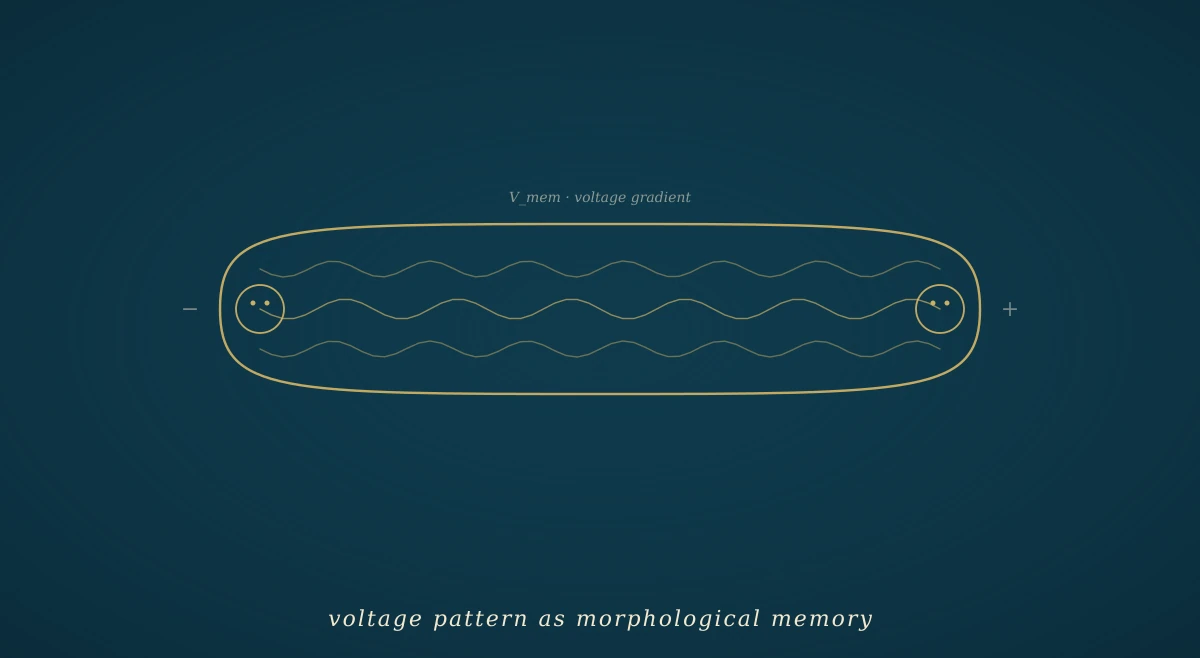
Every living cell has ion channels and gap junctions embedded in its membrane. By pumping charged ions (sodium, potassium, calcium, chloride) across its boundary, a cell creates a resting membrane potential (V_mem).
┌─────────────────────────────────────────────────────────────┐
│                 CELLULAR BIOELECTRIC COUPLING               │
├─────────────────────────────────────────────────────────────┤
│                                                             │
│   Cell A (High Voltage)           Cell B (Low Voltage)      │
│   ┌──────────────────┐            ┌──────────────────┐      │
│   │   -70 mV State   │            │   -20 mV State   │      │
│   │                  │  Gap       │                  │      │
│   │    [Ion Pump]    │  Junction  │    [Ion Pump]    │      │
│   │        │         │ ═══████═══ │        │         │      │
│   └────────┼─────────┘            └────────┼─────────┘      │
│            ▼                               ▼                │
│   ══════════════════════════════════════════════════════    │
│            MEMBRANE VOLTAGE GRADIENT PATTERN                │
│            (Carries Morphological Information)              │
│                                                             │
└─────────────────────────────────────────────────────────────┘
When cells join together through gap junctions, they share these ionic charges, establishing continuous voltage gradients across entire tissues. These gradients act as a distributed computational network:
- Target morphology encoding — the spatial voltage map acts as a pattern memory, instructing cells where the head end is, where the tail end is, and where boundaries must form.
- Top-down feedback — if tissue is cut or damaged, the bioelectric gradient shifts immediately, triggering local cell proliferation and differential gene expression until the target morphology is restored.
- Rewritable state — by artificially changing the voltage pattern with ionophores or light-activated channels (optogenetics), researchers can instruct frog embryos to grow eyes on their flanks or stomach, without changing their genetic code.
Isomorphism, not identity: why this is not “acupuncture proven”
This is the point where popular science writing and alternative-medicine advocacy routinely overreach, and an explicit epistemological line is worth holding.
It is tempting to look at Levin’s bioelectric voltage maps and declare: “Science has finally proven the existence of traditional chi meridians.”
It has done no such thing.
Levin himself has been explicit on the distinction. Endogenous bioelectric gradients are developmental control loops operating across epithelial and mesenchymal tissues. They are not anatomical “pipes”, they do not validate traditional meridian charts, and they do not prove that projecting energy across a room is possible.
┌─────────────────────────────────────────────────────────────┐
│          CONCEPTUAL ISOMORPHISM vs. FALSE IDENTIFICATION    │
├────────────────────────────┬────────────────────────────────┤
│ CONCEPTUAL ISOMORPHISM     │ FALSE IDENTIFICATION           │
│ (what is defensible)       │ (what to reject)               │
├────────────────────────────┼────────────────────────────────┤
│ Both describe information  │ "Bioelectricity is chi"        │
│ propagating beyond DNA     │                                │
│                            │ "Levin proved acupuncture      │
│ Similar logical shape of   │  meridians exist"              │
│ non-neural coordination    │                                │
│                            │ "Science confirmed traditional │
│ Functional pattern over    │  medical anatomy"              │
│ pure static mechanics      │                                │
└────────────────────────────┴────────────────────────────────┘
What Levin’s work establishes is a conceptual isomorphism — two descriptions with a similar logical shape:
- Traditional somatic systems mapped the intuition that an organism’s health and form are governed by dynamic, routing channels of organization running through tissue.
- Developmental biology has now measured an actual, physical mechanism — voltage gradients — by which non-neural tissue routes real-time structural information.
Recognising a shared structural logic is good systems thinking. Claims of literal identity are bad science. The two can be distinguished without collapsing one into the other.
What this contributes to the Learning Earth framework
The Science Behind The Learning Earth sets out the core thesis: that the planet, life, and consciousness form a single continuum of accumulating organization. For that thesis to hold, living systems must possess memory mechanisms that go beyond simple genetic inheritance and beyond neural thought.
Bioelectricity supplies exactly the kind of empirical bridge the argument needs:
- Nested delegation — it shows how living systems delegate structural tasks. The genome builds the cellular components, but the bioelectric layer handles real-time spatial assembly. The pattern repeats the delegation structure described across the book.
- Non-genetic memory — it demonstrates that living tissue can store, retrieve, and act upon informational patterns that outlast the immediate biochemical state, without editing the underlying DNA.
- Organization as active control — it shows that biological order is not just a byproduct of chemical collisions; it is actively controlled by dynamic electrical feedback loops running through open, dissipative systems.
Biological form is not a static sculpture cast in genetic stone. It is a live electrical conversation — a software loop continuously holding tissue against decay.
Primary references
- Levin, Michael. “Bioelectric signaling: reprogrammable circuits underlying embryogenesis, regeneration, and cancer.” Cell 184, no. 8 (2021): 1971–1989.
- Emmons-Bell, M., et al. “Gap junctional blockade stochastically induces different species-specific head anatomies in genetically wild-type Girardia dorotocephala flatworms.” International Journal of Molecular Sciences 16 (2015): 27865–27896.
- Levin, Michael, and C. J. Martyniuk. “The bioelectric code: An ancient computational medium for dynamic control of physiological and morphological phenotypes.” Biosystems 164 (2018): 76–93.
- Kokkorogiannis, Panagiotis. “The Science Behind The Learning Earth.” thelearningearth.com, 2026.
Related reading on this site
- The Science Behind The Learning Earth — the pillar page the book’s scientific argument hangs from.
- Dissipative Structures, Explained — the thermodynamic frame that living systems like Levin’s planaria depend on.
- Complex Adaptive Systems 101 — the systems-level vocabulary for talking about layered organization.
- Why Chi Is Not a Substance — the companion article that reads the ancient “chi” vocabulary as flow of organization rather than fluid, which is why the isomorphism with bioelectricity holds without collapsing one into the other.
- The Convergence Asymmetry — the meta-essay on where ancient body-maps and modern findings legitimately converge, and where they do not.
← Back to the The Science of Organization guide
More in this pillar
- Landauer’s Principle: Why Erasing Information Costs EnergyComing soon
The other pillars
Be first to know
The book is in its final editing stage. Leave your email and you will hear when it is ready.