Body Knowledge·Complete guide
Kāya, Vedanā and the Theravāda Body: A Complete Guide
A complete guide, from zero, to the Theravāda body: the sack of grains, vedanā as hinge, the two arrows, and the map of meditative distress.
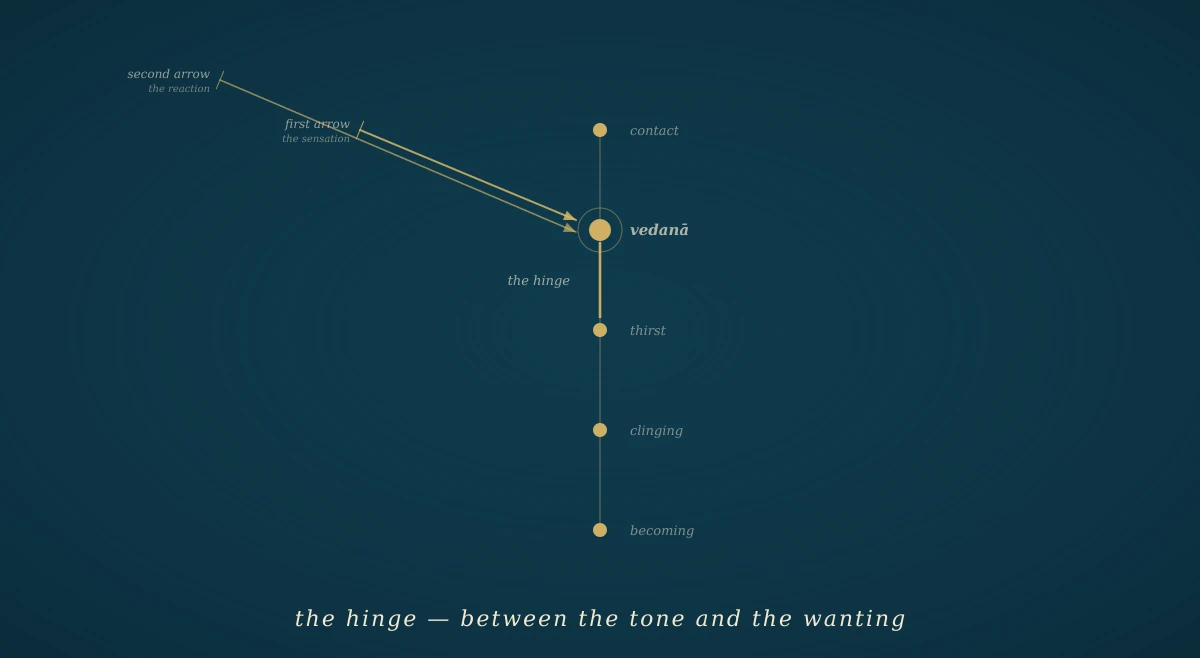
The guide, in 8 parts
- Part AThe Foundational IdeaThe image is verbatim from the text, not a construction of mine.
- Part BThe Body as Objectkāyagatāsati — "mindfulness directed to the body". The central text on mindfulness gives six distinct ways of examining.
- Part CThe BreathThe central, safest and most widespread object.
- Part DThe HingeThe most important chapter of the document.
- Part EThe Daily DisciplineThe body under rule — and the scale is surprising.
- Part FThe Hard SideThe finding of the document — and one of the most important of the entire series.
- Part GThe PracticeSynthesis. Marking: [textual] from the early suttas, [scholastic] from the later tradition, [my formulation].
- Part HSynthesis1. The sack opens. The body is not cultivated, not energetically mapped, not honoured — it is examined and enumerated, so it may stop being "I".
- ReferenceGlossary & pronunciationKey terms and how to say them.
How to read this text
You need no prior knowledge. Every term is explained the first time it appears.
Five honest notes before we start — and the first changes the kind of text this is
First: here the body is not improved
Every previous text in this series assumed, implicitly, that the body is cultivated, regulated, honoured or constructed. That there is a better state, and the work is to get there.
This is the first system that examines the body with the opposite purpose: to make it stop being “I”.
There is no energetic map to open. There is no force to accumulate. There is no perfection.
There is careful, methodical examination — and its purpose is the reduction of attachment.
This is foreign, and softening it would be falsification.
Second: lay meditation is, in large part, modern
You will read about practices today taught in dozens of countries, in retreats, in mobile apps.
For most of the history of this tradition, laypeople did not meditate.
The dominant lay practice was offering to the monastic community, ethical observance, ritual and the hearing of teaching. Meditation was, in the main, a monastic occupation — and a minority one even there.
The modern lay-meditation movement begins mainly in Burma around 1900, is systematised in the mid-20th century, and is mass-exported from the 1970s.
I do not cancel this. I date it — as I dated every analogous case in this series.
Third: there is real internal disagreement
And it is not academic. It concerns what exactly the texts teach and what counts as success in practice (chapter 12).
Where it exists, I note it rather than choose.
Fourth: there is documented harm — and the tradition has its own map for it
This is among the most noteworthy findings of the entire series, and two chapters are devoted to it (21 and 22).
Fifth: there is a serious contemporary political problem
And it is not sidestepped (chapter 24).
A system whose first ethical rule is abstention from causing harm has, in the 21st century, been linked to organised violence. To silence this would be inconsistent with what I did in the other eleven.
A short introduction to Theravāda thought, for the reader who is new
Before any of the technical material lands, it helps to have four things in mind.
Where this comes from, in time and place
Theravāda — “the way of the elders” — is one of the main branches of Buddhism, now dominant in Sri Lanka, Thailand, Myanmar, Cambodia, Laos, and with large diaspora communities worldwide. Its scriptural language is Pali, and its canon (the Tipiṭaka) was committed to writing in Sri Lanka in the 1st century BCE after centuries of oral transmission.
The Buddha lived in northeastern India in the 5th century BCE. The teachings this guide draws on come from the oldest layer of the canon (the five Nikāyas of the Sutta Piṭaka), plus the great 5th-century CE commentarial synthesis (Visuddhimagga) of Buddhaghosa, and the modern vipassanā movement from Burma that re-opened serious meditation to laypeople around 1900.
What this guide does and does not cover
It covers: the body as object of mindfulness, the vedanā as the hinge of the whole system, the breath practice, the monastic discipline of the body, the Theravāda map of meditative difficulty, and the contemporary issues (adverse effects, political entanglements, the women’s ordination question).
It does not cover: Mahāyāna or Vajrayāna (which the Tibetan guide treats), the whole doctrinal apparatus beyond what is needed for the body material, and the many national variants of Theravāda practice.
What this material is not
It is not an endorsement of unsupervised practice. Chapters 21–23 cover documented harm honestly.
It is not “mindfulness”. Chapter 16 explains why that modern English word covers something related but not identical.
It is not above criticism. Chapter 24 is dedicated to the political problems in contemporary Theravāda, kept honest and sourced.
A word on names
Pali transliteration throughout: kāya, vedanā, sati. Where a Pali term has entered English via Sanskrit (karma for kamma, nirvana for nibbāna), the guide keeps the Pali in context and only uses the Sanskritised form when the loan is being discussed.
Be first to know
The book is in its final editing stage. Leave your email and you will hear when it is ready.