Body Knowledge·Complete guide
Orí, Àṣẹ and the Yoruba Body: A Complete Guide
A complete guide, from zero, to the Yoruba body: orí, àṣẹ, the Ifá corpus, the drum that speaks, and the tradition that crossed the Atlantic.
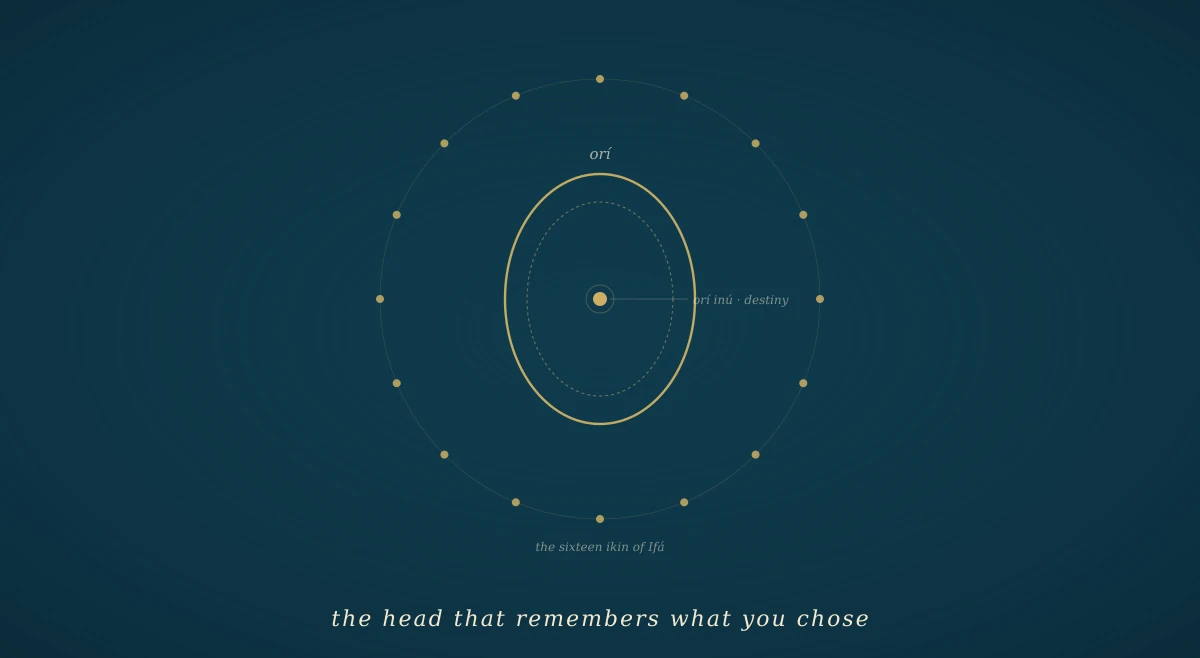
The guide, in 7 parts
- Part AThe Foundational IdeaBefore you are born, in the other world, you kneel and you choose.
- Part BThe Matter of the PersonHere lies the title of this document, and its most unusual idea.
- Part CThe KnowledgeIf destiny is chosen and forgotten (chapter 1), an instrument of retrieval is needed. This is Ifá.
- Part DThe Body in Practiceẹbọ — offering. The basic prescription that comes out of every Ifá session.
- Part EThe DiasporaBy the best estimates, approximately twelve to thirteen million people were forcibly embarked from Africa in the transatlantic slave trade.
- Part FThe Practice and the CostThere is no such list in the tradition. Synthesis. Marking: [corpus] from the body of Ifá and the proverbial tradition, [ethnography], [diaspora], [contemporary].
- Part GSynthesis1. You kneel and you choose. Destiny is self-selected and forgotten. So the central problem is not submission to it, but retrieval.
- ReferenceGlossary & pronunciationKey terms and how to say them.
How to read this text
You need no prior knowledge. Every term is explained the first time it appears.
Five honest notes before we start
First: this is not one system but two related ones
The text covers mainly the Yoruba (south-western Nigeria, Benin, Togo — about 45–50 million people) and secondarily the Fon and their related peoples in Benin, where the same basic scheme appears under other names.
The guide uses Yoruba terminology as the backbone and introduces Fon where it differs substantively.
Second: the corpus is oral, enormous — and the first systematisers were Yoruba themselves
There is no scripture. There is a memorised body of texts so vast no single person holds it all (chapter 10).
And here there is a significant difference from many analogous cases: the recording was not done exclusively by foreign missionaries or colonial officials. A large part of it is owed to Yoruba scholars and initiates who recorded their own tradition — some of them simultaneously bàbáláwo and university academics.
This is rare, and it changes the quality of the material.
Third: the tradition lives in more places outside Africa
Through the slave trade, the system exists today in full form in Cuba, Brazil, Haiti, Trinidad, the United States — and in some cases with greater institutional coherence than in Nigeria.
And there is active, sometimes acute dispute over who holds authority (chapter 23).
Fourth: a large part of the material is initiatically restricted
This text describes. It does not instruct. You will not find here ritual instructions, recipes or methods of divination — and not from mystification: the system presupposes decades of apprenticeship (chapter 10), and anything less is not a summary of it but something else.
Fifth: the “voodoo” of pop culture does not exist
The pin-stuck dolls, the zombies, the dark rituals — are an American construction with a specific date and a specific political purpose.
Chapter 20 shows when, by whom, and why.
A short introduction to Yoruba thought, for the reader who is new
Before any of the technical material lands, it helps to have five things in mind. If you already know them, skip to the Contents.
Where this comes from, in time and place
The Yoruba are a West African people (south-western Nigeria, parts of Benin and Togo), with a continuous urban civilisation reaching back to at least Ile-Ife in the 11th–12th centuries CE. The great kingdom of Ọ̀yọ́ rose from the 15th century; its collapse in the early 19th century, and the civil wars that followed, fed directly into the second phase of the Atlantic slave trade (chapter 17) — which is why the Yoruba diaspora in the Americas is both large and relatively late.
The Fon are a closely-related people in what is now Benin, and their kingdom of Dahomey rose to major regional power from the 17th century. The Fon word vodún is the root of all the words you will see in Part E — Haitian Vodou, Louisiana Voodoo and the rest.
Today the Yoruba number approximately 45–50 million in West Africa; the diaspora traditions reach tens of millions more across the Americas.
There is no “the” Yoruba tradition
The guide uses “Yoruba” where generalisation is warranted, and names the Fon equivalent (vodún instead of òrìṣà; Legba instead of Èṣù; Fa instead of Ifá) where it matters. Where the diaspora traditions diverge from both, the guide names which one: Lucumí / Regla de Ocha (Cuba), Candomblé (Brazil), Vodou (Haiti).
What kind of body-knowledge this is
The body material in this guide comes from four kinds of source:
- The Ifá literary corpus (ẹsẹ Ifá) — the 256 chapters of memorised verses that form the archive of the culture (chapter 10). Recorded in print largely by Yoruba scholars themselves from the mid-20th century onward.
- The ethnographic literature — some of it good (William Bascom, Pierre Verger, Robert Farris Thompson), some to be read with awareness of its colonial frame.
- The diaspora ethnography — above all the Cuban (Lydia Cabrera, Fernando Ortiz), the Brazilian (Roger Bastide, J. Lorand Matory), and the Haitian (Alfred Métraux, Karen McCarthy Brown).
- The institutional and legal record — because what is “tradition” in some places is current religion in others, protected by Supreme Court rulings (chapter 22).
What this material is not
It is not a single doctrine. Local variants, lineage differences and open disputes are real (chapter 23).
It is not “voodoo” as popular culture presents it. The pin dolls, the zombies, the sinister rituals are a 20th-century American construction (chapter 20), and the guide dedicates a chapter to showing when and why.
It is not safe to practise unsupervised. The system assumes decades of apprenticeship, and chapter 22 covers the real risks around unsupervised use.
It is not above criticism. Chapter 22 covers the hard parts honestly — animal sacrifice, historical human sacrifice, and the current catastrophe of child-witchcraft accusations (which is largely driven not by this tradition but by the neo-Pentecostal churches that attack it).
A word on names
The orthography uses dot-below vowels (ẹ, ọ) and the ṣ for sh, with the three tone marks (á, a, à). These matter: tone changes meaning. The guide gives the fully-marked form once and may drop marks in close reuse where context has fixed the pronunciation.
Be first to know
The book is in its final editing stage. Leave your email and you will hear when it is ready.