Body Knowledge·Complete guide
Tapu, Mana and the Māori Body: A Complete Guide
A complete guide, from zero, to the Māori body: tapu and noa, food as the switch, whakapapa, mana, and the river that is a legal person.
The guide, in 6 parts
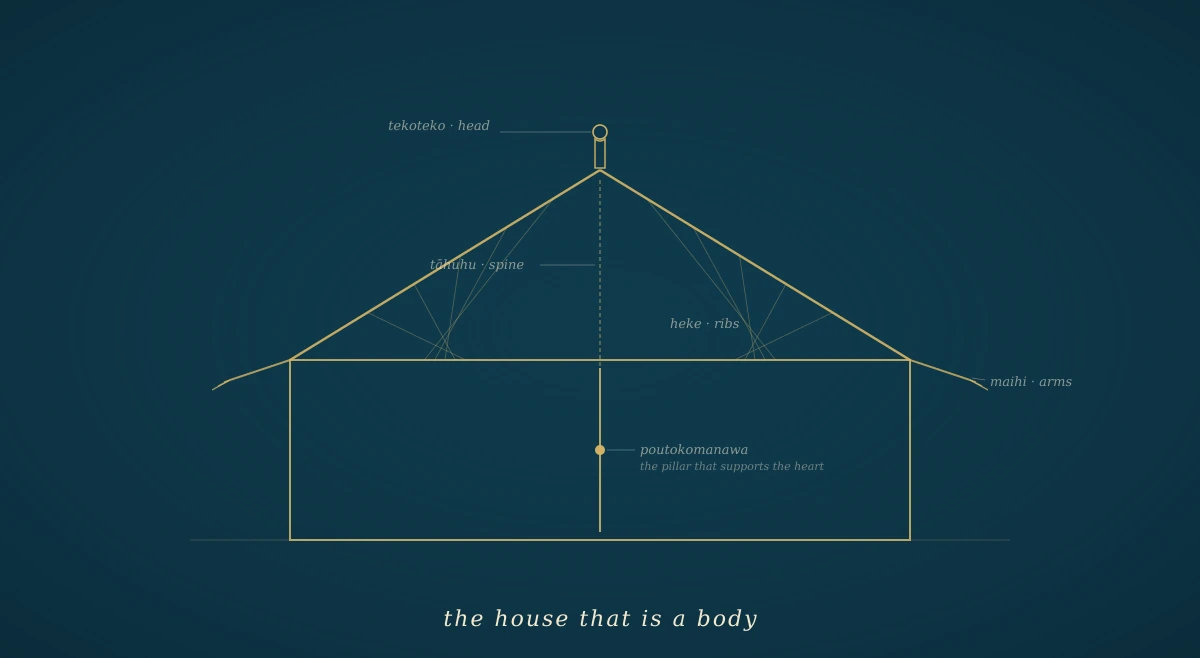
- Part AThe Foundational IdeaThe key image is not a metaphor. It is a building, and you can walk inside it.
- Part BThe Materialmauri — the principle that makes a thing be what it is and hold together.
- Part CThe Body, LiterallyThe head is the most tapu part of the body. Always, in every person — and especially in a chief.
- Part DThe Practiceutu — usually translated "revenge", and the translation is wrong.
- Part ETodayThe chapter without equivalent.
- Part FSynthesis1. The building is a body. The meeting house has head, arms, spine, ribs, heart — and you walk inside it.
- ReferenceGlossary & pronunciationKey terms and how to say them.
How to read this text
You need no prior knowledge. Every term is explained the first time it appears.
Four honest notes before we start
First: it is not one people
“Māori” is a collective term for over a hundred iwi — tribes with their own histories, their own variants of the myths, and in some cases real doctrinal differences.
The word māori itself means “ordinary, normal”, and was used as an ethnonym only after contact — when a word was needed to distinguish the locals from the newcomers.
Where traditions differ in substance, this guide says so.
Second: the sources have an unusual property
Māori adopted writing with remarkable speed. Within a few decades of its introduction in the 1830s, literacy was very high — and they wrote themselves: letters, newspapers, testimony in land courts, genealogical notebooks.
This is rare and valuable.
And at the same time: a portion of the material in circulation as “classical” passed through European editorship in the early 20th century, and is seriously disputed (chapter 4). This guide marks where.
Third: part of the knowledge is explicitly restricted
Some things are tapu — and this is not metaphor, it is the central concept of the text (chapter 5).
This guide describes; it does not quote. You will not find here karakia texts, specific iwi genealogies, or ritual details that belong to specific people.
Fourth: it is living and institutionally active
Approximately 900,000 people identify as Māori in New Zealand — about one in six of the population — and tens of thousands more in Australia.
The language has been official since 1987. There is a standing tribunal for breaches of the Treaty. And two rivers and a mountain are, in New Zealand law, legal persons (chapter 21).
We are not writing about something that ended. We are writing about something that legislates.
A short introduction to Māori thought, for the reader who is new
Before any of the technical material lands, it helps to have five things in mind. If you already know them, skip to the Contents.
Where this comes from, in time and place
Māori ancestors arrived in Aotearoa / New Zealand from eastern Polynesia, in multiple voyages, between approximately 1250 and 1350 CE. (The older “Great Fleet” narrative of a single organised arrival is no longer current; see chapter 4.)
Contact with Europeans begins intermittently with Tasman (1642), opens with Cook (1769), and intensifies through the first half of the 19th century. The Treaty of Waitangi was signed in 1840, between the British Crown and over 500 Māori chiefs. The two language versions of the Treaty differ in a way that matters, and this is still legally live.
The 19th and 20th centuries brought epidemics, land wars, massive land loss, suppression of language and healers (chapter 19), and a near-collapse of Māori society. The late 20th century brought the recovery described in Part E.
Today there are approximately 1 million Māori in New Zealand and across the Tasman, with a vigorous political, legal and institutional presence.
There is no “the” Māori tradition
The guide uses “Māori” where generalisation is warranted, and names specific iwi where it matters. Some of the most-cited iwi in this guide:
- Ngāti Raukawa — central North Island; the hau text that reached Marcel Mauss (chapter 9) came from here.
- Whanganui — “I am the river” is theirs (chapter 21).
- Tūhoe — people of the Te Urewera forests; granted the first legal personhood (chapter 21).
- Ngāti Toa — the “Ka Mate” haka is theirs (chapter 23).
What kind of body-knowledge this is
The body material in this guide comes from four kinds of source:
- 19th-century Māori writing in te reo Māori — letters, newspapers, land-court testimony, genealogical notebooks. Primary and under-used.
- Early-20th-century ethnography — valuable but to be read with caution, since much of it passed through European editing (chapter 4).
- Contemporary Māori scholarship — above all Mason Durie, Hirini Moko Mead, Cleve Barlow, Rangimarie Rose Pere, Ranginui Walker.
- New Zealand law and public policy — because much of what elsewhere is “tradition” is here current statute (chapters 15, 17, 20, 21).
What this material is not
It is not pre-contact “pure” tradition. Māori society has been in continuous contact with the European world for over two centuries, and the tradition described here has absorbed, resisted and reshaped that contact.
It is not a unified doctrine. Iwi differ. Scholars differ. Where they do, the guide says so.
It is not a menu for cultural borrowing. Chapter 23 is dedicated to this.
It is not a dead tradition under threat. It is a living tradition that writes statute.
A word on names
The orthography is settled. The guide uses the macron throughout, with original iwi names and the names of concepts, since the macron carries meaning. Where a term has entered English (taboo from tapu, mana as such), the guide uses the Māori form in context and the English only where it is the loan being discussed.
Be first to know
The book is in its final editing stage. Leave your email and you will hear when it is ready.