Body Knowledge·Complete guide
Mitzvot, Tefillin and the Jewish Body: A Complete Guide
A complete guide, from zero, to the Jewish body: tefillin as bound text, tumah as state not sin, Shabbat's melachot, and pikuach nefesh as obligation.
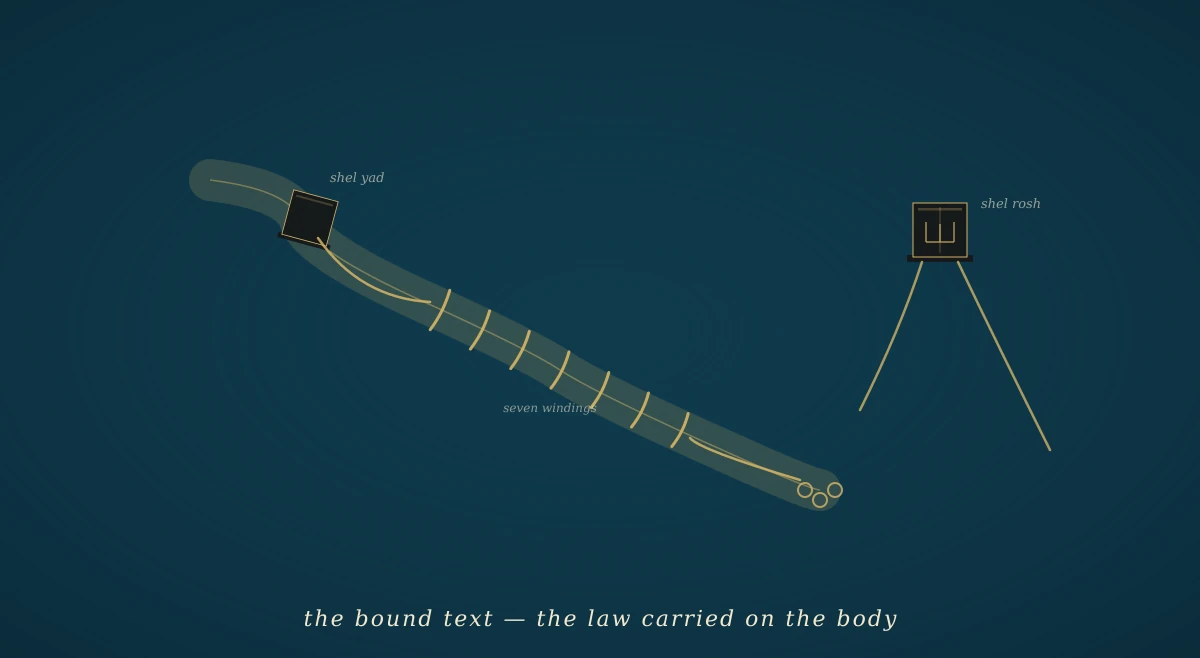
The guide, in 7 parts
- Part AThe Foundational IdeaThe key image is literal, and you can see it every morning.
- Part BPurityAnd here the most radical correction of the whole text is needed.
- Part CThe RhythmThe weightiest chapter of the document.
- Part DThe MindAnd here this tradition breaks a pattern that appeared almost everywhere else.
- Part EThe Mystical BodyThe Kabbalistic tradition — codified chiefly from the 13th century onward, with great further development in the 16th — describes ten sefirot: emanations or…
- Part FThe LimitsThe most unique structure we have encountered in thirteen texts.
- Part GSynthesis1. The text is bound onto you. Leather boxes on arm and forehead, fringes on the garment, parchment at the doorframe.
- ReferenceGlossary & pronunciationKey terms and how to say them.
How to read this text
You need no prior knowledge. Every term is explained the first time it appears.
Five honest notes before we start
First: it is not one Judaism
There are Orthodox streams (and within them significant differences between Ashkenazi, Sephardi, Mizrahi, Hasidic and non-Hasidic), Conservative, Reform, Reconstructionist, and people who identify culturally without religious practice.
And their differences are, to a large extent, exactly bodily: what you do on Shabbat, what you eat, who enters the mikveh, who wears tefillin.
I write chiefly for the traditional rabbinic practice, because that is where the system is complete — and I note where there is significant divergence.
Second: I write for practice and for its logic
I do not defend and do not refute theological claims. Where there is internal disagreement, I record it rather than take a side.
Third: much of the system is today inactive
And this changes the reading.
The entire purity system of Part B was designed around the Temple. The Temple was destroyed in 70 CE, and since then the vast majority of the relevant rules do not apply — not because they were abolished, but because the context that gave them meaning no longer exists.
What survived (chiefly chapter 7) is a small remnant of a much larger system.
Fourth: this text is, in part, background
It is the thirteenth of a series, and this text may be read on its own, but much of what grew up around and after it — the mikveh, the Shabbat, circumcision, the purity system — is the ground on which later religious history worked.
I write it however self-contained, without forward references.
Fifth, and important for the reading: the structure of the system
Two things to hold from the start:
Practice precedes understanding (chapter 2). You do not understand first and then act.
And disagreement is institutionalised. The central corpus of this tradition — the Talmud — is, literally, a record of disagreements, where the rejected positions are preserved alongside the prevailing ones.
This is not a detail. It is the form of the tradition.
A short introduction to Jewish thought, for the reader who is new
Before any of the technical material lands, it helps to have four things in mind.
Where this comes from, in time and place
The textual tradition reaches back to the Hebrew Bible (c. 1200–200 BCE in its final redaction), with Rabbinic Judaism — the form this guide describes — emerging after the destruction of the Second Temple in 70 CE. The central texts of this transformation are the Mishnah (c. 200 CE), the Talmud (completed c. 500 CE), and the great medieval codes (Maimonides, 12th c.; Shulchan Arukh, 16th c.).
Today there are approximately 15 million Jews worldwide, concentrated in Israel (about half), the United States, and in diaspora communities across Europe, Latin America, and the former Soviet space. The population is small — far smaller than most readers assume — and bears the demographic shadow of the Holocaust, which killed about two-thirds of European Jewry and destroyed the great scholarly centres of Eastern Europe (chapter 22).
There is no “the” Jewish tradition
The guide uses traditional rabbinic practice as the backbone and marks where the modern streams (Reform, Conservative, Reconstructionist) diverge. Within Orthodoxy, the main divisions are Ashkenazi (central-eastern European), Sephardi (Iberian and Mediterranean), Mizrahi (Middle Eastern), and the Hasidic movements that began in 18th-c. Eastern Europe (chapter 18).
What kind of body-knowledge this is
The body material in this guide comes from four kinds of source:
- The Hebrew Bible itself, especially the ritual-purity material of Leviticus, the covenant texts of Genesis, and the dietary and Sabbath material scattered throughout
- The rabbinic corpus — Mishnah, Talmud, and the halachic codes
- The medieval philosophical and mystical literature — Maimonides, the Zohar, the Lurianic Kabbalah
- Modern scholarship and contemporary practice, including the recent recovery of lay study and the women’s mikveh reformulations
What this material is not
It is not a continuous unified practice. It is a tradition shaped by exile, destruction, dispersal and recovery. Chapter 22 covers the hard parts (the position of women, metzitzah b’peh, the body under persecution) honestly.
It is not above internal criticism. The internal disagreements on gender are kept internal, and credited to the people conducting them (predominantly women within the tradition).
A word on names
Standard scholarly transliteration, with the Ashkenazi variant noted where it differs significantly (Shabbat/Shabbos). Hebrew terms are italicised at first use.
Be first to know
The book is in its final editing stage. Leave your email and you will hear when it is ready.