Body Knowledge·Complete guide
Ṣalāh, Ṭahāra and the Islamic Body: A Complete Guide
A complete guide, from zero, to the Islamic body: five prayers tied to the sun, the head below the heart, and a body that is obligation, not knowledge.
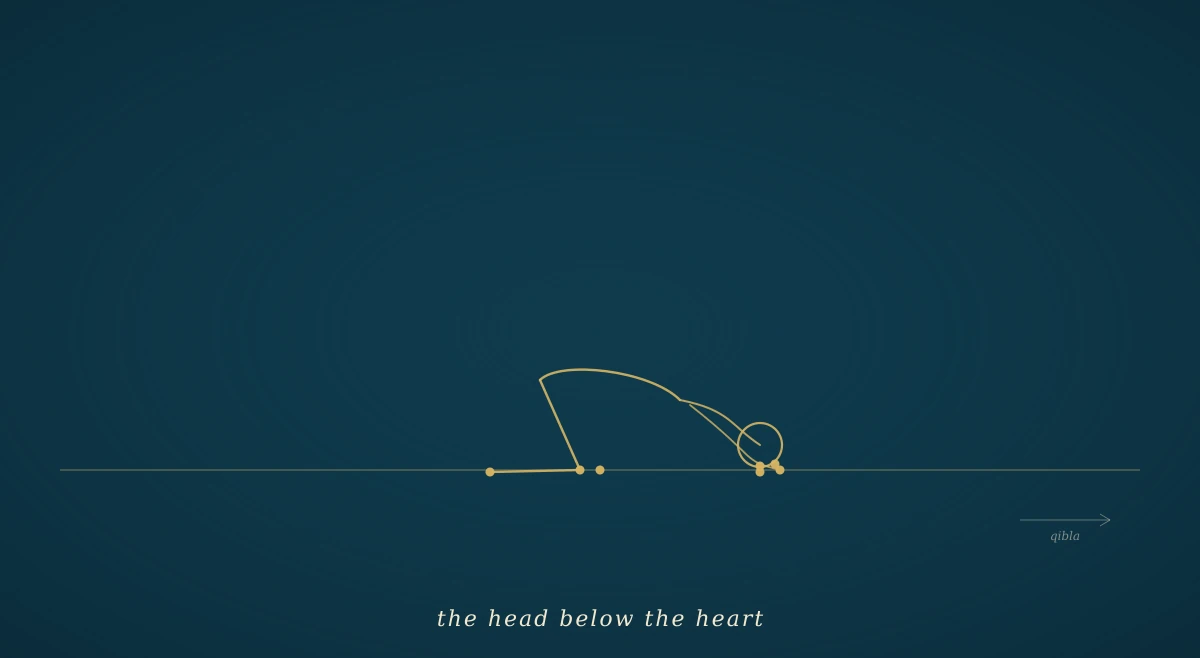
Most traditions treat the body as something to know — to map, to refine, to master. Islam treats it as something you owe: not an object of knowledge but a site of obligation, to be used correctly, with others, five times a day. What follows is a guide to that system, from zero — purity, posture, fasting and the inner life — in eight parts.
The guide, in 8 parts
- Part AThe Foundational IdeaThe key image is not metaphor and not theology. It is a measurable fact.
- Part BPurity as StateThe central polarity of the system — and it needs the same correction it needed elsewhere.
- Part CThe PostureThe rakʿa is the unit. Every prayer consists of a specific number of them.
- Part DThe Time of the BodyThe largest-scale collective dietary regulation in the world.
- Part EThe Mind and the BreathFour terms, and the sources do not fully agree on their relation — which should be said before the table.
- Part FThe MedicineFrom the 8th century, a great translation movement carried the Greek medical corpus into Arabic — Hippocrates, Galen, Dioscorides — together with Persian and Indian…
- Part GThe Practice and the CostSynthesis. Marking: [textual] from the Qurʾān and the main tradition, [legal] from fiqh, [Sufi], [my formulation].
- Part HSynthesis1. The wave. Five prayers tied to the sun, advancing around the earth. Universal, not specialist. Owed, not chosen. Synchronised, not personal.
- ReferenceGlossary & pronunciationKey terms and how to say them.
How to read this guide
You need no prior knowledge. Every term is explained the first time it appears.
Islam begins in the early 7th century CE in the Hijaz (western Arabia), with the Qurʾānic revelation to the Prophet Muhammad (c. 570–632). The community expanded rapidly — within a century it stretched from Spain to Central Asia — and the body of law (fiqh), theology (kalām) and spirituality (taṣawwuf) that this guide draws on was formed from the 8th century on.
Today there are approximately 1.9 billion Muslims, in every country, with major populations in Indonesia, Pakistan, India, Bangladesh, Nigeria, Egypt, Iran, Turkey, and large diaspora communities in Europe and the Americas. The religion is older, larger and more geographically distributed than most Western readers assume.
It is not one Islam
There is the Sunni majority with four legal schools (madhhab) — Ḥanafī, Mālikī, Shāfiʿī, Ḥanbalī — and the Shiʿi tradition, principally the Twelver, with its own legal school. And others, smaller. This guide uses the Sunni material as its backbone and names the Shiʿi, Sufi and school-specific variations where they matter.
And their differences are, to a large extent, bodily. Where the hands rest in the standing posture. What invalidates the state of purity. Whether the forehead rests on a clay tablet. These are not details — they are the proof that the system is genuinely bodily, because that is exactly where disagreement happens. The internal diversity of Islam is one of its real features, not a minor detail.
A different kind of body-knowledge
The other guides in this series describe mainly gnostic systems: the body as an object of mapping and technique, with specialists and apprenticeship. This one is normative. The body is not primarily an object of knowledge — it is a site of obligation. It does not tell you how it works; it tells you what you owe to do with it, five times a day, together with others. The specialists exist (jurists, physicians, Sufi masters), but the central practice is universal. This difference explains almost everything that follows.
The body material in this guide comes from four kinds of source:
- The Qurʾān itself, particularly on purity, prayer, fasting, food, and the nafs
- The hadith literature — canonical Sunni collections (Bukhārī, Muslim and the others) and Shiʿi collections
- The classical fiqh manuals of the four Sunni schools and the Shiʿi, which characteristically begin with the chapter on purity
- The classical and modern scholarly literature on medicine, Sufism, and legal theory
What this material is not
It is not a syncretic version of some generic “spirituality”. The practices described here are specific, rule-governed, and in continuous use. Removing the context sells well in the West and produces something that was never there (chapter 23 is dedicated to this with the Rūmī case).
It is not safe to re-perform without the context. The guide gives no instructions.
It is not above internal criticism. Chapters 8 and 27 cover the serious intra-Muslim debates on gender and the body honestly, as internal debates — not as external critique.
A note on names: scholarly transliteration throughout — Qurʾān (not “Koran”), ṣalāh, sujūd. The transliteration marks that the word belongs to a language, not to a stereotype.
Be first to know
The book is in its final editing stage. Leave your email and you will hear when it is ready.